It is late, and the menu will not stop scrolling. Row after row of films, each with its little tile of promise, each one plausible, none of them quite right.
Twenty minutes later you have watched nothing. You have read a great many synopses. You go to bed faintly cross, as if something had been taken from you, although all you were offered was more.
Most of us have a version of this evening: the shampoo aisle, the holiday website, the restaurant menu the size of a broadsheet. And many of us have heard the explanation that seems to fit it, usually delivered with a story about jam.
The jam story says that too much choice paralyses us. The truth, after 25 years of experiments, is stranger and more useful. Sometimes it does. Often it does not. And the difference depends on four things researchers can now name.
2000: two Saturdays at a jam stall in Menlo Park
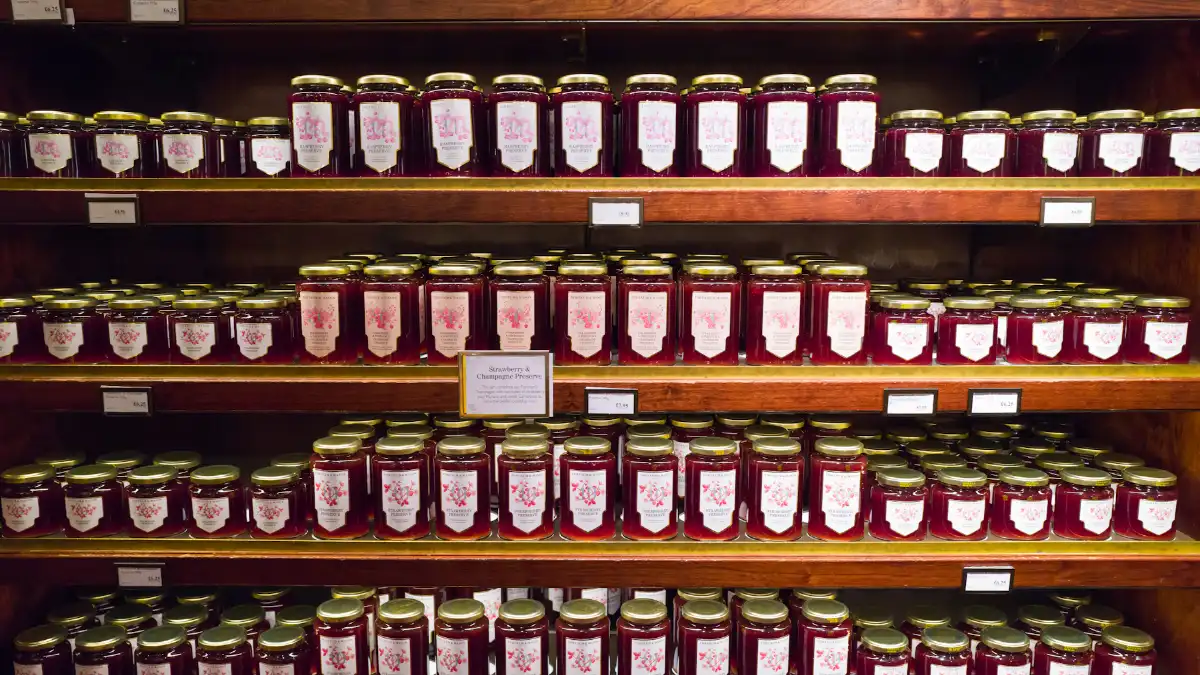
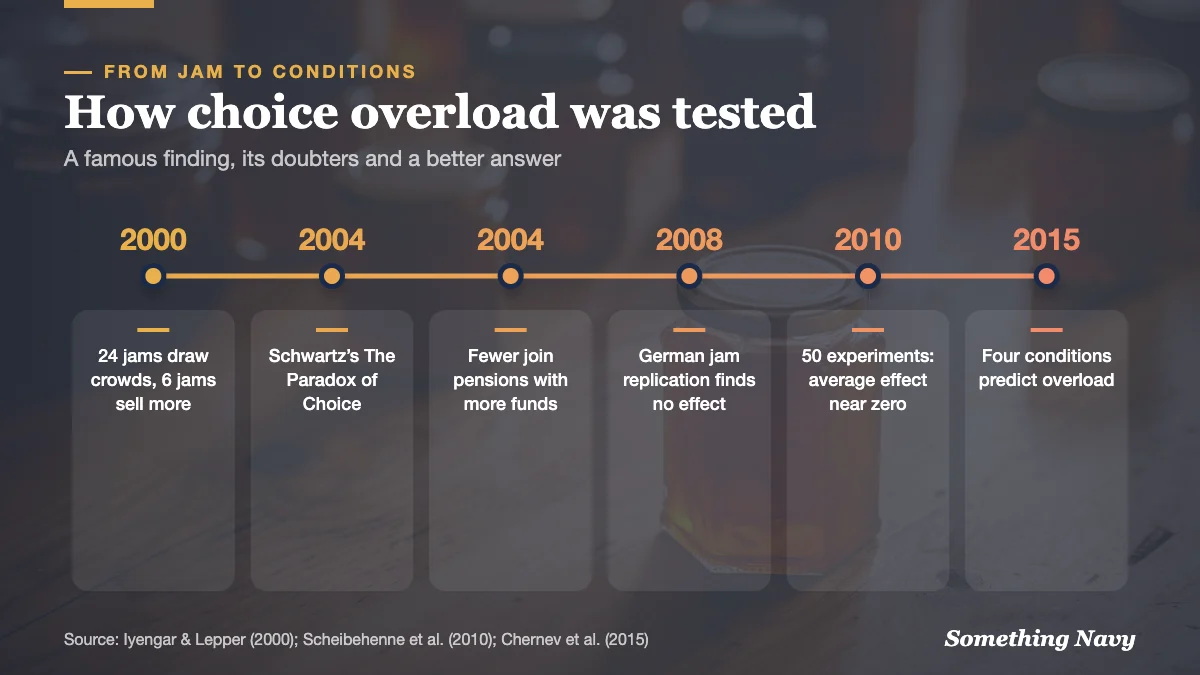
The story begins at Draeger’s, an upmarket supermarket in Menlo Park, California, a store the researchers describe as stocking more than 300 varieties of jam. Sheena Iyengar of Columbia University and Mark Lepper of Stanford University set up a tasting booth there for jams made by Wilkin & Sons.
On two consecutive Saturdays, the booth offered either 6 jams or 24. The display was switched every hour, so that neither size enjoyed the busier part of the day. Anyone who stopped to taste received a coupon for $1 off a jar, in a shop where these jams sold for $4 to $6.
The large display was the more seductive one. Of 242 shoppers who passed the 24 jams, 145 stopped, or 60%. Of 260 who passed the 6, 104 stopped, or 40%. On average, people at both tables tasted only one or two jams before moving on.
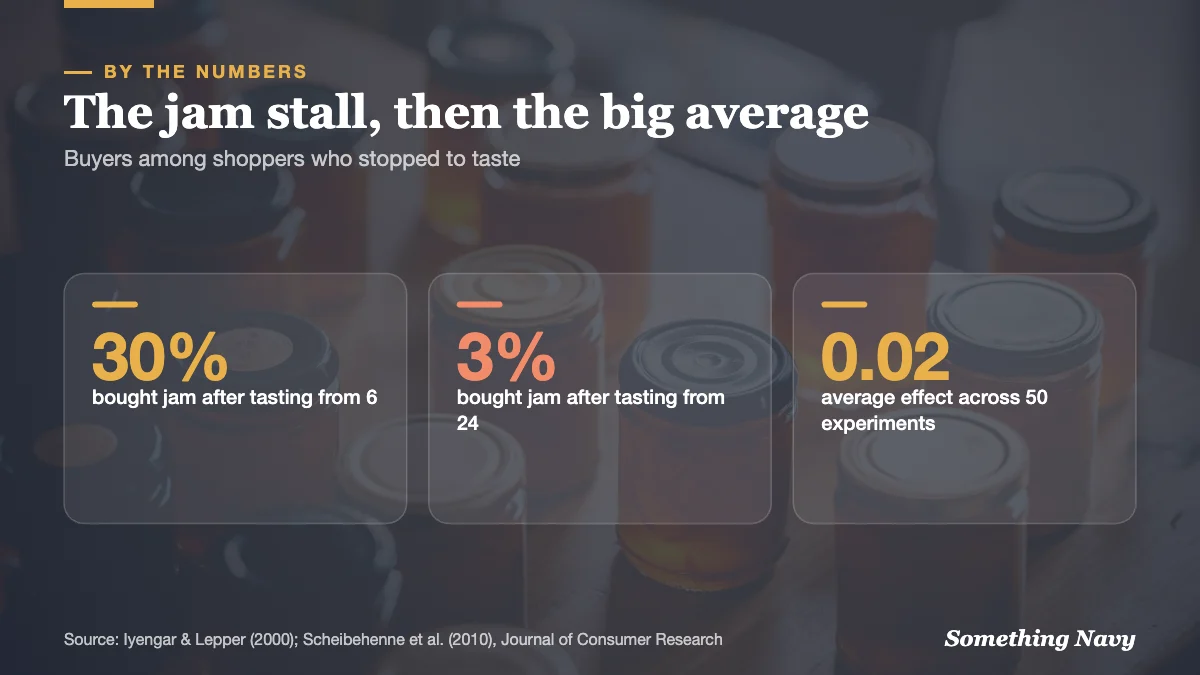
Then came the coupons. Of the people who had stopped at the small display, 31, about 30%, went on to buy a jar. Of those who had stopped at the large one, just 4 did, about 3%.
More choice had drawn people in. Less choice had sent them home with jam.
The paper Iyengar and Lepper published in the Journal of Personality and Social Psychology said it plainly: “consumers initially exposed to limited choices proved considerably more likely to purchase the product.” It is worth noticing what those percentages are. They are shares of the people who stopped at each table, not of everyone in the shop, a detail that often goes missing when the study is retold.
2000: an essay, a box of Godiva chocolates and the cost of 30 options
A single afternoon of jam, however neat, could have been a fluke. So the same paper reported two more studies, each built to test the idea in a different setting.
In the first, students on an introductory social psychology course at Stanford were offered the chance to earn extra credit by writing a short essay about the film Twelve Angry Men. Some sections were given a list of 6 possible topics; others were given 30. Of the 193 students who stayed on the course, 74% of those with 6 topics handed in an essay, against 60% of those with 30. Blind markers also rated the limited-choice essays as slightly, though significantly, better.
The second study moved into the laboratory. At Columbia, 134 students were asked to choose a Godiva chocolate, either from a tray of 6 or from a tray of 30, while a third group simply had one handed to them. The students with 30 to choose from said they enjoyed the choosing more. They also found it harder and more frustrating, and they took longer: about 24 seconds, against about 9.
Afterwards, the people who picked from 6 were the most satisfied with the chocolate they ate. And when it was time to be paid, offered either $5 in cash or a box of chocolates worth the same, 48% of the limited-choice group took the chocolates. Only 12% of the 30-chocolate group did, barely more than the 10% of people who had not chosen at all.
It was a tidy, almost moral result. The abundance we crave at the shelf, the authors suggested, may leave us less committed and less content once we have made our pick. That idea was about to become very famous indeed.
2004: The Paradox of Choice turns a jam stall into a worldview
Barry Schwartz, a psychologist at Swarthmore College in Pennsylvania, had been thinking about choice from another direction. In 2002 he and colleagues had published a paper in the Journal of Personality and Social Psychology on maximising versus satisficing: the difference between people who need to find the best possible option and those who are content with one that is good enough.
In 2004 he gathered those threads into a book, The Paradox of Choice: Why More Is Less. Its argument, in short, was that the modern flood of options does not simply free us. It can also leave us anxious, regretful and less happy with whatever we choose, and his faculty profile sums the book up as warning that excessive choice can lead to paralysis and, in some cases, depression.
The jam stall sat at the centre of the case. It was the perfect anecdote: small, homely, instantly understood. It travelled through business books, marketing seminars and countless dinner-table conversations, and somewhere along the way “24 jams” became shorthand for a law of human nature.
Part of the appeal was that it chimed with things people already sensed: that the options we turn down can linger, and that the shine of any choice fades, a process psychologists call hedonic adaptation. But it was the jam that people remembered.
A long menu does not only cost you time. It hands you a list of everything you did not pick.


2004: when your pension comes with 59 funds
The same year brought a harder test, with real money and real stakes. In a chapter published by Oxford University Press in Pension Design and Structure, Iyengar, Gur Huberman and Wei Jiang looked at American 401(k) workplace retirement plans run by the investment company Vanguard.
The data were large. As Iyengar later set out in a report for the TIAA-CREF Institute, the team had records of contributions in 2001 to 647 different plans. After exclusions, 793,794 employees were eligible to contribute.
The question was simple: as the number of funds on offer rose, did more people sign up, or fewer? Controlling for individual and plan-level factors, every ten funds added to a plan was associated, on average, with a drop of about 2% in participation. Participation peaked at 75% in plans offering just two funds, and dipped to around 60% where there were 59.
This was not jam. Joining a pension plan is one of the more consequential financial decisions many people make, and here a richer menu appeared to make some of them put the decision off altogether. Choosing nothing was, in effect, a choice too.
It is, however, an observational study. Plans with many funds may differ from plans with few in ways no statistical control fully captures, so it shows a strong association rather than proof that the extra funds caused the drop.
2008: a German supermarket tries the jam study again
By the late 2000s, choice overload was being taught as settled science. Then people began to try it for themselves.
The psychologist Benjamin Scheibehenne set out to repeat the jam study in an upmarket supermarket in Germany. It did not work. As a later review recorded, he “did not find any negative effects of choice overload.” Shoppers were no less likely to buy from a large display than from a small one.
Other attempts went the same way. A version of the chocolate study using jelly beans failed to reproduce the original result. Rainer Greifeneder, testing choices among exotic chocolates in a laboratory, found no difference between small and large assortments.
None of this proved Iyengar and Lepper wrong. The replicators themselves pointed to small differences, from culture to procedure, that might explain the gap. But it raised an uncomfortable question. If the effect was as general as its reputation suggested, why was it so hard to find?
2010: fifty experiments and an average of almost zero
The way to answer that kind of question is a meta-analysis, which pools many studies to see what they show together. Scheibehenne, now at the University of Basel, teamed up with Greifeneder, of the University of Mannheim, and Peter Todd of Indiana University, and published one in the Journal of Consumer Research in 2010.
They gathered every experiment they could find, published or not, from 2000 to 2009: 50 experiments, yielding 63 conditions, with 5,036 participants between them. Some came from 13 journal articles; others from 16 unpublished manuscripts, an important detail, because studies that find nothing are less likely to be printed.
The headline was blunt. In the authors’ words, they “found a mean effect size of virtually zero but considerable variance between studies.” The average effect was 0.02 on a standard scale where zero means no difference at all. Averaged across everything, giving people more options neither clearly helped nor clearly hurt.
The second half of that sentence matters as much as the first. Some studies found strong overload. Others found the opposite, with people choosing more and feeling better when the range was wide. People who already knew what they liked, or had some expertise, tended to do better with more options. Published studies leaned slightly more towards finding overload than unpublished ones, and more recent studies were less likely to find it at all.
An average of zero, in other words, did not mean nothing was happening. It meant two things were happening, in opposite directions, and the averages were cancelling each other out.
Too much choice is not a law of nature. It is a mismatch between the menu and the moment.
2015: the four conditions that turn variety into overload
If the effect came and went, the next job was to work out when. In 2015 a team led by Alexander Chernev of Northwestern University’s Kellogg School of Management, with Ulf Böckenholt and Joseph Goodman, published a fresh meta-analysis in the Journal of Consumer Psychology.
They pooled 99 observations covering 7,202 participants, and instead of asking only whether choice overload exists, they asked what conditions switch it on. Four factors stood out. When those were taken into account, they reported, the effect of assortment size was significant after all, in contrast to the earlier review.
When more choice backfires
- Complex options. Overload is likelier when no option clearly beats the rest. A standout choice makes a big range much easier.
- A difficult task. Many features to compare, little time, or a need to justify the decision to someone else all raise the strain.
- Uncertain preferences. If you do not know much about the category, or have no ideal in mind, a long list leaves you less sure.
- A goal of minimal effort. People who just want to be done struggle more than people who are browsing for pleasure.
Read like that, the jam stall makes more sense. Two dozen fruit preserves are hard to rank, few shoppers are jam experts, and nobody planned their Saturday around choosing one. The same 24 options might feel generous to someone who knows exactly what quince tastes like and has come in for it.
A 2024 review in Frontiers in Psychology by Raffaella Misuraca and colleagues sets out how each factor works in practice. A dominant option, they note, “simplifies large choice sets”. Overload rises with the number of dimensions on which options differ. And people whose goal is browsing rather than choosing are less likely to feel overwhelmed.
What “sometimes” really means for everyday decisions
It would be easy to tell this as a debunking story: famous study, failed replications, myth exposed. That would be its own kind of oversimplification.
The more honest reading is that the original experiments caught something real under particular conditions, and the culture generalised it to all conditions. Choice overload is not a constant pressure on every decision. It is a risk that rises when options are hard to compare, when we do not know what we want, when the task is fiddly and when we would rather not be choosing at all.
That also explains why it can feel so familiar. The streaming menu at 11pm ticks almost every box. The films are hard to compare, our preferences are vague, we are tired, and the goal is to be watching rather than deciding. A long day of small decisions makes it worse, a separate problem explored in our piece on decision fatigue.
The same logic explains when abundance is welcome. A keen cook in a well-stocked spice shop, a reader with a clear taste in a bookshop, a child who has been looking forward to the pick-and-mix: for each of them, more is simply more.
There is a quieter lesson in the jam data, too. The big table drew the crowd. Variety is attractive, and anyone selling things knows it. The trouble starts only at the point of decision, which suggests the answer is rarely to banish choice, but to shape it.
How to shrink a choice that feels too big
The four factors double as a practical checklist. If a decision is stalling, one of them is usually to blame, and each has a counter-move.
- Decide your must-haves first. Before opening the website or the menu, write down two or three things the choice has to do. Knowing what you like protected against overload in both meta-analyses.
- Cut the list to a shortlist. Filter hard, then choose among four or five. You are recreating the 6-jam table on purpose.
- Compare on fewer features. Overload rises with the number of dimensions. Pick the two that matter most and ignore the rest of the spec sheet.
- Allow “good enough”. Set a standard, take the first option that meets it and stop. Schwartz’s satisficers are not lazy; they simply know when to finish.
- Use defaults and rules. A capsule wardrobe or a fixed weekday breakfast removes dozens of tiny decisions before they start. For recurring choices, an if-then plan does the same job.
- Separate browsing from choosing. Enjoy the wide range when you have time to wander. When you need an answer, change mode deliberately.
For anyone who designs choices for others, a manager setting up a pension scheme, a café owner writing a menu, a parent laying out clothes, the advice runs the other way. Offer a clear default or a standout option, group long lists into categories, and keep the number of things people must compare as small as the task allows.
The jam stall, a quarter of a century on
It is tempting to wonder what became of the four shoppers who bought jam from the big table. They may simply have known what they wanted. Perhaps they were fond of a particular flavour and found it there among the two dozen. For them, the large display was not a burden but a gift.
That is the version of the story that survives the replications and the meta-analyses. Choice is not good or bad in itself. It is a tool, and like most tools it fits some hands and some tasks better than others.
So the next time the menu keeps scrolling, it may help to stop asking how many options there are and ask a different question instead: do I know what I came here for?
If the answer is yes, enjoy the abundance. If it is no, the kindest thing you can do for yourself is to make the table smaller.
Official links and research
- Iyengar, S. S., & Lepper, M. R. (2000). When choice is demotivating: Can one desire too much of a good thing? Journal of Personality and Social Psychology, 79(6), 995–1006. DOI
- Schwartz, B. (2004). The paradox of choice: Why more is less. Ecco. Publishers Weekly review. Link
- Swarthmore College. Barry Schwartz, faculty profile. Link
- Iyengar, S. S., Huberman, G., & Jiang, W. (2004). How much choice is too much? Contributions to 401(k) retirement plans. In O. S. Mitchell & S. P. Utkus (Eds.), Pension design and structure: New lessons from behavioral finance (pp. 83–96). Oxford University Press. Columbia Business School record. Link
- Iyengar, S. S. (2008). The effects of choice proliferation on retirement savings behavior. TIAA-CREF Institute. Link
- Scheibehenne, B., Greifeneder, R., & Todd, P. M. (2010). Can there ever be too many options? A meta-analytic review of choice overload. Journal of Consumer Research, 37(3), 409–425. DOI
- Chernev, A., Böckenholt, U., & Goodman, J. (2015). Choice overload: A conceptual review and meta-analysis. Journal of Consumer Psychology, 25, 333–358. Kellogg School of Management record. Link
- Misuraca, R., Nixon, A. E., Miceli, S., Di Stefano, G., & Scaffidi Abbate, C. (2024). On the advantages and disadvantages of choice: Future research directions in choice overload and its moderators. Frontiers in Psychology, 15, 1290359. DOI
Cover photo: Georg Eiermann on Unsplash. Charts and graphics: Something Navy, with photography by Rob Wicks on Unsplash.
How we reported this. Every figure was checked against the 8 sources above. Reviewed by Brooke Hilland, Senior Content Editor. Report an error · How we work