
You asked a simple question about the bins. Your partner sighed, looked at the ceiling and let their eyes roll, slowly, all the way round.
Nobody raised their voice. Yet something in the room went cold, and both of you felt it.
That tiny gesture is the thing relationship researchers worry about most. Not the shouting, not the slammed door, but the flicker of superiority that says: I am above you.
The psychologist John Gottman, who spent decades filming couples, gave it a name. Contempt is one of his “four horsemen”, alongside criticism, defensiveness and stonewalling. The Gottman Institute still calls contempt “the greatest predictor of divorce”. The good news, which tends to get lost, is that every horseman has a known antidote, and newer research is starting to show where these habits travel when couples argue on their phones.
Four habits, one lab and thousands of hours of tape
Gottman, later of the University of Washington, and the psychologist Robert Levenson did something unusual for the 1980s. Instead of asking couples how happy they were, he invited them into a lab, asked them to talk about a real disagreement and recorded everything: faces, words, heart rate, how much they fidgeted in their chairs.
Then he waited. Years later the team checked who was still together.
The best-known result came in 2000. Gottman and Levenson followed 79 couples from Bloomington, Indiana, for 14 years from 1983. By the end, 22 couples (28%) had divorced. Those who split early, mostly within the first seven years, tended to fight in an “attack and defend” mode, full of the four horsemen. Those who split later, often in midlife, looked different. They fought less but had drifted into emotional distance. Gottman described them as “alienated and avoidant”.
So the horsemen are not the whole story. A marriage can also die quietly, from a lack of warmth rather than an excess of heat.

Criticism: when a complaint turns into a verdict
Every couple complains. A complaint is about a specific event: “You said you would ring when you landed and you didn’t. I was worried.” Criticism slides from the event to the person: “You never think about anyone but yourself.”
The giveaway words are “always” and “never”. Once a grievance becomes a character diagnosis, the other person has two options, both bad: accept that they are a terrible human or fight back.
Gottman’s antidote is what he calls a gentle start-up. You describe what happened, how you feel and what you need, without the blame. It sounds almost too simple. In practice it is hard, because by the time we raise something we have usually been rehearsing the prosecution case for days.
Many of the rows that start this way are about something boring. We looked at why couples fight about the dishes and the answer was rarely the dishes.
Contempt is the horseman that does the most damage
Contempt is criticism delivered from a height. Sarcasm, mockery, a sneer, name-calling, the eye-roll from the opening of this piece. It tells your partner they are not just wrong, they are beneath you.
What makes it so corrosive is that it attacks the one thing a relationship runs on: the sense that the other person is on your side. You can recover from a bad argument with someone who respects you. It is much harder to recover from someone who looks down on you.
An eye-roll lasts half a second. The message it sends can last for years.
The antidote is not simply “stop being contemptuous”. Gottman’s advice is to build a culture of appreciation and respect, deliberately and often, so that admiration is the default setting rather than something you dig up for anniversaries. The Institute pairs this with what it calls a 5:1 “magic ratio” of positive to negative interactions. Treat that as a rule of thumb rather than a law of nature. The underlying idea, that small kindnesses outweigh occasional sharpness, is well supported. If you want a starting point, our piece on what gratitude practice actually does is a good one.
Defensiveness and stonewalling: the shields that keep the fight alive
Defensiveness
Defensiveness feels like self-protection, which is why almost everyone does it. “I was only late because you made me wait this morning.” It can be an excuse, a counter-attack or a wounded “I can’t do anything right, can I?”
The trouble is that it tells your partner their concern does not count. Gottman’s antidote is to accept responsibility, even for a small part of the problem. “You’re right, I should have texted” takes about three seconds and often ends a row that would otherwise run all evening.
Stonewalling
Stonewalling is the shutdown. Arms folded, eyes on the phone, one-word answers or simply leaving the room.
It is often misread as indifference. More often it is the opposite: the person is overwhelmed. Gottman calls this state flooding, when the body’s alarm system is so activated that listening, empathy and humour all go offline. The antidote is physiological self-soothing: a proper break, then a return.
Your body keeps a record of how you fight
For years the horsemen were discussed mainly as predictors of break-ups. A newer strand of research asks a different question: what do these habits do to the people having them?
In 2016, Claudia Haase and colleagues in Levenson’s lab at the University of California, Berkeley, published one of the longest studies of its kind. The team tracked 156 long-married couples for 20 years, coding their behaviour second by second during a 15-minute conflict conversation and checking their health over time. Husbands who showed more anger at the start went on to report steeper increases in self-reported cardiovascular symptoms. Husbands who stonewalled more reported more musculoskeletal symptoms, the aches and stiffness of muscles and joints.
The research continued in 2024. Haase, now at Northwestern University, worked with Tabea Meier and Jacquelyn Stephens to study 49 married couples from the Chicago area, recording their heartbeat while they discussed a conflict and, separately, something pleasant. They then transcribed every word. Spouses who used more negative emotion words, especially anger words, showed greater cardiovascular reactivity. Positive words showed no comparable link.
Two caveats matter. Both studies show associations, not proof that arguing style causes illness: a racing heart could shape language as easily as the reverse. And the samples were modest, with the older study largely white and comfortably off. Still, the direction is consistent. How you fight does not stay in the conversation.


The quiet moments matter more than the big fights
If the horsemen describe what goes wrong in conflict, Gottman’s work on “bids” describes what goes right the rest of the time.
A bid is any small attempt to connect. “Look at that dog.” A sigh at the news. A hand on a shoulder. The other person can turn towards it (“Ha, it’s wearing a coat”), turn away (silence) or turn against it (“Can you not see I’m busy?”).
In a study with newlyweds that Gottman followed up six years later, the couples who had stayed married turned towards each other’s bids 86% of the time. Those who divorced managed only 33%.
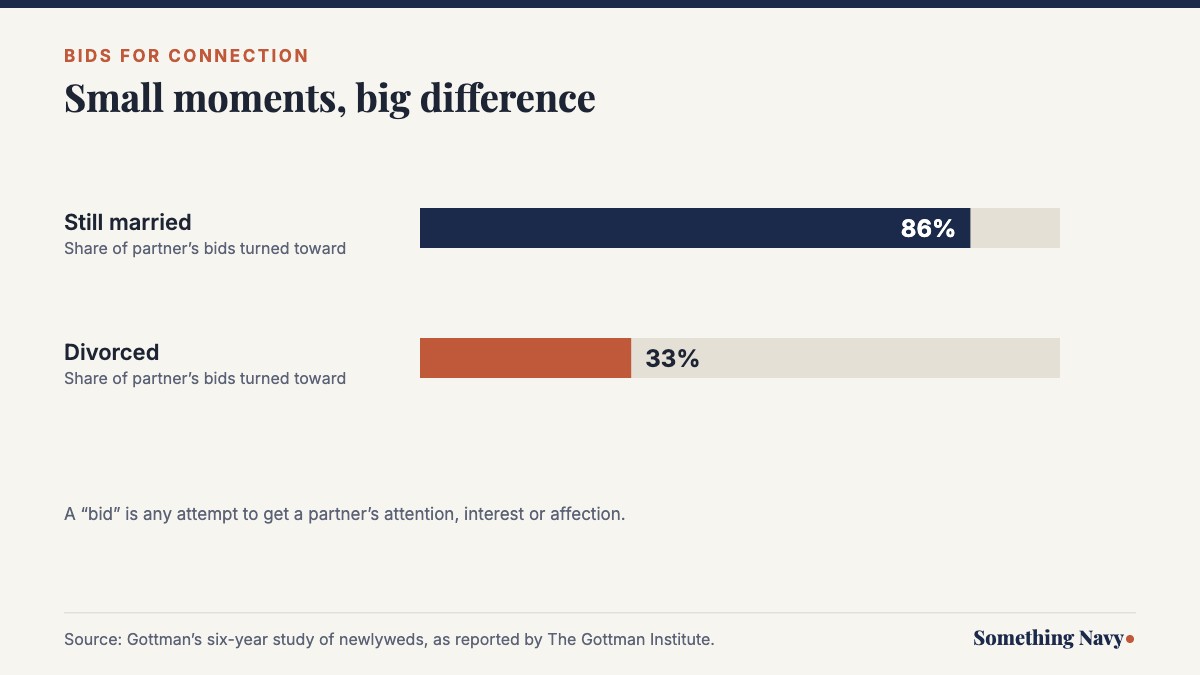
This matters for the horsemen because it shows where the antidotes really come from. Couples with plenty of small, warm exchanges in the bank seem to give each other more benefit of the doubt when things get heated. One of the easiest ways to miss a bid is to be looking at a screen, which is why phubbing has become a relationship problem in its own right.
The horsemen have moved into your messages
Gottman’s couples argued face to face, in a lab. Many couples now have half their disagreements by WhatsApp, often from different rooms of the same flat.
Does that make things better or worse? A 2026 systematic review led by the psychologist Marie-Ève Daspe tried to find out. The team searched four databases in December 2024, screened 5,862 abstracts and found just 15 studies, published between 2007 and 2024, that directly compared couples’ conflict by text, phone or video with conflict in person.
The honest answer is: it depends. A 2024 daily diary study of 298 people found fewer constructive conflict behaviours in text arguments, but no extra destructive ones. A 2016 survey of 328 people found that rows felt least resolved by text and email, more resolved by phone and most resolved face to face. Yet other experiments found text arguments ended just as well, and a 2020 study of 100 couples found no difference in distress, anger or resolution between the two modes.
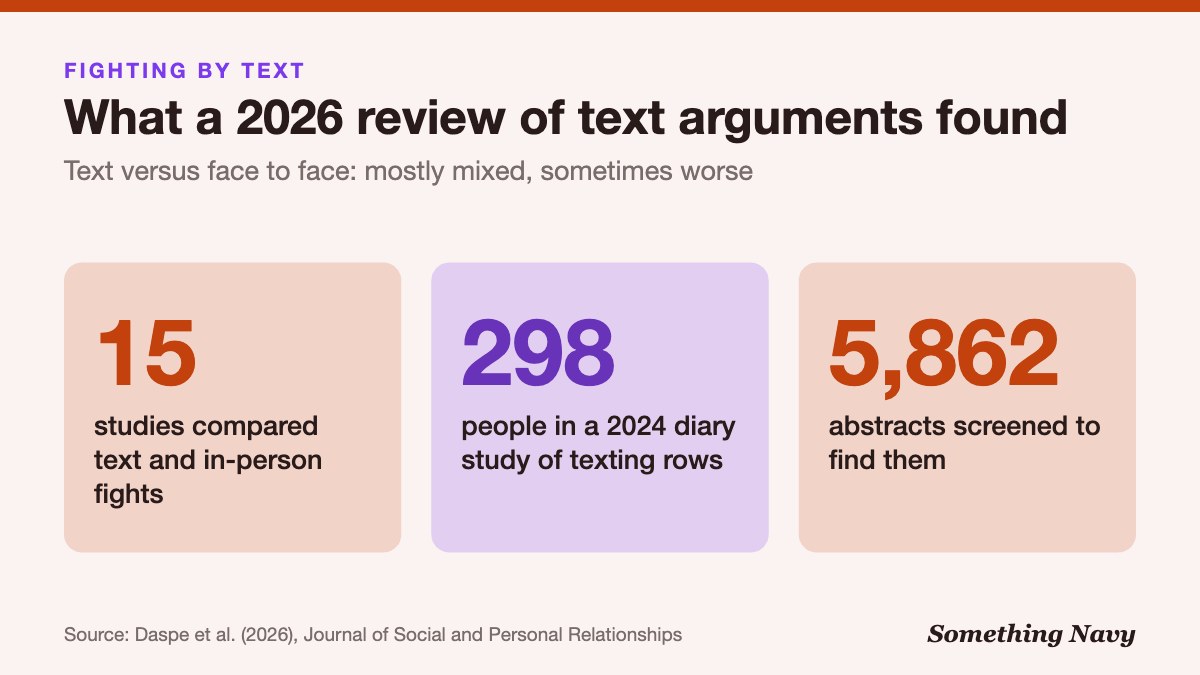
The reviewers concluded that the evidence is largely inconclusive, with mostly small samples. But if you read the findings with the horsemen in mind, a pattern emerges. Text makes it easy to stonewall (just stop replying), easy to be contemptuous (the single “ok.” or the sarcastic thumbs-up) and hard to show the softening cues, a smile, a hand, a tone, that make a repair land.
A full stop can be a raised eyebrow. A delay can be a slammed door.
The practical lesson is not to ban texting rows. For some people, especially those who find face-to-face conflict overwhelming, writing can help them say things calmly. It is to notice which horseman the medium is making easier for you, and to move the conversation when that happens.
What the newest therapy trial does, and does not, show
If the horsemen are learnable habits, they should be unlearnable too. That is the bet behind Gottman Method Couples Therapy, which teaches the antidotes directly.
The strongest recent test came in a randomised trial published in The Family Journal (online 2023, in print 2024). A research team randomly assigned 49 couples recovering from infidelity to either Gottman Method therapy or the usual therapy their clinicians would provide. The Gottman approach came out “globally more effective”, with gains in trust, conflict management, satisfaction and sex.
It is encouraging, and it is also a pilot. Only 19 couples completed every assessment, and John and Julie Gottman are among the authors, so the method’s founders were testing their own approach. It deserves a larger, independent replication before anyone calls it proven.
A cheat sheet for the next argument
It helps to recognise each horseman in the moment, in plain words. Here is what they tend to sound like, and what to try instead.
| Horseman | What it sounds like | Antidote | Try saying |
|---|---|---|---|
| Criticism | “You never listen. You’re so selfish.” | Gentle start-up | “I felt brushed off at dinner. Can we talk for ten minutes?” |
| Contempt | Eye-roll, mockery, “Well done, genius.” | Appreciation and respect | “I’m annoyed, but I know you’ve had a long week.” |
| Defensiveness | “It’s not my fault, you started it.” | Take some responsibility | “Fair point. I did forget to tell you.” |
| Stonewalling | Silence, leaving, staring at the phone | Self-soothing break | “I’m flooded. Give me 20 minutes and I’ll come back.” |
None of these lines is magic. What they share is that each one keeps the conversation about the problem rather than about who is the worse person.
How to take a break that actually calms you down
The antidote to stonewalling is the one people most often get wrong. Storming off is not a break. Neither is sitting in the next room composing a devastating reply.
Try this: the 20-minute reset
- Name it. Say you are flooded and need a pause, so it does not feel like abandonment.
- Set a time. The Gottman Institute says a break should last at least 20 minutes. Agree when you will return.
- Do something absorbing. Walk, shower, read. Do not rehearse the argument.
- Breathe slowly. Long exhales help the body come down from alarm mode.
- Come back. The break only works if you finish the conversation.
Couples with different attachment patterns often clash precisely here: one person needs space, the other experiences the space as rejection. If that sounds familiar, our guide to attachment styles explains why. An agreed return time is what turns a walk-out into a reset.
Where the prediction story oversells itself
You will often read that Gottman can predict divorce with more than 90% accuracy. Treat that with care. Those figures came from relatively small samples, and an equation that fits one group of couples will almost always perform worse on a fresh group. Several researchers have argued that the numbers are not a reliable guide for any individual couple.
What does hold up is the broader picture: patterns of contempt, defensiveness and withdrawal are warning signs, and warmth in ordinary moments is protective. Think of the horsemen as smoke alarms, not verdicts. Every couple sets them off sometimes. The question is whether you notice, and whether one of you can make a repair.
One important exception. Fear, threats, control or violence are not ordinary conflict, and the advice above is not designed for them. If you feel unsafe, talk to someone you trust or contact local support services.
The most hopeful finding in all of this is also the simplest. The couples who last are not the ones who never fight. They are the ones who, mid-argument, can still say “you’re right about that bit”, and mean it.
Frequently asked questions
Gottman’s research singles out contempt, because it communicates disgust and superiority rather than a specific grievance. The Gottman Institute calls it the greatest predictor of divorce.
Yes. Almost every couple slips into criticism or defensiveness sometimes. The concern is when the patterns become the default and repairs stop working.
Many do, particularly with deliberate effort to rebuild appreciation and, where needed, couples therapy. A 2023 pilot trial of Gottman Method therapy after infidelity was promising, though small.
Not consistently. A 2026 review found mixed results, but text can make stonewalling and sarcasm easier, so switching to a call or a face-to-face chat often helps when things escalate.
Sources
- Daspe, M.-È., Métellus, S., Emond, M., Bigras, N., Larouche, F., Adlhoch-Mathé, E., & Vaillancourt-Morel, M.-P. (2026). A systematic review of technology-mediated conflict management in couples. Journal of Social and Personal Relationships, 43(6), 1836–1861. DOI
- Gottman, J. M., & Levenson, R. W. (2000). The timing of divorce: Predicting when a couple will divorce over a 14-year period. Journal of Marriage and Family, 62(3), 737–745. DOI
- Haase, C. M., Holley, S. R., Bloch, L., Verstaen, A., & Levenson, R. W. (2016). Interpersonal emotional behaviors and physical health: A 20-year longitudinal study of long-term married couples. Emotion, 16. DOI
- Irvine, T. J., Peluso, P. R., Benson, K., Cole, C., Cole, D., Gottman, J. M., & Schwartz Gottman, J. (2024). A pilot study examining the effectiveness of Gottman Method Couples Therapy over treatment-as-usual approaches for treating couples dealing with infidelity. The Family Journal, 32(1), 81–94. DOI
- Meier, T., Stephens, J. E., & Haase, C. M. (2024). Feelings in words: Emotion word use and cardiovascular reactivity in marital interactions. Emotion, 24, 733–744. DOI
- The Gottman Institute. (2013, updated 2026). The four horsemen: The antidotes. Link
- The Gottman Institute. (2015, updated 2026). Turn toward instead of away. Link
- University of Washington News. (2000, 11 September). Marital researchers now can predict not only which couples will divorce, but when they will split. Link
Updated 18 October 2026: we expanded this article with newer research, fresh figures and new sections. Cover photo: Afif Ramdhasuma on Unsplash. Charts and graphics: Something Navy.
How we reported this. We went back to the original research for this story, 8 sources in all, listed above, and checked every figure against them. If you think we have got something wrong, tell us and we will look at it. Read more about how we work.