
It is 11.40pm and you have just answered question 18 of 20. “When my partner doesn’t reply for a few hours, I assume something is wrong.” You hover between “sometimes” and “often”, pick “often”, and the page thinks for a dramatic second before delivering its verdict in a pastel box: Anxious Attachment.
Suddenly a great deal makes sense. The rereading of messages. The ex who went quiet whenever things got serious (avoidant, obviously). You screenshot the result and send it to a friend, who replies within a minute with her own: secure, which somehow feels smug.
Millions of people have had some version of this evening. Attachment styles have become one of the most popular ways of explaining love, with their own vocabulary, social media accounts and dating-app shorthand. The striking thing is that the idea did not start with a self-help book. It started with a quiz in a newspaper, and the researchers who ran it went on to spend decades testing, refining and partly overturning what that quiz assumed.
So the fair answer to “is my quiz result real?” is: partly. Here is what the research supports, and what it does not.
A love quiz in a local paper
In the mid-1980s two psychologists, Cindy Hazan and Phillip Shaver, wondered whether the bonds adults form with romantic partners might work like the bonds infants form with their carers. To find out, they placed a “love quiz” in a local newspaper and invited readers to send in their answers.
The centrepiece was disarmingly simple. Readers saw three short paragraphs describing how they felt about closeness and picked the one that fitted best. One described finding it easy to get close and not worrying about being abandoned. One described discomfort with being too close and difficulty trusting. The third described wanting more closeness than partners seemed willing to give, and worrying that a partner did not really love them.
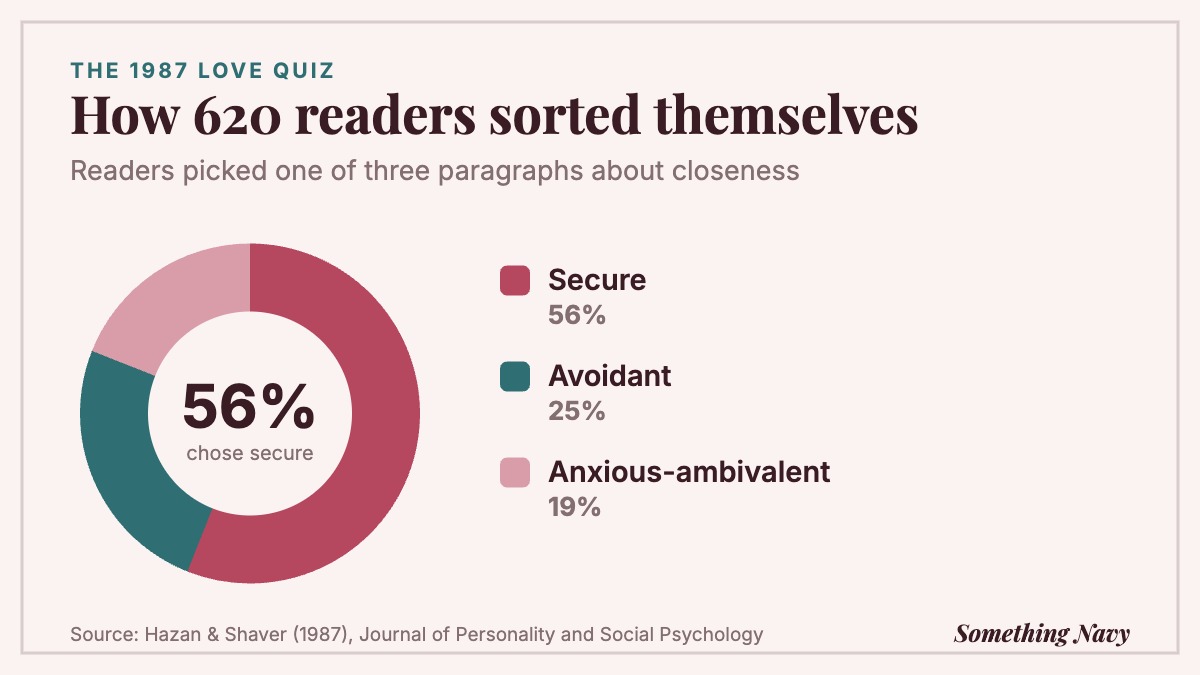
Of the 620 readers who replied (205 men and 415 women, aged 14 to 82), 56% chose the secure description, 25% the avoidant one and 19% the anxious-ambivalent one. A second study with 108 university students produced almost the same split. Hazan and Shaver published the results in the Journal of Personality and Social Psychology in 1987, noting that the proportions looked strikingly like those found in studies of infants.
It is worth pausing on who answered. These were self-selected readers of one newspaper who chose to post back a quiz about love, which is not a representative sample of anyone. Hazan and Shaver knew this; the study was meant to open a question, not settle it. It did open one. Their paper became one of the most cited in relationship science, and the three-paragraph format is the direct ancestor of the quiz you took at midnight.
The babies in Baltimore
The idea Hazan and Shaver borrowed came from the British psychiatrist John Bowlby, who argued that infants are biologically primed to stay close to a carer and to use that person as a safe base. His colleague Mary Ainsworth turned the idea into something you could observe. In her Baltimore Project, which followed 26 families from 1963, she visited homes month after month and, at the infant’s first birthday, ran a short laboratory procedure that became known as the Strange Situation: a mother leaves the room briefly, then comes back.
What mattered was the reunion. Some babies were upset, went to their mother, were soothed and returned to play. Others seemed to ignore her. Others clung and fussed and could not settle. Ainsworth found that these patterns tracked how sensitive the mother had been at home, and her 1978 book, Patterns of Attachment, set the template of secure, avoidant and anxious-ambivalent that adult research later inherited.
That lineage explains both the appeal of today’s quizzes and their biggest weakness. The language is borrowed from careful observation of one-year-olds. The adult version is usually a few minutes of self-report.
What the quiz gets right: two worries are real and measurable
Start with the good news for your pastel box. The feelings it describes are not astrology. Once researchers began writing dozens of questionnaires about adult attachment, Kelly Brennan, Catherine Clark and Phillip Shaver set out in 1998 to see what they had in common. They pooled 482 items from existing measures, trimmed duplicates to 323, and factor-analysed the lot in a large sample of respondents.
Almost everything collapsed onto two largely independent dimensions. One is attachment anxiety: worry about whether a partner is really available and will stay (sample item: “I worry about being abandoned”). The other is attachment avoidance: discomfort with depending on people and letting them close (“I try to avoid getting too close to my partner”). Their resulting 36-item questionnaire, Experiences in Close Relationships, is still a workhorse of the field.
A securely attached person, in this picture, is simply someone low on both. If your quiz asked about worrying when messages go unanswered, it was poking at a genuine, well-measured dimension of how people differ.
What the quiz gets right: insecurity does cost relationships something
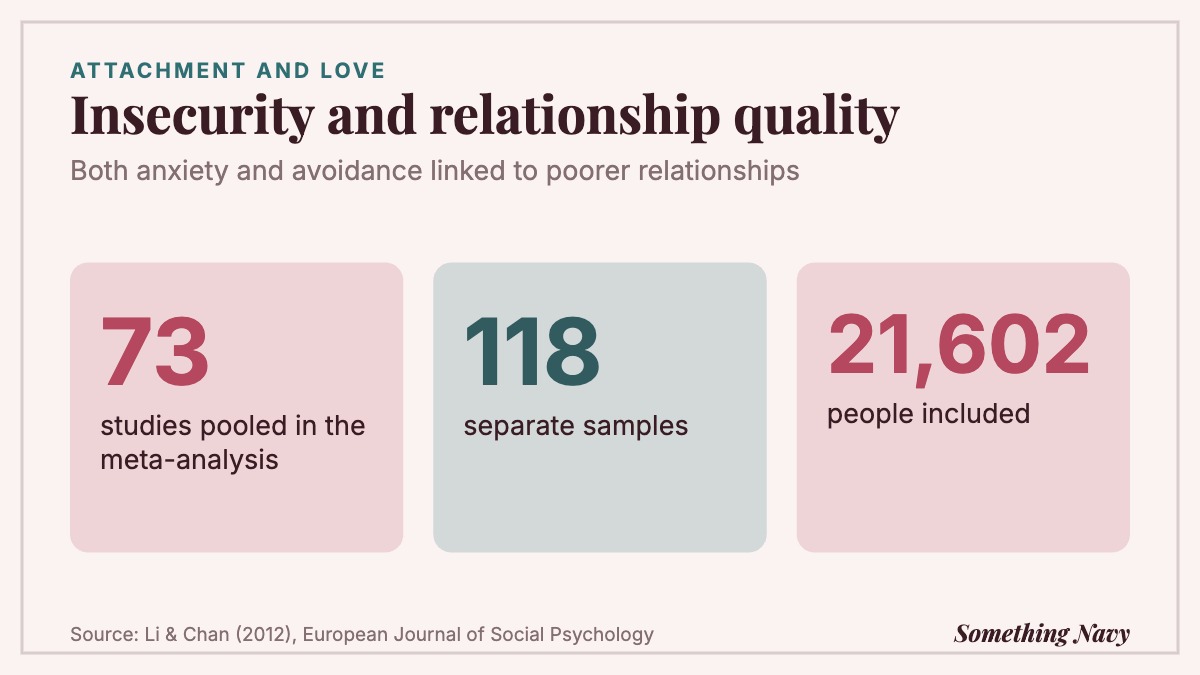
The second thing quizzes get right is that these dimensions matter. Psychologists Tianyuan Li and Darius Chan pulled together 73 studies covering 118 separate samples and 21,602 people for a 2012 meta-analysis in the European Journal of Social Psychology.
Both anxiety and avoidance were linked to poorer relationship quality across the board, in how people thought, felt and behaved. But they hurt in different ways. Avoidance was more strongly tied to lower satisfaction, less sense of connection and less support. Anxiety was more strongly tied to conflict. Gender made little difference.
That pattern fits what many couples describe. The anxious partner protests, chases and argues; the avoidant one withdraws, which can look calm but quietly drains the closeness out of things. Researchers who study couple conflict see similar dynamics in the habits that predict which relationships unravel.
Two caveats keep this honest. These are correlations, mostly from questionnaires completed by the same person who rates their own satisfaction, so some overlap is built in. And Li and Chan found that whether couple behaviour was self-reported or actually observed changed the size of some links. Insecurity predicts trouble on average. It does not doom any particular couple.


What the quiz gets wrong: there are no boxes
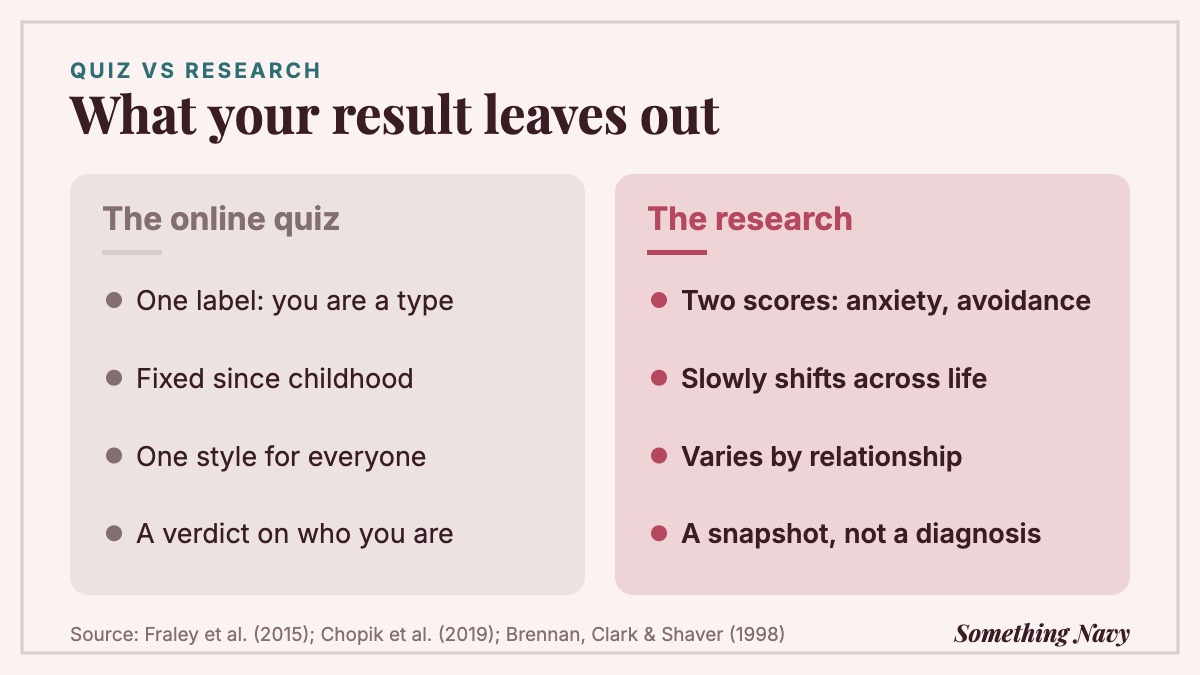
Here is where the pastel box starts to wobble. The original 1987 study asked people to choose one of three types, and most online quizzes still hand you a single label. The research community has spent the past three decades concluding that this is the wrong shape.
The key test is statistical. Taxometric methods ask whether a trait behaves like a category (you are either pregnant or not) or a dimension (like height). In a 2015 study, Chris Fraley of the University of Illinois and colleagues ran these analyses on two large samples, the second of 2,300 people and preregistered. Attachment looked dimensional, both in general and within specific relationships with mothers, fathers, partners and best friends. People, they concluded, “vary continuously, not categorically, in their attachment styles.”
The authors went further than most researchers allow themselves. They wrote that they no longer thought it defensible to use categorical measures in adult attachment research, or to turn continuous scores into categories. Chopping a continuous score in two, they pointed out, throws away a full 36% of the real variation between people.
In practical terms, someone who scores just above a quiz’s cut-off for “anxious” is far more similar to someone just below it than to someone at the extreme. The label hides that.
What the quiz gets wrong: your result is not a life sentence
Pop psychology often implies that your style was stamped in during infancy and now runs your love life on autopilot. The evidence for that is thin.
In a 2002 meta-analysis, Fraley gathered longitudinal studies that measured attachment security in infancy and again later on. The links were real but modest: in his own summary of the work, stability correlations sit at roughly .25 to .39. That fits what he called a prototype model, in which early experience leaves a lasting trace without fixing the outcome. Childhood and adult attachment, his overview notes, are moderately related at best.
Adult life keeps shifting the dial. William Chopik, Robin Edelstein and Kevin Grimm combined five long-running US studies, covering 628 people born between 1920 and 1967 and tracked for between 9 and 47 years. Their 2019 paper stitched these together to span ages 13 to 72. Anxiety peaked in young adulthood and then declined through middle and older age. Avoidance fell more gently and steadily. At every stage, people in a romantic relationship scored lower on both.
People vary continuously, not categorically, in their attachment styles.
Fraley and colleagues, 2015
That study has limits its authors flag themselves: the attachment scores were built from 14 items of an older personality measure never designed for the purpose, all participants were American, and averages can hide people who moved in opposite directions. Still, the broad message is consistent with other work. Attachment insecurity, especially anxiety, tends to ease with age and with steady relationships.
Change happens, but in small steps
If attachment can shift, what shifts it? Fraley, Omri Gillath and Pascal Deboeck tried to catch change in the act. They followed 4,920 people for between six months and three years, checking their attachment and their life events roughly monthly, and published the results in the Journal of Personality and Social Psychology in 2021.
Of 25 life events they tracked, around half were linked to an immediate shift in attachment and around a quarter to a lasting one. Conflict with a partner nudged people towards insecurity, and the effect stuck. Starting a new relationship made people feel more secure straight away, but that boost faded. The lasting effects were small on average, under a tenth of a standard deviation, though individuals varied a great deal.
One finding should give quiz-takers pause. More insecure people were more likely to go on to experience destabilising events such as break-ups, which means some of the story runs both ways. The sample, mostly white women, was not representative, and it was not an experiment. But the picture is of attachment as a slow-moving weather system rather than a fixed climate.
What the quiz gets wrong: you have more than one attachment
Most quizzes ask about “partners” in general and return one answer about “you”. Yet people can feel perfectly secure with a best friend and deeply anxious with a new partner. Fraley’s team found the same dimensional structure within each specific relationship, and studies comparing attachment to parents and to romantic partners find only modest overlap, with correlations of around .20 to .50.
That matters for the ex you diagnosed as avoidant. A person’s behaviour in one relationship reflects the relationship too: how responsive the other person was, how much conflict there was, how long it lasted. Labelling a partner from the outside, especially after being ghosted, is a guess dressed up as a diagnosis.
How to read your result without being ruled by it
Try this
- Look for your two scores, not just your label. If the quiz gives none, take a version of the Experiences in Close Relationships questionnaire, which researchers use and which is described openly by the lab that maintains it.
- Ask “compared with what?” A score near the middle is closer to everyone else than any label suggests.
- Answer for one relationship at a time. Your result with a partner may differ from your result with a parent or friend.
- Treat it as a snapshot. Retake it in a year, or after a big change, and see what moved.
A result can still be useful. Knowing that unanswered messages tip you into worst-case thinking is information you can act on, and so is noticing that you go cold when someone gets close. Couples sometimes find it easier to talk about “my anxiety kicks in when…” than to argue about who is unreasonable. Slow, deliberate closeness, the kind built by exercises such as the 36 questions, is the sort of experience the longitudinal research suggests can make people feel safer over time.
What a result cannot do is tell you who you are, predict which relationships will last, or excuse someone’s behaviour. The researchers who started all this with a newspaper quiz spent the next 30 years showing that people do not come in three flavours.
So go back to that pastel box and read it differently. It is not a verdict. It is a single reading on two dials that have been turning all your life, and will keep turning.
Frequently asked questions
Popular sources list secure, anxious and avoidant, often with a fourth “fearful” or “disorganised” type. Researchers now mostly describe people by two continuous scores, attachment anxiety and attachment avoidance, with security meaning low levels of both.
Yes, though usually slowly. Long-term studies find anxiety tends to fall after young adulthood, and stable relationships are linked to greater security, while conflict with a partner can push people the other way.
Some are adapted from validated research questionnaires and pick up real differences, but most squeeze the result into a single type. That throws away information, so treat the label as a rough snapshot rather than a diagnosis.
Not necessarily. Insecurity is linked to lower satisfaction on average, but these are modest associations across many couples, and how partners respond to each other matters a great deal.
Sources
- Hazan, C., & Shaver, P. (1987). Romantic love conceptualized as an attachment process. Journal of Personality and Social Psychology, 52(3), 511–524. DOI
- Brennan, K. A., Clark, C. L., & Shaver, P. R. (1998). Self-report measurement of adult attachment: An integrative overview. In J. A. Simpson & W. S. Rholes (Eds.), Attachment theory and close relationships. Guilford Press. Link
- Fraley, R. C. (2002). Attachment stability from infancy to adulthood: Meta-analysis and dynamic modeling of developmental mechanisms. Personality and Social Psychology Review, 6, 123–151. DOI
- Li, T., & Chan, D. K.-S. (2012). How anxious and avoidant attachment affect romantic relationship quality differently: A meta-analytic review. European Journal of Social Psychology, 42(4). DOI
- Fraley, R. C., Hudson, N. W., Heffernan, M. E., & Segal, N. (2015). Are adult attachment styles categorical or dimensional? A taxometric analysis of general and relationship-specific attachment orientations. Journal of Personality and Social Psychology, 109, 354–368. DOI
- Chopik, W. J., Edelstein, R. S., & Grimm, K. J. (2019). Longitudinal changes in attachment orientation over a 59-year period. Journal of Personality and Social Psychology, 116, 598–611. DOI
- Fraley, R. C., Gillath, O., & Deboeck, P. R. (2021). Do life events lead to enduring changes in adult attachment styles? A naturalistic longitudinal investigation. Journal of Personality and Social Psychology, 120(6), 1567–1606. Link
Cover photo: brooklyn on Unsplash. Charts and graphics: Something Navy.
How we reported this. We went back to the original research for this story, 7 sources in all, listed above, and checked every figure against them. If you think we have got something wrong, tell us and we will look at it. Read more about how we work.