

Your phone lights up mid-afternoon. “I got it!!” Your partner has landed the job, the flat, the place on the course. You are halfway through an email, so you type “Amazing, well done x” and go back to work.
Nothing about that reply is unkind. You meant it. And yet, according to two decades of research on how couples and friends share good news, it may be quietly costing you something.
Most of what we know about keeping relationships healthy is built around the hard moments: arguments, illness, loss, the slammed door. Psychologists spent years studying how partners support each other through trouble. Far fewer asked what happens when things go right.
When they finally did, the answer was surprising. In one study of dating couples, the way partners responded to each other’s good news was a better guide to whether the relationship lasted than the way they responded to bad news.
The research on sharing good news that changed relationship science
The idea has an unglamorous name: capitalisation. It comes from a 1994 paper by the psychologist C. A. Langston, who used it for what we do when something good happens and we tell someone about it, or celebrate it, rather than just quietly enjoying it.
A decade later, Shelly Gable, now at the University of California, Santa Barbara, and Harry Reis of the University of Rochester took the idea further. In a set of four studies published in 2004, they asked what happens to us, and to our relationships, when we share our wins.
First, they established how ordinary it is. In a daily diary study of 154 students, people told someone about their best event of the day on 70.8% of days. In a second diary study, that figure was 80.2%, and almost all of it (98%) went to close others: friends, partners, parents, siblings.
On days when people shared their good news, they reported more positive mood and higher life satisfaction than on days they kept it to themselves, even after the researchers accounted for how important the event was.
Telling someone, in other words, seems to make good things feel better. But the real discovery was about the person on the other end.
Four ways to respond when someone shares good news
Gable and her colleagues sorted listeners’ reactions along two lines. Is the response active or passive? And is it constructive (supporting the news) or destructive (undermining it)? That gives four styles, which have become one of the most widely taught frameworks in relationship psychology.
Here is how each one might sound if a friend tells you she has just been offered a promotion.
| Response style | What it looks like | Example reply |
|---|---|---|
| Active-constructive | Enthusiastic, curious, makes the news bigger | “That’s brilliant! When did they tell you? What did your manager actually say? We have to celebrate.” |
| Passive-constructive | Warm but brief, low energy, conversation moves on | “Oh nice, well done.” (Then back to the menu.) |
| Active-destructive | Engaged, but finds the problem or the downside | “Won’t that mean longer hours? Are you sure you can handle managing people?” |
| Passive-destructive | Ignores the news or turns attention elsewhere | “Hm. Did you see what happened to my car this morning?” |
The first and last are easy to judge. Nobody needs a psychologist to explain that ignoring a friend’s promotion to talk about your car is a bad look. The interesting ones are in the middle.
Active-destructive: the “just being realistic” reply
Active-destructive responses often come from a decent place. You are worried about the long hours. You want her to go in with her eyes open. But in the moment she is sharing joy, a list of risks lands as a verdict on her judgement. The news shrinks.
Passive-constructive: the reply most of us give
This is the “Amazing, well done x” from the opening. It is positive. It is also, research suggests, not much better than saying nothing at all.
Why a lukewarm “well done” can hurt as much as criticism
In their 2004 paper, Gable’s team built a short questionnaire to measure how people felt their partner usually responded to their good news. They gave it to 59 dating couples, and then to 89 married couples in Rochester, New York, who had been married for an average of about ten years.
People who said their partner typically responded in an active-constructive way reported more trust, more intimacy and more satisfaction with the relationship. That much was expected.
What caught attention was that the other three styles, including the polite, positive, passive one, all went in the opposite direction. Feeling that your partner met your good news with quiet, understated support was linked to lower relationship quality, not higher.
The married couples then kept daily diaries for around two weeks. Those who felt their spouse was usually enthusiastic about their good news reported higher daily marital satisfaction and more intimacy, and the link held even after controlling for how satisfied they had been at the start.
Being pleased for someone is not the same as showing them you are pleased. Only one of those counts.
A caveat is worth stating plainly. These were correlations. Happy couples may simply find it easier to be excited for each other, so the arrow could point both ways. To get closer to cause and effect, the researchers needed to watch it happen.


What 79 couples revealed on camera
In 2006, Gable and her colleagues Gonzaga and Strachman brought 79 dating couples into the lab. Partners took turns talking about a recent positive event and a recent negative one, while the other listened and responded. Everything was videotaped.
After each conversation, the person who had shared the news rated how understood, validated and cared for they felt. Independent observers, who did not know the couples, also coded how the listener behaved.
Two months later, the researchers checked in again. How were the relationships doing? Had anyone broken up?
Both the couples’ own ratings and the observers’ codes told the same story. How partners responded to positive news was more strongly linked to relationship well-being and to break-ups two months on than how they responded to negative news.
That does not mean comfort in hard times is unimportant. It means the good-news moments, which feel low-stakes and pass in seconds, carry more weight than anyone had assumed.
The authors’ explanation is intuitive. Bad news brings a script: we know we are supposed to listen and be supportive. Good news has no such script, so how someone responds may reveal more about how much they really care.
The $2 experiment: what an excited reply does to strangers
You might assume all this only matters in long-term relationships, where years of history are packed into each “nice, well done”. A 2010 study led by Reis suggests otherwise.
In one of five studies in the paper, two female experimenters approached students on three university campuses and asked them to describe a recent positive event. The experimenter then responded in one of three ways: enthusiastically, dismissively or neutrally. A fourth group simply received a sweet, to test whether a nice mood alone made a difference.
The students had been told they would get $1 for taking part. Each was handed an envelope containing $2. The question was who would come back and return the extra dollar.
Of the students who got an enthusiastic response, 68.3% handed back the money. Among those who got the neutral reply, it was 47.7%. Those given a sweet returned it 50.8% of the time. After a disparaging response, just 35.9% did.
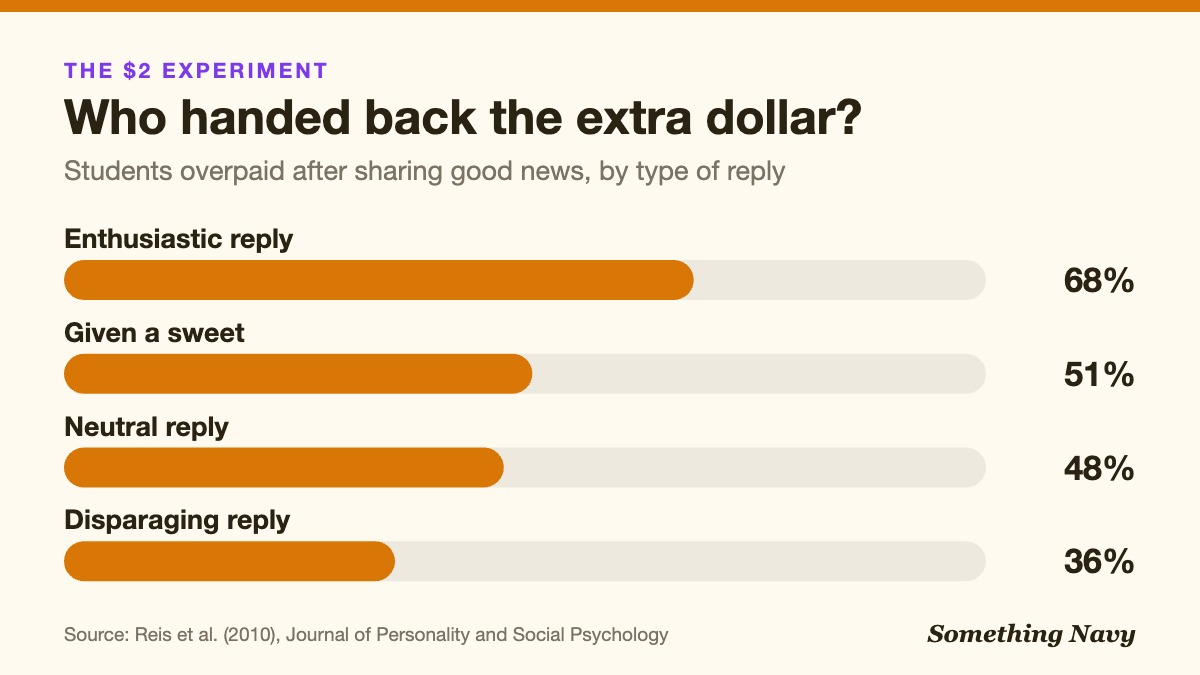
That is nearly twice the rate of the disparaging group, after a single brief exchange with someone they had never met.
Other experiments in the same paper found similar patterns in a gentler setting. People who described a positive event to an enthusiastic listener later rated the event itself more positively, and rated the listener as more responsive and trustworthy than people who had spent the same time doing a fun drawing task with them. A week later, the difference in perceived responsiveness was still there.
The small sweet is a useful control. A good mood alone did not do the job. What made people behave more generously was the sense that someone had paid attention to something that mattered to them.
Why being happy for someone builds trust
Researchers think active-constructive responding works through two routes.
The first is about the event itself. Telling the story again, especially to someone who asks questions, makes you relive it. You notice details, savour it a second time and lay it down more firmly in memory. In the 2004 diary study, people who told more people about a positive event were more likely to remember it later.
The second is about the relationship. An enthusiastic response is a small, clear signal: this person understands me, values what I care about and is on my side. Psychologists call this perceived responsiveness, and it is one of the strongest predictors of closeness and trust that relationship science has found.
Good news is also a cheap, low-risk way to test that responsiveness. If someone cannot get excited about your promotion, you might reasonably wonder how they will handle something harder. If they light up, you learn you can rely on them.
Seen this way, it echoes a theme from John Gottman’s research on couples, best known for the four horsemen that predict a relationship in trouble: much of what keeps a couple together happens in tiny, ordinary moments of turning towards each other rather than away. It is also why checking your phone while a partner is talking stings more than it seems it should.
Does active constructive responding work in every culture?
Most of the early work was done with American university students and couples, which raises an obvious question. Is gushing enthusiasm a universal good, or a particularly American one?
A 2024 study by Lester Sim and colleagues looked at 915 European American, East Asian and South Asian participants. Across all three groups, perceiving active-constructive responses went with greater partner responsiveness and relationship satisfaction, and passive-destructive responses went with less.
The middle styles were more mixed. For European Americans and East Asians, a passive-constructive response was linked to lower satisfaction, as in Gable’s original work. For South Asian participants, it was linked to higher satisfaction. And for East and South Asian participants, an active-destructive reply was not tied to lower satisfaction at all.
The authors argue that cultural norms shape what counts as a caring response. In some families, a calm “that’s good” is warmth. In others, a worried question about the long hours is how love is expressed.
Everyone, in every group, still seemed to value real engagement. What varied was how loud it needed to be.
Can you learn to respond better to good news?
If enthusiasm is mostly a product of a happy relationship, training people to do it should not change much. Researchers have tested this.
In a 2015 study published in the Journal of Social and Personal Relationships, participants were trained in active-constructive responding and compared with a control group whose members simply did a joint activity with their relationship partner. Those who were trained perceived more gratitude from their partner and saw their partner as more satisfied with the relationship.
It is an honest result, and a modest one. The trained participants did not report a rise in their own relationship satisfaction, and the study did not find that they expressed more gratitude. Still, it suggests that the skill can be practised, and that partners notice.
The technique has gone well beyond the lab. The US Army’s Master Resilience Training, developed with Martin Seligman and Karen Reivich of the University of Pennsylvania, includes active constructive responding as part of its module on strong relationships. Teachers, managers and couples therapists use versions of it too.
What the evidence does and does not show
- Strong: people who feel their partner meets good news with enthusiasm report better relationships, across several studies, ages and countries.
- Suggestive: in a two-month follow-up of 79 couples, responses to good news were more strongly linked to break-ups than responses to bad news.
- Causal, but short-term: lab and campus experiments show an excited reply raises trust and generosity towards the listener, even a stranger.
- Still open: how much training changes long-term relationship quality, and how the “right” reply differs across cultures.
How to respond to good news: a practical guide
The good news, fittingly, is that this does not require a personality transplant. Active-constructive responding is less about the size of your reaction and more about attention and curiosity.
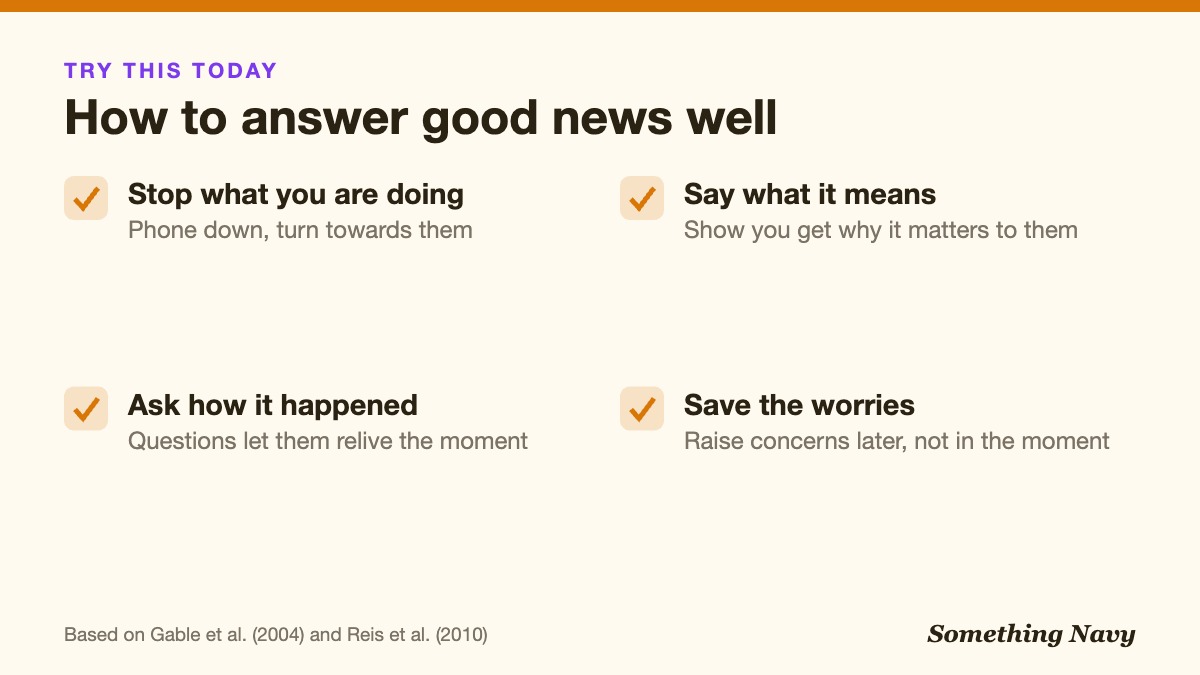
Stop what you are doing
Put the phone down, close the laptop, turn your body towards them. If you are texting, a voice note or a quick call says more than a line of exclamation marks. The message underneath is: this matters to me because it matters to you.
Ask a question that lets them relive it
“How did you find out?” “What did they say?” “What was the first thing you thought?” Questions invite the story, and the story is where the savouring happens. This also suits people who are not naturally gushing. You do not have to be loud. You have to be interested.
Name what it means to them
“You’ve wanted this since you started there.” Reflecting the significance shows you understand why it matters, not just that it happened. That is the core of perceived responsiveness.
Hold the worries for later
If you have real concerns, they will still be there tomorrow. Raise them once the celebration has had its moment. Leading with them turns an active-constructive moment into an active-destructive one.
Watch for your own envy
It is hardest to respond well when someone else’s good news touches a sore spot of your own. Noticing that sting, rather than letting it steer the reply, is half the work. Research on the liking gap suggests other people tend to think better of us after a conversation than we assume, so a generous response is rarely wasted.
The small reply that does the most work
It is tempting to think relationships are made or broken in the dramatic moments. Those matter. But much of what tells someone they are loved happens in the thirty seconds after they say “guess what”.
The useful thing about this research is how ordinary the opportunity is. Most of us hear good news from someone close to us most days. Each time, we choose, usually without noticing, between “nice, well done” and “tell me everything”.
So next time the phone lights up with “I got it!!”, try putting the email aside and asking how it happened.
It costs a minute. It might be the most important minute of their day.
Sources
- Gable, S. L., Reis, H. T., Impett, E. A., & Asher, E. R. (2004). What do you do when things go right? The intrapersonal and interpersonal benefits of sharing positive events. Journal of Personality and Social Psychology, 87(2), 228–245. DOI
- Gable, S. L., Gonzaga, G. C., & Strachman, A. (2006). Will you be there for me when things go right? Supportive responses to positive event disclosures. Journal of Personality and Social Psychology, 91(5), 904–917. DOI
- Reis, H. T., Smith, S. M., Carmichael, C. L., Caprariello, P. A., Tsai, F.-F., Rodrigues, A., & Maniaci, M. R. (2010). Are you happy for me? How sharing positive events with others provides personal and interpersonal benefits. Journal of Personality and Social Psychology, 99(2), 311–329. DOI
- Woods, S., Lambert, N., Brown, P., Fincham, F., & May, R. (2015). “I’m so excited for you!” How an enthusiastic responding intervention enhances close relationships. Journal of Social and Personal Relationships, 32(1), 24–40. DOI
- Sim, L., Ip, K. I., Ascigil, E., Edelstein, R. S., & Lee, F. (2024). Cross-cultural differences in supportive responses to positive event disclosure. The Journal of Positive Psychology, 19(2), 277–290. DOI
- Reivich, K. J., Seligman, M. E. P., & McBride, S. (2011). Master resilience training in the U.S. Army. American Psychologist, 66(1), 25–34. DOI
Cover photo: Jason Briscoe on Unsplash. Charts and graphics: Something Navy.
How we reported this. We went back to the original research for this story, 6 sources in all, listed above, and checked every figure against them. If you think we have got something wrong, tell us and we will look at it. Read more about how we work.