You are standing in the baby aisle, holding a CD with a cartoon violin on the cover. The back promises to “build your baby’s brain”. Next to it sits a streaming playlist called something like Mozart for Brain Power, with millions of plays.
Both rest on the same idea: play the right classical music and a mind gets sharper. It sounds harmless, even sweet. It also sounds like science, because once upon a time it was.
The trouble is what happened next. A modest laboratory finding about college students and paper-folding puzzles was stretched, retold and repackaged until it became a promise about infant IQ. Then dozens of other laboratories tested it.
This is a fact-check of the “Mozart effect”, claim by claim, with a grade for each.
The claim: Mozart makes you smarter, and the younger the better
The popular version comes in a few flavours. Listening to Mozart raises your IQ. Playing Mozart to babies makes them cleverer later in life. Classical music in general is brain food, and pop music is not.
Each of these is a separate claim, and each deserves to be tested separately. That matters, because the evidence for one does not automatically carry over to the next. A short-lived bump on a puzzle test in adults is not the same thing as a lasting change in a child’s intelligence.
So the method here is simple. Find where each claim started. Check what the original researchers actually measured. Then look at what happened when independent teams tried to get the same result.
Where it came from: 36 students and a piano sonata in 1993
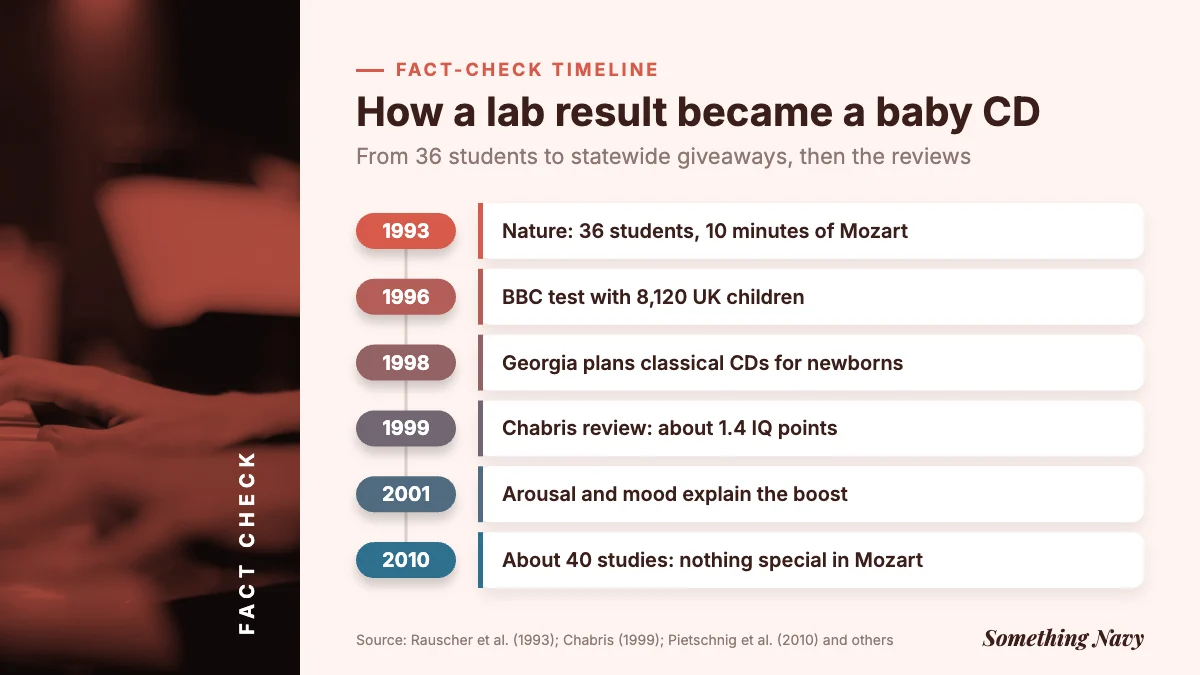
On 14 October 1993, the journal Nature published a one-page letter titled “Music and spatial task performance”. The authors were Frances Rauscher, Gordon Shaw and Katherine Ky, of the Center for the Neurobiology of Learning and Memory at the University of California, Irvine.
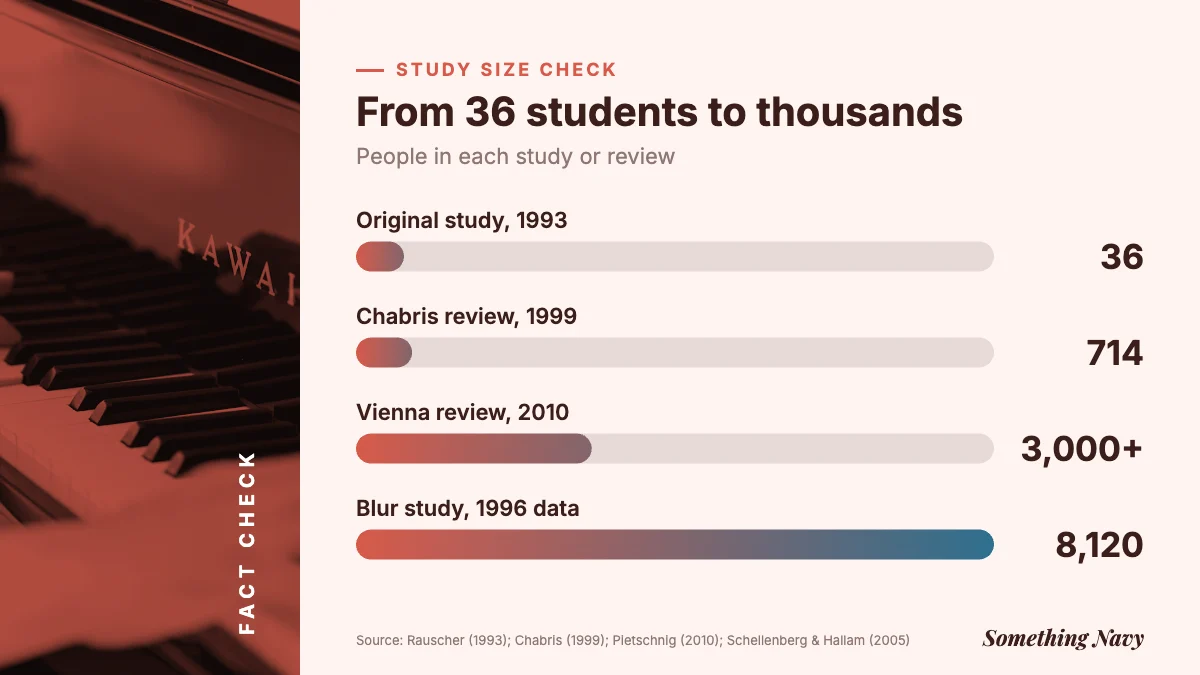
The design was small and tidy. Thirty-six college students each went through three listening conditions: 10 minutes of Mozart’s Sonata for Two Pianos in D major (K. 448), 10 minutes of relaxation instructions, and 10 minutes of silence. After each, they took spatial reasoning tasks drawn from the Stanford-Binet intelligence scale, such as pattern analysis and paper folding and cutting.
After the Mozart, the students did better. The authors converted the scores into IQ-style numbers and reported that, in the music condition, students scored 8 to 9 points above their results after relaxation or silence.
Two details in that letter tend to vanish from the retellings. First, the tasks were specifically spatial: folding paper in your head, spotting patterns. This was not a full IQ test. Second, the authors stated plainly that the boost was temporary, and did not extend beyond the 10 to 15 minutes in which students were tested.
Verdict on the original paper: a real, if small, finding, honestly reported. The limits were on the page from day one.


How a puzzle test turned into an IQ boost for babies
The leap from “college students did better on paper folding for a quarter of an hour” to “Mozart makes babies smarter” took about four years.
Popular books helped. Don Campbell’s 1997 book The Mozart Effect took the phrase into the self-help aisle, alongside the suggestion that listening to Mozart might temporarily raise IQ. Recordings for parents followed, with titles promising bigger brains.
Then politics arrived. In January 1998, Georgia’s governor Zell Miller asked the state legislature for $105,000 to give every newborn in Georgia a tape or CD of classical music. As NPR reported at the time, Miller wanted the music to boost the infant’s intelligence later in life, and he even suggested Beethoven’s “Ode to Joy” for the playlist.
A Connecticut legislative research report from 1998 records how it played out. The legislature was reluctant, and in the end the money was not needed: Sony offered recordings free to Georgia hospitals, under the title “Build Your Baby’s Brain Through the Power of Music”. Georgia had about 110,000 births a year, so this was no small giveaway.
The same report notes something striking. Rauscher herself said her studies did not show that casual listening, as opposed to music lessons, had any such effect.
No baby took part in the 1993 study. No full IQ test was given. No effect lasted longer than an exam break.
What happened when others tested it: the 1999 reckoning
A single study of 36 people is a starting point, not a conclusion. By the late 1990s other laboratories had tried to repeat it, and on 26 August 1999 Nature published two pieces that cooled things sharply.
The first was a meta-analysis by the psychologist Christopher Chabris, which pooled the results of 16 studies. Combining 20 comparisons between Mozart and silence, covering 714 people, he found an average enhancement of 0.09 standard deviations. In plain terms, that works out at about 1.4 IQ points.
Even on the spatial tasks where the effect should have been strongest, the figure was 0.14 standard deviations, or roughly 2.1 IQ points. The combined result was not statistically significant. Chabris concluded that any enhancement was small, did not reflect a change in general reasoning ability, and probably had a simple neuropsychological explanation.
The second piece came from Kenneth Steele and colleagues, who ran replications at three sites in the US and Canada. Across their studies, the sonata had no effect on performance. At one site, Mozart listeners scored the equivalent of 3 IQ points higher than the silence group. At another, they scored 4 points lower. The mean effect size across the work was 0.003, which is about as close to zero as psychology gets.
Rauscher replied in the same issue, defending her findings and arguing that some replications had used the wrong kinds of tasks. That is a fair scientific point to raise. But the burden had shifted: if the effect only shows up under very particular conditions, it is not the effect the baby CDs were selling.
Verdict on “listening to Mozart raises IQ”: not supported. The best 1999 estimate was a sliver of a point, on tests that were not IQ tests.
The biggest check: about 40 studies and more than 3,000 people
By 2010 there was far more data to work with. Jakob Pietschnig, Martin Voracek and Anton Formann, at the University of Vienna, gathered roughly 40 independent studies, including unpublished academic theses, with more than 3,000 participants in total. They published the result in the journal Intelligence under a title that did the fact-checking for them: “Mozart effect–Shmozart effect: A meta-analysis”.
Their conclusion, in the University of Vienna’s announcement, was blunt: there remained “no support for gains in spatial ability specifically due to listening to Mozart music”.
The word that matters there is “specifically”. Listeners did tend to score a little better after music than after sitting in silence. But other music produced a similar lift. Whatever was happening, it was not something unique to Mozart.
The team also spotted a pattern worth knowing about. Published studies linked to the laboratories of Rauscher or Rideout, two of the effect’s earliest proponents, reported effect sizes more than three times larger than studies run elsewhere. That does not mean anyone did anything wrong. It does mean that the clearest results tended to come from the people most invested in the idea, which is exactly when independent replication is most valuable. The same story has played out with other famous findings, including power poses.
Pietschnig put it kindly. He recommended listening to Mozart to everyone, but said it “will not meet expectations of boosting cognitive abilities.”
What actually explains the boost: arousal and mood
If Mozart is not special, why did some people score better after hearing him? The most convincing answer came from a neat experiment in 2001.
Thompson, Schellenberg and Husain, a Canadian team publishing in Psychological Science, tested 24 adults twice, a week apart. Once they sat in silence before a paper folding and cutting task. Once they heard 10 minutes of music. For half the group the music was the same bright, energetic Mozart sonata used in 1993. For the other half it was Albinoni’s Adagio in G minor, a slow and famously mournful piece.
The researchers also measured how much people enjoyed the music, how aroused (alert and energised) they felt, and their mood.
After Mozart, spatial scores went up compared with silence. After Albinoni, they did not. The Mozart listeners also reported higher arousal, better mood and more enjoyment.
Here is the decisive step. When the team statistically accounted for enjoyment or arousal, the Mozart effect disappeared. The authors described their results as compelling evidence that the Mozart effect is “an artifact of arousal and mood.”
In other words, the music was not tuning up any special spatial circuit. It was doing what a good song, a coffee or a brisk walk can do: lifting your energy and mood for a short while, which helps you perform a little better on a demanding task. That is real, but it is ordinary.
It also explains why your own favourite track can feel like it sharpens you. Familiar music we like tends to lift us more, partly through the mere exposure effect and partly because of the memories a song carries.


Blur beat Mozart: the test with 8,120 British children
If arousal and enjoyment are doing the work, then music that a given group finds more exciting should produce the same lift, or a bigger one. A remarkable piece of British broadcasting history put that to the test.
On 21 March 1996, at 11am, the BBC ran a schools experiment on the Mozart effect, with results due on the programme Tomorrow’s World the next day. More than 200 schools took part, and 8,120 children aged 10 and 11 were randomly assigned, within each school, to one of three 10-minute broadcasts.
One group heard a Mozart string quintet. One heard pop songs, including Blur’s “Country House”. One heard a discussion about the experiment itself. Afterwards, all the children completed two spatial tests: square completion and paper folding.
Schellenberg and Hallam analysed the data and published it in 2005 in the Annals of the New York Academy of Sciences. On square completion, there was no difference between the groups. On paper folding, the children who had heard the pop music did best. The authors called it the “Blur effect”.
Their explanation fits the arousal account neatly. For British 10-year-olds in 1996, Blur was more exciting than a string quintet. The authors argued that any benefit is most likely to show up when the music is enjoyed by the listener.
Verdict on “Mozart is special”: false. The effect, such as it is, follows enjoyment and energy, not the composer.
Music lessons are a different claim, with its own problems
Defenders of music sometimes switch to a stronger argument here. Forget listening, they say. Learning to play an instrument is what builds the brain. This is genuinely a separate claim, and it has better evidence than the CDs. But it is not as strong as many parents hear.
The best-known study came from Schellenberg in 2004, in Psychological Science. He recruited 144 six-year-olds through a newspaper advert and randomly assigned them to four groups: keyboard lessons, voice lessons, drama lessons or no lessons, with 36 weekly lessons at the Royal Conservatory of Music in Toronto.
Every group’s IQ rose over the year, which is normal for children starting school. But the music groups gained slightly more: an average of 7.0 points compared with 4.3 in the two control groups, a difference of 2.7 points. The study itself described the effect as relatively small.
That result has been questioned. In a 2005 reanalysis, the psychologist Kenneth Steele pointed out that the difference was significant only when the two music groups and the two control groups were combined, not when each group was compared separately.
Larger reviews have since been cooler still. In 2017, Giovanni Sala and Fernand Gobet pooled 38 studies with 3,085 participants and found an overall effect of 0.16 standard deviations, which shrank to around zero in studies that used random allocation and active control groups (children doing some other new activity).
Their 2020 meta-analysis in Memory & Cognition was bigger again: 54 studies, 254 effect sizes and 6,984 children aged 3 to 16. Before accounting for study quality, music training seemed to give a small benefit. In the best-designed studies, the overall effect was null. Small significant effects appeared only in studies that lacked random allocation and compared musicians with children doing nothing new.
Not every researcher accepts that conclusion, and debate about specific skills, such as listening and language, continues. But on the headline question, whether music lessons make children smarter in general, the strongest trials point to no meaningful gain.
Learn the cello because it is beautiful, hard and yours. Not because it is an IQ supplement.
The Mozart effect report card
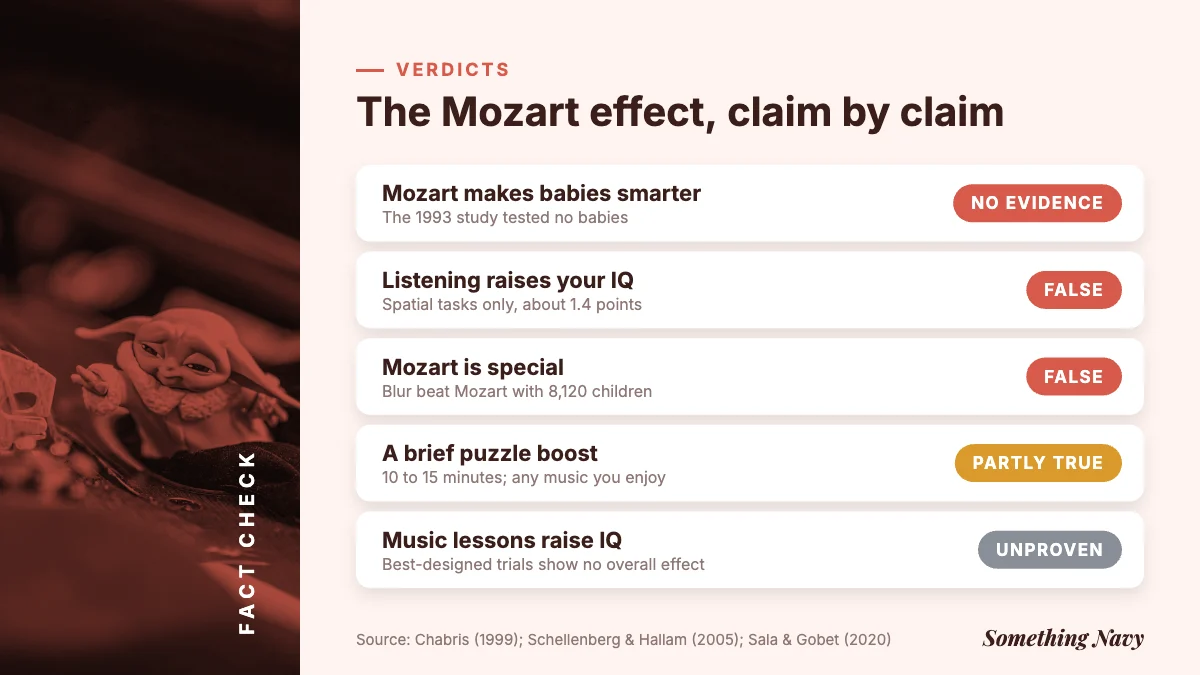
Here is how each popular version of the claim fares against the evidence covered above.
| Claim | What the evidence says | Verdict |
|---|---|---|
| Listening to Mozart raises your IQ | The 1993 study measured spatial subtests only, not IQ. Chabris (1999) put the average lift at about 1.4 IQ points, not significant. | False |
| Mozart boosts spatial puzzles for a short time | Some studies show a brief lift, lasting 10 to 15 minutes. Other music does the same. | Partly true, but misleading |
| Mozart is uniquely powerful | No support for Mozart specifically across about 40 studies (Pietschnig, 2010). Blur beat Mozart with 8,120 children. | False |
| Playing Mozart to babies makes them smarter | No study behind the claim tested babies. The 1993 subjects were college students. | No evidence |
| Upbeat music you enjoy can help you perform | Arousal and mood explained the effect in Thompson et al. (2001). | Mostly true, modest and short-lived |
| Music lessons raise children’s IQ | A small gain in one 2004 trial. The best-designed studies in a 2020 meta-analysis found no overall effect. | Unproven |
Fact-check verdict
- Claim: Listening to Mozart makes you, or your baby, smarter.
- Rating: False.
- Why: The 1993 study tested 36 adults on spatial tasks, not IQ, and the lift lasted 10 to 15 minutes. Later reviews of about 40 studies and more than 3,000 people found nothing special about Mozart. Mood and arousal explain the small, short boost, and any music you enjoy can produce it.
- What is true: Feeling alert and in a good mood helps you think for a short while.
The verdict, and what music can honestly do for you
Strip away the marketing and a modest, useful truth is left. Music changes how you feel, and how you feel changes how well you perform, for a little while. That is not magic, and it is not Mozart’s.
Here is how to use that honestly, today.
- Before a tricky task, play something that lifts you. An upbeat track you enjoy is the active ingredient, not a particular composer. If Mozart does that for you, wonderful. If it is Blur, that works too.
- Keep the timing short. The original effect lasted 10 to 15 minutes. Think of it as a warm-up, not a supplement.
- Watch out for lyrics while you work. The research above measured music played before a task, not during it. If words in a song pull your attention, save them for the break.
- Play music to your baby for the reasons that are real. Singing, rocking and sharing songs are lovely ways to soothe and bond. They do not need a brain-building label to be worth doing.
- Choose music lessons for the music. Skill, patience, friends in the orchestra and a lifelong hobby are solid reasons. A higher IQ is not one the best evidence supports.
It is worth noticing why this myth spread so well. It offered a small, cheap, pleasant act with a huge payoff, and it carried the authority of a top journal. That combination should make anyone a little more careful. Confidence and evidence are not the same thing, as the Dunning-Kruger effect reminds us.
The good news is the part that survives. Music that you love can still lift a dull afternoon, steady your nerves before an exam and fill a nursery with something tender.
It just will not do your thinking for you.
Official links and research
- Rauscher, F. H., Shaw, G. L., & Ky, K. N. (1993). Music and spatial task performance. Nature, 365, 611. DOI
- Chabris, C. F. (1999). Prelude or requiem for the ‘Mozart effect’? Nature, 400, 826–827. DOI
- Thompson, W. F., Schellenberg, E. G., & Husain, G. (2001). Arousal, mood, and the Mozart effect. Psychological Science, 12(3), 248–251. DOI
- Schellenberg, E. G. (2004). Music lessons enhance IQ. Psychological Science, 15, 511–514. DOI
- Schellenberg, E. G., & Hallam, S. (2005). Music listening and cognitive abilities in 10- and 11-year-olds: The Blur effect. Annals of the New York Academy of Sciences, 1060, 202–209. DOI
- Pietschnig, J., Voracek, M., & Formann, A. K. (2010). Mozart effect–Shmozart effect: A meta-analysis. Intelligence, 38(3), 314–323. DOI
- Sala, G., & Gobet, F. (2020). Cognitive and academic benefits of music training with children: A multilevel meta-analysis. Memory & Cognition, 48(8), 1429–1441. DOI
- Connecticut Office of Legislative Research. (1998, July 13). Georgia’s provision of classical music for newborns (Report 98-R-0888). Link
Cover photo: Fabian Kleiser on Unsplash. Charts and graphics: Something Navy, with photography by Dovydas Žilinskas, Bangyu Wang and Victor Serban on Unsplash.
How we reported this. Every figure was checked against the 8 sources above. Reviewed by Valentino Adkins, Senior Content Manager. Report an error · How we work