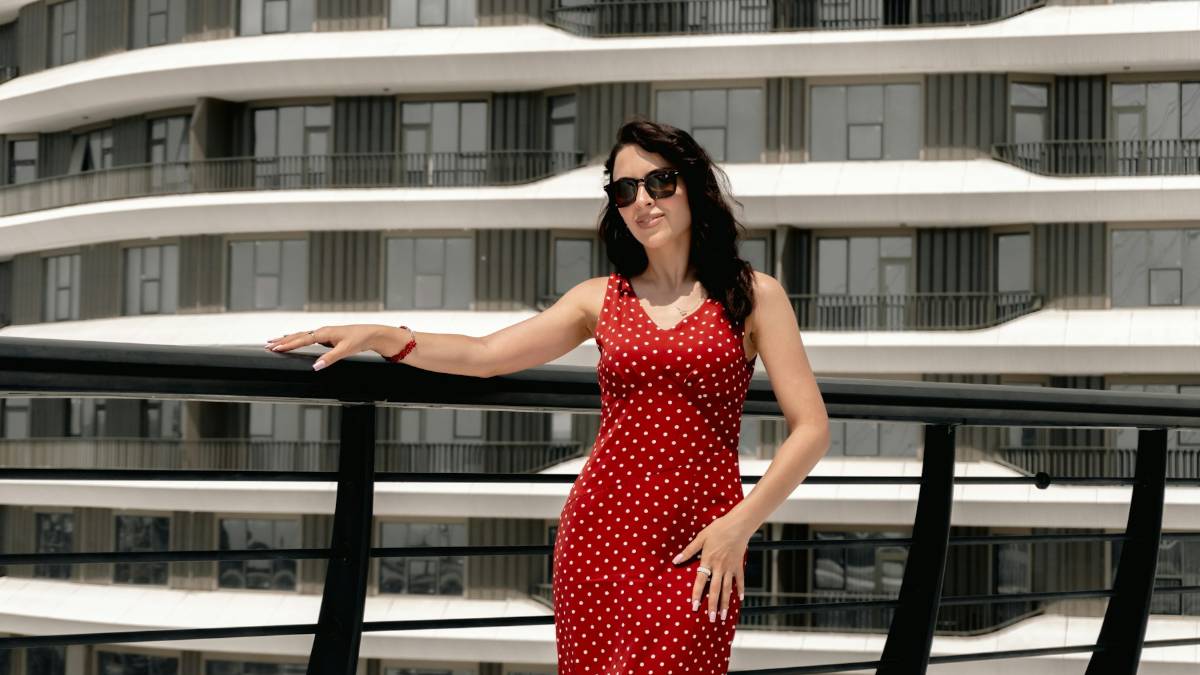
It is half past seven, the table is booked for eight, and there are two dresses on the bed. One is navy. One is red. Somewhere in the back of your mind is a headline you half remember: science says red makes you more attractive.
For about a decade, that headline was everywhere. It appeared around every Valentine’s Day, in dating advice columns and in pop psychology books. It came from real experiments, published in serious journals, by respected researchers.
And then, slowly and fairly quietly, it started to come apart.
The story of the “red effect” is worth telling in order, because it is two stories at once. One is about colour and desire. The other is about how psychology checks its own work, and what happens when a charming finding meets a much larger sample.
2005: A red vest in the Olympic ring
The idea that red gives people an edge did not start with dating. It started with fighting.
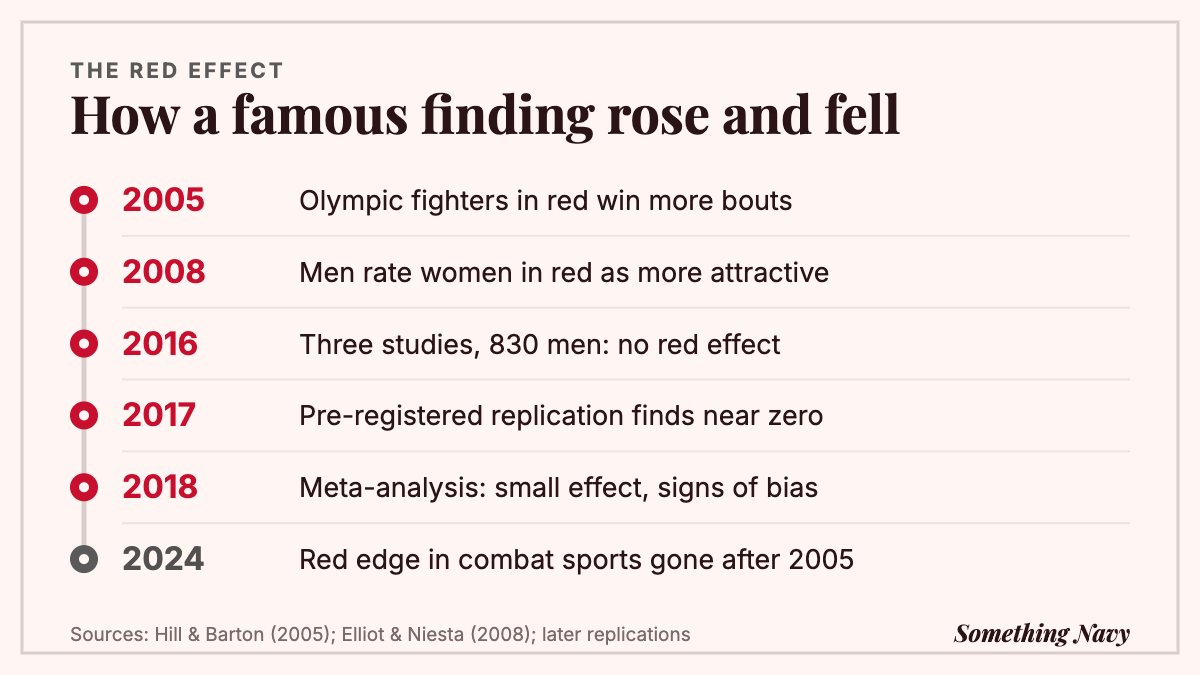
At the 2004 Athens Olympics, competitors in boxing, taekwondo, Greco-Roman wrestling and freestyle wrestling were randomly assigned red or blue kit. Two evolutionary anthropologists at Durham University, Russell Hill and Robert Barton, saw a natural experiment. They went through the results and, in a short paper in Nature in 2005, reported that athletes in red won significantly more bouts across all four sports.
The detail that made the paper persuasive was where the advantage showed up. It appeared only in contests between closely matched fighters. As Hill and Barton put it, wearing red “presumably tips the balance between losing and winning only when other factors are fairly equal.”
Their explanation drew on biology. In many animals, red colouring is a signal of male dominance and condition, so perhaps humans, too, read red as a threat. It was neat, it was memorable, and it opened a door. If red could change how we see a rival, could it change how we see a partner?
2008: The photograph in the red frame
Three years later, Andrew Elliot, a psychologist at the University of Rochester, and his postdoctoral colleague Daniela Niesta published “Romantic Red” in the Journal of Personality and Social Psychology, one of the field’s most prestigious journals.
Across five experiments, male undergraduates looked at a photograph of a woman and rated her. In the first, the photo was framed by either a red or a white border. Later experiments compared red with grey, green and blue, with the colours carefully matched for brightness and saturation so that only the hue differed. In the final experiment the border stayed the same, and the woman’s shirt was digitally recoloured red or blue.
The pattern was consistent. When red was present, men rated the woman as more attractive and more sexually desirable. They said they would be more likely to ask her on a date and would spend more money on it. Red did not change how likeable, kind or intelligent she seemed, and women rating the same photos showed no red effect at all.
The effects were not subtle. A later re-analysis of the five experiments put their effect sizes at roughly 0.6 to 1.1 on the standard scale psychologists use, where 0.2 counts as small and 0.8 as large. For something as trivial as a picture frame, that was remarkable.
Elliot was candid about the appeal. “It’s fascinating to find that something as ubiquitous as color can be having an effect on our behavior,” he said in the university’s announcement. The press loved it.
2010 to 2013: An idea that travelled well
More studies followed. In 2010, Elliot and colleagues reported in the Journal of Experimental Psychology: General that the effect ran the other way too: women rated men shown with red as more attractive, which the researchers linked to red signalling status.
Other studies reported that men approached women in red T-shirts more closely, and that the effect held even in a remote community in Burkina Faso, where red carries associations with illness and bad luck rather than romance. To supporters, that last result suggested something deeper than Valentine’s cards: perhaps a response with roots in our primate past, where some females redden around ovulation.
By the early 2010s the “red-romance hypothesis” had a theory behind it, a growing pile of supportive studies and a clean evolutionary story. It looked like one of the more solid findings in social psychology.
Why small samples tell big stories
There was a problem hiding in plain sight, and it was not unique to colour research. Many of the early red studies were small, often a few dozen people per condition. Small studies are noisy. Run enough of them and some will produce large, impressive effects by chance alone.
Those are precisely the results most likely to be written up and accepted by journals. The studies that found nothing tended to sit in filing cabinets. Psychologists call this publication bias, and its effect is to make the published record look more confident than reality.
From around 2011, psychology went through what became known as its replication crisis. Famous findings were re-tested in larger samples, often with the methods fixed in advance, and a worrying number shrank or vanished. The red effect, with its small samples and big effects, was an obvious candidate for a second look.
What a replication is
- A replication repeats a published study to see whether the result comes out the same way again. A direct replication copies the original as closely as possible, ideally with the same materials; a conceptual one tests the same idea a different way.
- Good modern replications are pre-registered: the researchers publicly record their hypotheses, sample size and analysis plan before collecting data, so they cannot quietly change course once they see the results.
- They also use larger samples, which shrink the role of luck. A failed replication does not prove an effect is zero. It does tell you the original estimate was probably too big.


2016: 830 men, three studies, one shrug
The first big blow came from a team of Dutch and British researchers led by Leonard Peperkoorn, with Craig Roberts and Thomas Pollet, published in Evolutionary Psychology in 2016.
In their first experiment, 206 young Dutch men looked at a woman’s dating-profile photo in which her shirt was red, black or white. Half were asked to imagine they were looking for a one-night stand, half for a long-term partner, to test whether red mattered more for short-term attraction. A second experiment repeated the design with nearly 200 American men.
The third was a direct replication of an earlier red study, using its original materials. This time, 433 men recruited online rated the same woman in red or white on how sexually receptive she seemed. That sample was about 17 times larger than the original.
In all three studies, shirt colour made no difference. In the first, the men themselves ranked it as the least important influence on their judgement. The authors wrote that the absence of an effect “leads us to question the robustness of the red effect in human mate preferences,” and suggested that if red does matter, the effect is likely to be small.
2017: Same photos, rules written in advance
At almost the same time, Robert Calin-Jageman, a psychologist at Dominican University in Illinois, and his colleague Gabrielle Lehmann were running their own test. Their paper, published in Social Psychology in 2017, is close to a model of how a replication should be done.
They obtained the original materials, worked out in advance how many participants they would need to detect a real effect, pre-registered the whole study and ran it both online and in person. They also included a “positive control”: a separate manipulation known to work reliably, to show that their participants were paying attention and their method could detect an effect when one existed.
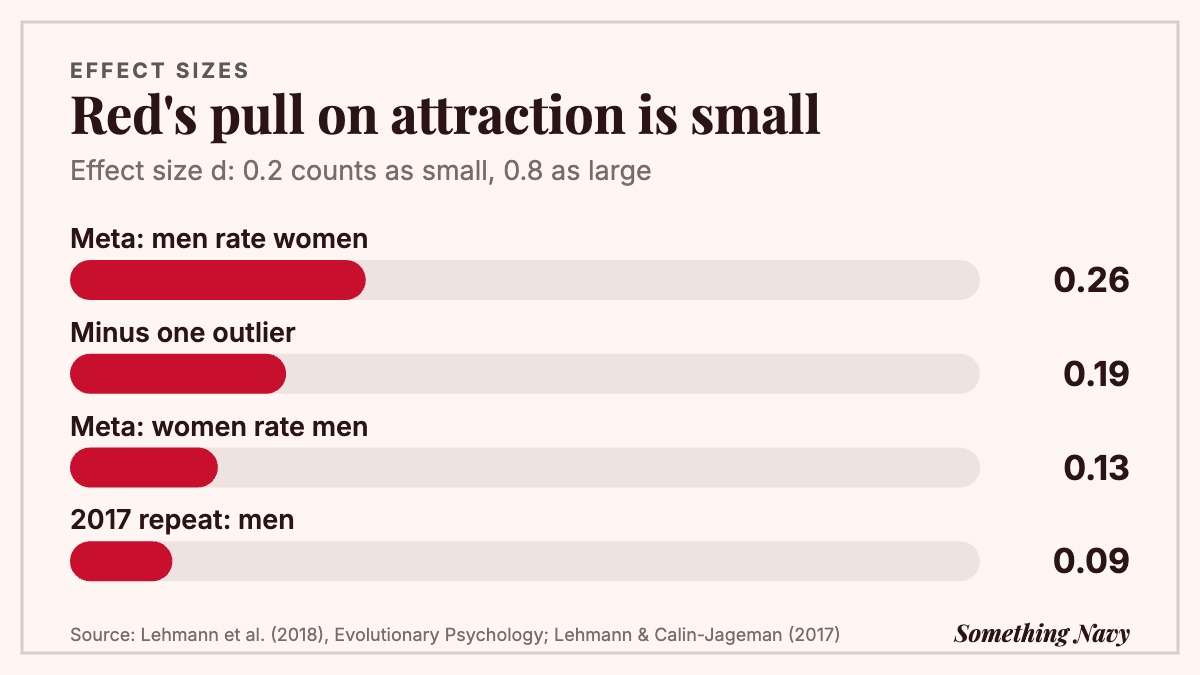
The results were close to nothing. Among 242 men rating women, red produced an effect of 0.09, a tiny nudge in the predicted direction that could easily be zero. Among 360 women rating men, the effect was −0.09: equally tiny, and pointing the wrong way.
The authors were careful in their conclusions. The original studies might have overestimated the effect, theirs might have underestimated it, or the effect might depend heavily on conditions nobody had yet identified. What they could say was that the large effects in the original papers did not reappear.
2018: The rival camps sit at one table
What happened next is one of the more admirable episodes in this story. Instead of trading critiques across journals, Lehmann and Calin-Jageman teamed up with Andrew Elliot himself to pool every piece of evidence they could find, published and unpublished.
The meta-analysis, published in Evolutionary Psychology in 2018, gathered 41 sources containing 98 comparisons and 6,682 participants. The authors openly described it as a kind of “adversarial collaboration”. Elliot leaned towards seeing the mixed results as a sign that colour research is complex and needs studies of the conditions under which red works. The other two, having run replications, were inclined to believe the effect is “small, potentially even nonexistent.”
The numbers gave both sides something, and neither side much comfort. For men rating women, the average effect was 0.26: small, and far below the original estimates. Removing a single study with an unusually large result brought it down to 0.19. For women rating men, the average was 0.13, very small.
Then came the warning signs. In the women-rating-men studies, there was clear statistical evidence of publication bias: smaller studies reported bigger effects, the classic fingerprint of a literature where null results went missing. For men rating women the evidence of bias was equivocal. Effects also appeared to have shrunk over time, and for women rating men, pre-registered studies found smaller effects than the rest.
Put simply: the honest estimate is that red has, at most, a small effect on attraction in the lab, and even that may be partly an artefact of which studies got published.
Meanwhile, back in the ring
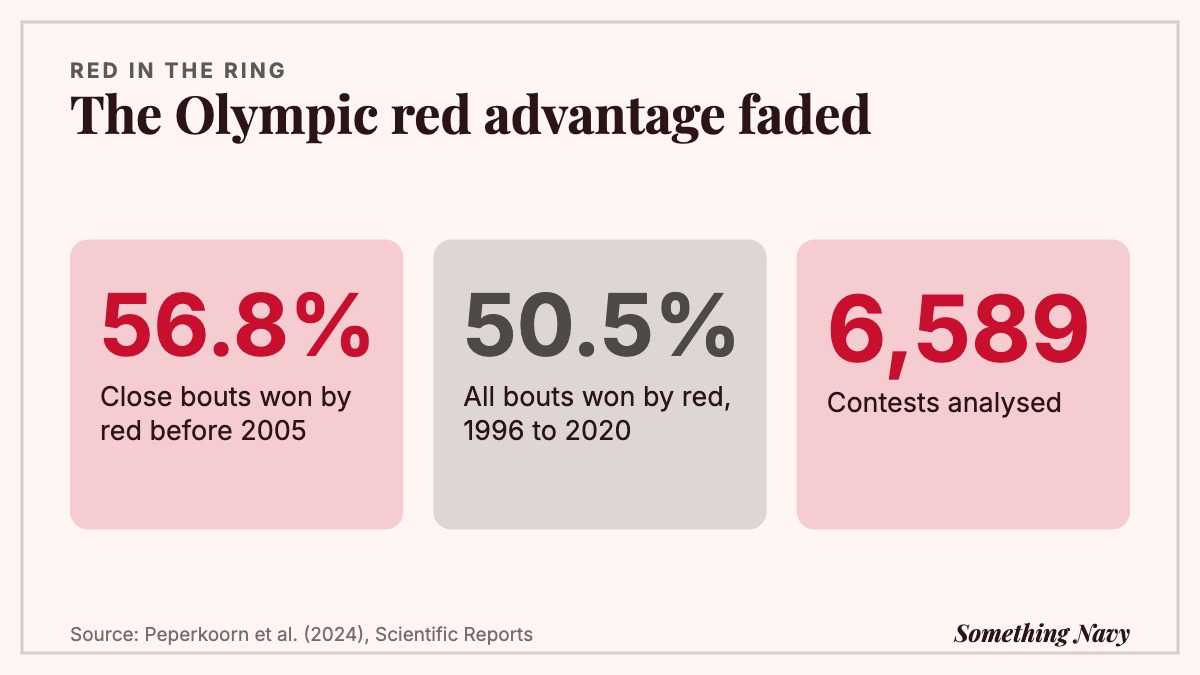
The sporting finding that started it all got its own reckoning. In 2024, Peperkoorn teamed up with Hill and Barton, the authors of the original Nature paper, to look at far more data. Their meta-analysis in Scientific Reports covered 6,589 contests in boxing, taekwondo and wrestling across seven Summer Olympic Games from 1996 to 2020 and nine World Boxing Championships.
Before 2005, the red advantage was there: fighters in red won 56.8% of close contests. Across the whole period, though, red won 50.5% of all bouts and 51.5% of close ones, neither statistically different from a coin toss.
The researchers’ preferred explanation is not that the original finding was a fluke but that the world changed. Scoring has become more technology-assisted and the rules tighter, leaving less room for a referee’s judgement, which is where a colour bias would most plausibly creep in. That is a useful lesson in itself: a real effect can be fragile, and depend entirely on the setting.
What actually remains
Strip away the headlines and here is a fair summary. Red probably does not have the large, reliable effect on attraction that the early studies reported. There may be a small effect for men rating women, though the true size is uncertain and could be close to zero. For women rating men, the evidence is weaker still.
It is also worth noticing what these studies measured. Nearly all of them asked strangers to rate a single photograph, often for a few seconds. That is a long way from a dinner date, where what you say, how you listen and whether you laugh at the same things will swamp the colour of your top.
Some researchers still think red could matter in particular contexts: certain shades, certain moments, face-to-face rather than on a screen. That is a reasonable hypothesis. It is not, at the moment, a finding.
So, should you wear the red dress?
Here is the honest style advice. If you love how you look in red, wear it. If red makes you feel conspicuous and you spend the evening tugging at the hem, wear the navy. The science gives you no reason to choose red to win someone over, and no reason to avoid it.
What clothes may do is change the wearer. Research on enclothed cognition explores how what we wear shapes how we think and feel, though that field has its own replication questions. A garment that makes you stand a little straighter is doing something useful, whatever its colour.
And if you are worried that everyone will notice the outfit, the spotlight effect suggests they will notice far less than you fear. The person across the table is mostly thinking about how they come across.
The red effect was a good story: simple, sexy and seemingly rooted in our evolutionary past. Its real legacy may be the way it was tested. The original author sat down with his sceptics, pooled the data and published the less exciting answer. That is worth more than any dress.
Sources
- Elliot, A. J., & Niesta, D. (2008). Romantic red: Red enhances men’s attraction to women. Journal of Personality and Social Psychology, 95(5), 1150–1164. DOI
- Elliot, A. J., et al. (2010). Red, rank, and romance in women viewing men. Journal of Experimental Psychology: General, 139, 399–417. DOI
- Hill, R. A., & Barton, R. A. (2005). Red enhances human performance in contests. Nature, 435, 293. DOI
- Lehmann, G. K., & Calin-Jageman, R. J. (2017). Is red really romantic? Two pre-registered replications of the red-romance hypothesis. Social Psychology, 48(3), 174–183. DOI
- Lehmann, G. K., Elliot, A. J., & Calin-Jageman, R. J. (2018). Meta-analysis of the effect of red on perceived attractiveness. Evolutionary Psychology, 16(4). DOI
- Peperkoorn, L. S., Roberts, S. C., & Pollet, T. V. (2016). Revisiting the red effect on attractiveness and sexual receptivity: No effect of the color red on human mate preferences. Evolutionary Psychology, 14(4). DOI
- Peperkoorn, L. S., Hill, R. A., Barton, R. A., et al. (2024). Meta-analysis of the red advantage in combat sports. Scientific Reports, 14, 30822. DOI
How we reported this. We went back to the original research for this story, 7 sources in all, listed above, and checked every figure against them. If you think we have got something wrong, tell us and we will look at it. Read more about how we work.
Cover photo: Zulfugar Karimov on Unsplash. Charts and graphics: Something Navy.