

It is 7.40am and you are standing in the vestibule of a train that was full two stops ago. Someone’s rucksack is pressed into your ribs. You cannot reach your phone, so you do the only thing left to do, which is arithmetic.
Fifty minutes each way. Five days a week. You divide your salary by the hours you actually spend on work, including this bit, and the hourly rate shrinks in front of you. Then you wonder whether the bigger flat, the better job, the nicer postcode was worth it.
The train lurches and you never finish the sum. Economists and transport researchers have been finishing it for you for years, and their answer is uncomfortable.
The commuting paradox: why economists expected long commutes to pay
Standard economic theory has a tidy story about commuting. Nobody enjoys a long journey, so people should only accept one if something makes up for it: higher wages, cheaper housing, a bigger garden. The trade should leave you as well off as someone who lives round the corner from the office.
In 2008, the economists Alois Stutzer and Bruno Frey tested that idea in the Scandinavian Journal of Economics, in a paper titled “Stress that doesn’t pay: the commuting paradox”. They used eight waves of the German Socio-Economic Panel between 1985 and 2003. Their main analysis covered 39,141 observations from 19,088 people who rated their life satisfaction on a scale from 0 to 10.
The average one-way commute in their data was 22 minutes, and about 6.8% of commuters travelled an hour or more. If the tidy story held, commute length should have had no link with life satisfaction. It did. Following the same people over time, an hour of commuting was associated with life satisfaction 0.2 points lower on that 0 to 10 scale.
How big is that, in money?
Stutzer and Frey then asked how much extra income would offset the typical 22-minute commute. Their rough answer was about 470 euros a month, or 35.4% of average monthly labour income. They were careful to add that they “do not want to insist on the specific number”, and you should hold it loosely too. The point is direction: on average, long-distance commuters were not being compensated enough to feel as satisfied as everyone else.
What 20 extra minutes of commuting does to job satisfaction
The best-known British figure comes from a team at the University of the West of England (UWE Bristol) and the University of Leeds, led by Kiron Chatterjee, an associate professor in travel behaviour at UWE. Their press release in October 2017 carried a headline built for train-carriage maths: an extra 20 minutes of commuting each day lowers job satisfaction by as much as a 19% pay cut.
The peer-reviewed version appeared in the journal Transportation in 2020, with Ben Clark as lead author alongside Chatterjee, Adam Martin and Adrian Davis. It used six waves of Understanding Society, a panel study that surveys members of 40,000 UK households every year, covering 2009/10 to 2014/15 and more than 26,000 workers in England.
Precisely, an extra 10 minutes of commuting each way, so 20 minutes a day, had the same association with job satisfaction as a 19% drop in gross personal income. For a worker on the sample’s median income of £21,600, the authors put that at roughly £4,080 a year.
Leisure time takes the biggest hit
Job satisfaction got the headlines, but longer commutes were also linked with more strain, poorer mental health and lower satisfaction with leisure time, and the strongest link of all was with leisure. Every minute on the A-road comes out of the evening, not the working day.
The effect was also uneven. The abstract reports a stronger link with lower job satisfaction for women than for men, although the full paper notes that this difference was not statistically significant. Meanwhile younger workers and lower-income groups did not show the negative link with job satisfaction at all.
The twist: overall life satisfaction mostly held steady
Here is the complication. In the UWE data, longer commutes were not linked with lower overall life satisfaction, except among people who kept a long commute across all six waves. Chatterjee’s own explanation was that people take on longer journeys partly to earn more or to live somewhere that suits them better, and those gains prop up their sense of how life is going overall.
So the commute is not ruining your life. It is quietly taxing your evenings while the bigger house or salary pays some of the bill.

How we feel during the commute itself
In 2004, Daniel Kahneman and Alan Krueger of Princeton University, with David Schkade, Norbert Schwarz and Arthur Stone, published the Day Reconstruction Method in the journal Science. They asked 909 employed women to reconstruct the previous day episode by episode and rate how each activity felt.
Relaxing with friends came out on top. Near the bottom, alongside time spent with the boss, sat commuting.
A 2020 review in Transport Reviews, led by Chatterjee with eight co-authors, pulled the wider literature together. Commuters report lower mood during the journey than during most other activities. Crowding, congestion and unpredictability drive stress, and satisfaction falls as journeys get longer, whatever the mode. Travelling with someone else helps.
Which commutes hurt most? Lessons from the ONS
In February 2014, the Office for National Statistics published “Commuting and personal well-being”, based on more than 60,000 people in the Annual Population Survey. On average, commuters reported lower life satisfaction and happiness, and higher anxiety, than non-commuters.
The worst band was a one-way commute of 61 to 90 minutes. Compared with people travelling 15 minutes or less, those commuters scored worse on every one of the four well-being measures. Contemporary reports put their life satisfaction 0.17 points lower on a 0 to 10 scale. Oddly, the negative effects disappeared for the small group commuting three hours or more, perhaps because their lives differ in other ways.
Mode mattered too. Bus or coach journeys of more than 30 minutes came out as the most negative option for well-being; the UWE team later found bus users felt longer commutes more keenly than others.
The commute in numbers
- 22 minutes: average one-way commute in Stutzer and Frey’s German data, 1985 to 2003
- 61 to 90 minutes: the one-way band with the lowest well-being in the ONS 2014 analysis
- 19%: the pay cut that matched 20 extra minutes a day for job satisfaction, UWE study
- 26.4 minutes: mean US travel time to work, 2020 to 2024, US Census Bureau
- 111: commuting trips per person in England in 2024, 21% fewer than in 2019
Do walkers and cyclists really commute happier?
Mostly, yes. The 2020 Transport Reviews overview found that people who walk or cycle are generally more satisfied with their commute than drivers, who in turn are more satisfied than public transport users.
The strongest longitudinal evidence comes from Martin, Goryakin and Suhrcke, writing in Preventive Medicine in 2014. They followed 17,985 adult commuters across 18 waves of the British Household Panel Survey, from 1991/2 to 2008/9, and tracked a 36-point measure of psychological wellbeing (the GHQ-12) as people’s commutes changed.
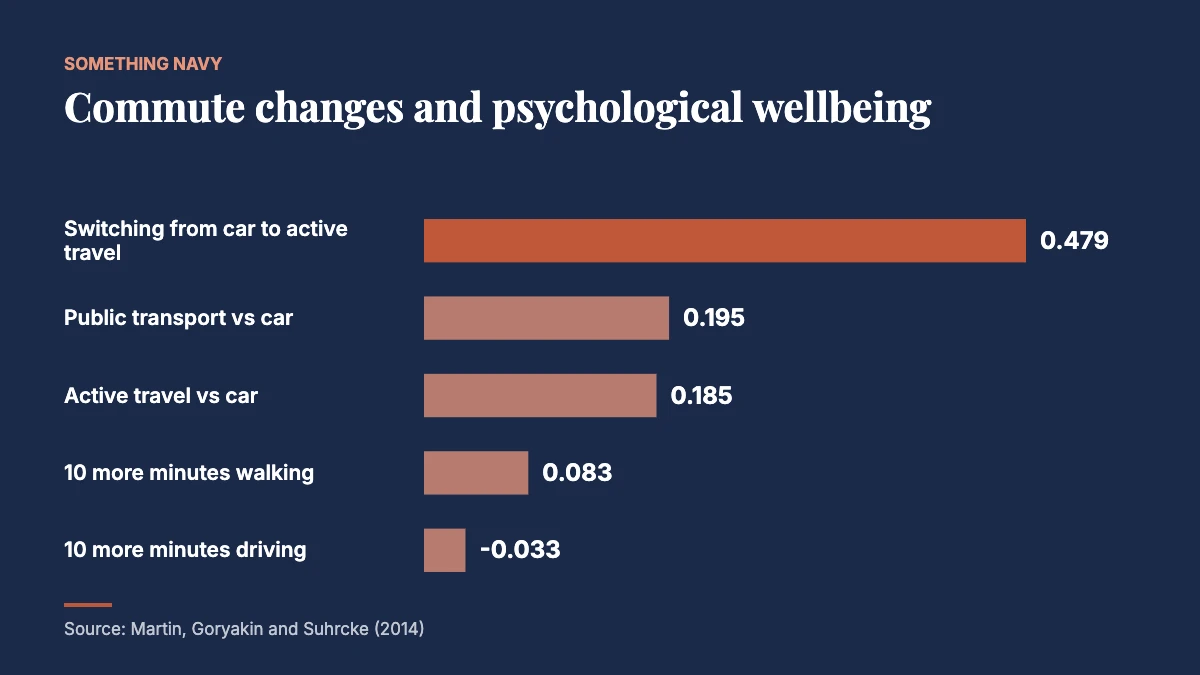
Switching from the car to walking or cycling was linked to the biggest gain. Each extra 10 minutes of walking was associated with slightly better wellbeing, while each extra 10 minutes of driving went the other way. In the UWE study, walkers and cyclists escaped the fall in leisure satisfaction other commuters felt, even on journeys just as long. That fits with the research on walking and creative thinking.
Now the asterisk. The ONS found that walking or cycling for 16 to 30 minutes each way was linked with some lower well-being scores than very short journeys. And the effects are small: 0.479 on a 36-point scale is modest. These are observational studies, so people who choose to cycle may differ in ways no regression captures.


Why we keep choosing long commutes anyway
Why accept the trade? Partly because the benefits are visible, a salary figure, a spare bedroom, while the costs are diffuse. You never see a payslip line reading “minus 40 minutes of evening”. It echoes the research on money and happiness: we weigh pounds far more readily than time.
The commute itself keeps shifting. Chatterjee’s 2017 release noted that average daily commuting time in England had risen from 48 to 60 minutes over the previous 20 years, with one in seven commuters spending at least two hours a day travelling. The Department for Transport’s National Travel Survey, published in August 2025, recorded 111 commuting trips per person in England in 2024, down 21% on 2019.
In the US, the Census Bureau puts the mean travel time to work at 26.4 minutes for 2020 to 2024. A March 2026 analysis by the Kem C. Gardner Policy Institute found that in Utah the share of workers working from home fell from 20.0% in 2021 to 15.7% in 2024, one local snapshot of the drift back to the daily journey.
That is why the debate over hybrid work and the four-day week trials is partly a debate about commuting. Removing one round trip a week hands back a slice of leisure time, exactly what commuting erodes most.
What this means for your next job offer
None of this says you should never take a long commute. When the journey buys something you value, overall life satisfaction can hold up. But the trade is usually less generous than it looks on paper, and its costs rarely make it into the spreadsheet.
So the next time you are doing sums on a crowded train, add one more column. Not the salary, not the rent, but the minutes. On the evidence, they are worth more than you have been charging for them.
Frequently asked questions
In the ONS 2014 analysis, one-way commutes of 61 to 90 minutes were linked with the lowest well-being across all four measures, compared with journeys of 15 minutes or less. The UWE study found every extra minute was associated with lower job and leisure satisfaction.
It comes from a peer-reviewed study of more than 26,000 workers in England. Ten extra minutes each way had the same link with job satisfaction as a 19% fall in income, but it is a correlation, and it applies to job satisfaction rather than overall life satisfaction.
On average they are more satisfied with their commute, and a British panel study found switching from car to active travel was linked to better psychological wellbeing. The effects were modest and the studies are observational.
Official links and research
- Chatterjee, K., Chng, S., Clark, B., Davis, A., De Vos, J., Ettema, D., Handy, S., Martin, A., & Reardon, L. (2020). Commuting and wellbeing: A critical overview of the literature with implications for policy and future research. Transport Reviews, 40(1), 5–34. DOI
- Clark, B., Chatterjee, K., Martin, A., & Davis, A. (2020). How commuting affects subjective wellbeing. Transportation, 47, 2777–2805. DOI
- Department for Transport. (2025). National Travel Survey 2024: Trips by purpose, age, mode and sex. https://www.gov.uk/government/statistics/national-travel-survey-2024/nts-2024-trips-by-purpose-age-mode-and-sex
- Kahneman, D., Krueger, A. B., Schkade, D. A., Schwarz, N., & Stone, A. A. (2004). A survey method for characterizing daily life experience: The day reconstruction method. Science, 306(5702), 1776–1780. DOI
- Martin, A., Goryakin, Y., & Suhrcke, M. (2014). Does active commuting improve psychological wellbeing? Longitudinal evidence from eighteen waves of the British Household Panel Survey. Preventive Medicine, 69, 296–303. DOI
- Office for National Statistics. (2014). Commuting and personal well-being, 2014. https://www.ons.gov.uk/peoplepopulationandcommunity/wellbeing/articles/commutingandpersonalwellbeing/2014-02-12
- Prior, H. (2026). Commuting in Utah: 2024 travel times. Kem C. Gardner Policy Institute. https://d36oiwf74r1rap.cloudfront.net/wp-content/uploads/2026/03/Commuting-Time-Mar2026.pdf
- Stutzer, A., & Frey, B. S. (2008). Stress that doesn’t pay: The commuting paradox. Scandinavian Journal of Economics, 110(2), 339–366. DOI
- U.S. Census Bureau. (n.d.). QuickFacts: United States, mean travel time to work (minutes), workers age 16 years+, 2020–2024. https://www.census.gov/quickfacts/fact/table/US/LFE305224
- University of the West of England. (2017, October 23). An additional 20 minutes commuting each day lowers job satisfaction equivalent to a 19 per cent pay cut [Press release, via Bristol Health Partners]. https://www.bristolhealthpartners.org.uk/news/an-additional-20-minutes-commuting-each-day-lowers-job-satisfaction-equivalent-to-a-19-per-cent-pay-cut/
Cover photo: Sergio Teixeira on Unsplash. Charts and graphics: Something Navy, with photography by Zoshua Colah on Unsplash.
How we reported this. Every figure was checked against the 10 sources above. Reviewed by Brooke Hilland, Senior Content Editor. Report an error · How we work