
Picture a Chicago commuter train on a weekday morning. Rows of people sit shoulder to shoulder, close enough to hear each other breathe, and almost nobody speaks. Earbuds are in, eyes are on phones or fixed on the window. Ask any of them why they are not chatting to the person beside them and the answers come quickly. It would be awkward. They would not want to be bothered. I would not know what to say.
A psychologist named Nicholas Epley found that silence puzzling. Humans are among the most social animals on the planet, and decades of research link social connection to happiness and health. So why do we treat the strangers we are pressed up against every day as if they were furniture? His answer, and the research it inspired, turns out to say less about strangers than about how badly we predict our own experiences.
An experiment on the morning train
Epley and his colleague Juliana Schroeder, then at the University of Chicago Booth School of Business, decided to test the assumption directly. In a series of experiments published in 2014 in the Journal of Experimental Psychology: General, they recruited people waiting for trains and buses and gave them one of three instructions. Some were asked to strike up a conversation with a stranger and try to get to know them. Some were told to keep to themselves and enjoy their solitude. The rest simply travelled as they normally would.
At the end of the journey, everyone filled in a short questionnaire about how pleasant the ride had been and how productive they had felt. A separate group of commuters was asked to imagine each of the three scenarios and predict how they would feel.
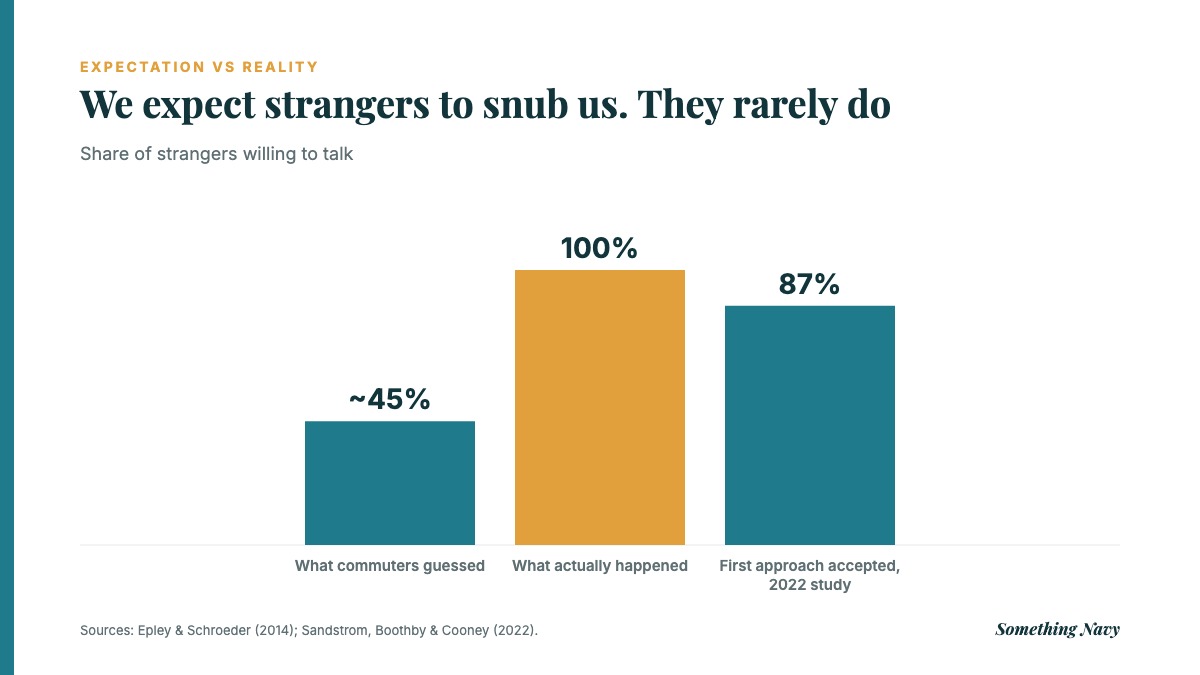
The predictions were gloomy. Most commuters expected that talking to a stranger would make their journey less pleasant, and they guessed that fewer than half of the people they approached would be willing to talk. The reality was the opposite on every count. Commuters who talked to someone reported the most pleasant journeys of all three groups, and they did not feel any less productive. Nobody who tried to start a conversation was rebuffed. And these were not polite ten-second exchanges: the conversations lasted, on average, more than 14 minutes on trains and almost 10 minutes on buses.
Not just a Chicago quirk
It would be easy to dismiss this as something peculiar to Chicago, a city with a reputation for being friendly. But the same pattern keeps turning up elsewhere. In 2019, Epley worked with the BBC to repeat the commuter experiment on trains in and around London, a city famous for its unwritten rule against talking on public transport. According to Chicago Booth, the London results matched the original findings, despite the different culture and longer journeys.
Other researchers had already been finding the same thing in different settings. Gillian Sandstrom, a psychologist who has spent much of her career studying what she calls our “weak ties”, the acquaintances and passers-by at the edges of our social lives, ran a simple experiment with Elizabeth Dunn at the University of British Columbia. They sent people into a busy coffee shop with one of two instructions: be as efficient as possible with the barista, or have a genuine, friendly interaction. The people who chatted left in a better mood and felt a stronger sense of belonging, according to their 2014 paper in Social Psychological and Personality Science.
In a separate set of studies published the same year in Personality and Social Psychology Bulletin, Sandstrom and Dunn tracked people’s everyday interactions. Students felt happier and more connected on days when they interacted with more classmates than usual, and interactions with weak ties, not just close friends, were linked to wellbeing. The people we barely know, it seems, matter more than we think.
The liking gap
If conversations with strangers go so well, why do we keep expecting them to go badly? Part of the answer comes from a striking finding that Erica Boothby, Gus Cooney, Gillian Sandstrom and Margaret Clark called “the liking gap”.
In a set of studies published in 2018 in Psychological Science, they paired strangers for conversations and then asked each person two questions: how much did you like your partner, and how much do you think your partner liked you? Again and again, people underestimated how much they had been liked. In the first study, participants rated their liking for their partner at 5.82 on a seven-point scale, but guessed their partner’s liking for them at only 5.17.
The gap showed up whether the conversations lasted a few minutes or most of an hour. It appeared among people attending workshops in the UK on how to talk to strangers. And it persisted among first-year university students sharing accommodation, lasting for months before finally disappearing towards the end of the academic year. Shyer people showed bigger gaps.
People are liked more than they know.
Boothby, Cooney, Sandstrom and Clark, Psychological Science, 2018
The researchers suggest that after a conversation we tend to replay our own awkward moments and missed opportunities, while our partner is busy doing the same thing about theirs. Each of us is too wrapped up in our own performance to notice that the other person is enjoying themselves.
Why the fears are so stubborn
In 2021, Sandstrom and Boothby pulled together seven of their studies, with more than 2,300 participants, in the journal Self and Identity. They wanted to know exactly what stops people from talking to strangers. The answers were familiar: people worried they would not enjoy the conversation, that the other person would not like them, and that they did not have the skills to start and end a conversation smoothly.
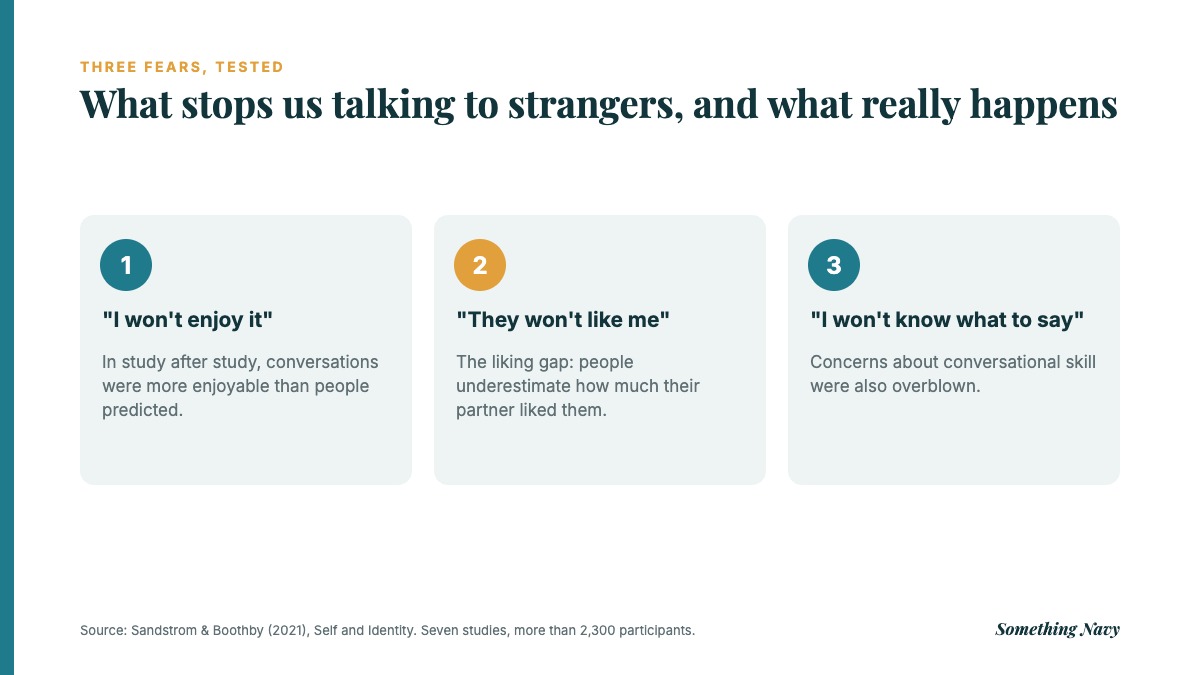
All three fears, they concluded, were overblown. Conversations went better than people expected, on every measure. The trouble is that because we rarely test our fears, we rarely find out they are wrong. Every conversation we avoid leaves the belief intact for next time.
This is closely related to something psychologists call the spotlight effect, the tendency to overestimate how much other people notice our mistakes and appearance. Combine the spotlight effect with the liking gap and it is no wonder that starting a conversation can feel like stepping on to a stage.


Small talk is fine. Deep talk is better
A common worry is not knowing what to talk about. Many of us default to safe topics, the weather, the delay, the traffic, because we assume anything more personal would be unwelcome from a stranger.
Michael Kardas, Amit Kumar and Nicholas Epley tested that assumption in a dozen experiments with more than 1,800 participants, published in 2022 in the Journal of Personality and Social Psychology. They paired strangers and asked them to discuss either shallow questions or much deeper ones, such as describing a time they had cried in front of another person.
People expected the deep conversations to be awkward. They were not. Both kinds of conversation went better than predicted, but the gap was biggest for the deep ones. Participants consistently underestimated how interested their partner would be in their thoughts and feelings, and many who had expected to prefer small talk ended up preferring the deeper exchange once they had tried both.
Strangers know things you do not
There is another benefit that is easy to overlook. In a 2022 study in PNAS, Stav Atir and colleagues, including Nicholas Epley, randomly paired strangers for ten-minute conversations and measured what they learned. People came away knowing more than they had expected to, picking up information, perspectives and ideas they would not have encountered otherwise. A stranger is, in a sense, a window into a life you have not lived.
It gets easier with practice
The most encouraging study in this field asks whether the fear can be unlearned. Sandstrom, Boothby and Gus Cooney designed a week-long programme, published in 2022 in the Journal of Experimental Social Psychology, in which participants were set small missions to talk to strangers and report back on each conversation.
Across 1,336 conversations, the first person approached agreed to talk 87% of the time. About 40% of conversations ended with the two people swapping contact details. Over the week, participants became less worried about rejection and more confident in their own ability, and those changes were still there a week after the programme ended. The first conversation was the hardest. After that, the fear began to shrink.
Why a two-minute chat matters more than it seems
It is tempting to treat all this as a curiosity: a pleasant commute here, a nicer coffee there. But the research on weak ties suggests these moments add up. Most of us have only a handful of close friends, and even the closest relationships cannot be the only source of connection in a day. The acquaintances we nod to, the neighbour we chat with at the bins, the regular at the gym, all contribute to a feeling that we belong somewhere.
That feeling is not trivial. In Sandstrom and Dunn’s coffee-shop study, the sense of belonging was the main reason the friendly customers left happier. The interaction itself lasted seconds. What it gave people was a small signal that they were part of a community rather than moving through it unseen.
There is also a practical point about how relationships begin. Every close friend you have was once a stranger. Somebody had to say the first word, ask the first question or suggest the first coffee. A habit of avoiding conversations with people you do not know is also, quietly, a habit of closing doors before you find out what is behind them.
None of this is an argument for forcing interactions on people who do not want them. It is an argument for noticing how often the thing stopping us is not the other person’s wishes, but our own predictions, and how often those predictions turn out to be wrong.
What if you are shy?
If you are naturally shy or introverted, all of this may sound like advice written for someone else. It is worth knowing that the research suggests shy people may have the most to gain. In the liking gap studies, shyer participants showed bigger gaps: they were especially likely to underestimate how much their conversation partner had enjoyed talking to them.
In other words, the people most anxious about these conversations are often the ones whose fears are most out of step with reality. That does not make the first step any easier, but it does mean the evidence is on your side. Introversion is also not the same as disliking people. Many introverts enjoy one-to-one conversation and simply prefer it in smaller doses, which is exactly what a short chat with a stranger offers.
A useful approach is to set a low bar. Rather than aiming for a long, meaningful exchange, aim for one friendly sentence and a genuine question. If the conversation takes off, wonderful. If it does not, you have still practised, and the week-long study suggests practice is what makes the fear shrink.
How to start your own
None of this means you must talk to everyone, everywhere. Some people genuinely want to be left alone, and there will be days when you do too. But if worry is what has been holding you back, the research points to a few gentle ways in.
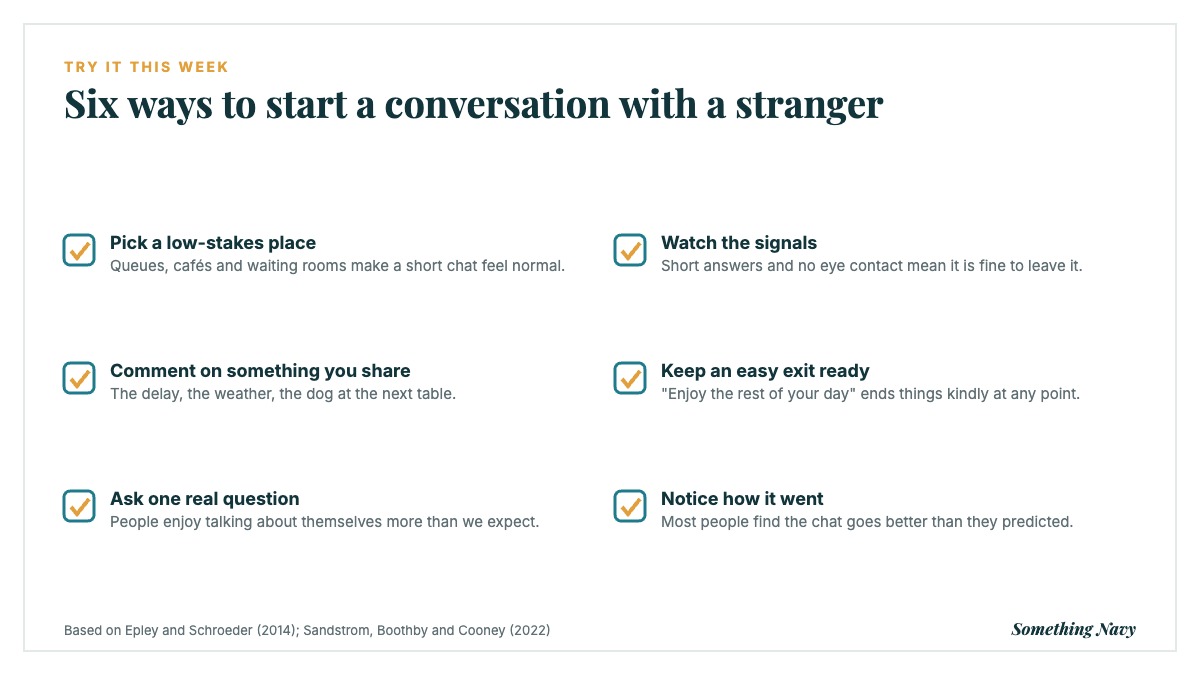
- Begin somewhere easy. A barista, a shop assistant or the person in the same queue gives you a natural reason to speak.
- Use what you share. The delay, the view, the dog at the next table. Shared context makes the opening feel ordinary.
- Ask a real question, then listen. People enjoy talking about themselves, and interest is the quickest way to show warmth.
- Remember the liking gap. When you walk away thinking it went badly, the other person probably enjoyed it more than you think.
- Read the signals. Short answers and no eye contact usually mean someone would rather not chat. That is fine, and it is far less common than you expect.
There is something quietly radical about all this. We spend a great deal of energy protecting ourselves from interactions that, the evidence says, would probably have made our day better. The stranger on the train is not an obstacle to a pleasant journey. More often than not, they are the pleasant part.
If a conversation with a stranger turns into something more, our piece on how many hours it takes to make a friend explains what happens next.
Sources
- Epley, N., & Schroeder, J. (2014). Mistakenly seeking solitude. Journal of Experimental Psychology: General, 143(5), 1980–1999. DOI
- Sandstrom, G. M., & Dunn, E. W. (2014). Is efficiency overrated? Minimal social interactions lead to belonging and positive affect. Social Psychological and Personality Science, 5(4), 437–442. DOI
- Sandstrom, G. M., & Dunn, E. W. (2014). Social interactions and well-being: The surprising power of weak ties. Personality and Social Psychology Bulletin, 40(7), 910–922. DOI
- Boothby, E. J., Cooney, G., Sandstrom, G. M., & Clark, M. S. (2018). The liking gap in conversations. Psychological Science. DOI
- Sandstrom, G. M., & Boothby, E. J. (2021). Why do people avoid talking to strangers? Self and Identity, 20(1), 47–71. DOI
- Kardas, M., Kumar, A., & Epley, N. (2022). Overly shallow?: Miscalibrated expectations create a barrier to deeper conversation. Journal of Personality and Social Psychology, 122(3), 367–398. DOI
- Atir, S., Wald, K. A., & Epley, N. (2022). Talking with strangers is surprisingly informative. PNAS. DOI
- Sandstrom, G. M., Boothby, E. J., & Cooney, G. (2022). Talking to strangers: A week-long intervention reduces psychological barriers to social connection. Journal of Experimental Social Psychology, 102, 104356. DOI
- Chicago Booth Review (2019). Nicholas Epley partners with BBC to replicate groundbreaking study. Chicago Booth
Cover photo: Nate Sagrada on Unsplash. Charts and graphics: Something Navy.