It usually happens in late November. Someone at work mentions Christmas, and a colleague groans that it cannot possibly be December again, because surely last Christmas was about six weeks ago. Everyone nods. Nobody in the room is under 30.
Compare that with being eight years old, when the stretch between one birthday and the next seemed to contain several geological ages. The summer holidays were a whole lifetime. A wet Sunday afternoon could last a week.
The feeling that time accelerates with age is one of the most widely shared complaints in human life. It turns up in pub conversations, in poetry and in surveys. It also turns out to be more slippery than it sounds. Psychologists have offered at least five explanations, and when you look at the evidence behind each one, they do not stand on equal footing. One of the best studies on the subject even suggests the effect is smaller than almost everyone believes.
Here are the five main contenders, judged on what the research can actually support.
First, is the speed-up even real?
Before weighing explanations, it is worth checking the thing being explained. If you ask people of different ages how fast time is passing, do the older ones really say “faster”?
In 2005, the psychologists Wittmann and Lehnhoff put that question to 499 people aged 14 to 94, from Germany and Austria. Participants rated how quickly time usually passes for them, and how fast the last week, month, year and decade had gone. They also rated metaphors and statements about time. The results, published in Psychological Reports, were muted. Age did predict how fast time seemed to fly, but the effects were small to moderate, accounting for at most 10% of the variance.
The clearest pattern concerned the past ten years. The sense that the last decade had raced by grew with age up to about 50, then levelled off and stayed roughly flat into the mid-90s. For shorter spans, such as an hour, a week or a month, there was little change with age. People of every age felt that time was going quickly.
That is the first clue worth holding on to. Whatever is going on, it seems to show up mainly when people look back across years, not when they live through a single afternoon.
Explanation one: each year is a smaller slice of your life
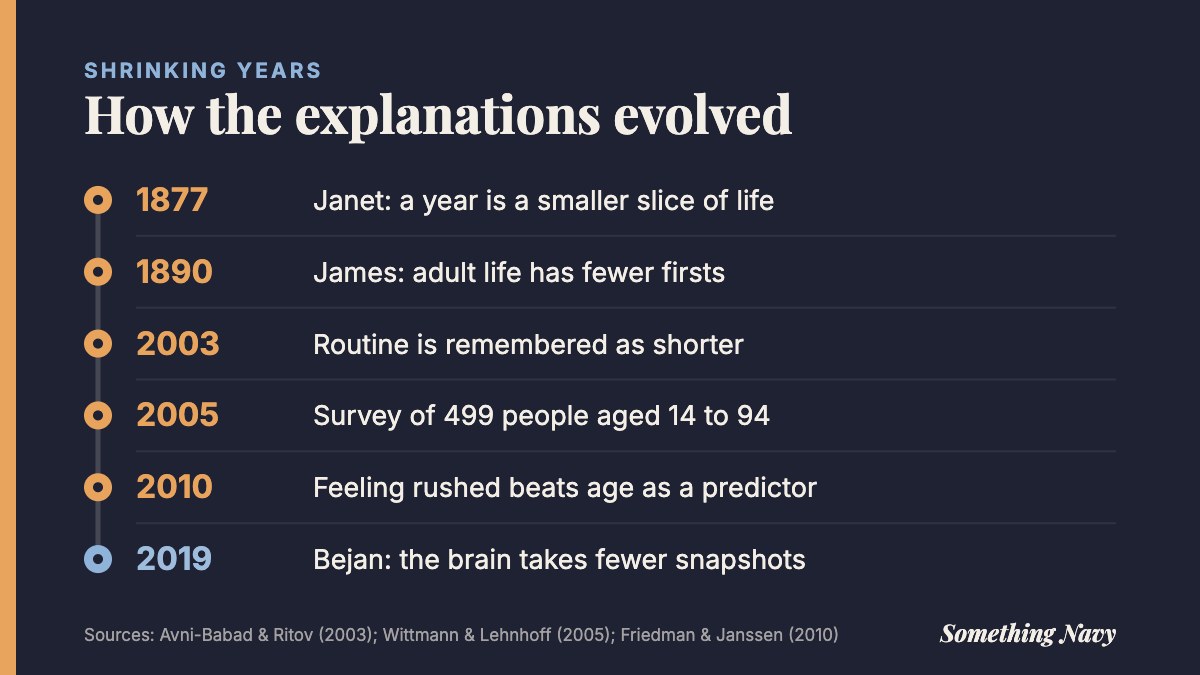
The oldest and most quoted explanation comes from the French philosopher Paul Janet, writing in 1877. His idea, often called the proportional or ratio theory, is simple arithmetic. To a five-year-old, one year is 20% of everything they have lived. To a 50-year-old, it is 2%. If we judge the length of a period against the total length of our lives, each year should feel shorter than the one before.
It is an elegant idea, and it matches the feeling of shrinking years beautifully. The trouble is that it is closer to a metaphor than a mechanism. Nobody has shown how, or why, the brain would divide the past twelve months by your age before deciding how long they felt.
It also makes a prediction the data do not support. If proportion were the driver, an hour or a week should shrink with age just as a year does, since each is also a smaller fraction of a longer life. Yet Wittmann and Lehnhoff found that ratings for short spans barely shifted across age groups. The BBC broadcaster and psychology writer Claudia Hammond, in her book Time Warped (Canongate, 2012), rejects the theory partly for this reason: it says nothing about attention or emotion, which we know shape how time feels.
Explanation two: routine leaves fewer marks in memory
The second explanation goes back to the American psychologist William James, who argued in 1890 that adult life simply has fewer memorable firsts. Childhood is packed with novelty: first day at school, first swim, first friend who moves away. Adult weeks blur together. When we look back, a stretch with few distinctive memories feels as if it must have been short.
This one has proper experimental support. In 2003, the psychologists Avni-Babad and Ritov of the Hebrew University of Jerusalem published six studies in the Journal of Experimental Psychology: General. Four were in the lab. In one, students did either a repetitive counting task or a varied one, then estimated how long it had lasted. The routine version was remembered as shorter, even when the number of segments was held constant.
The other two were field studies. The researchers asked 41 guests at a Club Med holiday village, on stays of three or four days, which part of their trip had felt longest; most picked the first part and judged the last part shortest. They also surveyed 44 kibbutz members and found that time spent on routine jobs was remembered as shorter than time on varied ones, even though both kinds of job were rated as equally interesting.
The authors’ explanation is that routine gives memory fewer changes in context to latch on to, so there are fewer anchors from which to reconstruct how much time has passed. It is a cousin of the effect behind forgetting why you walked into a room: the brain carves experience into episodes at boundaries, and boundaries are what we later count.


The holiday paradox
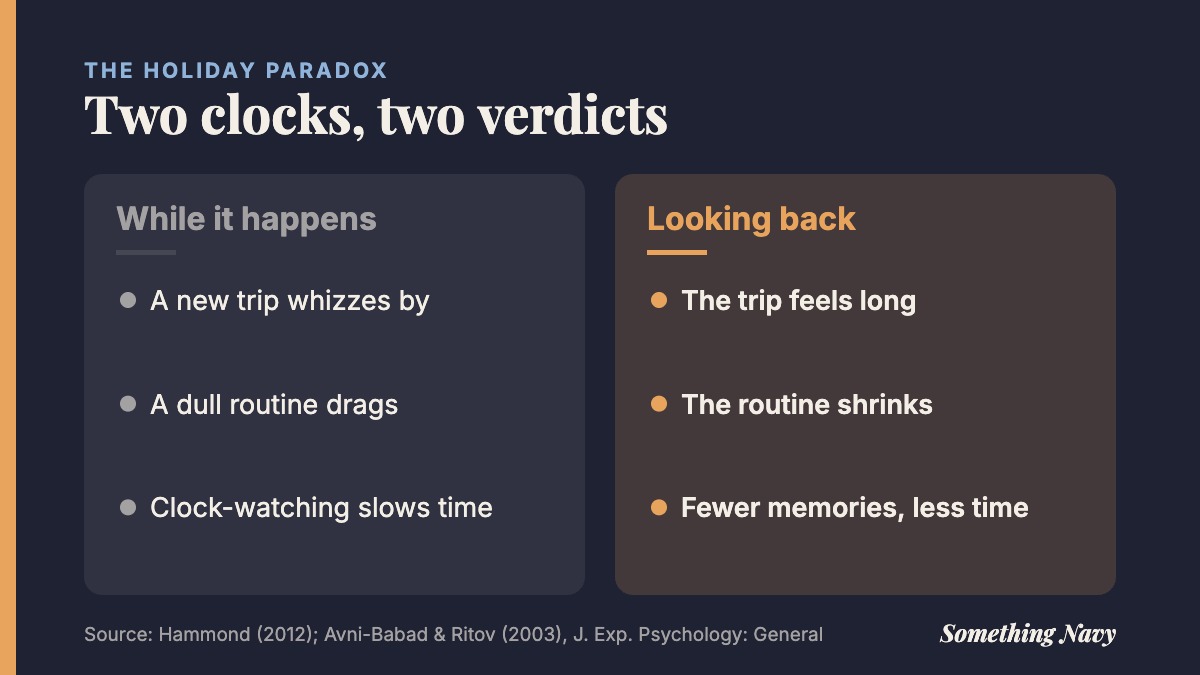
Avni-Babad and Ritov found a twist that matters here. When people knew in advance they would be asked to judge time, the pattern reversed: routine felt longer while it was happening. Time drags when you are bored and watching the clock, yet the same dull hour shrinks to almost nothing in memory.
Hammond calls the mirror image of this the holiday paradox: the contradictory feeling that a good holiday whizzes by while you are on it, yet seems long when you look back. A week abroad, full of new streets, food and faces, flies past in the moment. Afterwards it seems to have lasted far longer than a week at your desk. We judge time in two ways, as it passes and in retrospect, and novelty pushes those two judgements apart.
Seen this way, the speed-up with age is largely a retrospective illusion. A year of commutes, meetings and familiar dinners leaves a thin trail of memories, so when you look back from December it seems to have contained hardly anything.
The limitation is that most of this evidence concerns minutes, days and holidays, not decades. Nobody has followed people for 30 years, counting their novel experiences and tracking how fast each year felt. The step from “routine shortens remembered time” to “routine explains why ageing speeds up time” is reasonable, but it is an inference rather than a finding.
Explanation three: memory piles up in early adulthood
A related idea draws on one of the most robust findings in memory research, the reminiscence bump. Ask older adults to recall events from their lives and the memories are not spread evenly. A disproportionate number come from adolescence and early adulthood.
The pattern is well documented. In 2005, Steve Janssen and his colleagues Chessa and Murre ran an online study with almost 2,000 people aged 11 to 70. Each participant was given ten cue words and asked to recall and date a personal memory for each. After the researchers statistically separated out the effect of forgetting, a bump appeared in every group, peaking at ages 15 to 18 for men and 13 to 14 for women. The study appeared in Memory.
Hammond argues that the bump may be the real key to the speed-up. Those years are crowded with firsts: first job, first time living away from home, first real decisions about how to spend your days. Because they are so densely remembered, later decades feel thin by comparison.
The bump itself is about as solid as memory science gets. Its link to the sense of time speeding up is more speculative. It explains why the teenage years loom so large, but it does not directly show that people judge a recent year by comparing it with the memory density of their youth. That connection has been proposed far more often than it has been tested.
Explanation four: you are simply busier
The fourth explanation is the least romantic and, on current evidence, the best supported. It says the years fly because adults are busy, and busy people feel short of time.
The strongest test so far came from William Friedman of Oberlin College in Ohio and Steve Janssen, the same memory researcher behind the reminiscence-bump study. Their 2010 paper in Acta Psychologica set out to compare several theories head to head, with 1,865 adults aged 16 to 80 across two countries.
In the first study, 49 New Zealand undergraduates with an average age of 21 and 50 older adults with an average age of 68 rated how fast the last week, month, year and decade had gone. There were few differences. Only for the past ten years did older people report a faster pace, and that effect was small.
The researchers also tested whether people’s sense of speed came from misjudging when public events had happened, using twelve newsworthy events such as the capture of Saddam Hussein. They nudged participants’ dating errors up or down with false feedback. It made no difference to how fast time seemed to pass.
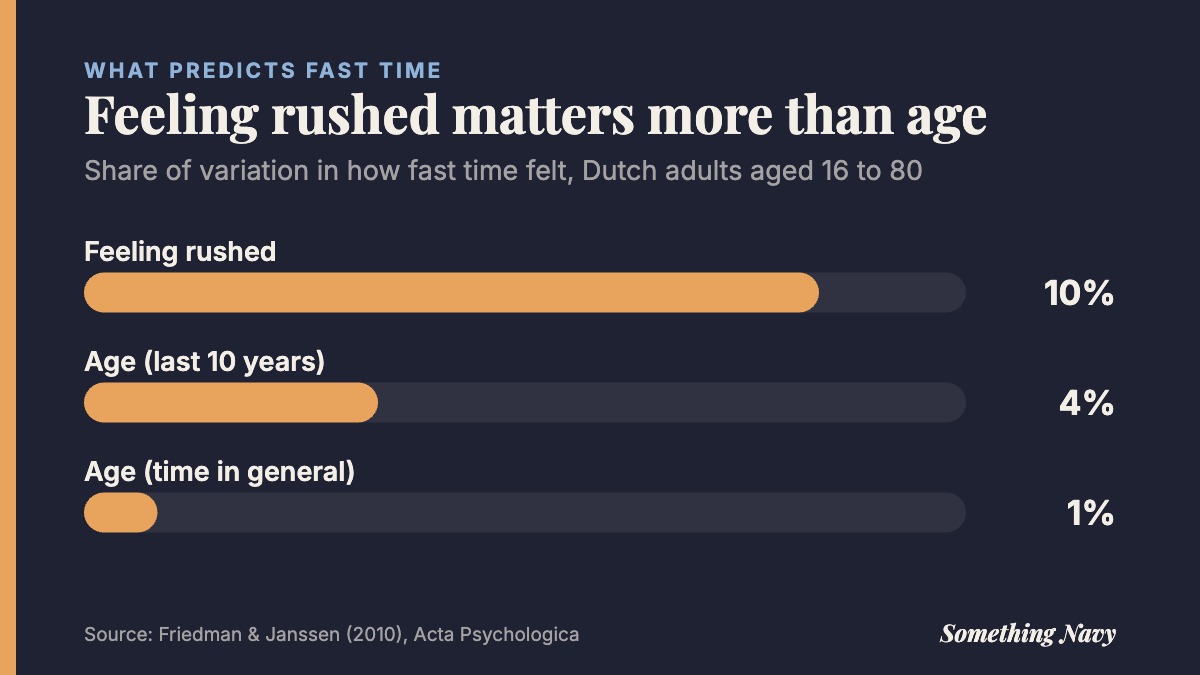
The second study surveyed a large sample of Dutch adults online. Again, age barely mattered. It explained only 4% of the variation in how fast the past decade seemed to have gone, and 1% of how fast time seemed to pass in general. How busy and rushed people felt explained 10%. Women reported feeling more rushed than men, and also felt time was passing more quickly.
Wittmann and Lehnhoff saw a hint of the same thing. People aged 20 to 59 were especially likely to choose time-pressure metaphors, which the authors linked to the demands of work and family. That fits neatly with the peak they found around 50, the age when careers, children and ageing parents often collide.
Friedman and Janssen raised one more possibility. The small effect for the last decade might partly reflect the cultural belief itself. If everyone tells you the years speed up after 40, you may come to report exactly that.
This is the most directly tested explanation, but it is correlational. Feeling rushed and feeling that time flies may both stem from something else, such as a crowded diary or poor sleep, and surveys of this kind cannot prove which way the arrow points. Busy people may also notice the passage of time more because of unfinished tasks nagging at them.
Explanation five: your brain takes fewer snapshots
The newest and boldest proposal comes not from a psychologist but from an engineer. In 2019, Adrian Bejan, the J.A. Jones Professor of Mechanical Engineering at Duke University, published an essay in European Review arguing that the effect is rooted in physics.
Bejan distinguishes clock time from “mind time”, which he describes as a sequence of mental images built from sensory input. As we age, he argues, the rate at which we take in and process new images slows down. Nerve networks grow larger and more complex, so signals travel further. Ageing pathways degrade and resist the flow of signals. He also points to saccades, the rapid eye movements we make several times a second, noting that infants make them more often than adults.
The human mind senses time changing when the perceived images change.
Adrian Bejan, Duke University (2019)
Fewer images per hour, the argument runs, means the same clock hour contains less mind time, so it feels as if it went by faster.
It is a striking idea, and it received wide press coverage. But it is a theoretical essay, not an experiment. Bejan drew on existing observations rather than new data, and nobody has yet measured whether an individual’s saccade rate or neural processing speed predicts how fast their years seem to pass. It also sits awkwardly with the survey findings. If slower image processing were the cause, the speed-up should show up across every timescale, including hours and weeks. The surveys suggest it mostly does not.
How the five stack up
How strong is the evidence?
- Proportional theory (Janet, 1877): weak. Intuitive arithmetic with no mechanism, and short timespans do not shrink with age as it predicts.
- Routine and novelty: moderate. Good lab and field evidence that routine shortens remembered time; the link to ageing is inferred, not measured.
- Reminiscence bump: strong for memory, indirect for time. The bump is well replicated, but its role in the speed-up is mostly untested.
- Time pressure: the best direct support. In large surveys, feeling rushed predicts fast time better than age does, though the data are correlational.
- Neural images (Bejan, 2019): speculative. A theoretical essay with no direct test linking eye movements or nerve signals to felt time.
Put together, the picture is less mysterious and more useful than the folklore. The speed-up is real but modest, and it lives mostly in our memories of long periods. Two of the explanations, routine and busyness, are closely connected: a crowded, repetitive life leaves both a sense of constant hurry and a thin record of distinct moments.
Slowing the years down
If that is right, there is some good news. Neither proportion nor neural wiring is easy to change, but routine and time pressure are, at least at the margins.
The holiday paradox points to one lever: novelty gives memory more to hold on to. That need not mean expensive travel. A new route to work, a class in something you are bad at, a weekend in a town you have never visited, or a friendship that takes you somewhere unfamiliar all add boundaries to the year. So do deliberate markers, the kind of fresh starts people attach to birthdays and new months.
The time-pressure finding points to the other lever. Feeling perpetually rushed seems to make time feel faster, whatever your age. Protecting some unhurried hours may matter as much as filling the calendar with adventures.
None of this will make a year feel as long as it did when you were eight. But the research suggests that the years do not shrink on their own. What shrinks is the number of moments we bother to notice, and that, unlike our age, is partly up to us.
Sources
- Avni-Babad, D., & Ritov, I. (2003). Routine and the perception of time. Journal of Experimental Psychology: General, 132(4), 543–550. DOI
- Bejan, A. (2019). Why the days seem shorter as we get older. European Review, 27(2), 187–194. DOI
- Friedman, W. J., & Janssen, S. M. J. (2010). Aging and the speed of time. Acta Psychologica, 134(2), 130–141. DOI
- Hammond, C. (2012). Time warped: Unlocking the mysteries of time perception. Canongate. Link
- Janssen, S. M. J., Chessa, A. G., & Murre, J. M. J. (2005). The reminiscence bump in autobiographical memory: Effects of age, gender, education, and culture. Memory, 13(6), 658–668. DOI
- Wittmann, M., & Lehnhoff, S. (2005). Age effects in perception of time. Psychological Reports, 97(3), 921–935. DOI
How we reported this. We went back to the original research for this story, 6 sources in all, listed above, and checked every figure against them. If you think we have got something wrong, tell us and we will look at it. Read more about how we work.
Cover photo: Immo Wegmann on Unsplash. Charts and graphics: Something Navy.