
Walk into any university lecture theatre and you can read the room by its sounds. A soft drizzle of keys from the back rows. The scratch of biros near the front. Somewhere, a lid snaps shut as a lecturer announces that laptops are no longer welcome.
That lecturer is probably thinking of a single paper. In 2014, two psychologists published a study with a title that read like a verdict: “The Pen Is Mightier Than the Keyboard”. It travelled around the world, was cited in classroom policies and became one of those findings everybody seems to know.
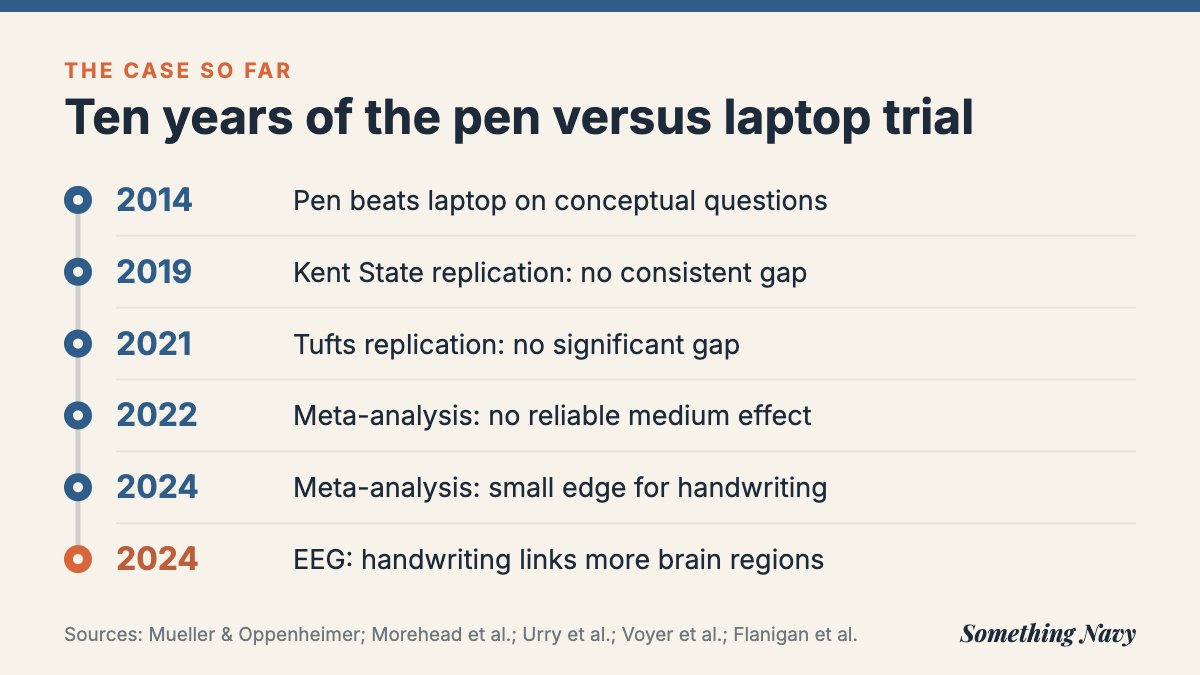
But science is not a single hearing. Over the decade since, the claim has been retested, pooled, challenged and, most recently, wired up to an EEG cap. So let us treat it as a case. Here are the witnesses, the evidence and the cross-examination, in the order they took the stand.
The charge: typing turns students into transcribers
The prosecution’s case begins at Princeton. Pam Mueller, then a graduate student there, and Daniel Oppenheimer of the University of California, Los Angeles, asked a simple question. If a laptop is used only for taking notes, with no email and no browsing, does it still change how much students learn?
In their first experiment, published in Psychological Science in 2014, 67 students watched 15-minute TED talks and took notes either by hand or on a laptop disconnected from the internet. After a 30-minute distraction task, they answered two kinds of question: factual ones (what was said) and conceptual ones (what it meant, and how ideas related).
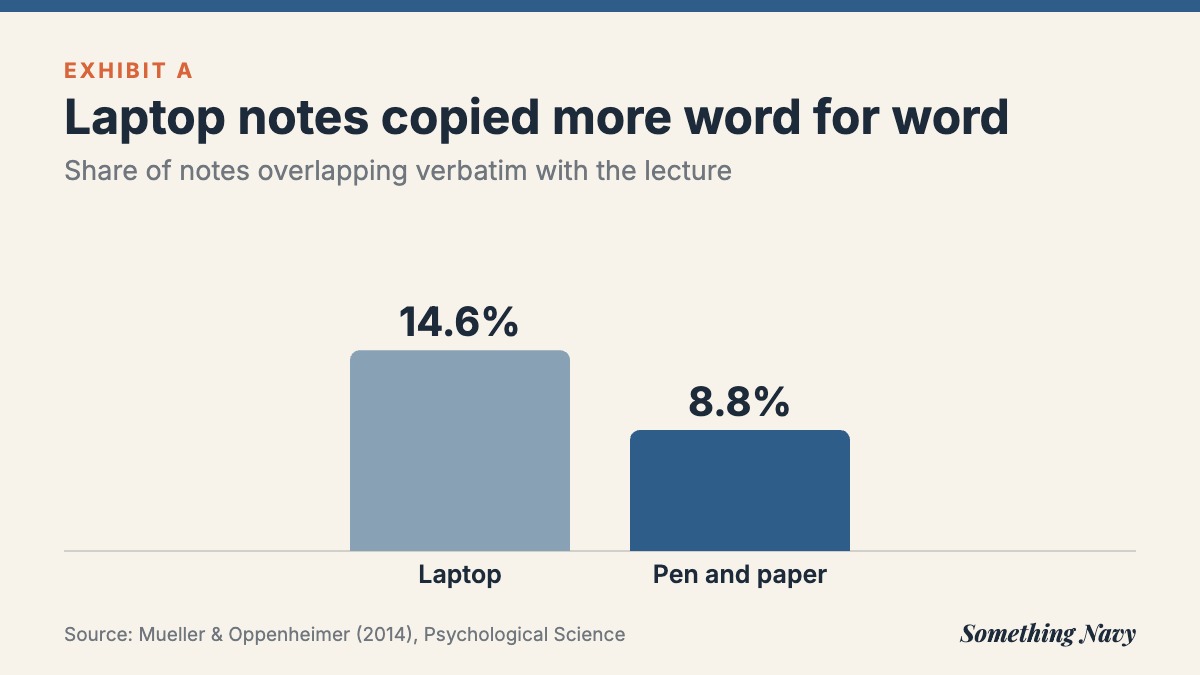
On facts, the two groups did about equally well. On conceptual questions, the longhand group did better. And the notes themselves told a story. Laptop users wrote more words, and far more of those words were lifted straight from the talk: 14.6% of their notes overlapped verbatim with the lecture, compared with 8.8% for handwritten notes.
The authors’ explanation was elegant. Handwriting is slow, so you cannot keep up with a speaker. You are forced to choose, compress and paraphrase, and that mental work is where learning happens. Typing is fast enough to let you act as a stenographer, recording sound without processing meaning.
Exhibit B: the warning that did not work
A good prosecutor anticipates the defence. Couldn’t laptop users simply be told to stop transcribing? Mueller and Oppenheimer tested exactly that. In a second study with 151 students, one group of typists was explicitly warned against verbatim note-taking and asked to put things in their own words.
It made no meaningful difference. The warned typists copied about as much word for word as those who had received no warning at all. Fast fingers, it seemed, were hard to slow down by instruction alone.
A third study, with 109 students, added the most realistic twist. Participants came back a week later, and some were given 10 minutes to review their notes before a test. Even with the chance to study, longhand note-takers came out ahead. You might expect more notes to mean more to revise. Instead, the shorter, digested handwritten notes appeared to be the better study material.
The case looked strong. Laptop bans followed. Then the defence stood up.
The defence calls the laptop
The defence does not need to prove the laptop is better. It only needs to raise reasonable doubt, and it has some genuine arguments.
The first is volume. Typists capture more of a lecture, and in many studies the sheer number of ideas recorded predicts later performance. If you missed a key point because your hand could not keep up, no amount of deep processing will bring it back.
The second is practicality. Typed notes can be searched, reorganised, backed up and shared. For students with dyspraxia, dyslexia or a hand injury, a keyboard can be the difference between taking notes and not taking them at all.
The third argument is more of a confession. Many of the harms blamed on laptops are not about typing. They are about everything else a laptop invites. In a 2013 study in Computers & Education, Faria Sana, then at McMaster University, and her colleagues found that students who multitasked on laptops during a lecture scored about 11% lower on a comprehension quiz. Students who simply sat where they could see a multitasking peer’s screen scored about 17% lower, and did not realise they had been distracted.
That is a real cost, but it is a charge against distraction, not against keyboards. It belongs in the same file as research on how a phone nearby can sap your attention even when you are not using it. Mueller and Oppenheimer deliberately removed the internet from their laptops, so their finding was meant to be about the act of typing itself.
What the original study did
- Who: 67 students in study one, 151 in study two and 109 in study three.
- What: watched short recorded lectures, taking notes by hand or on an offline laptop.
- Tested: factual recall and conceptual understanding, either 30 minutes later or a week later.
- Found: typists wrote more and copied more verbatim; handwriters did better on conceptual questions.
Cross-examination: the replications
The strongest test of any finding is to run it again, carefully, with new people. Two teams did exactly that.
In 2019, Kayla Morehead, John Dunlosky and Katherine Rawson of Kent State University published a replication and extension in Educational Psychology Review. They used the original TED talks and materials and added extra groups, including students who took notes on an eWriter tablet and students who took no notes at all.
The results were messy. Some trends leaned towards longhand, but differences between groups were not consistent across their experiments. In one experiment, even the group that took no notes did not reliably differ from the note-takers on the immediate test. When students were allowed to study their notes, the gaps shrank further. Pooling the direct replications produced small, statistically nonsignificant effects in favour of the pen. The authors concluded it was premature to declare either method superior.
Then, in 2021, came the replication with the most pointed title. Heather Urry of Tufts University and a large team of colleagues published “Don’t Ditch the Laptop Just Yet” in the same journal that had carried the original, Psychological Science. It was a direct replication of Mueller and Oppenheimer’s first study, with 142 participants in the final analysis.
Several things replicated neatly. Laptop users again wrote more words and again copied more of the lecture verbatim. More words went with better scores, while more verbatim overlap went with worse ones.
We found only small, statistically nonsignificant differences in quiz performance as a function of note-taking medium.
Urry et al. (2021), Psychological Science
The crucial result did not replicate: handwriters were not reliably better on conceptual questions. A mini meta-analysis across eight similar studies also found no significant overall effect of typing versus handwriting. The mechanism looked real. The headline effect looked much smaller than first claimed.


Expert witnesses: what the pooled evidence says
When individual studies disagree, judges of evidence turn to meta-analysis, which combines many studies to estimate an overall effect. Here, unhelpfully for anyone wanting a tidy ending, two expert witnesses gave somewhat different testimony.
The first was a 2022 systematic review in Contemporary Educational Psychology by Daniel Voyer, Scott Ronis and Narissa Byers of the University of New Brunswick. It drew on 77 effect sizes from 39 samples across 36 articles, and on the question of the medium, it did not find a reliable advantage for either pen or keyboard.
The second, published in 2024 in Educational Psychology Review, was led by Abraham Flanigan of Georgia Southern University with Kenneth Kiewra of the University of Nebraska–Lincoln and colleagues. It was narrower by design, including 24 studies of college students learning from lectures, and it reached a firmer conclusion.
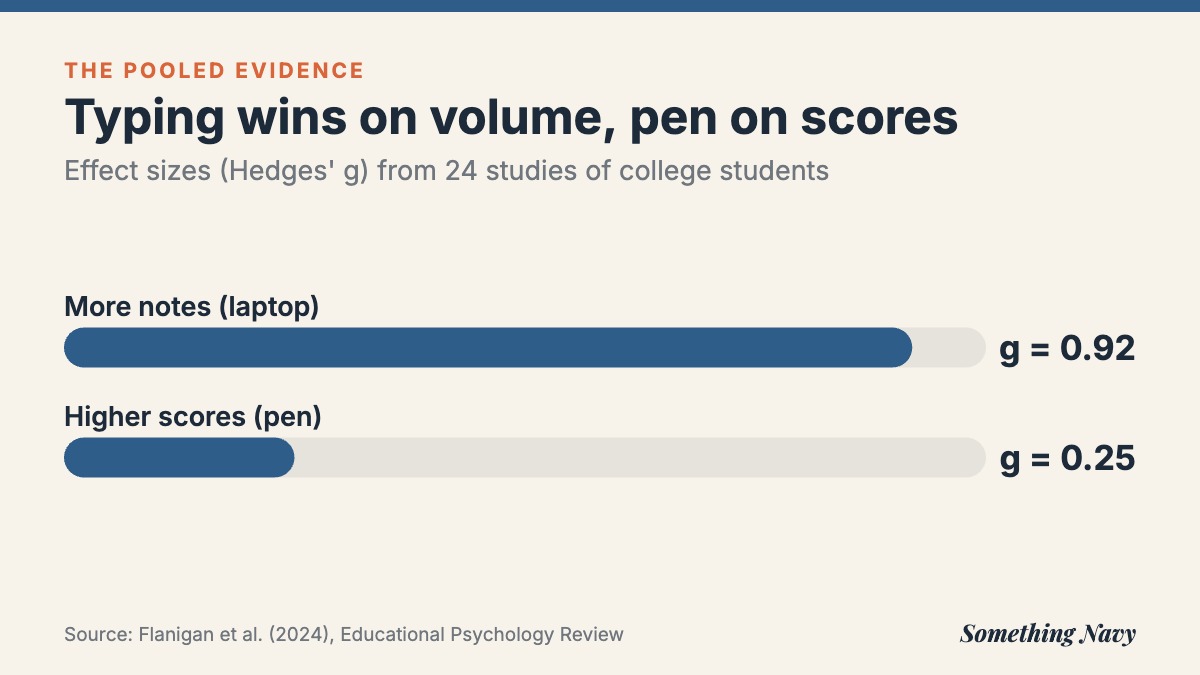
Typing produced a large increase in the volume of notes, with an effect size (Hedges’ g) of 0.92. Yet taking and reviewing handwritten notes was linked to higher achievement, with an effect size of 0.25. In plain English: the laptop wins on quantity by a wide margin, while the pen wins on results by a small but meaningful one.
Why the difference between the two expert witnesses? Partly it is what they let into the courtroom. Different inclusion rules, different outcome measures and different study populations lead to different pooled answers. An effect size of 0.25 is also the sort that can disappear in any single small study and only show itself when many are combined, which may be why individual replications kept coming back inconclusive.
The neuroscientist takes the stand
In January 2024 a new kind of witness arrived, and the headlines were dramatic. Audrey van der Meer and Ruud van der Weel of the Norwegian University of Science and Technology (NTNU) in Trondheim published an EEG study in Frontiers in Psychology with the title “Handwriting but not typewriting leads to widespread brain connectivity”.
They recruited 40 university students and analysed the data of 36, recording their brain activity with a dense net of 256 electrodes. Participants saw words from the game Pictionary on a screen. Sometimes they wrote each word in cursive with a digital pen on a touchscreen. Sometimes they typed it with their right index finger on a keyboard.
When participants wrote by hand, the researchers saw far more extensive connectivity between parietal and central brain regions, in slow theta and alpha frequency bands that have been linked to memory and to encoding new information. Typing produced much less of this coordinated activity. The authors wrote that patterns during handwriting were “far more elaborate” than during typing, and they urged that children be exposed to handwriting from an early age.
Objection: what the brain scan cannot prove
The EEG findings are interesting. They are also easy to oversell, and a fair trial should say why.
First, nobody in the study learned anything that was then tested. There was no lecture, no quiz and no measure of memory. The study shows that handwriting and typing engage the brain differently, not that one produces better learning. The link to memory comes from earlier research, not from this experiment.
Second, the typing condition was unusual. Typing a single word with one index finger, with the letters hidden from view, is not how a student types lecture notes. Writing in cursive with a stylus is closer to normal handwriting than one-finger typing is to normal typing.
Third, “more brain activity” is not automatically “better”. A harder, slower motor task may simply demand more coordination. Richer connectivity is consistent with deeper encoding, but it is consistent with other explanations too. The sample of 36 right-handed students in their early twenties is also small and narrow.
None of this makes the study worthless. It adds a plausible piece to the picture: the hand and eye working together may give the brain more hooks to hang information on. But it is supporting evidence, not a confession.
The evidence, side by side
Strip away the headlines and the two tools have a fairly clear profile.
| Question | Pen and paper | Laptop |
|---|---|---|
| How much gets recorded? | Less; you must select | Much more (g = 0.92 in Flanigan et al.) |
| How much is copied verbatim? | Less (8.8% in the 2014 study) | More (14.6% in the 2014 study) |
| Conceptual understanding | Advantage in 2014; not replicated by Urry et al. | Not reliably worse in later replications |
| Overall achievement | Small edge (g = 0.25) in the 2024 meta-analysis | No reliable gap in the 2022 meta-analysis |
| Distraction risk | Low | High if online; affects neighbours too |
| Searching, editing, access needs | Limited | Strong |
What stands out is how consistent the mechanism is, even when the headline result wobbles. Across studies, typing means more words and more verbatim copying. Verbatim copying tends to go with poorer performance. The open question has always been whether those facts add up to a reliable gap in learning, and the honest answer is: a small one, sometimes.
Reasonable doubt, and what really matters
If you take one thing from the trial, make it this: the medium matters less than what your mind is doing while your hand moves. The pen’s supposed advantage comes from forcing you to process, and a typist who summarises can get much of that benefit. A handwriter who scribbles down every word they can catch gets less of it.
The other lesson is about review. In Mueller and Oppenheimer’s third study and in the 2024 meta-analysis, the evidence for handwriting was tied to students going back over their notes. Notes are not just a record. They are a study tool, and compact notes in your own words are easier to learn from than a near-transcript.
It also helps to remember that memory is fragile in ways that have nothing to do with ink. The same mind that forgets why it walked into a room will forget a lecture you never revisited, however beautifully it was written down.
Sentencing: a practical plan for your next lecture
Given everything on the record, here is a sensible sentence for anyone who takes notes.
- If you type, go offline. Close the browser and silence notifications. The clearest harm in this whole literature is distraction, for you and for the people behind you.
- Paraphrase on purpose. Whatever the tool, aim to write ideas in your own words. If you notice you are transcribing, stop and summarise the last point in a sentence.
- Leave gaps, then fill them. Typing lets you capture more. Use that, then go back later and condense it into shorter notes, ideally by hand.
- Review within days. The best evidence for either method involves going back over notes. Plan when you will do it, using a simple if-then plan such as “if it is Thursday after lunch, I reread Monday’s notes”.
- Use the tool that lets you take notes at all. For many students with access needs, the keyboard is not a compromise. It is the right answer.
The pen is not mightier than the keyboard, at least not by the margin the 2014 headline promised. But the original study left a lasting insight that has survived every cross-examination since. The point of note-taking was never to capture the lecture. It was to make the lecture your own.
Frequently asked questions
The best pooled evidence suggests a small advantage for handwriting when students review their notes, but several careful replications found no reliable difference. How you take notes, in your own words rather than verbatim, matters more than the tool.
Partly. Later studies confirmed that typists write more and copy more verbatim, but a 2021 direct replication in Psychological Science found no significant difference in quiz scores between the two groups.
A 2024 EEG study at NTNU found more widespread connectivity during handwriting than one-finger typing. It did not measure learning, so it shows a difference in brain activity rather than proof of better memory.
There is less research on this, and results are mixed. Writing with a stylus slows you down in a similar way to a pen, which may encourage summarising, but an internet-connected tablet carries the same distraction risk as a laptop.
Sources
- Flanigan, A. E., Wheeler, J., Colliot, T., Lu, J., & Kiewra, K. A. (2024). Typed versus handwritten lecture notes and college student achievement: A meta-analysis. Educational Psychology Review, 36(3), 78. DOI
- Morehead, K., Dunlosky, J., & Rawson, K. A. (2019). How much mightier is the pen than the keyboard for note-taking? A replication and extension of Mueller and Oppenheimer (2014). Educational Psychology Review, 31(3), 753–780. DOI
- Mueller, P. A., & Oppenheimer, D. M. (2014). The pen is mightier than the keyboard: Advantages of longhand over laptop note taking. Psychological Science, 25(6), 1159–1168. DOI
- Sana, F., Weston, T., & Cepeda, N. J. (2013). Laptop multitasking hinders classroom learning for both users and nearby peers. Computers & Education, 62, 24–31. DOI
- Urry, H. L., Crittle, C. S., Floerke, V. A., Leonard, M. Z., Perry, C. S., Akdilek, N., et al. (2021). Don’t ditch the laptop just yet: A direct replication of Mueller and Oppenheimer’s (2014) Study 1 plus mini meta-analyses across similar studies. Psychological Science, 32(3), 326–339. DOI
- Van der Weel, F. R., & Van der Meer, A. L. H. (2024). Handwriting but not typewriting leads to widespread brain connectivity: A high-density EEG study with implications for the classroom. Frontiers in Psychology, 14, 1219945. DOI
- Voyer, D., Ronis, S. T., & Byers, N. (2022). The effect of notetaking method on academic performance: A systematic review and meta-analysis. Contemporary Educational Psychology, 68, 102025. DOI
How we reported this. We went back to the original research for this story, 7 sources in all, listed above, and checked every figure against them. If you think we have got something wrong, tell us and we will look at it. Read more about how we work.
Cover photo: Luke Southern on Unsplash. Charts and graphics: Something Navy.