
It is mid-morning in an Israeli prison, and a parole board is working through its list. Each prisoner gets a few minutes. A man asks to have his sentence cut short, or for a change to the terms of his release, and three people decide. Then someone brings in sandwiches.
According to one of the most quoted studies in modern psychology, that sandwich matters more than it should. Prisoners heard just after a break walked out with good news about two times in three. Prisoners heard just before one almost never did.
The finding became the founding exhibit for a popular idea: that every choice we make drains a mental battery, and that by late afternoon we are all a little like those judges, defaulting to “no” because we are too tired to think. Fifteen years on, it is worth reopening the file.
Exhibit A: 1,112 rulings and two snack breaks
The study was published in 2011 in Proceedings of the National Academy of Sciences by Shai Danziger and Liora Avnaim-Pesso of Ben Gurion University of the Negev and Jonathan Levav of Columbia Business School. They set out to test an old jibe from legal realism, that justice depends on “what the judge ate for breakfast.”
Their data came from two Israeli parole boards serving four major prisons. Eight experienced judges, with an average of 22.5 years on the bench, made 1,112 rulings over 50 days spread across ten months. Each day they heard between 14 and 35 cases, spending about six minutes on each.
Crucially, every working day was split into three sessions by two food breaks: a late-morning snack and lunch. That gave the researchers a natural experiment. If judges were simply applying the law, the timing of a hearing within a session should make no difference.
It made an enormous difference. At the start of each session, about 65% of rulings went in the prisoner’s favour. As the session wore on, that share slid steadily until it reached nearly zero just before the break. After the judges had eaten, it jumped back to around 65% and the slide began again.
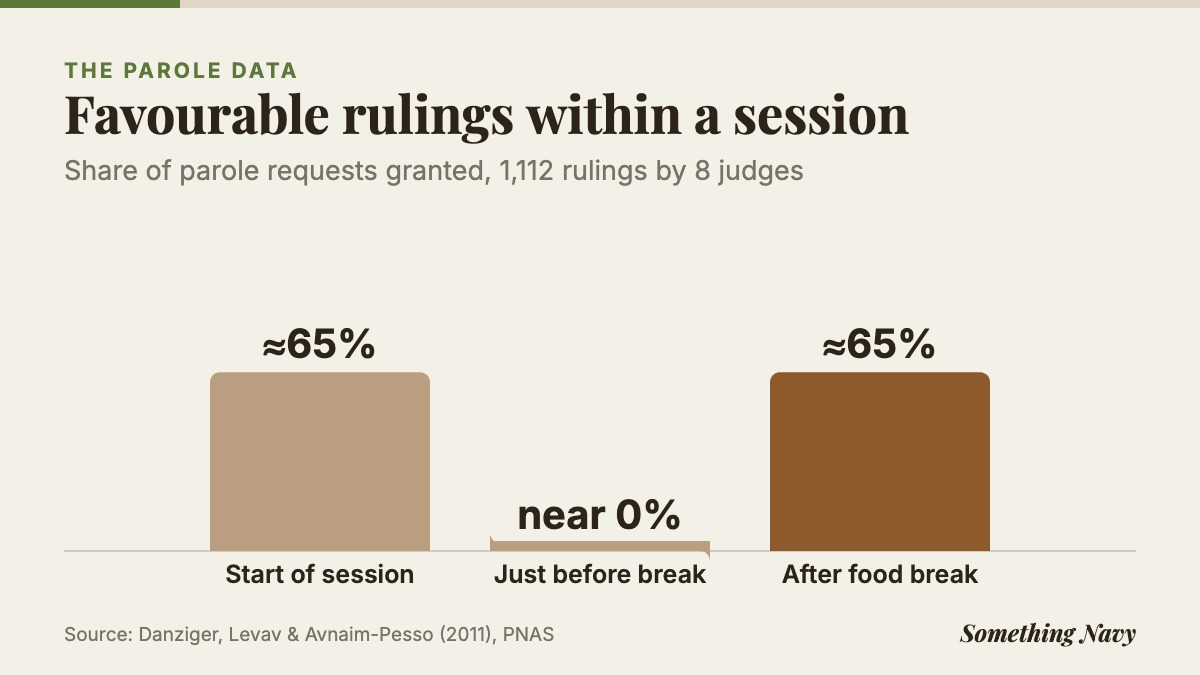
Overall, 64.2% of requests were turned down, so refusal was already the default. The authors argued that tired, depleted decision-makers fall back on that status quo, because saying no keeps every option open and requires less justification. Their conclusion was blunt: legal rulings can be swayed by factors that should have no bearing on them.
How a parole board became a self-help staple
The timing was perfect. The paper landed when psychology already had a ready-made explanation for it. Later that year, a widely read New York Times essay by John Tierney popularised the phrase “decision fatigue”, and it opened with three men in Israeli prisons waiting for their parole hearings.
Since then the study has turned up in popular books, talks, management courses and endless productivity posts. The tech founder who wears the same outfit every day, the advice to schedule your hardest choices before lunch, the warning never to go food shopping after work: much of it borrows authority from those Israeli courtrooms.
An investigation, though, does not stop at a compelling exhibit. It asks who else saw what happened, and whether the explanation everyone accepted is the only one that fits.
Witness for the prosecution: radishes and cookies
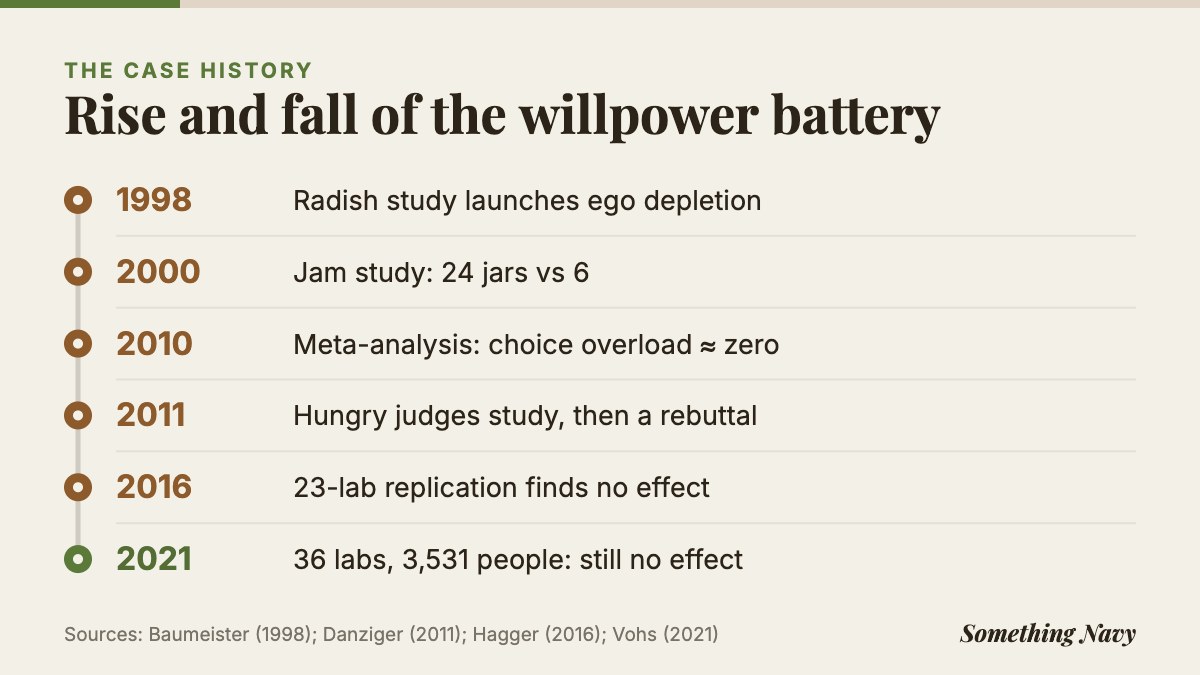
The theory behind decision fatigue is older than the parole study. In 1998, Roy Baumeister and colleagues at Case Western Reserve University published a paper that gave psychology the term “ego depletion”: the idea that self-control draws on a limited resource that gets used up.
Their best-known experiment involved 67 psychology students who had been asked to skip a meal. They arrived at a lab that smelled of freshly baked chocolate chip cookies. Some were allowed to eat the cookies and chocolates. Others had to sit with the treats in front of them and eat radishes instead. A third group skipped the food stage altogether.
Everyone then tackled geometric puzzles that, unknown to them, were impossible to solve. The radish eaters gave up after an average of 8.35 minutes. The cookie eaters kept going for 18.90 minutes, and the no-food group for 20.86. Resisting temptation, it seemed, left people with less in the tank for whatever came next.
Over the following decade, hundreds of studies reported similar depletion effects, and Baumeister’s group extended the idea from self-control to choice itself. Making decisions, they argued, drew on the same reserve. The parole data looked like the real-world proof.

Witness for the defence: the order of the docket
The first serious challenge arrived within months. In a letter to the same journal, Keren Weinshall-Margel and John Shapard, the latter of the US Federal Judicial Center, questioned a quiet assumption in the original analysis: that cases reached the judges in more or less random order.
After informal interviews with people involved in the Israeli parole process, they concluded that ordering was not random at all. In particular, prisoners without a lawyer tended to be heard last in a session. Those same unrepresented prisoners were, unsurprisingly, less likely to be granted parole than prisoners who had an attorney arguing for them.
If the weakest cases cluster at the end of each session, the falling line needs no hungry judges to explain it. The board would be working through a list that gets harder to say yes to as it goes.
Danziger and his colleagues replied that the downward trend still held when they controlled for legal representation. That is a fair rebuttal, but it left open the question of how big the effect remained once the case mix was accounted for.
Cross-examination by simulation
In 2016, Andreas Glöckner, then at the University of Hagen and the Max Planck Institute for Research on Collective Goods in Bonn, took a different approach. Rather than argue about interviews, he asked whether a perfectly rational, never-tired board could produce the same curve. His paper in Judgment and Decision Making set out to answer that with simulations.
The key detail came from the original data. Favourable rulings took longer than unfavourable ones, on average about 7.37 minutes against 5.21. Glöckner generated 10,000 randomly ordered cases, 36% of them favourable, and gave each a realistic decision time. Then he imposed one sensible rule: a board does not start a case it cannot finish before the break.
That rule alone tilts the numbers. Long cases are the ones most likely to get bumped to the next session, and long cases are disproportionately the ones that end in parole. So the final slots before a break fill up with quick refusals, while freshly started sessions pick up the postponed, more favourable cases.
The simulated boards produced a falling pattern of their own, somewhat smaller than the real one but with the same shape. Glöckner did not claim this explained everything; he estimated that rational time management could account for only part of the drop. But he concluded that the original work had overestimated the effect of mental depletion, and that it did not offer conclusive evidence that extraneous factors drive legal rulings.
He also pointed to something that should give any reader pause. Taken at face value, the parole effect was enormous, far larger than anything depletion researchers had ever measured in the lab. Real psychological effects rarely look like a cliff edge.
The star witness falters
By the mid-2010s the lab evidence was wobbling too. Psychology was in the middle of its replication crisis, and ego depletion, with its hundreds of supportive studies, became a test case. (It was not alone: the story of power posing followed a similar arc.)
In 2016, Martin Hagger and Nikos Chatzisarantis of Curtin University in Australia coordinated a registered replication report in Perspectives on Psychological Science. The protocol was agreed in advance, so nobody could tweak the analysis after seeing the results. Twenty-three laboratories took part, with 2,141 participants in the final analysis.
Participants did a tiring version of a letter-crossing task, pressing a key for every “e” except under awkward rules, or an easy version. Then they did a demanding attention test. If depletion were real, the tired group should have performed worse. The overall effect size was 0.04, with a confidence interval that included zero. In plain terms: nothing.
Defenders argued that the chosen tasks were too weak. So in 2021 a second, even larger effort, led by Kathleen Vohs of the University of Minnesota, herself a prominent ego-depletion researcher, ran a preregistered test across 36 laboratories and 3,531 participants. The confirmatory effect was 0.06, and the Bayesian analysis favoured no effect by roughly four to one.
That does not prove nobody ever gets tired. It means the specific claim, that a few minutes of self-control measurably drains a general-purpose willpower tank, has not survived its toughest tests.
The jam on the table
Decision fatigue has a close cousin that is often cited alongside it: choice overload, the idea that too many options paralyse us. Its founding study is almost as famous as the hungry judges.
In a 2000 paper, Sheena Iyengar of Columbia University and Mark Lepper of Stanford set up a tasting stand at Draeger’s, an upmarket supermarket in Menlo Park, California. On two Saturdays they alternated between displaying 24 jams and just six.
The big display drew more interest: 60% of passing shoppers stopped, compared with 40% for the small one. But only about 3% of those who stopped at the 24-jam table bought a jar, against roughly 30% at the six-jam table. In raw numbers, that was four buyers versus 31.
It is a striking result, and a modest study. When Benjamin Scheibehenne, Rainer Greifeneder and Peter Todd pooled 50 experiments covering 63 conditions and 5,036 participants in 2010, the average effect of offering more options was virtually zero. Some studies found overload, some found that more choice helped, and many found nothing.
The authors did not say choice overload never happens. They found considerable variation between studies, which suggests it appears only under particular conditions. A shelf of jams is not, on its own, enough.
The verdict
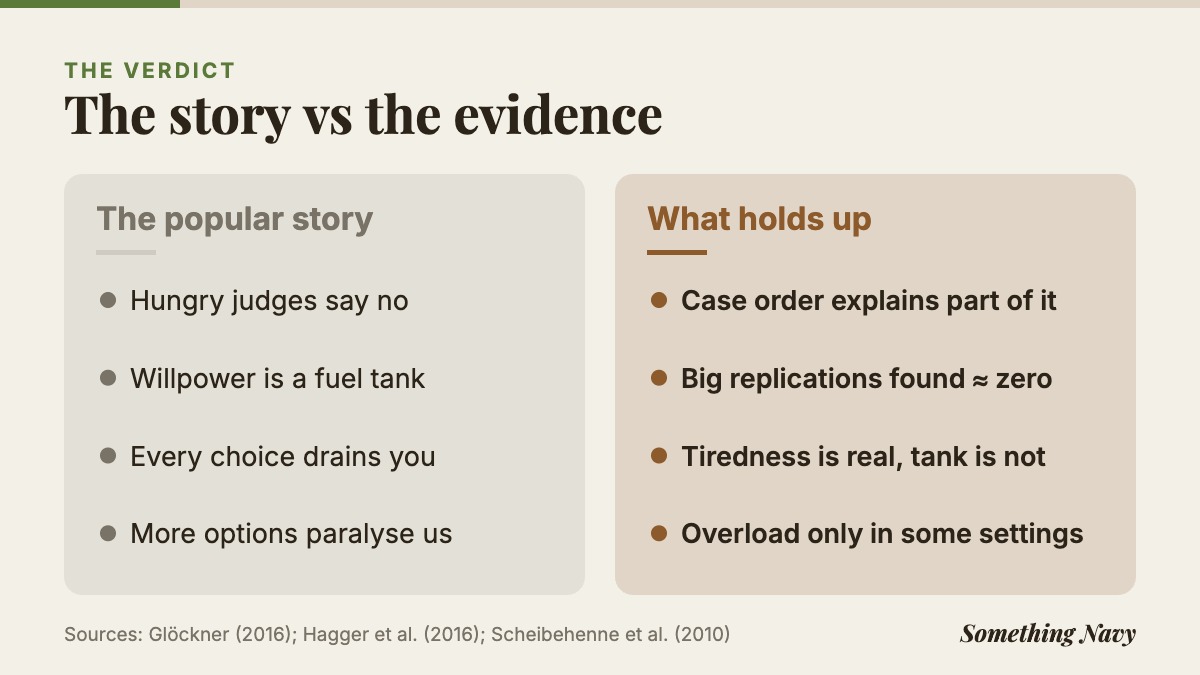
So, is decision fatigue real? The honest answer is split into charges.
On the charge that parole judges grow harsher purely because they are hungry: not proven. The pattern in the data is real, but case ordering and time management can produce much of it without any depletion at all. The original authors’ rebuttal on legal representation keeps the question open rather than settling it.
On the charge that willpower is a limited fuel that every choice burns: largely unsupported. Two large, preregistered, multi-lab efforts found effects indistinguishable from zero.
On the charge that too many options reliably make people give up: overstated. The average effect across dozens of studies is close to nothing, though it may appear in specific circumstances.
What remains standing is less dramatic and more ordinary. People do get tired, bored and hungry. Long stretches of demanding work feel worse as they go on, and some researchers have argued that what changes is motivation and attention rather than a depleted tank. Feeling worn out is real; the battery is the metaphor that failed.
What survives for the rest of us
None of this means the familiar advice is useless. It means the reasons behind it need updating, and some of it should be held more loosely.
Routines and defaults still help, not because they save willpower units, but because they free time and attention for things you care about. Planning a decision in advance, such as if-then plans that fix what you will do when a situation arises, has a much better evidence base than ego depletion ever did.
Trimming options is worth trying when choices are hard to compare or you do not yet know what you want. It is not a law of nature, and a large menu is not automatically a trap.
And if you notice yourself saying “no” to everything at five o’clock, the hungry judges are still a useful prompt, just a different one. Rather than blaming an empty tank, ask whether you are rushing to clear a list, avoiding the slow, complicated cases, or putting off something uncomfortable (a habit explored in our piece on why we procrastinate).
Try this
- Make recurring low-stakes choices once, such as a weekday breakfast or a default workout slot, and stop re-deciding them.
- Before a big decision, write down the two or three criteria that matter most. That makes long lists easier to compare.
- Notice whether hard tasks drift to the end of your day. If they do, the problem may be scheduling, not stamina.
- Take breaks because rest and food help you feel better and work well, not to refill a willpower meter.
The parole study endures because it captures a fear most of us share: that something as trivial as a late lunch might quietly decide our fate. The evidence suggests the answer is less spooky. Our decisions are shaped by the queue, the clock and the order in which things land on the desk.
That is a more mundane culprit than hunger. It is also one we can actually do something about.
Frequently asked questions
No. It is a popular term for feeling worn down by lots of choices, not a clinical diagnosis. If tiredness or difficulty making decisions persists, it is worth speaking to a GP, as it can be linked to sleep problems or low mood.
There is no suggestion of that. The critiques concern how the pattern should be interpreted, especially whether case ordering and scheduling explain the drop, not whether the rulings were recorded accurately.
The strong version, in which brief acts of self-control drain a shared resource, failed two large preregistered tests. Some researchers still study related ideas about fatigue and motivation, but the simple battery model is no longer well supported.
If you feel sharper then, it is a reasonable habit. The evidence simply does not show that your judgement collapses as the day goes on, so making a careful decision in the afternoon is fine too.
Sources
- Danziger, S., Levav, J., & Avnaim-Pesso, L. (2011). Extraneous factors in judicial decisions. Proceedings of the National Academy of Sciences, 108(17), 6889–6892. DOI
- Weinshall-Margel, K., & Shapard, J. (2011). Overlooked factors in the analysis of parole decisions. Proceedings of the National Academy of Sciences, 108(42), E833. DOI
- Glöckner, A. (2016). The irrational hungry judge effect revisited: Simulations reveal that the magnitude of the effect is overestimated. Judgment and Decision Making, 11(6), 601–610. DOI
- Baumeister, R. F., Bratslavsky, E., Muraven, M., & Tice, D. M. (1998). Ego depletion: Is the active self a limited resource? Journal of Personality and Social Psychology, 74(5), 1252–1265. DOI
- Hagger, M. S., Chatzisarantis, N. L. D., et al. (2016). A multilab preregistered replication of the ego-depletion effect. Perspectives on Psychological Science, 11(4), 546–573. DOI
- Iyengar, S. S., & Lepper, M. R. (2000). When choice is demotivating: Can one desire too much of a good thing? Journal of Personality and Social Psychology, 79(6), 995–1006. DOI
- Scheibehenne, B., Greifeneder, R., & Todd, P. M. (2010). Can there ever be too many options? A meta-analytic review of choice overload. Journal of Consumer Research, 37(3), 409–425. DOI
Cover photo: Vitaly Gariev on Unsplash. Charts and graphics: Something Navy.
How we reported this. We went back to the original research for this story, 7 sources in all, listed above, and checked every figure against them. If you think we have got something wrong, tell us and we will look at it. Read more about how we work.