There is a reason gyms are packed on the first Monday of January and half empty by February. There is also a reason so many people promise themselves that the diet, the savings plan or the early nights will start “on Monday”, or “after my birthday”, or “when the kids go back to school”.
It is tempting to dismiss this as procrastination with a calendar attached. Researchers who have studied it think something more interesting is going on. They call it the fresh start effect: the tendency to feel more motivated to change at moments that mark a new beginning, and the evidence that people really do act on that feeling.
Where the idea comes from
The term comes from a 2014 paper in the journal Management Science by Hengchen Dai, Katherine Milkman and Jason Riis, then at the Wharton School of the University of Pennsylvania. They wanted to know whether the New Year was a one-off or part of a broader pattern, so they looked at three very different kinds of data.
First, they analysed Google searches for the word “diet”. Searches did not just jump in January. They also rose at the start of each week, at the start of each month, after public holidays and at other points that people tend to treat as beginnings. The researchers estimated that the start of a new week alone was associated with a rise in diet searches about three times as large as the bump that followed a front-page New York Times article about a diet pill.
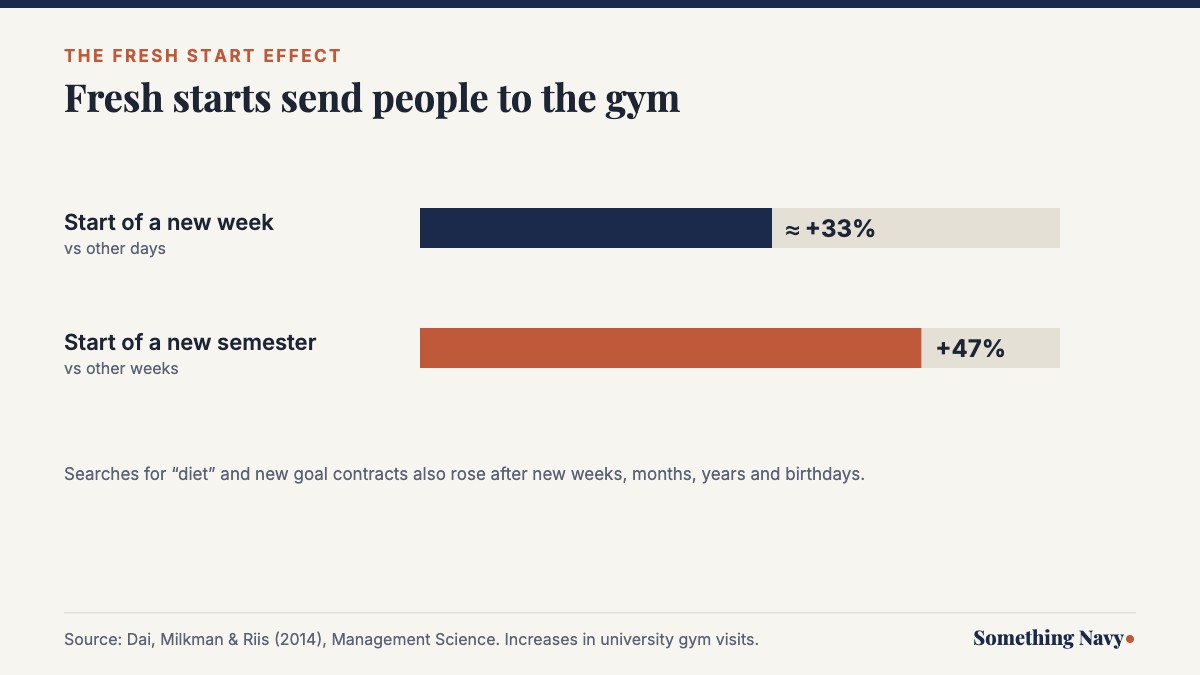
Second, they used attendance records from a university gym. Visits rose by about a third at the start of a new week and by 47% at the start of a new semester. They also climbed after birthdays, with one telling exception: people’s 21st birthdays, which in the United States are more often celebrated in a bar than a gym.
Third, they looked at stickK, a website where people sign commitment contracts, putting money on the line to hold themselves to a goal. New commitments rose around the same kinds of dates.


Why a date on the calendar changes anything
On the face of it, a Monday is no different from a Sunday. Your body, your bank balance and your fridge are exactly the same. So why does the date matter?
The researchers proposed two explanations. The first is psychological distance. Moments like a birthday or a new year help us draw a line between a “past self” and a “current self”. Past failures, the skipped workouts and the abandoned budgets, can be filed away as belonging to that older version of you. That makes it easier to believe that this time could go differently.
The second is perspective. Landmark dates tend to make us step back from the routine of daily life and think about the bigger picture: where we are, where we hoped to be and how far apart those two things are. That kind of reflection is often exactly what prompts someone to set a goal in the first place.
Milkman has since built much of her work on the idea, including in her book How to Change, and later studies have found similar patterns in areas such as saving for retirement and taking up healthy habits.
The catch
The fresh start effect is good at getting people to begin. It is less clear that it keeps them going. A burst of motivation at a landmark date is a different thing from a habit, and anyone who has watched the January gym crowd thin out has seen the gap between the two.
There is a quieter risk as well. If you rely on fresh starts, a slip can become a reason to wait for the next one. Missed a workout on Wednesday? Might as well start again next Monday. Used this way, the effect can turn into the very procrastination people accuse it of being.
The research on habits suggests a more patient view. In a well-known study from University College London, people took a median of 66 days to make a new behaviour feel automatic, with a very wide range between individuals. We looked at what that study really found in our piece on how long it takes to form a habit.
How to make a fresh start work for you
The useful lesson is not to wait for New Year’s Day. It is that there are far more fresh starts available than most people realise, and you can use them deliberately.
- Look for landmarks. A new week, a new month, the first day of spring, a birthday, a move, a new job or the end of a big project can all serve as a starting line.
- Name the new chapter. In later experiments, Dai and her colleagues found that simply describing a date as a beginning, for instance “the first day of spring” rather than “the third Thursday in March”, made people more interested in starting a goal.
- Pair motivation with a plan. The energy of a fresh start fades. Decide in advance exactly when and where you will act. Our article on if-then planning explains one of the best-studied ways to do it.
- Treat a slip as a small reset, not a failure. If a week goes badly, the next morning is a perfectly good landmark. You do not need to wait for January.
Seen this way, the fresh start effect is less an excuse than a tool. The feeling that you can begin again is not a trick of the calendar. It is something you can choose to create whenever you need it.
FAQ’s
It is the tendency to feel more motivated to pursue goals after “temporal landmarks”, such as the start of a new week, month or year, a birthday or a holiday.
The term comes from a 2014 study by Hengchen Dai, Katherine Milkman and Jason Riis at the Wharton School, published in Management Science.
Mondays mark a new week, which can make people feel separated from past failures and more focused on long-term goals. Google searches for “diet” rise at the start of each week.
It is good at prompting people to begin, but motivation tends to fade. Concrete plans and habits are usually needed to keep a new behaviour going.
More in our Modern Life section.
Sources
- Dai, H., Milkman, K. L., & Riis, J. (2014). The fresh start effect: Temporal landmarks motivate aspirational behavior. Management Science, 60(10), 2563–2582. DOI
- Dai, H., Milkman, K. L., & Riis, J. (2015). Put your imperfections behind you: Temporal landmarks spur goal initiation when they signal new beginnings. Psychological Science, 26(12), 1927–1936. DOI
- Lally, P., van Jaarsveld, C. H. M., Potts, H. W. W., & Wardle, J. (2010). How are habits formed: Modelling habit formation in the real world. European Journal of Social Psychology, 40(6), 998–1009. DOI
How we reported this. We went back to the original research for this story, 3 sources in all, listed above, and checked every figure against them. If you think we have got something wrong, tell us and we will look at it. Read more about how we work.
Cover photo: 2H Media on Unsplash. Charts and graphics: Something Navy.