
Run your own fingertips lightly up your ribs. Slowly, then quickly, then in that scrabbling way a sibling used to do. Nothing. A faint pressure, perhaps a slight itch, and an odd sense of foolishness.
Now picture someone else’s hand hovering a few centimetres from the same spot. You flinch and squeal before they have touched you at all.
Same skin, same fingers, same movement. Completely different feeling.
The reason is not in your ribs. It is in your head, and it is one of the neatest experiments in modern neuroscience: your brain predicts the touch you are about to give yourself, and quietly turns it down before you ever feel it.
Understand that, and the self-tickle becomes a small window into how you perceive almost everything.
The tickling machine that started it all in 1971
The question is old, but the first proper test arrived in a short letter to Nature in 1971. Its authors, L. Weiskrantz, J. Elliott and C. Darlington, opened with a disarmingly simple line: “WHY is it that most people cannot tickle themselves?”
Their answer came from a tickling apparatus. Volunteers could either operate it themselves or let a researcher operate it, and the device delivered the same tickles either way. As the Donders Institute’s science blog explains, people felt a much stronger tickle when the researcher was at the controls.
The skin was getting identical input, so whatever dulled the self-tickle had to be happening somewhere between the hand that moved and the mind that felt.
For almost three decades, nobody could look inside that gap.

What a brain scanner showed about self-tickling
In 1998, Sarah-Jayne Blakemore, working with the neuroscientists D. M. Wolpert and C. D. Frith in London, put the question into an fMRI scanner. The results appeared in Nature Neuroscience under the title “Central cancellation of self-produced tickle sensation”.
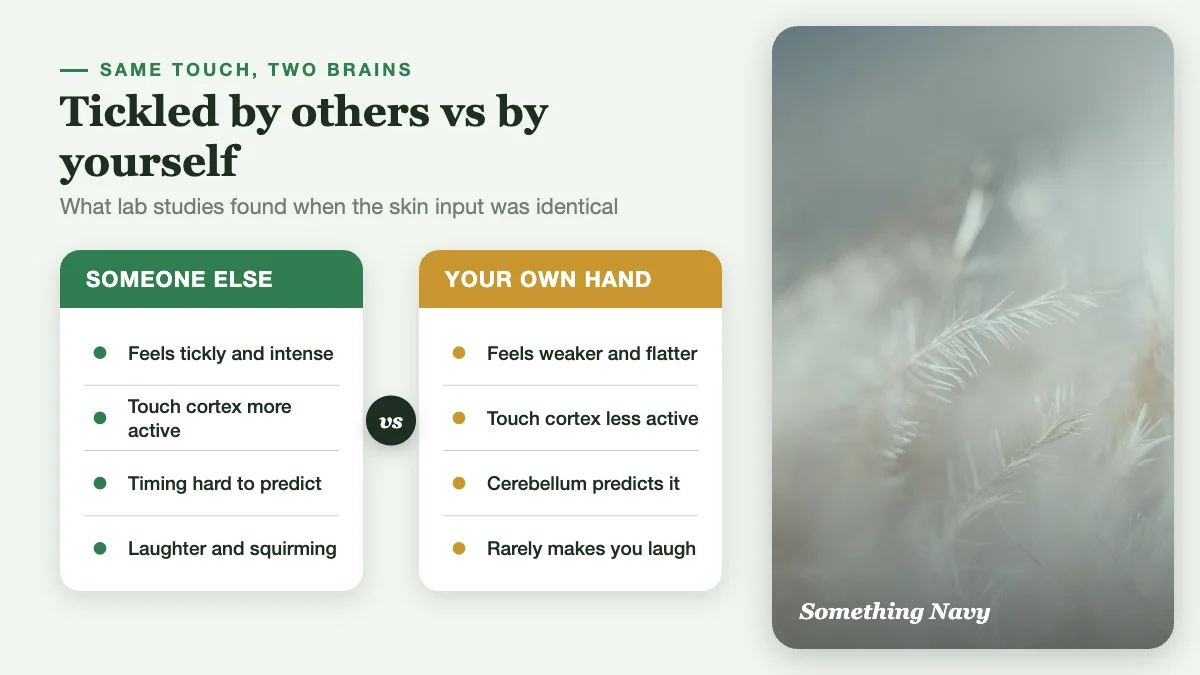
Volunteers lay in the scanner and received a tactile stimulus. Sometimes they produced it themselves. Sometimes it was produced for them. The touch on the skin was the same.
The brain’s response was not. The somatosensory cortex, the strip of brain that registers touch, was more active when the stimulus came from outside. In a later explainer for Scientific American, Blakemore added that a second region, the anterior cingulate cortex, was also less active during self-tickling than during tickling by someone else.
The most interesting result came from the cerebellum, the wrinkled structure tucked under the back of the brain that is best known for coordinating movement. Its activity was lower when a movement produced a touch than when the same movement produced nothing.
The team’s interpretation was that the cerebellum predicts the specific sensory consequences of a movement, and supplies the signal used to cancel the response to touch you make yourself.


How prediction cancels a tickle, step by step
To see why a prediction would mute a sensation, it helps to follow one self-tickle from start to finish. Neuroscientists describe it using an idea called a forward model: an internal simulation that guesses what your body is about to feel.
Step one: the command leaves a copy behind
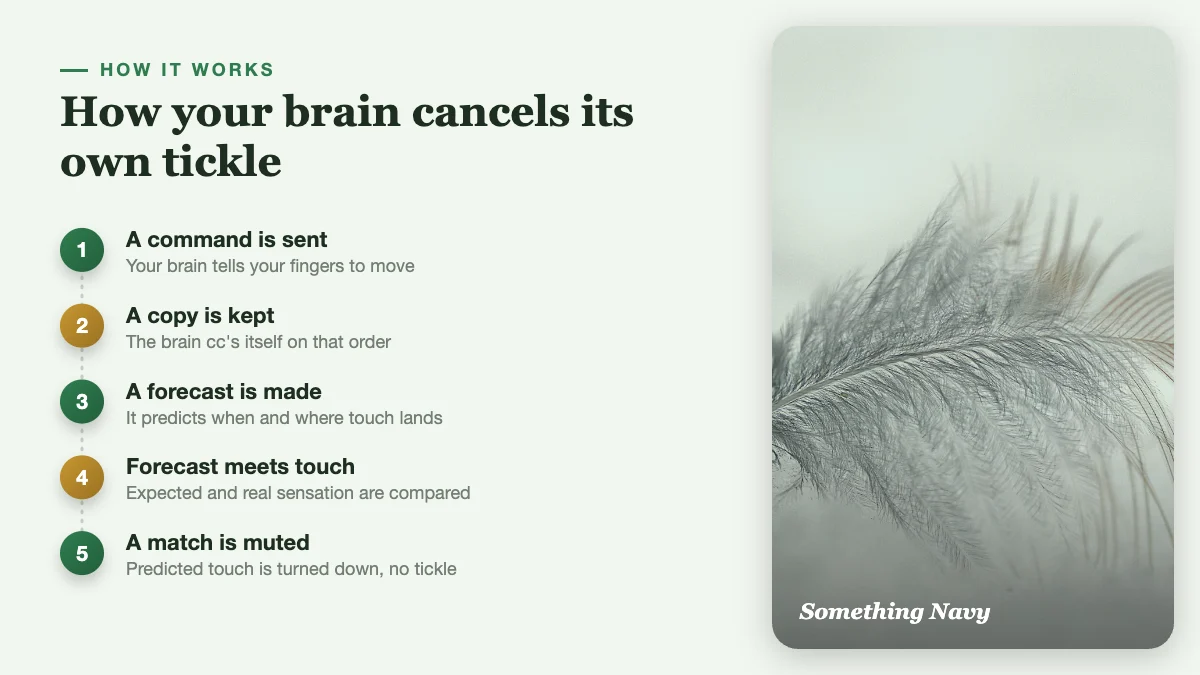
When you decide to wiggle your fingers against your ribs, your motor system sends a command to your hand. At the same moment, it keeps a copy of that command for itself. Think of it as the brain cc’ing itself on its own email.
Step two: the copy becomes a forecast
That copy is used to predict what the movement will feel like: where the touch will land, when, and in which direction it will travel. The 1998 scans point to the cerebellum as a key part of this forecasting.
Step three: the forecast meets the real touch
A fraction of a second later, the actual sensation arrives from your skin. The brain compares what it expected with what it got.
Step four: whatever was expected gets turned down
If the two match closely, the touch is flagged as yours and its signal is dampened. Less is left over to feel tickly, intense or pleasant. If something does not match, because someone else’s hand is doing the moving, the full sensation comes through.
A tickle, in other words, is partly a surprise. And you cannot surprise yourself.
The tickling robot that fooled the brain’s forecast
An elegant theory needs a test that could break it. Blakemore, Frith and Wolpert supplied one in a 1999 paper in the Journal of Cognitive Neuroscience.
They built a two-robot set-up. Volunteers moved a robot arm with their left hand. A second robot copied that movement and stroked a piece of soft material across their right palm. On other trials, the robot did the stroking entirely on its own.
As expected, people rated the self-produced strokes as less tickly, less intense and less pleasant than the external ones.
Then the researchers began to meddle. They introduced short delays between the left hand’s movement and the stroke on the right palm. They also changed the trajectory, so the stroke travelled in a different direction from the hand that caused it.
Each tweak made self-touch more ticklish. The greater the delay and the bigger the change in direction, the higher people rated the tickle. The authors concluded that the dimming only works when the touch and the movement match in both time and space, and that ticklishness rises with the mismatch between what was predicted and what arrived.
Put simply, the brain’s forecast is precise. Nudge the timing by a fraction of a second, or tilt the angle, and the self-tickle starts to work.
Why your own push always feels weaker than it is
If the brain turns down self-made sensations, there should be side effects. One of the cleverest experiments on this idea was published in Science in 2003 by Sukhwinder Shergill, of University College London and King’s College London, with P. M. Bays, Frith and Wolpert.
As described in the paper, six pairs of volunteers sat with a finger resting under a small lever attached to a motor. A gentle force of 0.25 newtons was applied to one person’s finger. That person then pressed down on their partner’s finger, with instructions to match exactly the force they had just felt. The partner did the same back.
Each person thought they were being fair. Over eight turns, the force rose by an average of 3.2 newtons, an escalation of around 38% per turn. It went up significantly in every single pair.
A separate experiment with 12 volunteers showed why. When people pressed with their own finger to match a force, they consistently overshot. When they set the force indirectly, using a joystick that controlled the motor, they were far more accurate. Your own press feels weaker to you than it really is, so you press harder to make it feel right.
“The results showed that to get same feeling of force, you need to exert more force,” Shergill said in UCL’s press release, which pointed out the obvious parallel with playground scuffles that get out of hand.
Every playful shove you give feels gentler to you than it does to the person receiving it.
The authors called force escalation “a byproduct of predictive sensory attenuation”. It is the same mechanism that spoils the self-tickle, showing up in the way two people trade pokes.
When self-touch stops feeling like your own
If a brain can mistake its own actions for someone else’s, the self-tickle should work. That is exactly what Blakemore and colleagues tested in a 2000 study in Psychological Medicine, with psychiatric patients who heard voices or had “passivity experiences”, the feeling that their actions are controlled by an outside force.
The set-up was simpler than a robot: a piece of soft foam on a pivoting plastic rod, which brushed the palm of the left hand. Either the participant moved the rod with their right hand, or the experimenter did. People rated each touch from 0 to 10 for intensity, tickliness and pleasantness.
Three groups were analysed: 15 patients with hallucinations or passivity experiences, 23 patients without these symptoms, and 15 healthy controls. The patients included people with schizophrenia and people with bipolar disorder or depression.
Controls and symptom-free patients behaved as expected, rating self-made touch lower than the experimenter’s. Healthy controls, for example, gave their own touch an average combined rating of 2.10, against 2.60 for the experimenter’s. Patients with the symptoms did not. On the combined rating, their self-produced touch scored 3.60 against 3.63 for touch from the experimenter, a gap of almost nothing.
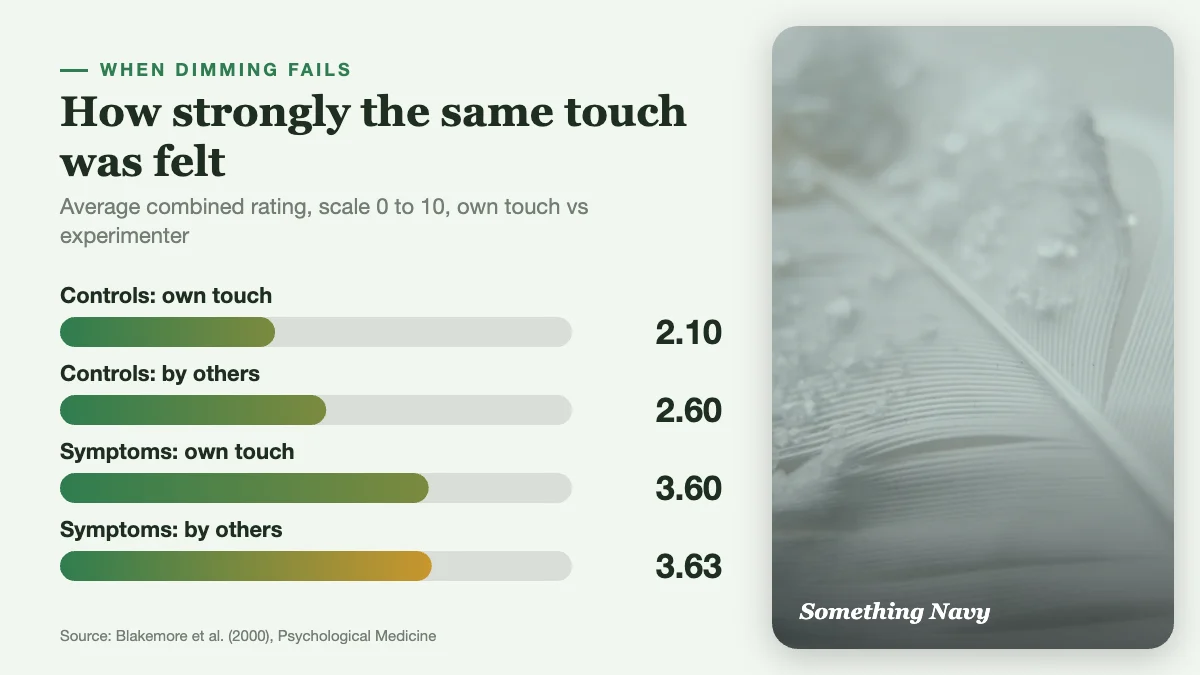
Note what this does and does not show. Patients with these symptoms did not find their own touch more ticklish than other people’s. They simply lost the usual dimming. The difference tracked the symptoms rather than the diagnosis, and the groups were small, so it is a clue about self-monitoring rather than a test for anything.
Still, it is a striking idea. A voice that is really your own inner speech, mislabelled as coming from outside, may be a cousin of a tickle that suddenly works.


Knismesis and gargalesis: the two kinds of tickle
Scientists separate two sensations, using terms coined by the American psychologists G. Stanley Hall and Arthur Allin in 1897.
Knismesis is the light, feathery sensation of an insect walking across your arm or a strand of hair on your neck. A 2004 review in the Journal of the American Academy of Dermatology describes it as a light or feather-type noxious sensation. It makes you want to brush it away, not laugh.
Gargalesis is the heavy, laughter-associated kind: fingers digging at ribs, armpits or the soles of the feet. This is the tickle of play, and the one you most obviously cannot give yourself.
The same review notes that most studies have examined one or the other, rarely both. The two may rely on different mixes of touch and itch signals, and why some patches of skin are more ticklish than others is still unclear.
Why being tickled makes you laugh, even when you hate it
Here is the strangest part. In her essay “The Mystery of Ticklish Laughter” in American Scientist, the psychologist Christine Harris observed that “most people, especially adults, say they hate to be tickled”. Yet they laugh anyway.
One school of thought treats ticklish laughter as social. The 2004 dermatology review argues that the laughing kind of tickle is better seen as a social behaviour than a reflex, rooted in parent and child interaction and in play, with laughter and squirming acting partly as signals of submission. On that view, the most ticklish spots are the ones that feel most vulnerable.
Harris and her colleague N. Christenfeld tested part of this in a 1999 study in Psychonomic Bulletin & Review. Thirty-five volunteers were tickled twice. In one session the experimenter did it. In the other, they believed an automated machine was doing it.
They laughed, smiled and squirmed just as often for the “machine”, and rated their ticklishness almost identically. Believing another person was behind the touch made no difference. The authors took this as support for the view that tickling needs unpredictability or a lack of control, rather than a social partner.
That fits neatly with the self-tickling research. The thing that makes a tickle work is not a person as such. It is the brain’s inability to see it coming.
It also explains why laughter is a poor guide to whether someone is enjoying themselves. The laugh may be closer to a reflex than a verdict, which is worth remembering the next time a child, or a partner, says stop between giggles. Real shared laughter is a different thing altogether.
Rats laugh when tickled, too
If tickling is an evolutionary oddity of humans, nobody told the rats. In a 2016 study in Science, Shimpei Ishiyama and Michael Brecht at Humboldt University of Berlin tickled rats and recorded from the touch region of their brains.
According to Science News, Ishiyama simply put his hand in the cage and scribbled his fingers through the animals’ fur. The rats responded with ultrasonic chirps at around 50 kilohertz, too high for human ears, and with joyful little leaps. The belly was the most ticklish spot, more so than the back or tail.
The rats chased the tickling hand around the cage. Many neurons in the trunk region of the somatosensory cortex fired strongly during tickling, and some fired when the rats were chasing the hand without being touched at all. Stimulating those cells made untouched rats call out.
Mood mattered as well. Anxious rats, placed on a platform under bright lights, made fewer laugh-like calls, and their cortical response to tickling dropped. Context, it seems, can switch a tickle off as surely as prediction can.
By the numbers
- 1971: the year Weiskrantz, Elliott and Darlington reported in Nature that a self-operated tickling device felt weaker than the same device run by someone else.
- 38%: the average rise in force per turn when six pairs of volunteers tried to trade equal finger presses (Shergill et al., 2003).
- 3.60 vs 3.63: self-made versus external touch ratings among patients with hallucinations or passivity experiences, almost no difference (Blakemore et al., 2000).
- 35: volunteers who laughed just as much when they thought a machine was tickling them (Harris and Christenfeld, 1999).
- 50 kHz: the pitch of a tickled rat’s laugh-like chirp, beyond human hearing (Ishiyama and Brecht, 2016).
How prediction shapes what you feel every day
The self-tickle is a small, slightly silly example of something enormous. Your brain is not a passive receiver of sensations. It is constantly forecasting what is about to happen, and it treats the expected and the unexpected very differently.
The touches you cause are muted, so the ones you do not cause stand out. A spider on your arm or a tap on the shoulder breaks through precisely because it was not predicted. Seen this way, the dimming is not a bug. It keeps your attention free for news from outside your own body.
The flip side is that a brain wired for expectation sometimes hears what it expected. The buzz of a phone that never rang, known as phantom vibration, may be an everyday example of a forecast leaking into perception. A primed brain also explains why a word you have just learned suddenly seems to be everywhere, the frequency illusion.
Researchers are still filling in the details. Work from Konstantina Kilteni’s group, profiled in The Scientist, continues to probe how the cerebellum talks to the brain’s touch areas, and she describes tickling as “a big enigma for neuroscience.” The core finding, though, has held up for more than half a century.
You feel the world partly as it is, and partly as your brain expected it to be.
Putting the tickle science to use
A few practical ideas follow from the studies above.
Try the robot trick at home. Tickle your own palm with a fingertip, then ask someone to do the same. Next, rest your hand lightly on theirs while they do it, so you can feel the movement coming. It is not a formal test, but it lets you feel the role of prediction for yourself.
Take a laughing “stop” seriously. Ticklish laughter can happen even when people dislike being tickled. If someone asks you to stop, believe the words, not the giggles.
Go gentler than you think. The finger-pressing experiment suggests your own pushes, pokes and playful thumps feel lighter to you than to the receiver. With children, partners and pets, aim below what feels “equal”.
The next time someone wiggles their fingers at you from across the room and you shriek before they have even moved, you will know what is happening. Your brain is not overreacting. It is doing the one thing it cannot do for your own hand: waiting to be surprised.
Frequently asked questions
Most people cannot produce a strong tickle on themselves, though self-touch can still feel faintly tickly. Lab studies show it becomes more ticklish when the brain’s timing or direction prediction is thrown off, for example by a robot that adds a delay.
Researchers do not fully know. Mood, context and how vulnerable an area feels all seem to play a part, and the rat studies suggest anxiety can dampen the response.
Laughter alone does not mean someone is enjoying it, because ticklish laughter can occur even when people dislike the sensation. Keep it brief and stop as soon as they ask.
It is the usual pattern, but it is not a medical test. The studies linking reduced self-dimming to hallucinations used small groups and measured averages, not individual diagnoses.
Official links and research
- Blakemore, S.-J., Wolpert, D., & Frith, C. (1998). Central cancellation of self-produced tickle sensation. Nature Neuroscience, 1, 635–640. DOI
- Blakemore, S.-J., Frith, C. D., & Wolpert, D. M. (1999). Spatio-temporal prediction modulates the perception of self-produced stimuli. Journal of Cognitive Neuroscience, 11(5), 551–559. Link
- Weiskrantz, L., Elliott, J., & Darlington, C. (1971). Preliminary observations on tickling oneself. Nature, 230, 598–599. DOI
- Shergill, S. S., Bays, P. M., Frith, C. D., & Wolpert, D. M. (2003). Two eyes for an eye: The neuroscience of force escalation. Science, 301(5630), 187. Link
- Blakemore, S.-J., Smith, J., Steel, R., Johnstone, E. C., & Frith, C. D. (2000). The perception of self-produced sensory stimuli in patients with auditory hallucinations and passivity experiences: Evidence for a breakdown in self-monitoring. Psychological Medicine, 30(5), 1131–1139. Link
- Ishiyama, S., & Brecht, M. (2016). Neural correlates of ticklishness in the rat somatosensory cortex. Science, 354(6313), 757–760. DOI
- Harris, C. R., & Christenfeld, N. (1999). Can a machine tickle? Psychonomic Bulletin & Review, 6(3), 504–510. DOI
- Selden, S. T. (2004). Tickle. Journal of the American Academy of Dermatology, 50(1), 93–97. Link
Cover photo: Pedro Vit on Unsplash. Charts and graphics: Something Navy, with photography by Evie S. and Wolfgang Hasselmann on Unsplash.
How we reported this. Every figure was checked against the 8 sources above. Reviewed by Brooke Hilland, Senior Content Editor. Report an error · How we work