

You have just driven a red hatchback off the forecourt. Same model you spent three weekends researching, same slightly impractical shade of red.
By the time you reach the ring road you have passed four of them. There is one outside the bakery the next morning, two in the supermarket car park, another idling beside you at the lights. Did half the town buy one the same week you did?
No. They were always there. What changed was you.
The experience has two names. Linguists call it the frequency illusion. Almost everyone else knows it by the stranger label, the Baader-Meinhof phenomenon. And the research behind it says something slightly unsettling about how much of the world you are missing at any given moment: in one famous experiment, nearly half of the people watching a short video failed to see a person in a gorilla suit walk straight through the middle of it.
The same filter that hides the gorilla is the one that makes your red car multiply.
A 1994 letter to a Minnesota newspaper gave it a name
The Baader-Meinhof group was a far-left militant organisation in 1970s West Germany. It has nothing to do with psychology, which is exactly why the name stuck.
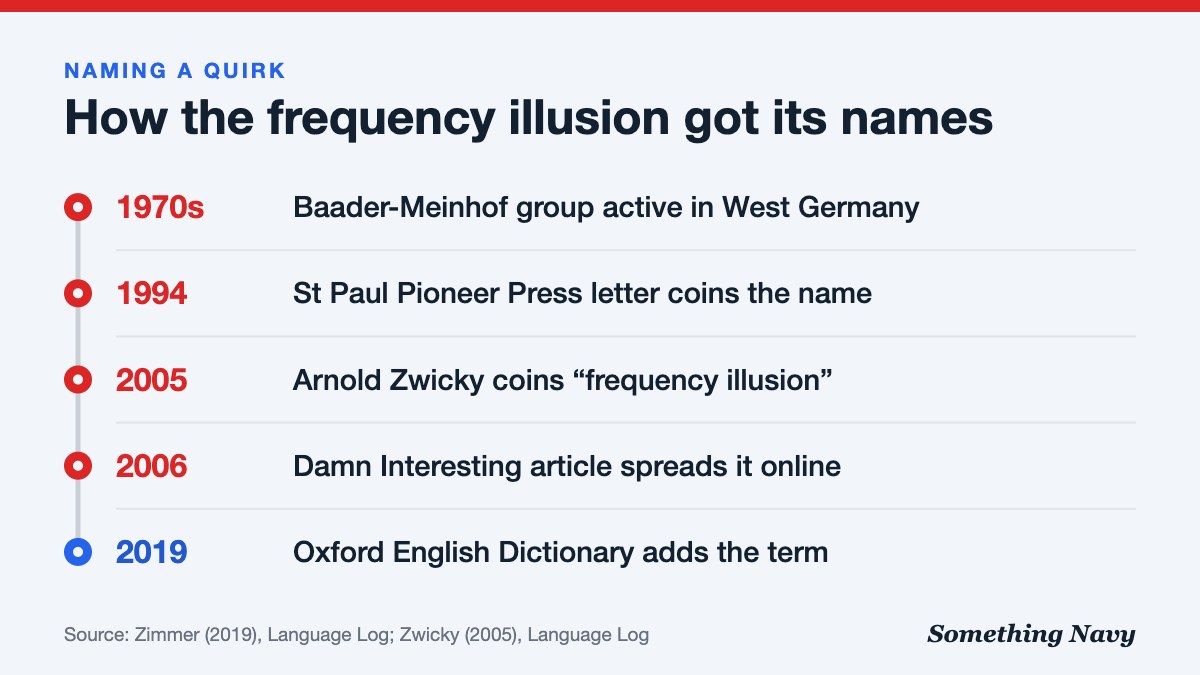
The story goes back to the St Paul Pioneer Press in Minnesota, which for years ran a daily reader column called Bulletin Board. On 16 October 1994 it printed a submission from a reader writing under the pen name “Gigetto on Lincoln”. The writer described a startling pattern: the first time you learn a new word, phrase or idea, you meet it again within a day or so. The example that gave the pattern its name was the Baader-Meinhof group, encountered once and then, almost at once, again.
That 1994 item is the earliest citation the Oxford English Dictionary gives for the phrase. As the linguist Ben Zimmer reported on Language Log in 2019, the term then got its big break online in 2006, when the writer Alan Bellows covered it on the website Damn Interesting. The pen name has since been linked to a reader called Terry Mullen, on the word of Dan Kelly, the former features editor who published the submission.
So the most widely used name for a quirk of perception is, in effect, an in-joke from a newspaper letters column. Fitting, really, for a phenomenon about things suddenly turning up wherever you look.
How a Stanford linguist turned it into the frequency illusion
The scientific-sounding name arrived a decade later. On 7 August 2005 Arnold Zwicky, a linguist at Stanford University, wrote a post on Language Log about people who complain that new grammatical habits are sweeping the language.
His point was that many of these “new” usages are centuries old. The complainers had simply started noticing them. In that 2005 post Zwicky named two traps. The recency illusion is believing that something you noticed recently is itself recent. The frequency illusion is the sense that once you have noticed something, it happens “a whole lot, even ‘all the time’”.
The Oxford English Dictionary added “frequency illusion” in its March 2019 update, defining it as a quirk of perception in which something you are newly alert to suddenly seems to be everywhere. It cites Zwicky’s post as the first use, and lists the Baader-Meinhof phenomenon alongside it.
Worth saying plainly: the frequency illusion is a label, not a single laboratory finding. Nobody has run a trial called “the Baader-Meinhof study”. What psychologists do have is a large body of research on attention and memory that explains each step of the experience very well. Put together, those steps look like this.


What your brain is doing, stage by stage
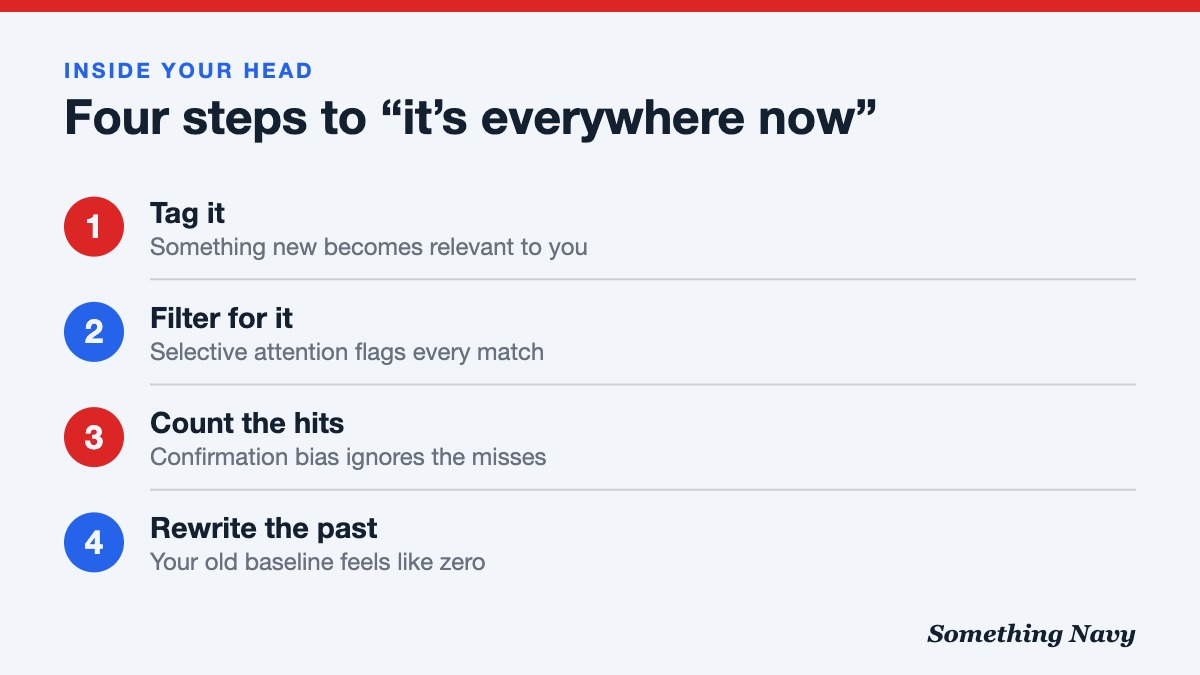
Stage one: something new gets tagged as relevant
It starts with an encounter that matters to you. You buy the car. A friend uses a word you had to look up. Your doctor mentions a condition you had never heard of. A colleague recommends a band.
At that moment the thing moves from background noise to something you care about. It now has a place in your memory and, crucially, a reason to be there. That small shift in relevance is the trigger for everything that follows.
Stage two: selective attention starts filtering the world for it
Your senses take in far more than you can consciously process. Attention is the bouncer that decides what gets in, and it works from a guest list built out of your current goals and interests.
The classic demonstration is the cocktail party effect: in a noisy room you tune out the chatter until someone across the room says your name. In a 2001 paper in Psychonomic Bulletin & Review, Andrew Conway, Nelson Cowan and Michael Bunting noted that earlier experiments had found about a third of listeners reported hearing their own name in a message they had been told to ignore. Your name is permanently on the guest list. A newly bought car joins it for a while.
So the red hatchbacks were always in the traffic. Before, attention waved them through unexamined. Now it flags every one.
Stage three: confirmation bias keeps the score
Noticing is only half of it. The other half is the conclusion you draw: “these are everywhere now”.
That conclusion leans on confirmation bias, our habit of counting the evidence that fits what we already think and quietly skipping the evidence that does not. In a widely cited 1998 review in Review of General Psychology, Raymond Nickerson of Tufts University described it as a bias that turns up in many different guises, from everyday judgements to science and the law.
In the car example, every red hatchback you spot is a vivid, memorable hit. The thousands of other cars you passed are misses that leave no trace. Nobody goes home thinking, “I saw 2,000 cars today that weren’t mine.” Your tally only ever has one column.
Stage four: memory rewrites the past
The final step is the comparison. To feel that something has become more common, you need a “before” to compare it with. But you never counted red hatchbacks before you bought one, so the before-figure your brain reaches for is close to zero.
That is Zwicky’s recency illusion sneaking in. Against an empty baseline, almost any number looks like a surge.
The world didn’t fill up with red cars. Your attention just started counting them.
The invisible gorilla experiment: the other side of the coin
If attention makes some things leap out, it must also make other things vanish. The most famous proof of that comes from a short video of people passing basketballs.
What the study did
- Who: Daniel Simons and Christopher Chabris, then at Harvard University, published it in Perception in 1999.
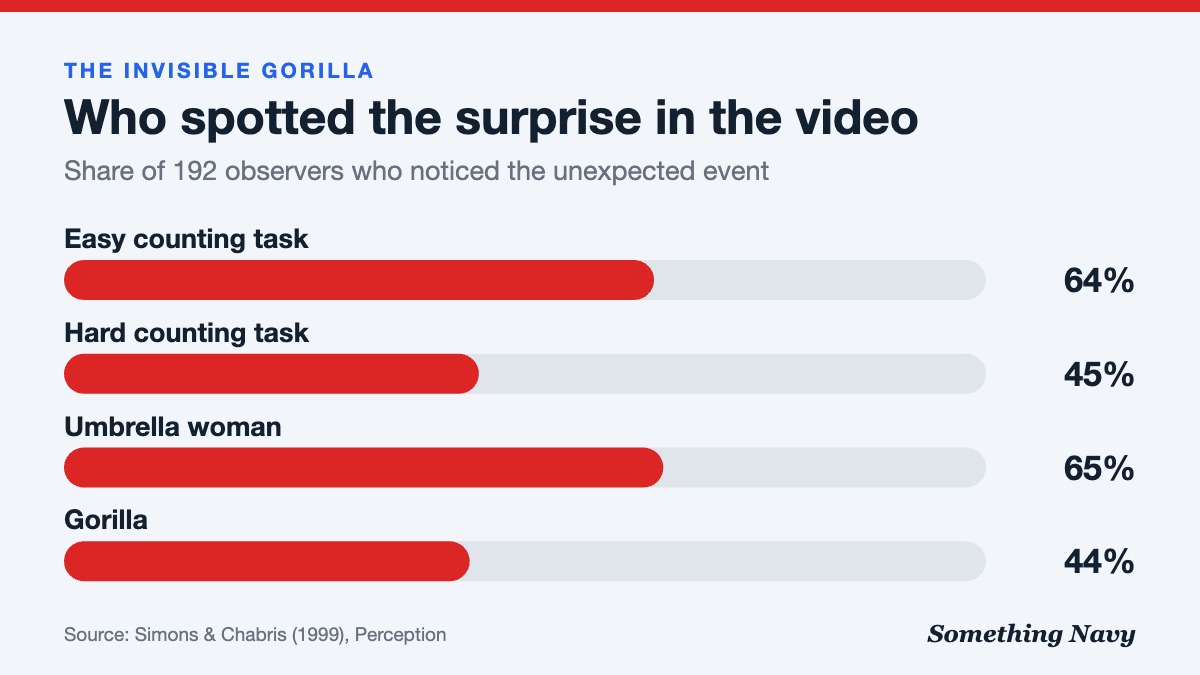
- Sample: 192 observers whose results were analysed, each shown one of four 75-second videos.
- Task: count the passes made by one team, either a simple total or a harder count tracking two kinds of pass separately.
- The surprise: about 45 seconds in, a woman with an umbrella or a person in a gorilla suit walked through the game for 5 seconds.
- The result: 46% of observers did not notice the unexpected event at all.
In the paper, the authors called this sustained inattentional blindness. People were not looking away. They were staring at the screen, absorbed in a counting job, and their attention simply had no slot for a gorilla.
The details are revealing. When the task was easy, 64% noticed the surprise, against 45% when it was hard. The umbrella woman was spotted by 65% of observers, the gorilla by only 44%. In a follow-up within the same study, a gorilla that stopped, faced the camera and thumped its chest was noticed by just 50%.
A later study explains why the gorilla did so badly. In 2001, Steven Most and colleagues asked people to track either black or white shapes on a screen. Whether they noticed an unexpected object depended heavily on how similar it was to the things they were tracking; even a bright red cross sliding across the display was missed by nearly 30% of observers. Attention, in other words, works like a template. Whatever matches the template gets in.
That template is the whole story of the frequency illusion. When you buy a red hatchback, you have effectively updated your template. Red hatchbacks now match. Everything else carries on being filtered out, just as before.
Experts are not immune: a gorilla on a lung scan
It would be comforting to think that training fixes this. It does not.
In 2013 Trafton Drew, Melissa Võ and Jeremy Wolfe at Brigham and Women’s Hospital in Boston asked 24 radiologists to search five lung CT scans for nodules, a routine task for them. Into the final scan they inserted a picture of a gorilla roughly 48 times the size of an average nodule.
As they reported in Psychological Science, 83% of the radiologists did not report the gorilla. Eye-tracking showed that most of those who missed it had looked directly at it.
Their eyes were on it. Their attention was somewhere else.
This is not a story about careless doctors; these were experts doing exactly what they were asked to do, very well. It is a story about how a mind set to look for one thing becomes efficient by ignoring others. The frequency illusion is the same machinery seen from the inside, when the thing you are set to look for happens to be common.
Knowing about the gorilla does not make you see everything
Here is the twist that makes the frequency illusion more than a party fact.
In 2010 Daniel Simons ran a new version of the basketball video for i-Perception. This time some viewers already knew about the original gorilla study, and some did not. Every one of the 23 people who knew about it spotted the gorilla. Among the 41 who did not, 56% did.
So far, so frequency illusion: tell people what to look for and they see it every time.
But the new video had two other surprises: the background curtain changed colour, and one player left the game. Only 17% of the people who knew about the gorilla noticed either, compared with 29% of those who did not. The sample was small and that gap was not statistically significant, so it should not be overread. Still, the direction is telling. Knowing what to look for did not make anyone more observant in general. If anything, it narrowed their view.
That is the deal your attention makes every day. Tune in to one thing and you gain it. Something else quietly drops off the list.


Where the frequency illusion can trip you up
Most of the time this is harmless. You notice more red cars, or a word you just learned, and smile at the coincidence. But the same pattern can mislead you in ways that matter.
- Health worries. Read about a symptom and you may start noticing every twinge that seems to fit, while the many days you felt fine fade from memory.
- “Everyone is saying it now.” Zwicky’s original target. A phrase you have just started to dislike feels like a new epidemic, even when it has been in use for generations.
- Coincidences that feel like signs. Seeing a name or number repeatedly can feel meaningful, but the misses never get counted, so the pattern always looks stronger than it is.
- Trends and fears. After one dramatic news story, similar stories leap out at you, which can make a rare event feel like a rising tide.
None of this means your perceptions are worthless. It means that “I keep seeing it” is evidence about your attention first, and about the world second.
If you have ever felt that a song keeps following you around after you rediscovered it, or that a face you just met turns up everywhere, you have met this effect. It sits close to the mere exposure effect, where familiarity makes things feel more likeable, to the spotlight effect, where we overestimate how much others notice us, and to phantom vibration syndrome, where a brain primed for a buzz starts feeling one that is not there.
How to use the frequency illusion on purpose
Once you understand the filter, you can steer it. A few practical ideas to try today:
Count the misses, not just the hits. When something seems suddenly everywhere, ask what the base rate would be. Next time you are in traffic, count all the cars for a minute, not just the red ones. The illusion usually shrinks fast.
Write a “before” number down. If you are worried something is increasing, a habit, a symptom, a behaviour in a colleague, note how often it happens now. Future you will have a real baseline instead of an empty one.
Set your filter deliberately. Learning a language, a plant name or a bird call makes you notice it in the wild. That is the frequency illusion working for you. Choose one thing a week you would like to see more of and watch it start appearing.
Look again when it matters. The radiologist study is a reminder that a focused search can hide the obvious. On important tasks, take a second pass with a different question in mind. Switching attention is costly, as anyone who has read about the multitasking myth knows, so make the second look a separate, deliberate step.
Enjoy it. There is something quietly lovely about the moment a new word or idea starts turning up everywhere. It is evidence that you have learned something and that your brain has made room for it.
“I keep seeing it everywhere” is a report on your attention first, and on the world second.
What the red car is really telling you
The Baader-Meinhof phenomenon gets treated as a cute quirk, the kind of thing that turns up in listicles next to déjà vu. But the research behind it points to something bigger.
At every moment, you are seeing a heavily edited version of the world, cut to fit whatever you currently care about. Most of the time that edit is a gift. It lets a radiologist find a tiny nodule, and it lets you hear your name across a crowded room.
The red hatchback in the next lane is a small, harmless reminder of that edit at work. It was always there. You just finally had a reason to see it.
Which raises a pleasant question for the drive home: what else is out there, right in front of you, waiting for a reason?
Frequently asked questions
Yes. They describe the same experience. “Baader-Meinhof phenomenon” comes from a 1994 newspaper column, while “frequency illusion” is the term the linguist Arnold Zwicky coined in 2005 and the one the Oxford English Dictionary now records.
It is best thought of as a combination of two well-studied processes: selective attention, which makes newly relevant things stand out, and confirmation bias, which makes you count the hits and forget the misses.
Learning the word gives your attention a new target, so instances you would have skimmed past now register. Because you never counted the word before, any number of sightings feels like a sudden jump.
Yes. Deliberately learning what to look for, such as bird calls, plant names or signs of a problem at work, helps you notice them. The catch is that a narrow focus can hide other things, so it pays to look again with fresh eyes.
Sources
- Conway, A. R. A., Cowan, N., & Bunting, M. F. (2001). The cocktail party phenomenon revisited: The importance of working memory capacity. Psychonomic Bulletin & Review, 8(2), 331–335. DOI
- Drew, T., Võ, M. L.-H., & Wolfe, J. M. (2013). The invisible gorilla strikes again: Sustained inattentional blindness in expert observers. Psychological Science, 24(9), 1848–1853. DOI
- Most, S. B., Simons, D. J., Scholl, B. J., Jimenez, R., Clifford, E., & Chabris, C. F. (2001). How not to be seen: The contribution of similarity and selective ignoring to sustained inattentional blindness. Psychological Science, 12(1), 9–17. DOI
- Nickerson, R. S. (1998). Confirmation bias: A ubiquitous phenomenon in many guises. Review of General Psychology, 2(2), 175–220. DOI
- Simons, D. J. (2010). Monkeying around with the gorillas in our midst: Familiarity with an inattentional-blindness task does not improve the detection of unexpected events. i-Perception, 1(1), 3–6. DOI
- Simons, D. J., & Chabris, C. F. (1999). Gorillas in our midst: Sustained inattentional blindness for dynamic events. Perception, 28(9), 1059–1074. DOI
- Zimmer, B. (2019, March 19). “Frequency illusion” in the OED. Language Log, University of Pennsylvania. Link
- Zwicky, A. (2005, August 7). Just between Dr. Language and I. Language Log, University of Pennsylvania. Link
Cover photo: Barbara Batári on Unsplash. Charts and graphics: Something Navy.
How we reported this. We went back to the original research for this story, 8 sources in all, listed above, and checked every figure against them. If you think we have got something wrong, tell us and we will look at it. Read more about how we work.