

It is usually laminated. A cartoon brain lifting weights, or a staircase with “I can’t do this… yet” on the bottom step. You have seen it in a school corridor, a staffroom, perhaps on the wall of your child’s classroom.
Maybe you have heard the pep talk that goes with it, too. Your brain is like a muscle. Mistakes make it grow. Believe you can get better, and you will.
The idea behind the poster is the “growth mindset”, popularised by the Stanford University psychologist Carol Dweck in her 2006 book Mindset: The New Psychology of Success. It became one of the most successful exports psychology has ever had, from primary schools to boardrooms.
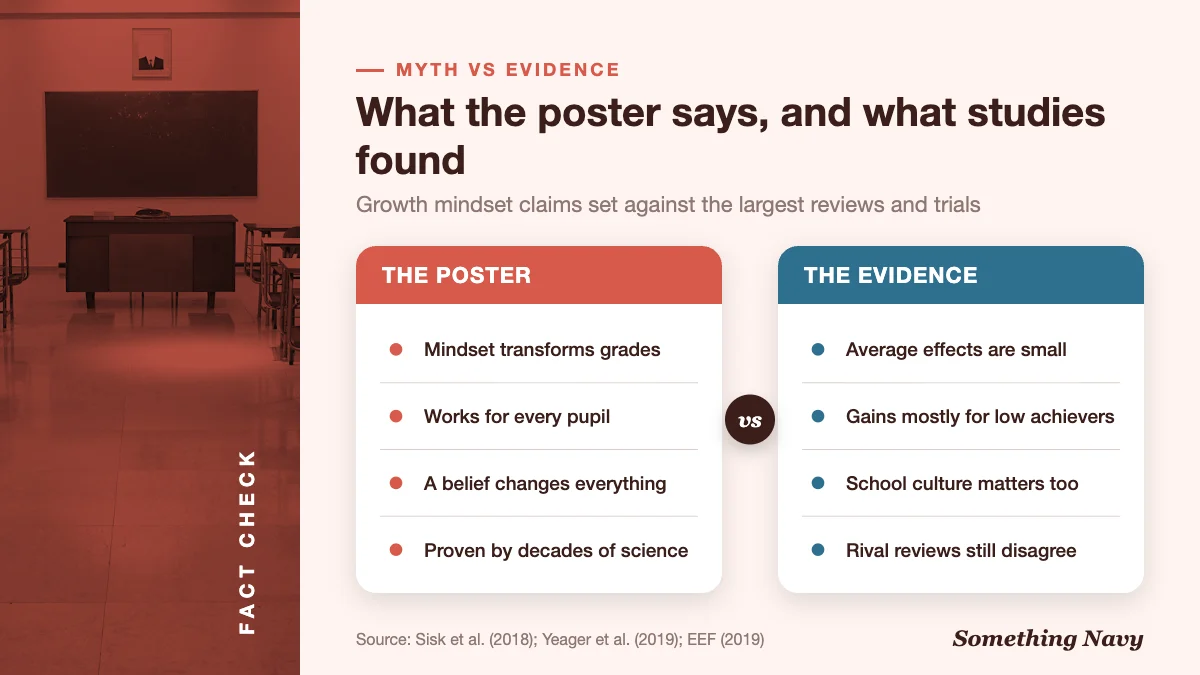
And then, over the past decade, the evidence got messier. Large reviews found the average effects were small. A big trial in English primary schools found no improvement in test results at all. Two teams of researchers looked at much the same body of studies and reached opposite-sounding conclusions in the same journal, three weeks apart.
So does it work? The honest answer is more interesting than yes or no.
The growth mindset claims, laid out one by one
The phrase “growth mindset” gets used to mean several different things. Some of them are well supported. Some are not. Separating them is the only fair way to weigh the research.
- Claim 1: Praising a child for being clever backfires, while praising effort helps.
- Claim 2: Students who believe ability can grow do better at school.
- Claim 3: Teaching pupils a growth mindset raises achievement across the board.
- Claim 4: A short, cheap mindset lesson can lift the grades of students who are struggling.
Each one gets a verdict below, based on what the researchers actually measured, how many people took part and how big the effects turned out to be.

Where it began: the praise experiments of 1998
The research that launched a thousand posters was a set of six experiments published in 1998 by Mueller and Dweck in the Journal of Personality and Social Psychology. Their subjects were fifth-graders aged 10 to 12, from public schools in two parts of the United States.
In the first study, 128 children took part and 123 were analysed. Each child worked on a set of reasoning puzzles and was told they had done very well. Then came the twist. One group heard an extra line of praise for their ability: “You must be smart at these problems.” A second group heard praise for their effort: “You must have worked hard at these problems.” A control group heard nothing more.
Next, every child was given a much harder set of puzzles and told they had done “a lot worse”. Then the researchers watched what happened.
The differences were striking. When asked to choose their next task, 67% of the children praised for intelligence picked an easier one that would let them look good, rather than one they could learn from. Among those praised for effort, only 8% did. After the setback, the “smart” group enjoyed the puzzles less, wanted to persist less and actually solved fewer problems on a final set. The effort group solved more.
In a later study in the same paper, children were asked to report their scores to a child at another school. Among those praised for intelligence, 38% misrepresented how well they had done, compared with 13% of the effort-praised group and 14% of controls.
That is a memorable set of results, and it was carefully designed. It is also worth remembering what it was: short laboratory sessions with fifth-graders, measuring how they reacted that day. It did not track school grades over months or years.
Verdict on Claim 1, that praising intelligence backfires: supported in controlled experiments, over the short term. How much a single comment shapes a child over years is not something these studies tested.


Do mindsets predict grades? The 2007 classroom study
The next big step moved from the laboratory into real classrooms. In 2007 Blackwell, Trzesniewski and Dweck published two studies of junior high school students in Child Development.
The first followed 373 seventh-graders across two years. Students who saw intelligence as something that can be developed showed rising grades over that period. Students who saw it as fixed stayed flat.
The second was an experiment, run in New York City. Seventh-graders were split into two groups for a series of lessons on the brain and study skills. Both groups got the same core content, but the 48 students in the experimental group were also taught that the brain grows stronger with effort. The 43 students in the control group were not.
According to a Stanford SPARQ summary of the study, the control group’s maths grades kept sliding, from about a C+ average to about a C−. The paper reports that the experimental group’s decline was reversed, and that classroom motivation improved.
It was an encouraging result. It was also a study of 91 students, which is small for an idea that went on to fill school corridors.
What two meta-analyses found in 2018
By the mid-2010s, hundreds of studies had been published. The obvious next step was to pool them. That is what a meta-analysis does: it combines many studies to estimate the typical effect, so no single striking result dominates.
In 2018 Sisk, Burgoyne, Sun, Butler and Macnamara published two meta-analyses in Psychological Science.
The first asked whether students’ mindsets are linked with their grades at all. It pooled 273 studies with 365,915 participants. The answer was yes, but only faintly. The average correlation was 0.10, a weak relationship, and 58% of the individual effects were not significantly different from zero.
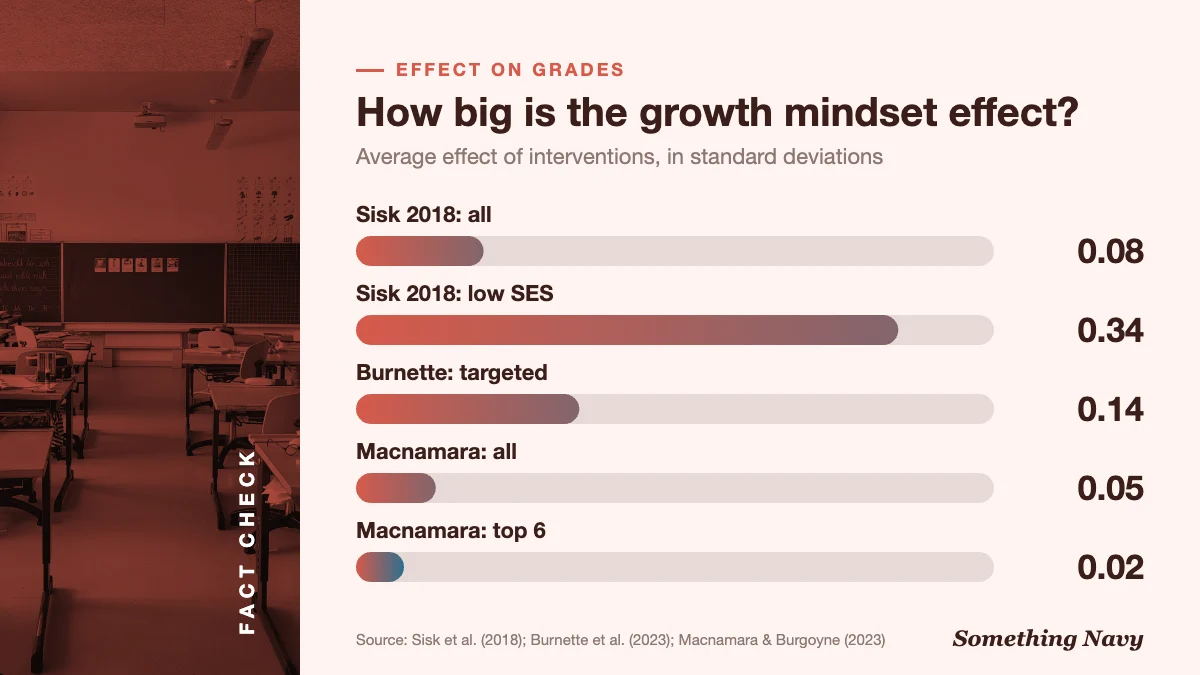
The second asked whether mindset interventions improve achievement. It pooled 43 studies with 57,155 participants. The overall effect was 0.08. Effects like this are measured in standard deviations, so the average gain was less than a tenth of one. Of the 43 effects, 37 were not significantly different from zero.
“Overall effects were weak for both meta-analyses,” the authors concluded.
There was one hint of something more. For students from low socioeconomic backgrounds, the intervention effect was larger, at 0.34. But that estimate rested on just seven effects and 577 people, and the authors urged caution. Hold on to that detail. It comes back.
Verdict on Claim 2, that a growth mindset goes with better grades: true, but weakly. Believing ability can grow is linked with achievement, yet the link is small and many individual studies find nothing.
The English schools trial that found no impact
Britain ran its own test. The Education Endowment Foundation (EEF), which commissions independent evaluations of teaching approaches, backed a programme called Changing Mindsets, delivered by the University of Portsmouth.
It was not a small study. The trial involved 5,018 Year 6 pupils in 101 schools. Teachers received training, lesson plans and classroom resources, ran sessions over eight weeks and were encouraged to weave the message into everyday feedback. The independent evaluation was carried out by the National Institute of Economic and Social Research.
The result, published by the EEF in July 2019, was clear. Pupils made no additional progress in literacy or numeracy on their national Key Stage 2 tests. On the project page, the EEF adds that pupils eligible for free school meals did not benefit either, and that there was no evidence of impact on self-efficacy, test anxiety or self-regulation.
There is a fair caveat. The EEF noted that many teachers in the control schools already knew about growth mindset theory, which may have blurred the comparison. When an idea is everywhere, it is hard to find a group that has never heard it.
Even so, the EEF’s advice was blunt: teachers “should be cautious about using the approach as a standalone method of improving pupil attainment”.
Inside the US National Study of Learning Mindsets
Supporters of the idea had an answer to the critics: many early studies were small and varied, so test it properly, at scale, with the analysis plan fixed in advance. That is what a large team led by David Yeager, with Dweck among the co-authors, set out to do.
Their results appeared in Nature in 2019. The study randomly assigned 12,490 ninth-graders in a nationally representative sample of US secondary schools. The intervention was tiny: two self-administered online sessions of about 25 minutes each, roughly 20 days apart. Less than an hour in total.
The main pre-registered question was about lower-achieving students, defined as those whose grades were at or below their school’s median before the study. For that group, 6,320 students in the main analysis, core-course grades rose by 0.10 grade points compared with controls. In standardised terms that is 0.11, a small effect.
An exploratory analysis, not planned in advance, found that across all students in the 41 schools with the relevant data, enrolment in advanced maths the following year rose from 33% to 36%.
The effect also depended on the school. It was larger where classmates tended to seek out challenging work, and the authors measured this rather than manipulating it, so they did not claim it as cause and effect.
Look at what this study is, and what it is not. It is unusually rigorous, very large and honest about its target group. It also found a modest gain for that group, not a transformation.
A tenth of a grade point is not a miracle. For less than an hour of a student’s time, it is not nothing either.


Two rival meta-analyses, three weeks apart
In late 2022, the debate came to a head in Psychological Bulletin, in two papers that appear together in the 2023 volume.
The first, led by Jeni Burnette of North Carolina State University, reviewed randomised studies published from 2002 to 2020, covering 53 independent samples. Rather than asking only whether mindset interventions work on average, it asked for whom and under what conditions. When interventions targeted the students expected to benefit most and were delivered as intended, the team reported a small positive effect on academic achievement of 0.14. The prediction interval, though, ran from slightly below zero to 0.35, meaning a future study could plausibly find nothing.
The second, from Brooke Macnamara of Case Western Reserve University and her co-author Burgoyne, pooled 63 studies with 97,672 participants. They rated each study against a list of best practices for drawing causal conclusions. They found an overall effect of 0.05, which was no longer significant after correcting for publication bias. In the 13 studies where the intervention was shown to have actually changed students’ mindsets, the effect was 0.04. In the six highest-quality studies, it was 0.02. Neither was significant.
They also flagged a pattern in who reported what. Published studies by authors with a financial incentive to report positive results averaged an effect of 0.18. Published studies by authors without one averaged −0.10.
Why the same studies produced opposite headlines
How can two serious teams read largely the same evidence and come away so differently? Mostly, they asked different questions.
Macnamara and Burgoyne asked whether these interventions raise achievement in general, and whether the effects survive strict quality checks. Burnette’s team asked where the effects are concentrated. Both sets of answers can be true at once: a tiny average, with most of it coming from one group.
Elizabeth Tipton, a statistician at Northwestern University, made this case in a commentary, reanalysing the Macnamara studies with Burnette’s methods and finding positive results for low-income and low-achieving students, as the Hechinger Report described. She used a gardening analogy: “When you look across many people’s gardens, it doesn’t look like it works on average.” The point is that something can help the plants that need it and still look useless across every garden.
Macnamara’s side has an answer to that too. In their paper they argued that apparent effects are likely explained by “inadequate study design, reporting flaws, and bias”, and their quality checks found no study that met every best-practice criterion.
On money, it is fair to report both sides. Dweck told the Hechinger Report she had divested from Mindset Works, a company that sells mindset lessons, “years ago”, and said: “None of us make money from any product.”
Verdict on Claim 3, that teaching a growth mindset raises achievement for everyone: not supported. The large reviews find small or no average effects, and England’s biggest trial found none.
Verdict on Claim 4, that a short lesson can help struggling students: plausible but contested. The strongest single trial and the targeted meta-analysis point to a small gain for lower-achieving or disadvantaged students. The sceptical review says even that does not survive its quality filters.
The growth mindset report card
Here is where each claim stands after weighing both sides.
| Claim | What the evidence shows | Verdict |
|---|---|---|
| Praising intelligence backfires | Six 1998 lab experiments with fifth-graders; 67% of “smart”-praised children chose easier tasks vs 8% of effort-praised. | Supported, short term |
| A growth mindset goes with better grades | Pooled correlation of 0.10 across 273 studies (Sisk et al., 2018). | True but weak |
| Mindset lessons lift achievement for all | Average effects of 0.08 and 0.05; no impact in an EEF trial of 5,018 pupils. | Not supported |
| A short lesson helps struggling students | +0.10 grade points for lower achievers in a 12,490-student trial; disputed by Macnamara & Burgoyne. | Plausible, contested |
Fact-check verdict
- Claim: Teaching children a growth mindset improves their results.
- Rating: Mostly overstated.
- Why: Across hundreds of studies, the average effect on grades is small and, in the strictest analysis, indistinguishable from zero. England’s large 2019 trial found no gain.
- What holds up: A brief, well-designed online lesson produced a small grade gain for lower-achieving US ninth-graders in a rigorous national trial, and praise for effort beats praise for “being smart” in the lab.
Why the idea still matters, at the right size
None of this makes growth mindset a fraud. The core belief, that abilities can be developed with practice and good strategies, is true. Nobody serious disputes that people learn.
The problem was the size of the promise. A poster cannot do what teaching, feedback and support do. When schools treated a mindset message as a fix in itself, the data say they got little back.
It fits a familiar pattern in popular psychology. A careful, modest finding gets retold until it promises far more than it found, as happened with power poses and the left-brain, right-brain myth.
The fairest summary is not “it works” or “it’s debunked”. It is that a growth mindset is a small lever. Small levers are still worth pulling, as long as nobody pretends they move mountains.
How to use growth mindset research at home, school or work
Strip away the slogans and some practical, evidence-based habits remain. None of them needs a laminated poster.
Praise the process, specifically
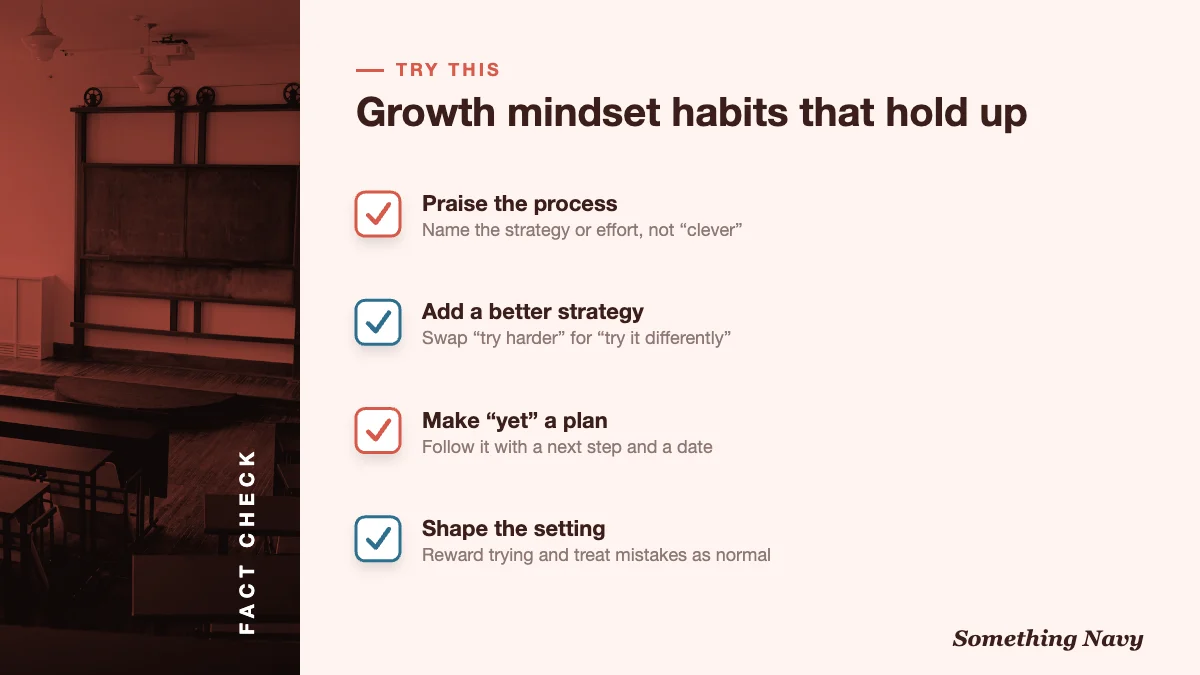
The 1998 experiments contrasted “You must be smart” with “You must have worked hard”. The useful lesson is to comment on what someone did: the strategy they tried, the draft they reworked, the problem they stuck with. That gives them something to repeat. A label like “clever” gives them something to protect.
Pair belief with a better strategy
Effort alone is not the point. In the 2007 classroom study, the message about the brain growing came alongside lessons on how to study. If a child, or a colleague, is stuck, “try harder” is less useful than “try it a different way”. A concrete plan helps here, and if-then planning is one well-tested way to make one.
Treat “yet” as a plan, not a mood
The poster’s favourite word is “yet”. It is most useful when followed by a next step: what will you practise, when, and how will you know it is working? Without that, it is just optimism.
Notice the setting, not just the student
In the 2019 national trial, the message worked better in schools where peers tended to take on hard work. A mindset is easier to keep when the people around you reward trying, and do not punish mistakes. If you lead a team or a classroom, the culture you set may matter as much as anything you say.
Go easy on yourself when ability feels fixed
Fixed thinking often shows up as “I’m just not a maths person” or the nagging sense of being found out at work, a close cousin of imposter syndrome. Simply telling yourself to think differently can feel hollow. Treating a setback with the kindness you would show a friend, which is the core of self-compassion, gives you a steadier place to try again from.
Be sceptical of anything sold as a cure
If a programme promises to transform results through mindset alone, the best available evidence says to be careful. Look for whether it was tested in a randomised trial, how large the effect was and who it helped.
The poster can stay on the wall. Just read it as what the research says it is: a nudge in the right direction, most useful to the children who are finding school hardest, and only one small part of what helps anyone get better at anything.
Frequently asked questions
No. The idea that abilities can be developed is sound, but the claim that teaching it reliably raises grades is overstated. Large reviews find small average effects, and the strictest analysis finds none after correcting for bias.
The best evidence points to lower-achieving and disadvantaged students. In the 2019 US national trial, lower achievers gained 0.10 grade points, while sceptics argue even that may not hold up.
Praising effort and strategy rather than fixed ability is supported by the 1998 experiments, which found intelligence praise made children avoid challenges after a setback. Specific, honest praise about what they did is the safest choice.
The EEF’s 2019 evaluation of 5,018 Year 6 pupils in 101 schools found no extra progress in literacy or numeracy. Many control teachers already knew the theory, which may have blurred the comparison.
Official links and research
- Mueller, C. M., & Dweck, C. S. (1998). Praise for intelligence can undermine children’s motivation and performance. Journal of Personality and Social Psychology, 75(1), 33–52. DOI
- Blackwell, L. S., Trzesniewski, K. H., & Dweck, C. S. (2007). Implicit theories of intelligence predict achievement across an adolescent transition: A longitudinal study and an intervention. Child Development, 78(1), 246–263. DOI
- Sisk, V. F., Burgoyne, A. P., Sun, J., Butler, J. L., & Macnamara, B. N. (2018). To what extent and under which circumstances are growth mind-sets important to academic achievement? Two meta-analyses. Psychological Science, 29(4), 549–571. DOI
- Yeager, D. S., Hanselman, P., Walton, G. M., Murray, J. S., Crosnoe, R., Muller, C., Tipton, E., Schneider, B., Hulleman, C. S., Hinojosa, C. P., Paunesku, D., Romero, C., Flint, K., Roberts, A., Trott, J., Iachan, R., Buontempo, J., Yang, S. M., Carvalho, C. M., … Dweck, C. S. (2019). A national experiment reveals where a growth mindset improves achievement. Nature, 573(7774), 364–369. DOI
- Burnette, J. L., Billingsley, J., Banks, G. C., Knouse, L. E., Hoyt, C. L., Pollack, J. M., & Simon, S. (2023). A systematic review and meta-analysis of growth mindset interventions: For whom, how, and why might such interventions work? Psychological Bulletin, 149(3–4), 174–205. DOI
- Macnamara, B. N., & Burgoyne, A. P. (2023). Do growth mindset interventions impact students’ academic achievement? A systematic review and meta-analysis with recommendations for best practices. Psychological Bulletin, 149(3–4), 133–173. DOI
- Education Endowment Foundation. (2019, 11 July). EEF publishes new evaluation reports, including findings from ‘growth mindsets’ approach. Link
- Barshay, J. (2022, 5 December). Proof Points: Does growth mindset matter? The debate heats up. The Hechinger Report. Link
Cover photo: Jun Ren on Unsplash. Charts and graphics: Something Navy, with photography by Ivan Aleksic, Nathan Cima and Vida Huang on Unsplash.
How we reported this. Every figure was checked against the 8 sources above. Reviewed by Valentino Adkins, Senior Content Manager. Report an error · How we work