
It is 9.40 on a Tuesday and you have opened your inbox four times since you sat down. Nothing urgent arrived. You still clicked, the way you might pat a pocket for keys you know are there.
On a hybrid day it is worse. The laptop pings, the phone buzzes a second later with the same message, and a chat window lights up asking whether you saw the email.
Most of us suspect this is not doing us any good. The interesting part is that researchers have tested it, in real offices, with inbox limits, activity logs and heart-rate monitors strapped to people’s chests.
The headline result sounds almost too simple. When people in one Canadian study checked email three times a day for a week, they reported less daily stress, without answering fewer messages. But the rest of the evidence adds a twist that matters for anyone trying to copy it.
The University of British Columbia email experiment
In 2015 Kostadin Kushlev, then a PhD candidate, and Elizabeth Dunn, both psychologists at the University of British Columbia in Vancouver, published what they described as the first field experiment on how often people check email. It appeared in Computers in Human Behavior.
They recruited people who received a lot of email and sometimes felt overwhelmed by it. Of 142 adults who signed up, 124 completed enough surveys to be analysed. Their average age was 30, and about two-thirds were university students; the rest worked in fields such as health care, finance, administration and IT.
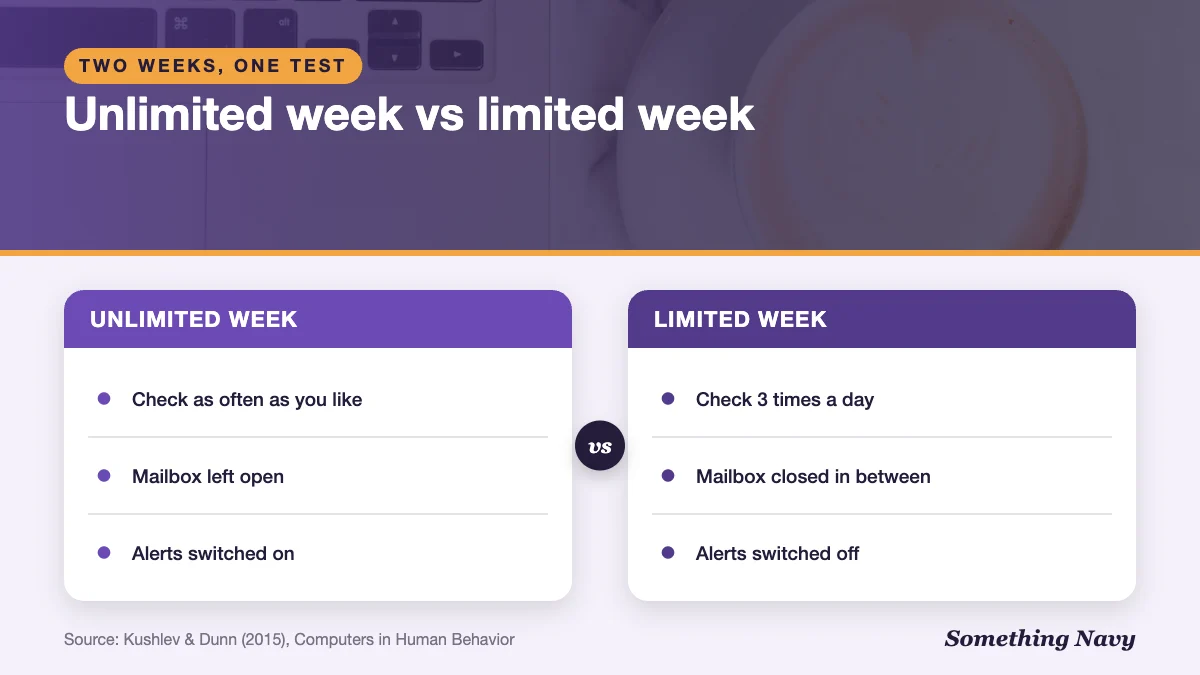
Everyone lived through two different weeks, in a random order. In the limited week, they were asked to check email three times a day, keep the mailbox closed the rest of the time and switch off new-mail alerts. In the unlimited week, they checked as often as they liked, with the inbox open and notifications on. Each weekday at 5pm they filled in a short survey.
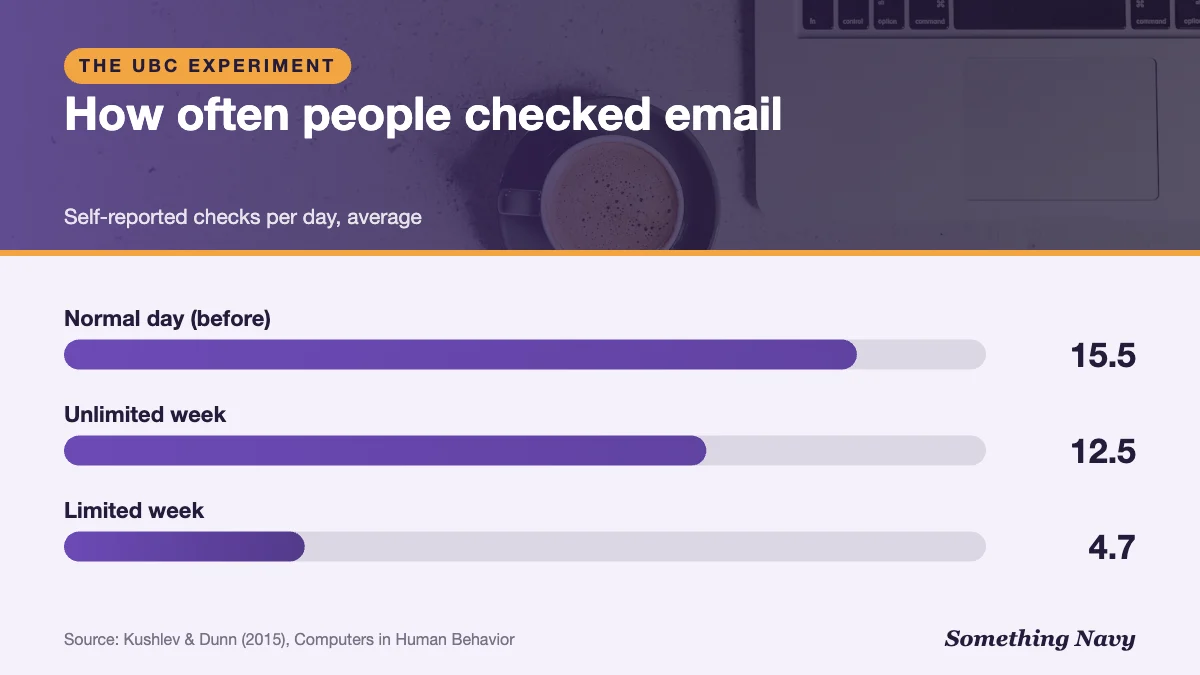
The instructions worked, roughly. People said they checked about 4.7 times a day in the limited week and about 12.5 times in the unlimited week. Before the study began, on a normal day, they reported checking around 15.5 times.
Here is the part that surprised people. They received and answered about the same number of emails in both weeks. Checking less often did not mean doing less email. It meant doing it in fewer sittings.
And in the limited week, daily stress was lower. They also felt less tense during the most important task of their day, and less distracted by email. The researchers then found that lower daily stress went along with better scores on a range of other measures, from mood and mindfulness to sleep quality and feeling productive.
The stress effect was real but modest. On average, scores dropped from 1.55 to 1.46, a small-to-medium effect by the usual yardsticks. When people looked back over the whole week, their recalled stress was no different. And self-rated productivity did not change directly at all.
It was also hard. As Kushlev told the UBC psychology department, “Most participants in our study found it quite difficult to check their email only a few times a day.”
Checking less did not mean answering less. It meant being interrupted less.


What happened when one office switched email off for five days
A few years earlier, Gloria Mark, an informatics professor at the University of California, Irvine, had tried a blunter test. With her colleague Stephen Voida and Armand Cardello, a senior research scientist with the US Army, she cut off email entirely for a small group of civilian staff at the Army’s Natick Soldier Systems Center near Boston.
The paper, presented at the CHI conference on human-computer interaction in 2012, followed 13 information workers. For three days they used email as normal. For the next five, an Outlook rule quietly filed incoming mail away and they were asked not to send work email.
Software logged every time they switched between windows on their computers. With email, they switched about 37 times an hour. Without it, about 18. Each window stayed in focus for an average of roughly 132 seconds, up from about 76.
Every one of the 13 switched less often once email was gone.
They also wore heart-rate monitors, which the team used to estimate stress from heart-rate variability. Here the story needs care. Technical problems meant usable heart data came from only seven people, and the difference pointed towards lower stress without email but did not reach the usual threshold for statistical significance. A questionnaire on workload found no clear difference either.
What participants said was clearer. In interviews they described feeling more focused and more relaxed. As Mark put it in the university’s announcement: “We found that when you remove email from workers’ lives, they multitask less and experience less stress.”
There was a cost, though. Some felt cut off. Their colleagues showed a trend towards finding it harder to get the information they needed. Email, it turns out, is not only a source of interruptions. It is also how work gets passed along.
Inside a big company: 77 email checks a day
If the Natick study was a dramatic experiment, the next one was closer to normal office life. In 2016 Mark teamed up with Shamsi Iqbal, Mary Czerwinski and Paul Johns of Microsoft Research, and Akane Sano of the MIT Media Lab, to watch how people actually used email over roughly two working weeks.
The study followed 40 information workers from a research division of a large corporation, including administrators, engineers and managers. Software logged their computer use, chest-worn monitors tracked heart rate during waking hours, and each evening they rated their own productivity.
On average, they checked email 77 times a day. The median was 58, and one person checked 408 times.
The more time people spent in email each day, the less productive they felt. Hours with more email time were also linked to higher stress, as measured by heart-rate variability.
Then came the finding that complicates the popular advice. The researchers sorted people into “batchers”, who did most of their email in a few concentrated hours, and those who spread it through the day. Batching did not go with lower stress. In the paper’s words, “despite widespread claims, we found no evidence that batching email leads to lower stress.”
Batchers did rate themselves as more productive, but only among people who spent a lot of time on email. And people who mostly checked email on their own initiative, rather than in response to notifications, also felt more productive as their email time grew. Neither group showed lower stress.
This was an observational study at one company, so it cannot show cause and effect. But it is a useful check on the idea that a tidy inbox schedule is a cure-all.
Myth versus evidence on email checking
Put these studies side by side and several familiar claims start to wobble.
Myth: checking constantly keeps you on top of things
In the UBC experiment, people who checked about a third as often answered the same number of emails, and their self-rated productivity did not fall. Constant checking felt like vigilance, but it did not buy extra output. It mostly bought more interruptions, and if you have ever lost a train of thought to a buzz that was not even there, you know how those feel.
Myth: batching your email is a proven stress cure
Kushlev and Dunn found lower daily stress when people checked less. Mark and her Microsoft colleagues, measuring heart-rate variability rather than questionnaires, found no stress advantage for natural batchers. The two findings are not really in conflict: one tested an instruction, the other observed habits. Together they suggest batching can help, but it is not magic, and how much time email takes up overall may matter more.
Myth: interruptions just slow you down
In a 2008 lab study, Mark, Daniela Gudith and Ulrich Klocke of Humboldt University in Berlin asked 48 people, mostly German students, to work through a set of emails while being interrupted every couple of minutes. The results were not what you might expect. Interrupted people finished faster, with no more errors.
But they rated their stress, frustration, time pressure and effort higher. The authors concluded that people “compensate for interruptions by working faster, but this comes at a price”. A pinging inbox may not wreck your output. It may simply make you pay for it in tension, which is exactly what the research on multitasking would predict.
Myth: the answer is to quit email altogether
The five-day email blackout produced the sharpest change in focus, but it also left people feeling isolated and colleagues struggling to reach them. For most jobs, the realistic goal is fewer interruptions, not radio silence.
Your inbox will always have more to say. It does not need to say it every few minutes.


Comparing the four email studies at a glance
Each study has a weak spot. Read together, they point in a fairly consistent direction.
| Study | What they did | What they found | Main limitation |
|---|---|---|---|
| Kushlev & Dunn (2015) | 124 adults: one week checking 3 times a day, one week unlimited | Lower daily stress in the limited week; same number of emails answered | Self-reported, mostly students, one week each |
| Mark, Voida & Cardello (2012) | 13 Army civilian staff, five days without email | Window switching roughly halved; people felt more focused | Tiny sample; heart data from only seven |
| Mark et al. (2016) | 40 workers at one company, logging and heart monitors | More email time linked to lower productivity and higher stress; batching did not lower stress | Observational, one workplace |
| Mark, Gudith & Klocke (2008) | 48 people in a lab, interrupted while doing email tasks | Faster work, but more stress and frustration | Lab tasks, mostly students |
A short history of the inbox that never closes
Email was not born as a stress machine. In 1971 Ray Tomlinson, an engineer at the Boston firm BBN, sent messages between computers on ARPANET and picked the @ sign to separate a person’s name from their machine. He later called it “the only preposition on the keyboard.”
For decades email lived on a desk. Then it moved into pockets, and the boundary moved with it.
By 2011 Volkswagen’s works council in Germany had won a rule for staff issued with BlackBerrys: email stopped reaching their phones 30 minutes after a shift ended and resumed 30 minutes before the next one. Senior managers were exempt.
The research followed. Mark’s email blackout was presented in 2012, the UBC experiment was published in 2015 and the large-company study in 2016.
On 1 January 2017 France went further, with a “right to disconnect”. Introduced under Labour Minister Myriam El Khomri, it required organisations with more than 50 workers to negotiate with staff over switching off, or else publish a charter on out-of-hours contact. As The Local reported, the law set no sanction for firms that failed to do so.
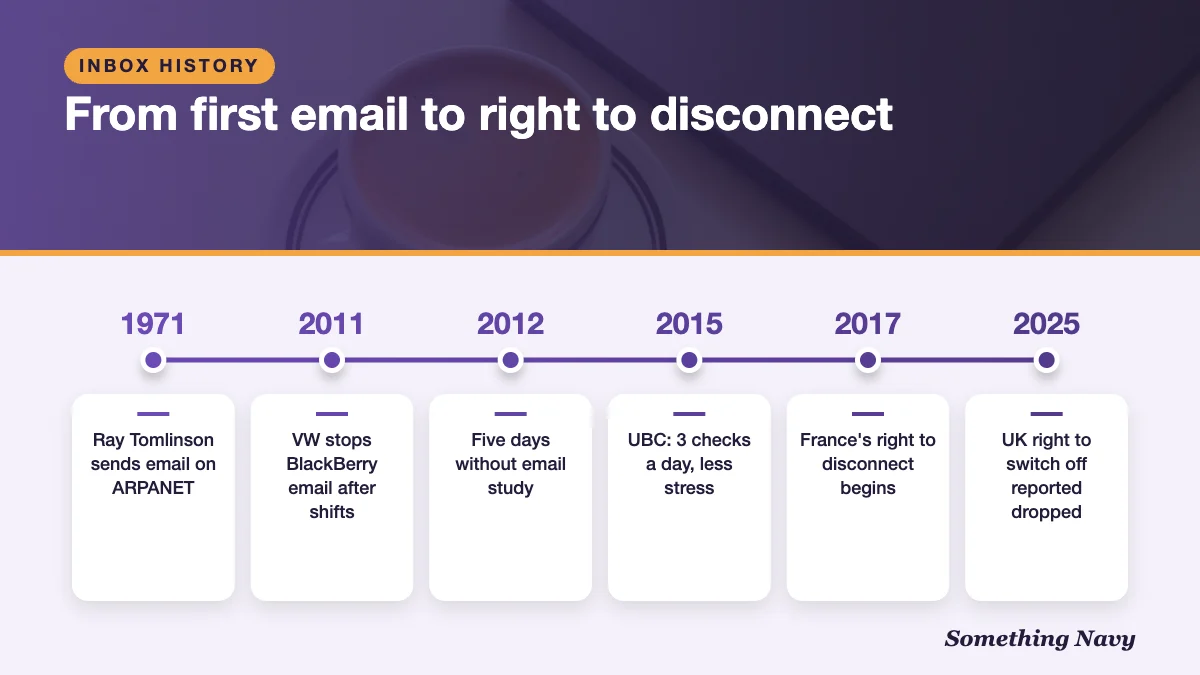
Britain has argued about the same idea. Labour’s pre-election “New Deal for Working People” promised a right to switch off. In March 2025, PA reported, citing the Sunday Times, that ministers were expected to drop it from employment reforms, with a government source saying the policy “is dead”. The Employment Rights Act became law in December 2025, and the UK still has no specific legal right to disconnect.
So for most UK workers, how often the inbox gets checked is still a matter of habit and team culture, not law.
Why hybrid work has made the email problem louder
The volume has not stood still. In June 2025 Microsoft’s Work Trend Index, drawing on anonymised Microsoft 365 data, reported that the average worker receives 117 emails a day, most of them skimmed in under a minute.
The same report said employees are interrupted every two minutes by a meeting, email or notification, and that the average employee sends or receives more than 50 messages outside core hours. Among people online at 6am, 40% are reviewing email.
Two cautions apply. These are figures from a software company that sells the tools in question, based on usage data rather than a peer-reviewed study, and they exclude EU customers. But they fit the picture you probably already recognise.
Hybrid work adds a twist. On office days, you hear the chat across an open-plan floor on top of the pings. On home days, email and messaging become the only way colleagues know you are working, which makes an unanswered message feel louder. The pressure to check is partly about being seen.
That is also why Kushlev and Dunn flagged a limitation that matters more than any statistic. They did not control what colleagues expected. If your team assumes a reply within ten minutes, checking three times a day is not a wellbeing habit. It is a risk.


How to check email less often without missing anything
The research points to a realistic middle path: fewer, deliberate check-ins, notifications off, and a clear route for anything genuinely urgent.
Try this: a calmer inbox in one week
- Pick three to five check-in times. Kushlev and Dunn chose three a day because most people could manage it. Morning, after lunch and late afternoon is a sensible start.
- Close the mailbox between check-ins. Not minimise. Close. In the UBC study, the limited week meant the inbox was shut, not just ignored.
- Turn off new-mail alerts on laptop and phone. One buzz is enough to pull you out of a task, even if you do not open the message. Keeping your phone out of sight helps too.
- Give people a fast lane. Tell colleagues to phone or message you for anything that cannot wait a few hours. That one sentence removes most of the fear of missing something.
- Use an if-then rule for the itch. “If I feel the urge to check, then I write down the thought and return to it at my next check-in.” If-then plans are one of the better-tested ways to change a habit.
- Watch total email time, not just frequency. In the large-company study, the clearest link with stress and lower productivity was simply how long people spent in email.
Expect the first few days to feel uncomfortable. That restless pull towards an unread inbox is a cousin of the Zeigarnik effect, the nagging that unfinished business produces. Writing down what you meant to check usually quietens it.
What managers can do about team email habits
Individual willpower only goes so far when the culture rewards instant replies. The researchers repeatedly suggest the bigger gains sit with teams and organisations.
- Say out loud what response time you expect. “Same day” or “within four hours” gives people permission to batch. Mark noted that participants loved being without email, “especially if their manager said it was OK”.
- Separate urgent from routine channels. If something is urgent, agree it goes by phone or a named chat channel, not a subject line in capitals.
- Stop sending at night, or schedule it. Use delayed send for evening and weekend emails so colleagues are not pulled back in.
- Cut copy lists. Every unnecessary “cc” adds to the 117-a-day pile for someone else.
- Protect focus blocks. Agree team hours with no meetings and no expectation of email replies, and do not make the person who takes them look less committed.
- Trial it and measure. Try a two-week team experiment with fewer check-ins, then ask people how stressed and productive they felt. The UBC design is simple enough to copy.
None of this needs a law. France chose to make it a negotiation, and many UK teams could have the same conversation over a Monday coffee.
Fewer check-ins, same work
The honest summary of the evidence is modest. Checking email less often seems to lower stress a little, in the short term, for people who have some control over their day. Removing email entirely sharpens focus but costs connection. And batching on its own does not guarantee calm.
Yet the most useful finding is also the most reassuring one. In the one experiment that tested it directly, people who checked a third as often still dealt with the same amount of email.
The work did not shrink. The interruptions did.
Frequently asked questions
There is no proven ideal number. The UBC study used three times a day because it was manageable for most people, and even that modest limit was linked to lower daily stress.
Switching off alerts was part of the limited condition in the UBC experiment, which reduced stress and email distraction. In a separate workplace study, people who checked on their own initiative felt more productive than notification-driven users when they spent a lot of time on email.
In the experiment that tested it, people answered as many emails as usual and their self-rated productivity did not drop. Jobs that genuinely need constant updates may be the exception.
Not as a specific legal right. France introduced one in 2017 for organisations with more than 50 workers, but a planned UK “right to switch off” was left out of the employment reforms that became law in December 2025.
Official links and research
- Kushlev, K., & Dunn, E. W. (2015). Checking email less frequently reduces stress. Computers in Human Behavior, 43, 220–228. DOI
- Mark, G., Iqbal, S. T., Czerwinski, M., Johns, P., & Sano, A. (2016). Email duration, batching and self-interruption: Patterns of email use on productivity and stress. Proceedings of the 2016 CHI Conference on Human Factors in Computing Systems. ACM. Link
- Mark, G. J., Voida, S., & Cardello, A. V. (2012). “A pace not dictated by electrons”: An empirical study of work without email. Proceedings of CHI 2012. ACM. Link
- Mark, G., Gudith, D., & Klocke, U. (2008). The cost of interrupted work: More speed and stress. Proceedings of CHI 2008, 107–110. ACM. Link
- University of California, Irvine. (2012). Jettisoning work email reduces stress. UCI News. Link
- Microsoft WorkLab. (2025). Breaking down the infinite workday. Work Trend Index special report. Link
- The Local France. (2017). France brings in “right to disconnect” law. Link
- Lynch, D. (2025). Ministers expected to axe “right to switch off” in coming week. PA Media, via Express & Star. Link
Cover photo: Andrew Neel on Unsplash. Charts and graphics: Something Navy, with photography by Liana Mikah, ubeyonroad and Kirsten Drew on Unsplash.
How we reported this. Every figure was checked against the 8 sources above. Reviewed by Brooke Hilland, Senior Content Editor. Report an error · How we work