
It is 7.40 on a Tuesday. You are standing in front of a full rail, holding the same grey jumper you wore on Friday, and thinking the familiar thought: I have nothing to wear.
Behind the jumper hangs a linen shirt with the tag still on. Next to it, a pair of trousers bought for a wedding in 2023. Further back, a jacket that looked brilliant in the shop and has never once looked brilliant on a weekday.
You are not unusual. You are average.
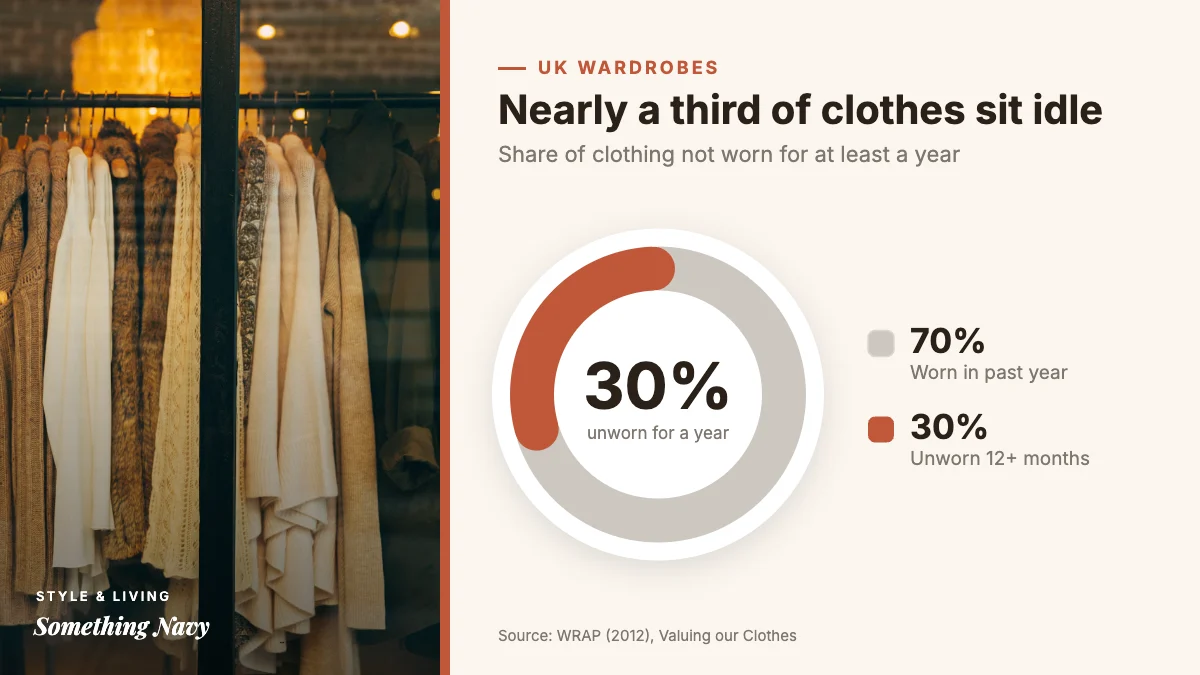
When the UK waste charity WRAP surveyed households for its report Valuing our Clothes, it found that around 30% of the clothing in the average wardrobe had not been worn for at least a year. Across the UK, that idle stock was worth roughly £30 billion. The good news: most of the reasons are predictable, which means most of them are fixable.
In brief
- About 30% of clothes in UK wardrobes had gone unworn for a year or more in WRAP’s 2012 research, with poor fit the most common reason.
- Unworn clothes are rarely random. They tend to come from a handful of thinking habits: shopping for your mood, your fantasy self or a future occasion.
- Keeping them is driven by the same biases that make letting go feel like losing money.
- A five-step wardrobe audit and a simple cost-per-wear check can stop much of the waste before it reaches the rail.
The 30% problem: what the UK wardrobe data actually shows
WRAP’s figures come from consumer research carried out for its 2012 report on the environmental and financial cost of clothing. The headline numbers are blunt. The average UK household owned around £4,000 worth of clothes, and close to a third of that wardrobe had sat untouched for 12 months or more.
The most common explanation people gave was not taste or trend. It was fit. The clothes simply no longer fitted the bodies they were bought for, or never quite had.
Two caveats are worth keeping in mind. The data is more than a decade old, and it relies on people estimating their own habits, which is never perfectly accurate. But anyone who has cleared out a wardrobe will recognise the pattern, and the psychology behind it has been studied far more recently.
Treat that 30% as a strategy problem, not a moral failing. Some buying conditions reliably produce bad calls. Here are six.
1. You shop for the weather, mood and moment you are in
Economists have a name for assuming your future self will want what you want right now: projection bias. One of the neatest demonstrations involves clothing.
Michael Conlin, Ted O’Donoghue and Timothy Vogelsang analysed US catalogue orders for cold-weather items, published in the American Economic Review in 2007. They compared the temperature on the day each order was placed with whether the item was later sent back. A 30°F (roughly 17°C) drop in temperature on the order date raised the probability of a return by 3.95%.
That is a modest effect, but the mechanism is the point. On a freezing afternoon, a heavy parka feels essential. A week later, on a mild day, the same coat feels like a mistake. The buyer has not changed. The weather has.
Most unworn clothes never get returned. They just stay, like the summer dress bought in a heatwave.
The fix: before you pay, picture a dull, ordinary day three weeks from now. Would you reach for it then?


2. Retail therapy works, and that is exactly the problem
Shopping to cheer yourself up has a poor reputation, but the evidence is more interesting than the stereotype.
Marketing researchers Selin Atalay and Margaret Meloy studied “retail therapy” in a set of studies published in Psychology & Marketing in 2011. In one, they surveyed nearly 200 shoppers at a US mall on the way in and the way out. People who arrived in a bad mood were more likely to leave having bought something unplanned for themselves. In another, 69 students kept purchase diaries. About 62% of their treat purchases were prompted by a low mood, and those treats rarely triggered regret.
The samples were small and mostly students, and mood was self-reported. Still, the finding fits everyday experience: the mood boost happens at the till. Once the bag is home, the item has already done its job.
A bargain you never wear is the most expensive thing you own.
Clothes bought for an emotional lift are bought for a feeling, not a gap in your wardrobe. That is why they so often have nothing to go with. If your unworn pieces were mostly bought on bad days, try a different mood repair: a walk, a call, anything that needs no hanger space.
3. Too many options make worse choices, sometimes
The most quoted study in this area involved jam, not jeans. In 2000, Sheena Iyengar of Columbia University and Mark Lepper of Stanford University set up tasting stalls in an upmarket grocery store, offering either 6 or 24 varieties. The bigger display drew more people, but only about 3% of those who stopped there bought jam, against almost 30% at the smaller display.
Here the nuance matters. A 2010 meta-analysis by Benjamin Scheibehenne, Rainer Greifeneder and Peter Todd pooled 50 experiments with 5,036 participants and found an average choice-overload effect close to zero. The effect clearly appears in some situations and not others.
Online clothes shopping looks like one of the riskier situations. Thousands of near-identical white shirts and a fresh “new in” feed every morning invite decision fatigue. When you are tired of comparing, you stop asking “Is this right?” and start asking “Is this fine?” Fine clothes are the ones that end up unworn.
The fix: shrink the choice set before you start. Decide the colour, fabric and price ceiling first, then shop only within those limits.
4. You buy for the life you imagine, not the one you have
Decluttering coaches call it the “fantasy self”: the version of you who hosts dinner parties, goes to gallery openings, hikes on weekends or fits into the jeans from five years ago. It is not a formal scientific term, but it describes a real pattern, and it overlaps neatly with WRAP’s finding that fit is the main reason clothes go unworn.
The trouble is not ambition. It is maths. If the imagined occasion happens twice a year, the outfit gets worn twice a year at best. Meanwhile, the life you actually lead (commutes, school runs, video calls, supermarket trips) is underserved, which is why the grey jumper does all the work.
A quick test helps. For any piece you are tempted by, ask which column it belongs in.
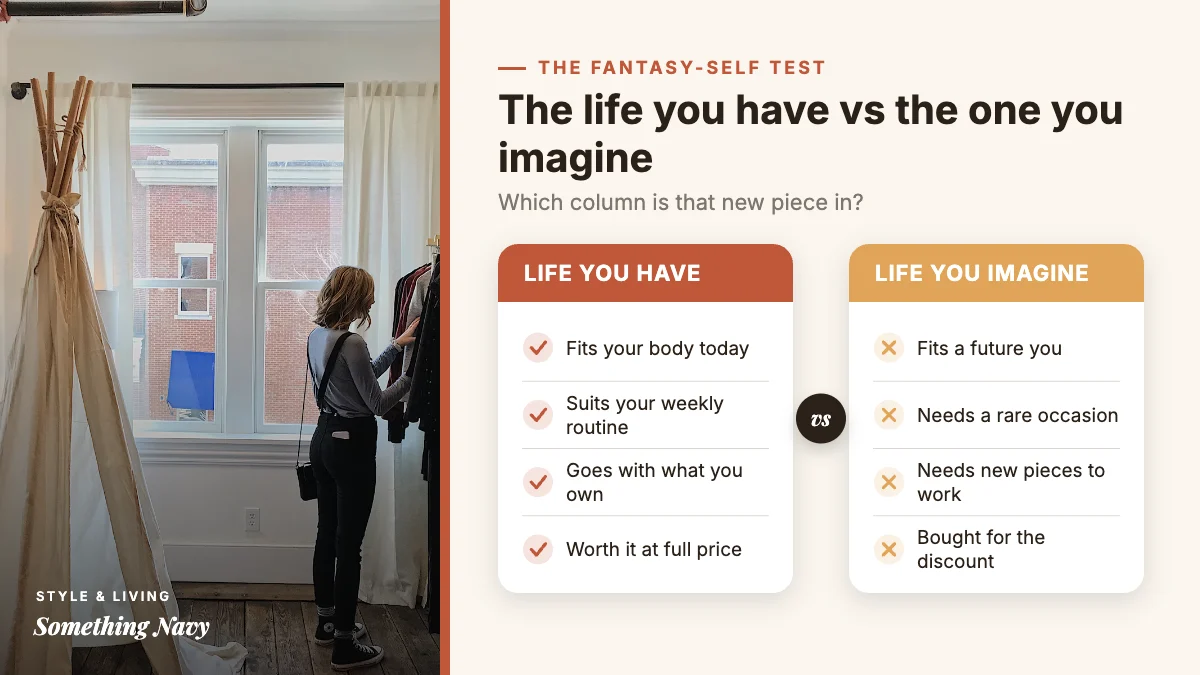
Your wardrobe is a record of who you hoped to be on the day you shopped. That is a perfectly human thing. It just needs a reality check before the money leaves your account.
5. Saving it for best: the specialness spiral
Some of the most expensive unworn clothes are not mistakes at all. They are favourites. You love the silk shirt so much that an ordinary Thursday never seems good enough for it.
Jacqueline Rifkin, then at the University of Missouri–Kansas City, and Jonah Berger of the Wharton School at the University of Pennsylvania tested this across six studies, published in 2021 in the Journal of the Association for Consumer Research. In one, people who passed up the chance to use a new notebook were less likely to use it later. In another, people who imagined deciding not to open an ordinary bottle of wine rated it as more special afterwards and became less willing to open it on an everyday occasion.
The researchers called this a “specialness spiral”. Each time you skip using something, it feels a little more precious, so the bar for wearing it rises again. The effect was strongest when people framed the delay as saving the item for later.
Saving it for best is how “best” quietly becomes “never”.
Most of the studies used hypothetical scenarios and items such as wine and notebooks rather than clothes, so treat the finding as a strong clue rather than a law. But if you own something “too nice to wear”, the advice is simple: wear it this week, on a normal day, on purpose.


6. Why letting go of unworn clothes feels like losing money
Even once you admit a piece is never going to be worn, getting rid of it is surprisingly hard. Two well-studied biases explain why.
The endowment effect
In a classic experiment published in 1990, Daniel Kahneman, Jack Knetsch and Richard Thaler gave Cornell students coffee mugs that sold for $6 in the campus bookshop. In one round, the median owner would not sell for less than $5.25, while the median would-be buyer would pay only $2.25. Simply owning the mug roughly doubled its value in the owner’s eyes.
Later research has debated how large and universal the effect is, but the pull is familiar: the unworn jacket is worth more to you than to anyone browsing a charity shop rail.
The sunk cost trap
In 1985, Hal Arkes and Catherine Blumer randomly assigned season-ticket buyers at the Ohio University Theater to pay full price ($15) or a discounted $13 or $8. Over the first five plays of the season, the full-price group used an average of 4.11 tickets, against about 3.3 for the discount groups. Having paid more, they felt more obliged to show up.
With clothes, the same pull keeps you from letting go. “I paid £90 for that” feels like a reason to keep a coat. It is not. The £90 is gone whether the coat hangs in your wardrobe or keeps someone else warm. The only live question is whether it earns its space now.
Holding on has a cost of its own, too. A packed rail makes the clothes you do love harder to find, and research on clutter and stress suggests a crowded home can weigh on your mood.
Cost per wear: the number that reframes every purchase
If there is one tool that cuts through all six habits, it is cost per wear: the price of an item divided by the number of times you actually wear it. It is not a scientific measure, just honest arithmetic, and it turns “cheap” and “expensive” upside down.
| Item | Price | Times worn | Cost per wear |
|---|---|---|---|
| Sale top bought on a bad day | £25 | 2 | £12.50 |
| Occasion dress, worn once | £150 | 1 | £150.00 |
| Well-fitting jeans | £70 | 100 | £0.70 |
| Winter coat, three winters | £180 | 180 | £1.00 |
The coat looks extravagant at the till and turns out to be excellent value. The sale top costs more per outing than a decent lunch. And a dress with one outing could have been rented or borrowed.
Use it before you buy, not after. A useful rule of thumb: if you cannot name at least 30 realistic occasions to wear something in the next year, it should clear a much higher bar. This is the logic behind a capsule wardrobe: fewer pieces, each worn often enough to justify its price.
The wardrobe audit: a five-step plan for the clothes you never wear
Knowing the psychology is half the job. The other half is one honest hour with a clear bed and three bags.
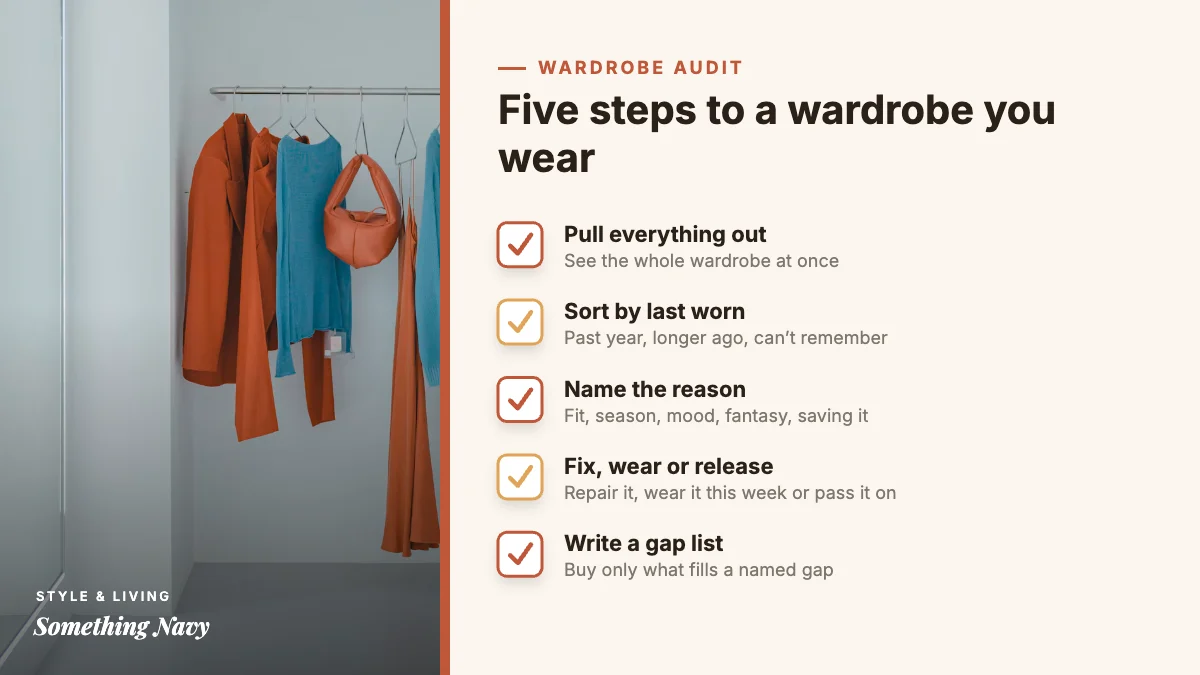
Step 1: Pull everything out
Everything, not one shelf at a time. That is how you notice four black cardigans and no trousers that fit.
Step 2: Sort by when you last wore it
Make three piles: worn in the past year, worn longer ago, and “honestly cannot remember”. The second and third piles are your personal version of WRAP’s 30%.
Step 3: Name the reason for every unworn piece
For each item in those piles, give one reason. Most will fall into the six patterns above: wrong fit, wrong season, mood purchase, fantasy self, saving it for best, or no matching pieces. Writing the reason down is the valuable part, because it shows you which habit to change.
Step 4: Fix it, wear it or let it go
Fixable items (a hem, a button, a tailor’s nip at the waist) go in the repair bag with a deadline. Anything you are “saving” gets worn within seven days. Everything else is resold, donated or recycled. If you hesitate, remember the mugs: your attachment is inflating the price.
Step 5: Write a gap list
Finish by listing what you are genuinely missing, based on the life you actually lead. That list becomes the only shopping you do for the next few months.
How to buy fewer clothes you will never wear
The audit clears the backlog. These rules stop it from refilling.
- Wait 48 hours on anything unplanned. Mood and weather-driven wants usually fade within that window.
- Shop the gap list, not the homepage. If it is not on the list, it needs a very good reason.
- Name three outfits using things you already own before buying any new piece.
- Buy for the body you have today. Clothes that fit now get worn now.
- Check the care label. Hand-wash-only and dry-clean-only pieces quietly drop out of rotation.
- Build from basics. Reliable wardrobe basics make every other piece easier to wear.
None of this requires a 30-item wardrobe or a vow never to shop again. The goal is narrower and more useful: every piece you own should have a realistic job in the life you live.
Next time you stand at that rail at 7.40 on a Tuesday, the problem will not be that you have nothing to wear. It will be that you finally know exactly what you have, and you like all of it.
Frequently asked questions
WRAP’s 2012 research found that around 30% of clothing in the average UK wardrobe had not been worn for at least a year. The most common reason given was that it no longer fitted.
A common working rule is 12 months, because that covers every season and most occasions. If a piece has gone a full year unworn and is not a genuine special-occasion item, it is unlikely to come back into rotation.
Mostly because of sunk cost and the endowment effect: the money already spent feels lost, and owning something makes it feel more valuable. Passing it on to someone who will wear it is usually the better use of that money.
Divide the price of an item by the number of times you wear it. A £70 pair of jeans worn 100 times costs £0.70 per wear, while a £25 top worn twice costs £12.50.
Official links and research
- WRAP. (2012). Valuing our clothes: The true cost of how we design, use and dispose of clothing in the UK. WRAP. Link
- Conlin, M., O’Donoghue, T., & Vogelsang, T. J. (2007). Projection bias in catalog orders. American Economic Review, 97(4), 1217–1249. DOI
- Atalay, A. S., & Meloy, M. G. (2011). Retail therapy: A strategic effort to improve mood. Psychology & Marketing, 28(6), 638–659. DOI
- Iyengar, S. S., & Lepper, M. R. (2000). When choice is demotivating: Can one desire too much of a good thing? Journal of Personality and Social Psychology, 79(6), 995–1006. DOI
- Scheibehenne, B., Greifeneder, R., & Todd, P. M. (2010). Can there ever be too many options? A meta-analytic review of choice overload. Journal of Consumer Research, 37(3), 409–425. DOI
- Rifkin, J. R., & Berger, J. (2021). How nonconsumption can turn ordinary items into perceived treasures. Journal of the Association for Consumer Research, 6(3), 350–361. DOI
- Kahneman, D., Knetsch, J. L., & Thaler, R. H. (1990). Experimental tests of the endowment effect and the Coase theorem. Journal of Political Economy, 98(6), 1325–1348. DOI
- Arkes, H. R., & Blumer, C. (1985). The psychology of sunk cost. Organizational Behavior and Human Decision Processes, 35(1), 124–140. DOI
Cover photo: Priscilla Du Preez on Unsplash. Charts and graphics: Something Navy, with photography by Hannah Morgan, Cam Morin and Egor Myznik on Unsplash.
How we reported this. Every figure was checked against the 8 sources above. Reviewed by Valentino Adkins, Senior Content Manager. Report an error · How we work