It is 7pm, the gym bag is by the door, and the sofa is winning. Then you remember: the next episode of the podcast you are hooked on is waiting, and you have promised yourself you will only hear it on the treadmill.
Suddenly the gym is not just a chore. It is the only place the story continues.
That small mental deal has a name. Behavioural scientists call it temptation bundling: you pair something you want to do but feel slightly guilty about with something you should do but keep putting off, and you only allow yourself the first while doing the second.
When it was first tested properly, at a university gym in Philadelphia, people who could only reach their gripping audiobooks at the gym initially went 51% more often than a comparison group. A much bigger trial years later found a far smaller boost. Both results matter, and together they tell you how to use the idea well.
The Hunger Games experiment at a Pennsylvania gym
The idea came from Katherine Milkman, a behavioural economist at the Wharton School of the University of Pennsylvania. She loves audiobooks and has a weakness for addictive fiction, and when she was struggling to get to the gym she began allowing herself those stories only while exercising. Later, with Julia Minson and Kevin Volpp, she decided to test whether her personal trick held up for other people.
Their study, published in Management Science in 2014, recruited 226 students and staff who were members of the university gym and said they wanted to work out more. It ran for about nine weeks, with gym check-ins tracked electronically, and people were randomly split into three groups.
- Full treatment: participants chose four tempting audiobooks, loaded onto an iPod that stayed locked at the gym. No gym, no story.
- Intermediate group: the same four audiobooks went on their own devices at home, with encouragement to listen only while exercising. Nobody checked.
- Control: a $25 Barnes & Noble gift card and encouragement to exercise more.
The novels were not chosen at random. According to Knowledge at Wharton, participants chose from “82 pre-tested novels deemed highly tempting”, which is how The Hunger Games ended up in the paper’s title.
At first, the result was striking. In the opening weeks, the full-treatment group visited the gym 51% more often than the control group, and the intermediate group 29% more often.
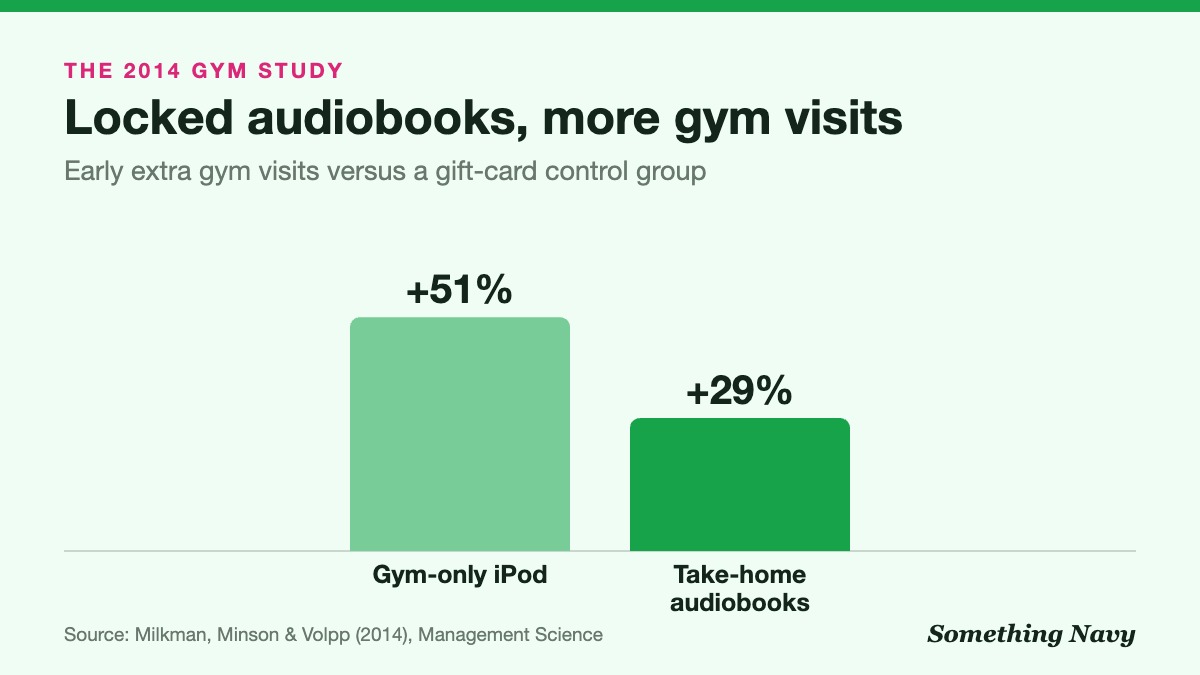
The people who had the strongest wall between the treat and the rest of their lives did best. The honour system helped too, just less.
What happened after Thanksgiving
Then came the break. Thanksgiving fell in week eight of the study, the gym closed for part of it, and attendance dropped sharply in every group. After the holiday, the extra visits faded and the differences between the groups shrank to levels the researchers could no longer reliably detect.
Milkman’s interpretation, quoted by Penn Today, was that “habits formed during school terms tend to be eliminated during breaks.” Anyone who has lost a January gym streak to a fortnight’s holiday will recognise the pattern.
There was a more hopeful finding at the end. When the study finished, participants were offered the chance to pay for gym-only access to iPods loaded with tempting audiobooks. Across the groups, 61% chose to pay to have their own access restricted in this way.
That is a remarkable number. People were paying, with real money, to have a treat taken away from them except when it was earned.
Commitment devices are usually things we resist. Here, most people asked for one.
Why pairing a guilty pleasure with a chore works
The mechanism rests on something economists call present bias. We tend to overvalue what feels good now and undervalue rewards that arrive later. Exercise, filing, revision and cleaning all cost effort today and pay off in some fuzzy future. A binge-worthy series pays off immediately and leaves a faint aftertaste of guilt.
Temptation bundling attacks both problems at once. The chore borrows some instant pleasure from the treat, so it is easier to start. The treat borrows some virtue from the chore, so you enjoy it without the nagging sense of wasted time.
Milkman put the logic neatly to Penn Today: “The instantly gratifying component grabs you in, and the long-term benefits are why you want to bundle in the first place.”
There is a second, quieter effect. If you only ever hear the next chapter while walking, you start to look forward to the walk. The craving you feel for the story becomes, in part, a craving for the setting. That is the hope, at least: that pleasure leaks from one activity into the other and nudges a habit along. If you want the longer view of how long that takes, our piece on how long it really takes to form a habit covers the research on that.
You are not bribing yourself. You are rationing something you already love so it pulls you towards something you keep avoiding.
And there is a reason the exclusivity matters. A treat you can have any time is not much of a lure. The power comes from making the chore the only door to the pleasure.


The bigger 24 Hour Fitness trial and its smaller effect
A promising nine-week study of 226 people is a starting point, not a final answer. So Milkman and colleagues tested the idea at scale. Led by Erika Kirgios, with co-authors including Angela Duckworth, the team published the results in Organizational Behavior and Human Decision Processes in 2020.
This time the participants were members of 24 Hour Fitness, one of the largest gym chains in the United States, recruited between March 2018 and January 2019 into a free, four-week programme called StepUp. The main experiment included 6,792 people, split three ways:
- a control group that received neither an audiobook nor any information about temptation bundling;
- a group that received a code for one free audiobook from Audible, and nothing else;
- a group that received the free audiobook plus an explanation of temptation bundling and an invitation to pledge to enjoy their favourite media only while exercising.
Most of that last group, 78.6%, signed the pledge. During the programme and in the weeks after it, people in the bundling group were 10–14% more likely to work out in a given week than the control group, and they made roughly 10–12% more weekly gym visits. Encouragingly, a measurable benefit was still visible weeks after the programme ended, with the authors reporting effects up to 17 weeks later.
There was a twist. The free audiobook on its own did roughly as well on some measures as the audiobook plus the lesson. On average weekly visits during the programme, the audiobook-only group actually gained slightly more over the control than the bundling group did. Being taught the strategy and asked to pledge added only a modest extra lift, mainly to whether people went to the gym at all in a given week.
The authors suggest a plausible reason: a gym chain handing out free audiobooks is itself a hint. People may have worked out the bundle without being told.
How big is the effect, really?
This is the section most articles about temptation bundling skip, so let’s be plain about it.
The famous 51% figure was real, but it described the first weeks of a small study, using locked devices, against a control group that received a gift card rather than any audiobook. In absolute terms, the Kirgios paper describes the 2014 effect as roughly 0.27 extra gym visits per week at its peak, and it notes that this boost soon fell below detectable levels.
The 2020 trial was about 30 times larger and fully digital. Its effect, around 10–14%, was smaller, and the authors themselves describe their version as roughly half as effective as the in-person 2014 intervention, though its benefits lasted longer. That is a common story in behavioural science: early, small studies often produce bigger numbers than later, larger ones.
By the numbers
- 226 university gym members in the 2014 study, which ran for about nine weeks
- 51% more early gym visits with gym-locked audiobooks, versus a gift-card control
- 61% later paid to restrict their own audiobook access to the gym
- 6,792 24 Hour Fitness members in the 2020 trial
- 10–14% higher weekly chance of working out with an audiobook plus bundling advice
It also helps to see temptation bundling alongside other ideas tested on the same kind of people. In a 2021 Nature megastudy, Milkman, Duckworth and a large team tested 54 different four-week programmes on 61,293 members of the same gym chain. About 45% of the programmes significantly increased weekly gym visits, with gains of 9–27%, and the top performer offered small rewards for getting back to the gym after a missed workout. Only 8% of the programmes produced changes that clearly outlasted the four weeks.
Put together, the honest picture is this. Temptation bundling works, modestly, for a good number of people, and it sits in the normal range for a cheap behavioural nudge. It is not a personality transplant.
Ten per cent more workouts sounds small until you add it up over a year.
Temptation bundle ideas: chores, treats and rules
The research focused on exercise and audiobooks, but the logic transfers to almost any task you resent. The trick is to choose a treat that does not ruin the chore. A thriller works on a cross-trainer; it does not work while you write a report that needs your full attention. Here are pairings that respect that limit.
| The chore | The treat | The rule |
|---|---|---|
| Gym or a brisk walk | A gripping audiobook or true-crime podcast | New episodes only while moving |
| Ironing or folding laundry | A comfort TV series you have already seen | The series stays paused unless the iron is on |
| Weekly food shop or meal prep | A favourite playlist or a phone call with a friend | Calls to that friend happen at the chopping board |
| Washing up after dinner | The next chapter of a podcast drama | The drama lives at the sink |
| Clearing your inbox or admin | A posh coffee or a pastry from a favourite café | The café is your admin office, not your treat stop |
| Stretching or physio exercises | Reality TV you would be embarrassed to admit you watch | Only on the mat, only while stretching |
| A long commute or school run | A language-learning app or audiobook series | Saved for the journey, never on the sofa |
If you notice that you are using these chores to avoid something bigger, our guide to why we procrastinate is a useful companion. Bundling makes boring tasks easier to start; it does not fix dread about a specific task.
How to design your own temptation bundle
The studies point to a few design principles. None is complicated, but skipping them is the most common reason a bundle fizzles out after a fortnight.
Start with a treat you genuinely crave
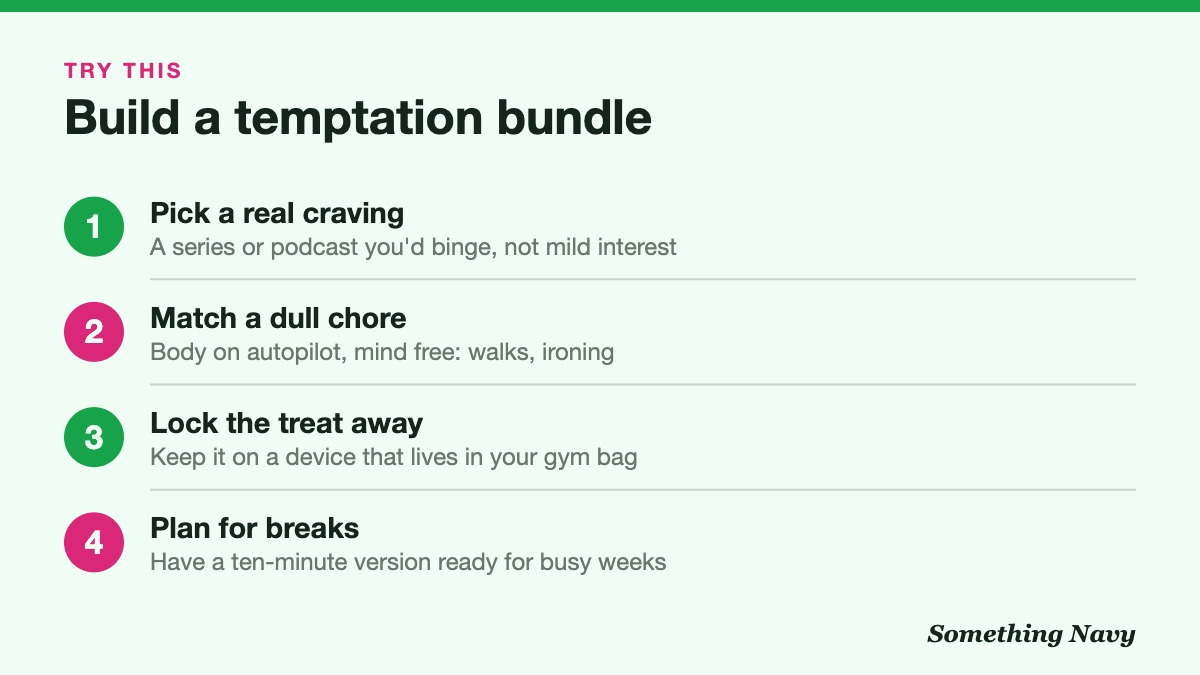
The 2014 team pre-tested novels for how tempting they were. You should do the same, informally. Mild interest is not enough. You want something you would happily lose an evening to: a series with cliffhangers, a narrator you love, a podcast you binge.
Build a wall around the treat
The biggest early effect in 2014 came from the locked iPod, not the honour system. Recreate that wall wherever you can: download the series only to an old phone that lives in your gym bag, keep the posh coffee as a strictly at-the-desk ritual, or ask a partner to hold you to it. The less willpower the rule needs, the longer it survives.
Write the rule as an if-then plan
“If I press play on the next episode, then I am on the treadmill” is much clearer than “I’ll try to save it for the gym.” Specific rules of this kind draw on the same research behind if-then planning, one of the better-supported tools in the habit literature.
Plan for the Thanksgiving problem
Breaks killed the effect in the original study. Before a holiday or a busy week, decide what the bundle looks like in miniature: a ten-minute walk with one chapter, a hotel gym with the same podcast. A shorter version keeps the link alive so you are not starting from scratch. A new month or term can also be a good moment to restart, which is the idea behind the fresh start effect.
Refresh the treat before it goes stale
Pleasures fade with repetition. When the series ends, line up the next one before you need it, so there is never a gap where the chore stands alone.
When temptation bundling is the wrong tool
Bundling is best for tasks that are dull rather than difficult. It suits the body-on-autopilot jobs: walking, cleaning, sorting, cooking from a recipe you know. It is a poor match for work that needs concentration, where splitting your attention will make the chore slower and worse.
It also does not work if the treat is itself the problem. Bundling an extra glass of wine with the washing-up, or late-night scrolling with stretching, simply builds a new habit you might later want to break. Choose temptations that are guilty pleasures in the mild sense: a bit indulgent, not harmful.
And it will not rescue a goal you do not actually want. In both trials, the participants were people who had signed up because they wanted to exercise more. The bundle gave them a push; it did not create the wish.
Frequently asked questions
Katherine Milkman of the Wharton School coined the term and tested it with Julia Minson and Kevin Volpp in a study published in 2014. It grew out of a rule she set herself: gripping audiobooks only at the gym.
It has been tested mostly on exercise, so evidence for other tasks is thinner. It is likely to help most with routine admin or tidying, and least with work that needs deep focus, because a treat that grabs your attention will compete with the task.
In the 2014 study, the gym-only iPods produced a bigger early boost than simply asking people to restrict themselves. A firm barrier, such as keeping a series on a device that stays in your gym bag, reduces how much willpower the rule needs.
In the 2014 study the boost faded after a holiday break. In the larger 2020 trial, a smaller benefit was still detectable weeks after the four-week programme ended, so planning for breaks and refreshing your treats both help.
The next time the sofa is winning, you do not need more discipline. You need a better story, and a rule that says you can only hear it once your trainers are on.
Sources
- Milkman, K. L., Minson, J. A., & Volpp, K. G. M. (2014). Holding the Hunger Games hostage at the gym: An evaluation of temptation bundling. Management Science, 60(2), 283–299. DOI
- Kirgios, E. L., Mandel, G. H., Park, Y., Milkman, K. L., Gromet, D. M., Kay, J. S., & Duckworth, A. L. (2020). Teaching temptation bundling to boost exercise: A field experiment. Organizational Behavior and Human Decision Processes, 161, 20–35. DOI
- Milkman, K. L., Gromet, D., Ho, H., Kay, J. S., Lee, T. W., Pandiloski, P., … Duckworth, A. L. (2021). Megastudies improve the impact of applied behavioural science. Nature, 600, 478–483. DOI
- Penn Today. (2014, January 16). Guilty pleasures and obtaining goals. University of Pennsylvania. Link
- Knowledge at Wharton. (2013, November 19). Using ‘The Hunger Games’ to encourage healthier choices. The Wharton School, University of Pennsylvania. Link
Cover photo: Vitaly Gariev on Unsplash. Charts and graphics: Something Navy.
How we reported this. We went back to the original research for this story, 5 sources in all, listed above, and checked every figure against them. If you think we have got something wrong, tell us and we will look at it. Read more about how we work.