
The kettle clicks off. Afternoon light falls across the worktop at a low angle, someone in the next room laughs at something on the radio, and you reach for a mug.
Then it arrives. A soft, total certainty that this exact moment, the light, the laugh, the hand on the mug, has happened before. Not something like it. This.
You know it cannot be true. The feeling does not care. It hangs there for a few seconds, oddly vivid, and then it drains away and leaves only a faint question behind.
That question has kept memory researchers busy for decades. The short version of what they have found is surprisingly reassuring: déjà vu looks less like a fault in time and more like a brain noticing that one of its own signals does not add up.
Déjà vu is one of the most common quirks of human memory
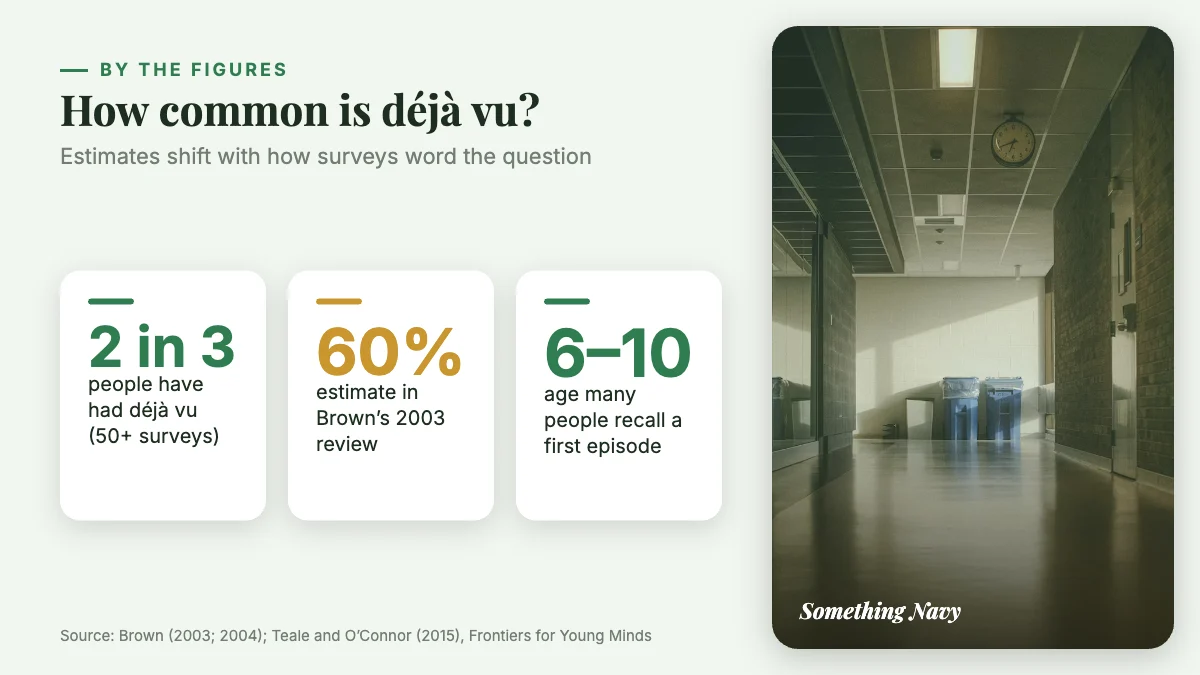
The French phrase means “already seen”, and the experience is far from rare. In 2003 the psychologist Alan S. Brown, then at Southern Methodist University in Dallas, published a review in Psychological Bulletin pulling together more than a century of surveys and case reports. His estimate was that about 60% of the population had experienced it.
A year later, in a shorter summary for Current Directions in Psychological Science, Brown put the figure at roughly two thirds, drawing on more than 50 surveys. Most people who have had one episode report several.
Those numbers come with a wobble. Julia Teale and Akira O’Connor of the University of St Andrews point out that the share depends heavily on how the question is worded, and that estimates range anywhere from about 30% to 100%. For most people who do get it, it turns up somewhere between every few weeks and every few months.
In other words, if it happens to you, you are in the majority.
First comes a familiarity signal with nothing attached
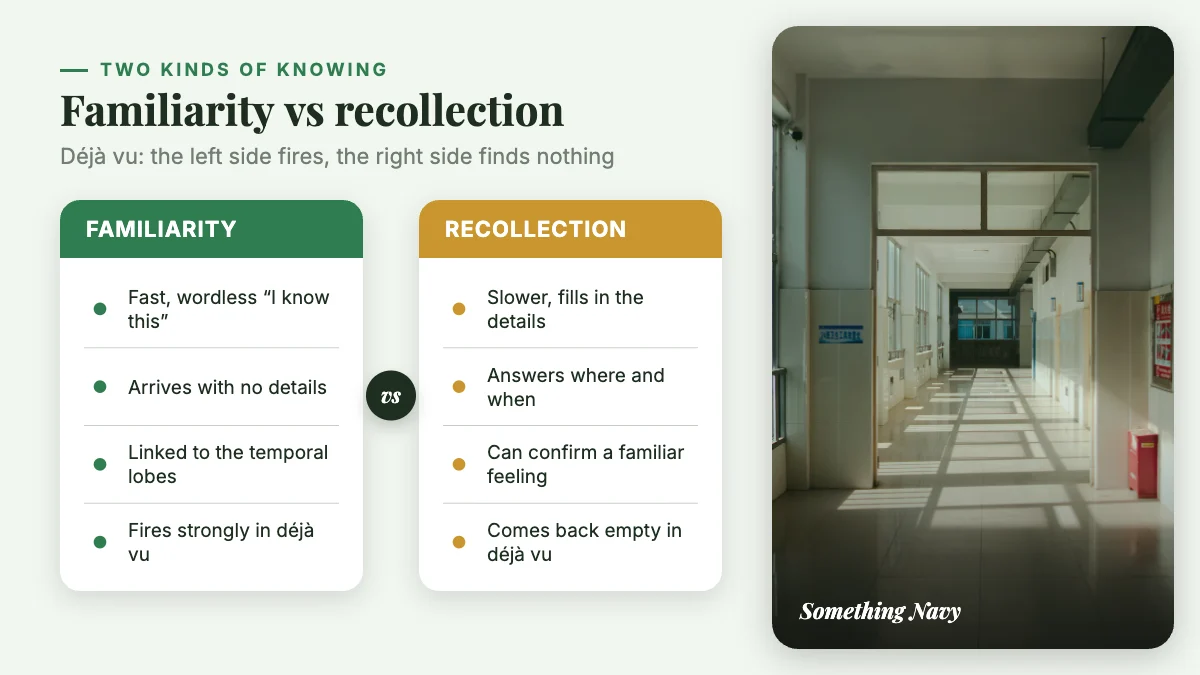
To see what goes wrong, it helps to separate two ways the brain recognises things. Memory scientists call them familiarity and recollection.
Familiarity is the quick, wordless sense that something is known. Think of a face on the bus that you just know. Recollection is the slower process that fills in the details: the woman from the dentist’s reception, last March.
Most of the time the two travel together, so you never notice they are separate. Déjà vu seems to be what happens when they come apart. The familiarity signal fires at full strength, and recollection comes back with nothing.
Anne Cleary, a cognitive psychologist at Colorado State University who has studied the experience for well over a decade, has described her working hypothesis in plain terms: “déjà vu is a particular manifestation of familiarity.” The temporal lobes, the regions on either side of the brain just above the ears, are heavily involved in producing that sense of knowing.
Familiarity is a powerful feeling that does not always explain itself, which is also why the mere exposure effect can make a song grow on you.



A virtual town called Deja ville showed how a forgotten layout can trigger it
Studying déjà vu is awkward, because nobody can order one on demand. Cleary’s solution was to build places.
In a 2012 study in Consciousness and Cognition, her team used the video game The Sims to create a set of scenes the researchers called “Deja ville”. Across two experiments, 24 and then 18 students at Colorado State University explored them through a head-mounted display.
The trick was in the furniture. Some new scenes looked nothing like earlier ones on the surface but repeated their spatial layout. A university press release gave the example of a museum whose central statue sat among benches and rugs in exactly the same arrangement as a potted plant among bushes in a courtyard seen earlier.
When people could not recall the earlier scene, the matching layout still raised their sense of familiarity, and déjà vu reports in the first experiment rose from 17% to 27% of scenes. The more strongly a scene felt familiar, the more likely it was to produce déjà vu.
The shape of a room, the angle of the light or the distance between a door and a window can echo something stored years ago, even when the memory itself stays out of reach.
That fits the scene at the kettle. Nothing in it had happened before. But something with the same bones probably had.
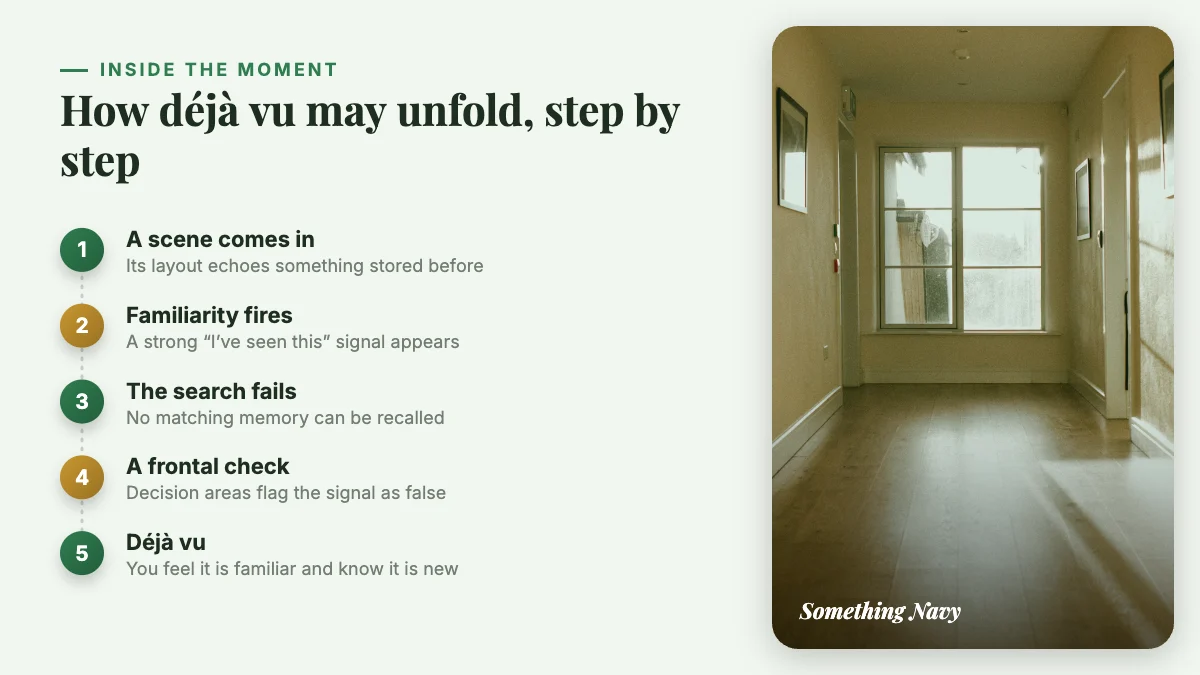
Then the brain runs a check, and déjà vu is the alarm
Familiarity without recollection usually just feels like vague recognition. What makes déjà vu so strange is the second half: the certainty that the feeling is wrong.
Akira O’Connor’s group at St Andrews tested that half directly. In 2016, at the International Conference on Memory in Budapest, the team presented preliminary brain-scanning data from 21 volunteers. Participants heard lists of related words such as bed, pillow, night and dream, which tend to make “sleep” feel familiar even though it was never said. They were then asked whether any word had started with S, and said no. So when “sleep” came up, it felt familiar while they knew it was new.
Many of them reported something resembling déjà vu. Using fMRI (functional magnetic resonance imaging, which tracks changes in blood flow as a proxy for brain activity), the team found the most active areas were frontal regions linked with decision-making, rather than the regions most associated with memory itself.
The full study was published online in the journal Memory in 2018. Of the 21 participants, 16 reported déjà vu, and the memory conflict was linked to activity in the anterior cingulate cortex, the medial prefrontal cortex and parietal cortex. The authors concluded that resolving memory conflict may play an integral role in the experience.
Think of it as a smoke alarm that goes off, followed by someone walking into the kitchen, seeing no smoke, and saying out loud: “That’s odd.” Déjà vu may be the moment you hear that remark.
Seen that way, déjà vu is not a glitch. It may be the sound of a healthy brain catching its own mistake.
Five explanations still competing for the evidence
None of this is settled. Brown’s 2003 review sorted scientific explanations into four broad families, and newer work has added a fifth way of framing the problem. They are not all mutually exclusive.
Dual processing: two systems briefly out of step
This idea holds that two cognitive processes which normally run in sync momentarily slip out of step. The result is a moment that feels new and old at the same time. It is intuitive, but hard to test directly.
A neurological misfire in the temporal lobe
Here déjà vu comes from a brief disruption in how signals pass between neurons, or a tiny seizure-like event, in the memory regions of the temporal lobe. Support comes from people with epilepsy. In a 2004 study reported by the American Psychiatric Association’s Psychiatric News, Fabrice Bartolomei’s team in Marseille electrically stimulated four structures in 24 patients with drug-resistant epilepsy. Of 280 stimulations, 19 produced déjà vu, and 14 of those were in the entorhinal cortex, part of the rhinal cortex that sits on the inner surface of the temporal lobe.
That shows the region can generate the feeling. It does not prove that everyday déjà vu in people without epilepsy works the same way.
Hidden memory: the resemblance account
This is Cleary’s approach. A current scene resembles something you have genuinely experienced but cannot recall, and the resemblance alone drives familiarity. The Deja ville experiments are its strongest evidence.
Split attention: seeing it twice
Brown described this family as unattended perception followed by attended perception. You take in a scene while distracted, perhaps glancing at a phone, then look properly a moment later. The second, fuller look meets a faint trace of the first and reads it as an old memory.
Memory conflict: the checking account
O’Connor’s framing focuses less on where the false familiarity comes from and more on the frontal process that spots it. On this view, déjà vu needs both a misleading signal and a working fact-checker.
Why déjà vu feels like a premonition
Many people describe déjà vu as knowing what is about to happen next. Cleary and her former graduate student Alexander Claxton put that to the test in a 2018 paper in Psychological Science.
Participants watched scenes that moved them along a route with a series of turns. Some later routes matched the layout of earlier ones they could not consciously recall, which made déjà vu more likely. At the final junction, the video stopped and they were asked which way the next turn would go.
About half of participants reported a strong feeling of premonition during déjà vu. They were no better than chance at picking the right turn.
The researchers concluded the sense of prediction can be illusory. The feeling of knowing is real; the knowing is not.


Déjà vu peaks in your teens and twenties, then fades
Age is one of the most consistent patterns in the surveys. Teale and O’Connor note that many people place their first episode between the ages of 6 and 10, that reports peak from the mid-teens to the mid-twenties, and that they steadily decrease after about 25.
Brown’s reviews found the same decline, along with a higher incidence among people with more education and higher incomes, and among people who travel. Why déjà vu becomes rarer with age is still an open question.
For anyone who notices it less than they used to, that is the expected pattern, not a sign of anything wrong.
Tiredness, stress and unfamiliar places seem to make it more likely
Brown’s reviews link déjà vu with stress and fatigue, which frequently accompany it. Travel shows up in the data too.
These are associations from surveys rather than proof of cause. Still, they fit the lab picture. New places are full of layouts that partly echo old ones, and a tired or distracted brain may be more likely to take in a scene in two uneven glances. A similar mismatch between surroundings and memory turns up in the doorway effect, where walking into a new room wipes the reason you went there.
By the numbers
- Over 50 surveys of déjà vu reviewed by Alan S. Brown by 2004.
- 24 and 18 students explored Cleary’s virtual “Deja ville” across two experiments.
- 16 of 21 volunteers reported déjà vu in O’Connor’s brain-scanning study.
- 19 of 280 electrical stimulations produced déjà vu in Bartolomei’s 2004 epilepsy study.
- About half of participants felt a strong premonition in Cleary and Claxton’s 2018 study, with no better than chance accuracy.
The temporal lobe epilepsy link, explained calmly
Déjà vu has a well-known connection with epilepsy, and it is worth understanding properly rather than worrying about.
Focal seizures begin in one part of the brain and, according to the UK charity Epilepsy Action, they most commonly start in the temporal lobes. Some people get a warning before a larger seizure, often called an aura. Medically, an aura is itself a small focal seizure, and a feeling that what is happening has happened before is one recognised form it can take.
Epilepsy Action lists other temporal lobe signs that can come alongside it, including a rising sensation in the stomach and an unpleasant taste or smell. Most focal seizures last between a few seconds and a few minutes.
Context matters. Brown’s 2004 summary concluded that déjà vu on its own does not have diagnostic or clinical significance for epilepsy. For the large majority of people, an occasional episode is simply part of how a normal memory system works.
When to mention it to a doctor
This is general information, not medical advice. Occasional, brief déjà vu that passes and leaves you feeling yourself is very common and usually needs no action. It may be worth booking a GP appointment if episodes:
- come with other unusual sensations, such as a rising feeling in the stomach or a strange taste or smell;
- are followed by confusion, a gap in awareness, or someone telling you that you seemed blank or unresponsive;
- start happening much more often than usual, or feel very different from the déjà vu you have had before;
- come alongside any other new or worrying symptom.
A GP can ask the right questions and, if needed, refer you to a specialist. Epilepsy Action advises calling an ambulance if someone has their first seizure, or if a seizure lasts longer than five minutes.
Writing down when episodes happen, how long they last and anything that came with them can make that conversation much easier.
What to do the next time it happens
Knowing the mechanism changes how the moment feels. Instead of a shiver, it can become a small piece of live neuroscience.
Next time, try three things. Notice where you are and what the space looks like, since layout seems to matter more than objects. Ask whether you are tired, rushed or somewhere new. And resist the pull of the premonition: the sense that you know what comes next is, on the best evidence available, a feeling rather than a forecast.
The same quiet filing system explains why a smell can drop you into a childhood kitchen.
The light on the worktop, the laugh from the next room. Your brain found an echo and then had the good sense to doubt it.
Frequently asked questions
Usually not. It is common in healthy people, especially in their teens and twenties. It is worth raising with a GP if it comes with other symptoms, such as an odd smell or taste, a rising stomach feeling or lost awareness.
There is no evidence that it can. In Cleary and Claxton’s 2018 experiment, people felt they knew the next turn during déjà vu but chose it no more accurately than chance.
Surveys consistently find that déjà vu becomes less frequent with age, with reports declining from the mid-twenties onwards. The reason is not yet known.
Survey research links déjà vu with stress and fatigue, but that is an association rather than proof of cause. Which comes first has not been established.
Official links and research
- Brown, A. S. (2003). A review of the déjà vu experience. Psychological Bulletin, 129(3), 394–413. DOI
- Brown, A. S. (2004). The déjà vu illusion. Current Directions in Psychological Science, 13(6), 256–259. DOI
- Cleary, A. M., Brown, A. S., Sawyer, B. D., Nomi, J. S., Ajoku, A. C., & Ryals, A. J. (2012). Familiarity from the configuration of objects in 3-dimensional space and its relation to déjà vu: A virtual reality investigation. Consciousness and Cognition, 21(2), 969–975. DOI
- Cleary, A. M., & Claxton, A. B. (2018). Déjà vu: An illusion of prediction. Psychological Science, 29(4), 635–644. DOI
- Urquhart, J. A., Sivakumaran, M. H., Macfarlane, J. A., & O’Connor, A. R. (2018). fMRI evidence supporting the role of memory conflict in the déjà vu experience. Memory, 29(7), 921–932. DOI
- Teale, J. C., & O’Connor, A. R. (2015). What is déjà vu? Frontiers for Young Minds, 3, 1. DOI
- Psychiatric News (2004). Déjà vu experiences linked to brain region (report on Bartolomei et al., Neurology, 63, 858). Link
- Epilepsy Action. Focal seizures. Link
Cover photo: Arisa Chattasa on Unsplash. Charts and graphics: Something Navy, with photography by chris wang, Al Butler and Allen Y on Unsplash.
How we reported this. Every figure was checked against the 8 sources above. Reviewed by Brooke Hilland, Senior Content Editor. Report an error · How we work