Your phone lights up with a number you don’t recognise. Your stomach drops a little, your thumb hovers, and you watch it ring out until the screen goes quiet.
Then you wait to see if they leave a voicemail. Or, better, send a text.
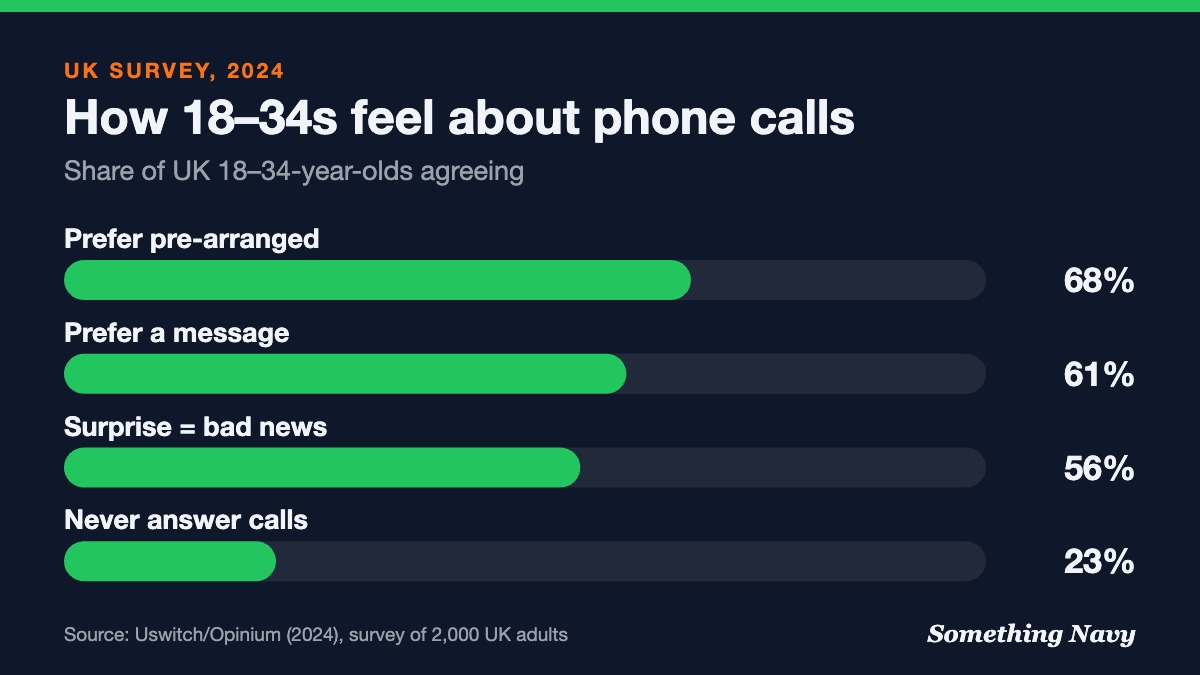
If that sounds familiar, you have a lot of company. In an April 2024 survey of 2,000 UK adults, run by Opinium for the comparison site Uswitch, 23% of 18–34-year-olds said they never answer voice or audio calls at all. Among people aged 55 and over, the figure was 8%.
It is easy to read that as a generational quirk, or as proof that young people have lost the knack of talking. The research tells a more interesting story. Most of what we fear about a phone call turns out to be a forecasting error: we expect it to feel worse than it does, and we expect the other person to mind more than they do.
So let’s take the common beliefs about phone dread one at a time, set them against the evidence, and finish with a short guide to actually making the call.
What the 2024 Uswitch survey found about 18–34s and phone calls
The Uswitch numbers are worth a closer look, because they say less about laziness than about expectation. Among 18–34s, 56% agreed that an out-of-the-blue call probably means bad news. Across all adults the figure was 43%.
Younger respondents were also clear about how they like to be contacted. Some 61% said they would rather receive a message than an audio call, and 68% said they prefer calls that are arranged in advance.
Put those together and a pattern appears. The phone itself isn’t the problem. The surprise is.
A few caveats. This is a commercial poll, published as a press release rather than a peer-reviewed paper, and Uswitch does not publish the size of each age group. It tells us how people describe their habits, not how often they actually let the phone ring. Still, it is a large, recent sample, and its headline matches what many of us see in our own call logs.
It also fits a longer trend. Back in 2012, Ofcom’s Communications Market Report found that 58% of UK adults texted friends and family at least once a day, against 47% who talked on a mobile daily. In the same report, minutes of calls made from mobiles fell for the first time, down 1.1% on 2010. A whole generation has since grown up with typing as the default and calling as the exception.
Myth: young people ignore calls because they can’t be bothered
The evidence points somewhere else. When Uswitch asked why people avoid answering, the most common reason across all ages was nuisance calls: 63% said spam and scam calls made them more likely to leave the phone alone. Among the over-55s, 74% said this was their top reason. Half of all respondents said they wanted to find out who was calling first.
That is not an irrational fear. In January 2024, Ofcom research with YouGov surveyed 2,096 UK adults about fraud. Among the 1,732 who had previously received suspicious mobile calls, 18% said they were getting a little more than a year earlier and 11% a lot more.
So screening an unknown number is often sensible self-defence. The trouble starts when the habit spreads to calls from people we know, and to calls we need to make ourselves: the GP surgery, the landlord, the friend whose birthday we half-remembered.
That is where a different force takes over. Not caution, but dread.


Myth: a phone call will be more awkward than a text
This is the belief at the heart of phone anxiety, and it is the one that has been tested most directly.
In a set of experiments published in 2021 in the Journal of Experimental Psychology: General, Amit Kumar of the University of Texas at Austin and Nicholas Epley of the University of Chicago asked people to reconnect with an old friend they hadn’t been in touch with for a while.
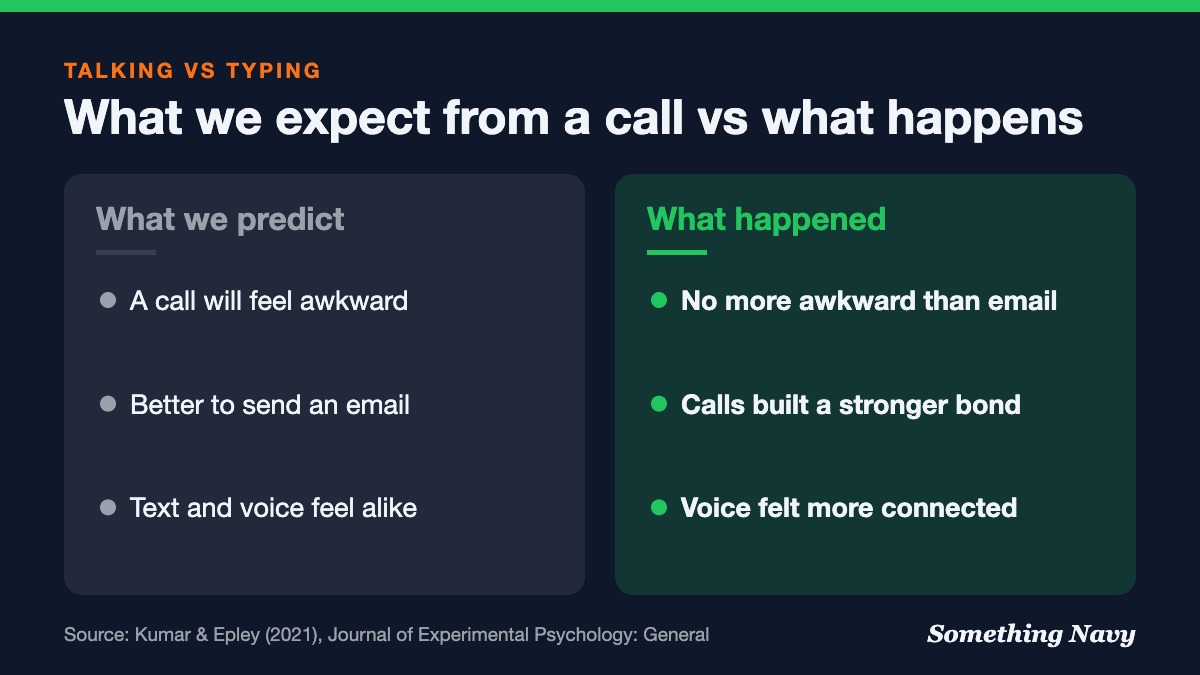
In one study, 200 participants first predicted how reconnecting would feel by email and by phone. They expected a call to create a closer connection, but they also expected it to be more awkward, and so most said they would rather email. Then the researchers randomly assigned each person to one method and had them actually do it.
The calls did create a stronger bond. They were not more awkward. And when the researchers timed both, a call took about as long as writing and reading emails.
In another experiment, strangers were paired up and randomly assigned to talk by text chat, by audio only or by video, answering personal questions such as whether there was something they had long dreamed of doing. Participants predicted the medium wouldn’t make much difference. In practice, they felt more connected when they could hear each other’s voices than when they typed, with no extra awkwardness. Audio alone did about as well as video.
The authors summed it up neatly: “The human voice appears to provide benefits for connection without the expected costs.”
We dread the phone for the awkwardness it might bring, then miss the closeness it actually brings.
These were controlled experiments, mostly with US participants, and they measured how people felt straight afterwards. They don’t prove that every call will go smoothly. They do show that our predictions about calls are systematically gloomier than our experience of them.
Myth: calling someone out of the blue is an imposition
Recall that 56% of young adults in the Uswitch poll assume a surprise call signals bad news. It is natural to project that onto other people and assume our own call will land as an interruption.
Peggy Liu of the University of Pittsburgh and colleagues tested a related assumption. In a series of preregistered experiments with more than 5,900 participants, published in 2023 in the Journal of Personality and Social Psychology, people reached out to someone they hadn’t spoken to in a while, with a short note or a note and a small gift. Senders predicted how much it would be appreciated. Recipients then said how much it actually was.
Senders consistently underestimated the appreciation. The gap was biggest when the contact was more surprising, which is exactly the situation that makes us hesitate. As Liu put it in the American Psychological Association’s release, “people significantly underestimate how much others will appreciate being reached out to.”
These studies used messages and small gifts rather than phone calls specifically, so the finding is about reaching out in general. But it chips away at the same fear. The surprise you worry will be unwelcome is often the very thing that makes the gesture feel warm.
If you want to explore this kind of mismatch further, it is closely related to the liking gap, our habit of underestimating how much people enjoyed talking to us.
Myth: you’ll run out of things to say
For many people, the scariest part of a call isn’t the opening. It’s the silence that might come three minutes in.
Michael Kardas, Juliana Schroeder and Ed O’Brien looked at this in a paper published in 2022 in the Journal of Personality and Social Psychology. Across five studies with around 1,000 participants, strangers were paired up to talk face to face or over video.
People tended to expect their conversations to become less enjoyable as they went on and to run dry. Their enjoyment typically held steady instead. When participants were asked why they would end a chat early, the worry about running out of things to say mattered more than awkwardness.
In the researchers’ words, conversation stayed “replete with material for longer than participants imagined.”
This research was about face-to-face and video chats between strangers, not phone calls between friends. But the mechanism is the same one that makes us hang back from dialling: a pessimistic forecast about a conversation that usually turns out fine.
You have more to say than you think. So does the person on the other end.
Myth: if calls make you anxious, something is wrong with you
Feeling a flicker of nerves before a call is ordinary. Most of us run a quick, anxious rehearsal of what we will say, and many of us also overestimate how closely others notice our stumbles, a bias known as the spotlight effect.
For some people, though, the fear runs deeper. The NHS lists worrying about everyday activities, including “speaking on the phone”, as one of the signs of social anxiety disorder, alongside fear of meeting strangers or starting conversations.
The NHS describes cognitive behavioural therapy (CBT) as generally the best treatment. Its self-help suggestions include keeping a diary of what you think in social situations and tackling difficult situations in smaller steps. If the fear is significantly affecting your daily life, it recommends seeing a GP, and in England you can also refer yourself to NHS talking therapies.
There is no shame in either end of that spectrum. Mild phone dread is a habit you can wear down. Severe phone dread is a recognised, treatable problem, and asking for help with it is a sensible move, not a dramatic one.


Why the dread feels so convincing
If calls usually go better than expected, why doesn’t experience correct us?
Partly because avoidance is self-sealing. Every call you let go to voicemail is a call that never gets the chance to prove your prediction wrong. The relief of not answering is immediate. The cost, a slightly thinner connection or a task left hanging, is quiet and delayed.
Text also offers real advantages that make it feel safer: you can edit, delay and reread. A call takes those options away and asks you to be present in real time. That loss of control is uncomfortable, and our brains treat discomfort as a warning even when nothing bad is coming.
The fix, then, isn’t to argue yourself out of the feeling. It’s to collect new evidence, one small call at a time.
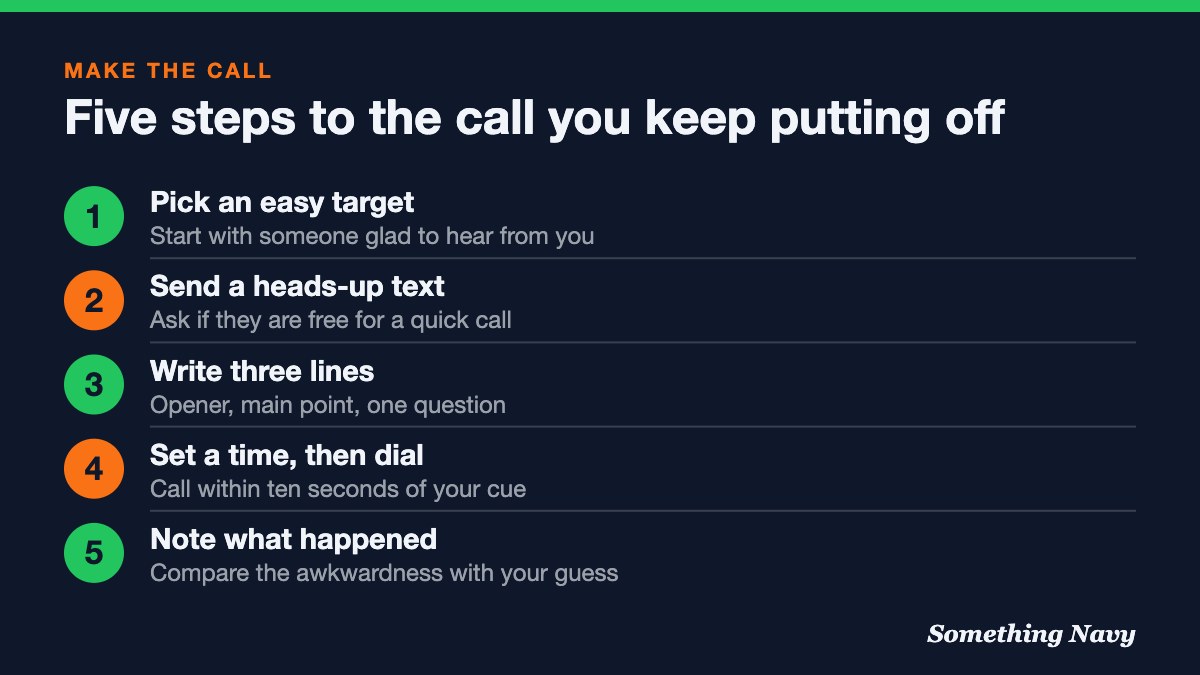
How to make the call: a five-step guide
These steps draw on the research above and on the NHS advice to break hard situations into smaller pieces. None of them requires you to become a phone person overnight.
1. Pick an easy first target
Start with someone who will be glad to hear from you: a sibling, an old friend, a grandparent. Save the landlord and the bank for later. Early wins teach your brain that calls are survivable.
2. Send a heads-up text
Remember that 68% of young adults prefer calls that are arranged. A quick “Free for a five-minute call later?” removes the bad-news jolt for both of you and gives you a fixed time to aim at.
3. Write three lines, not a script
Note your opening sentence, the one thing you need to say or ask, and one question to ask them. A full script makes you sound stiff. Three prompts give you a safety net without boxing you in.
4. Set a time, then dial before you overthink it
Anticipation is usually the worst part. Decide in advance: “When I finish my coffee, I’ll call.” This kind of if-then plan turns a vague intention into a cue you can act on. When the moment comes, dial within ten seconds.
5. Afterwards, note what actually happened
Jot down how awkward you expected the call to be and how awkward it really was. Over a few weeks, that record becomes your own private version of the Kumar and Epley experiment, and it is far more persuasive than anything you read.
Try this today
- Think of one person you have meant to message for months.
- Text them: “Thought of you today. Free for a quick call this week?”
- When they reply, call. Aim for ten minutes, not an hour.
- Afterwards, rate how awkward it was from 1 to 10, and compare it with your guess.
When texting really is the better choice
None of this means calls are always superior. Messages are better for logistics, for sharing a link, for people who are deaf or hard of hearing, and for anyone who simply communicates more comfortably in writing. Screening unknown numbers remains wise, given how common scam calls are.
Text also has a quiet kindness of its own. It lets the other person reply when it suits them, which matters for anyone juggling work, children or a bad day.
The point of the research is narrower and more useful: when you want to feel closer to someone, or sort something out properly, the voice tends to do more for you than you expect. Use text for the arrangements. Use your voice for the relationship.
Uswitch’s own data hints that people know this. Some 53% of 18–34s said they would be offended if happy news reached them without a call. We may dread making calls, but we still value receiving them.
The voice on the other end is probably glad you rang
Think back to that unknown number lighting up your screen. Your caution there is reasonable. But the call you keep postponing, to the friend you drifted from or the parent you mean to ring on Sundays, is a different thing entirely.
The studies are small in places and imperfect in others, and none of them can promise that your next call will be easy. What they show, again and again, is that the awkwardness lives mostly in the waiting.
So pick one name. Send the heads-up. And let the phone ring at their end for once.
Frequently asked questions
Fear of phone calls is not a separate diagnosis, but the NHS lists worry about speaking on the phone as one possible sign of social anxiety disorder. Many more people have milder dread that is uncomfortable without being a disorder.
In the 2024 Uswitch survey, 18–34s were far more likely to say they never answer calls and to assume an unexpected call means bad news. Growing up with messaging as the default, and a steady stream of scam calls, both seem to play a part.
Usually the opposite. Most young adults in the Uswitch poll said they prefer calls arranged in advance, so a quick heads-up text often makes the call more welcome.
Start small, with someone friendly, and plan just a few prompts rather than a script. If the fear is seriously affecting your life, a GP or NHS talking therapies can help, and CBT is the treatment the NHS generally recommends.
Sources
- Kardas, M., Schroeder, J., & O’Brien, E. (2022). Keep talking: (Mis)understanding the hedonic trajectory of conversation. Journal of Personality and Social Psychology, 123(4), 717–740. DOI
- Kumar, A., & Epley, N. (2021). It’s surprisingly nice to hear you: Misunderstanding the impact of communication media can lead to suboptimal choices of how to connect with others. Journal of Experimental Psychology: General, 150(3), 595–607. DOI
- Liu, P. J., Rim, S., Min, L., & Min, K. E. (2023). The surprise of reaching out: Appreciated more than we think. Journal of Personality and Social Psychology, 124(4), 754–771. DOI
- NHS. (n.d.). Social anxiety (social phobia). Link
- Ofcom. (2012). Communications Market Report 2012. Link
- Ofcom. (2024). Joint online, calls and texts fraud research, January 2024 (YouGov fieldwork). Link
- Uswitch. (2024). Call me maybe (not): A quarter of young people never answer the phone [Press release; Opinium survey of 2,000 UK adults, 9–12 April 2024]. Link
- University of Texas at Austin. (2020, September 11). Phone calls create stronger bonds than text-based communications [Press release]. Link
Cover photo: Jay Openiano on Unsplash. Charts and graphics: Something Navy.
How we reported this. We went back to the original research for this story, 8 sources in all, listed above, and checked every figure against them. If you think we have got something wrong, tell us and we will look at it. Read more about how we work.