

It is a little after eight on a Sunday evening. The washing-up is done, the television is murmuring to itself, and you pick up your phone with no particular plan. You open your contacts and start scrolling.
There are hundreds of names. A plumber from 2019. Someone called “Dave gym”. A university friend you last spoke to at a wedding. Your thumb slows over a few of them, and each time a small calculation runs: it’s been too long, it would be odd, they’ll be busy, what would I even say.
You reach the bottom of the list, scroll back to the top, and put the phone face down on the sofa. Nothing is wrong, exactly. You just could not think of one person to call.
If that feels familiar, you have probably also heard that you are part of something bigger: a loneliness epidemic, declared by health officials, counted in deaths and compared to a cigarette habit. Some of that is well supported. Some of it is shakier than the headlines suggest. Here is what the numbers say when you go back to the sources.
Where the “loneliness epidemic” label came from
The phrase entered the mainstream in May 2023, when Dr Vivek Murthy, then the US Surgeon General, published an advisory with the title Our Epidemic of Loneliness and Isolation. The framing was deliberate: Murthy wanted loneliness treated as a public health problem rather than a private sadness.
The advisory’s headline claim was that roughly half of US adults report experiencing loneliness, with some of the highest rates among young adults. It defines loneliness as a distressing, subjective feeling that comes from a gap between the connection you want and the connection you have. That definition matters, because it means loneliness is not the same as being alone. You can live alone and feel fine, or sit at a crowded dinner table and feel invisible.
What the advisory said about time spent alone
Some of the most striking material in the advisory is not about feelings at all. It is about how Americans spend their days. According to time-use figures in the report, the average person spent 285 minutes a day alone in 2003. By 2019 that had crept up to 309 minutes, and in 2020, the first pandemic year, it reached 333 minutes. That works out at an extra 24 hours alone every month compared with 2003.
Time with friends in person moved the other way. In 2003 Americans averaged about 60 minutes a day with friends. By 2020 it was 20 minutes. For people aged 15 to 24, the drop was steeper still: from roughly 150 minutes a day to 40, a fall of nearly 70%.
Notice what these figures measure: behaviour, not emotion. More evenings at home is not automatically more loneliness, and 2020 was a lockdown year. Still, if friendship takes time to build, as our piece on how many hours it takes to make a friend explains, a steady loss of shared hours is not nothing.
The health claims in the advisory
The advisory also set out the health case. Drawing on published research, it said loneliness raises the risk of premature death by 26% and social isolation by 29%. A synthesis of 16 longitudinal studies linked poor social relationships to a 29% higher risk of heart disease and a 32% higher risk of stroke. Chronic loneliness and isolation in older adults were linked to roughly a 50% higher risk of dementia.
And then there was the line that travelled furthest: that lacking social connection can be as dangerous to your lifespan as smoking “up to 15 cigarettes a day”. We will come back to that one.

What the WHO Commission on Social Connection found in 2025
Two years later the question went global. On 30 June 2025 the World Health Organization published From loneliness to social connection: charting a path to healthier societies, the report of its Commission on Social Connection. Murthy co-chaired the commission alongside Chido Mpemba, an adviser to the African Union Chairperson.
The WHO’s headline figure was that about one in six people worldwide, or 16%, were affected by loneliness over the period 2014 to 2023. It also estimated that loneliness accounts for around 871,000 deaths a year (the estimate covers 2014 to 2019).
Loneliness is not a rich-world problem
The loneliness epidemic is usually discussed as a Western affliction of remote work and streaming services. The WHO data point the other way. Loneliness was most common in the WHO African Region, at 24.3%, followed by the Eastern Mediterranean at 21.0% and South-East Asia at 18.3%. The Americas sat at 13.6%, the Western Pacific at 11.0% and the European Region at 10.1%.
Income told the same story. In low-income countries 24.3% of people were lonely, compared with 10.6% in high-income countries. Poverty, insecurity and conflict appear to be at least as relevant to loneliness as smartphones.
The age pattern in the WHO data
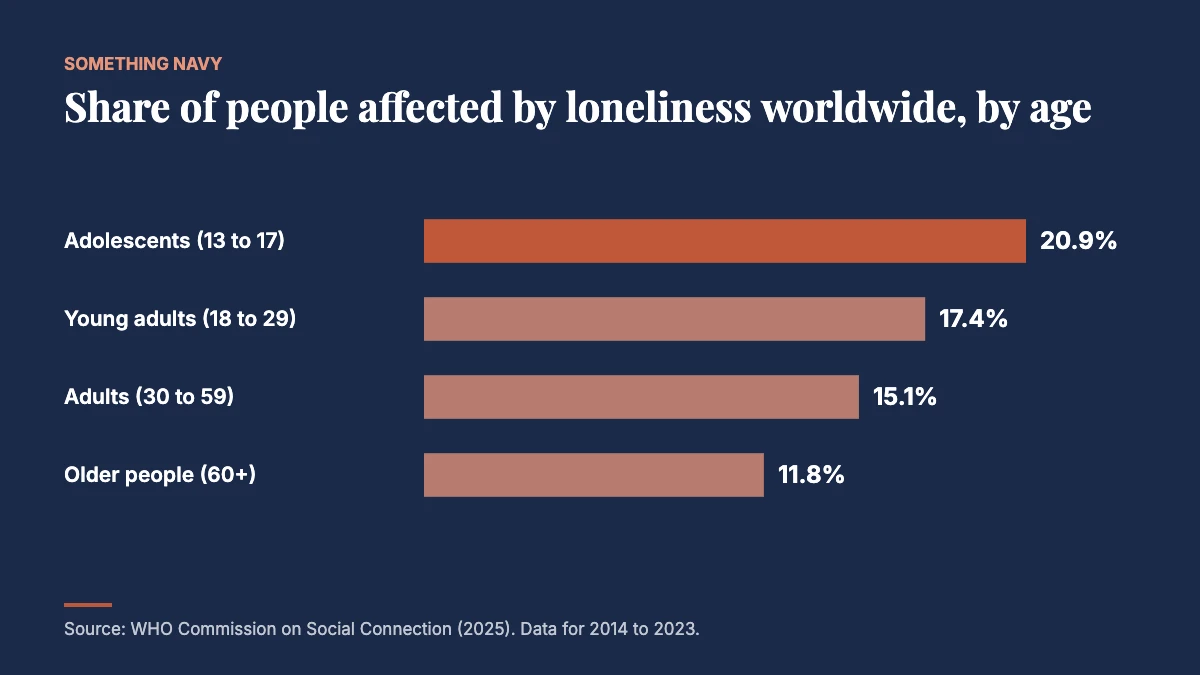
Adolescents aged 13 to 17 had the highest rate, at 20.9%, and the rate fell with each older group, down to 11.8% among people aged 60 and over. The report also found a gender gap that was widest among teenagers, where 24.3% of girls were lonely compared with 17.2% of boys.
One sentence in the report rarely makes the news. The commission said that earlier data are too limited to show whether loneliness and isolation have actually gone up or down over time. In other words, the WHO measured a large problem. It did not measure a rising one.
What Gallup’s global and US surveys show
Gallup’s question is refreshingly simple: did you experience loneliness “a lot of the day yesterday”? It captures one specific day rather than asking you to sum up your life.
Gallup World Poll: more than one in five
In July 2024 Gallup reported that 23% of adults across 142 countries and areas said they had felt lonely a lot of the previous day in 2023. That is based on roughly 1,000 interviews per country with people aged 15 and over.
The country range was enormous. Comoros had the highest rate at 45%. Vietnam had the lowest, at 6%, with Finland, Iceland and Denmark among the countries at 11 or 12%. Of the 22 countries where at least 30% reported loneliness, more than half were in Africa, which lines up neatly with the WHO’s regional findings.
Money mattered a great deal: 32% of people who found it difficult to get by on their income felt lonely, compared with 15% of those living comfortably. Relationships mattered too: 28% of unmarried people reported loneliness against 19% of those married or living with a partner.
Age, oddly, barely mattered at the global level. Gallup found 22% loneliness among 15 to 29 year olds, 23% among 30 to 49 year olds and 22% among those 50 and over. That flatness hides very different patterns underneath. In a substantial number of countries, older adults were at least 10 points lonelier than the youngest group. In the United States and some others, the pattern was reversed.
Young American men stand out
That American reversal got its own analysis in May 2025, when Gallup’s Benedict Vigers pooled 2023 and 2024 data. A quarter (25%) of US men aged 15 to 34 said they had felt lonely a lot of the previous day. That compared with 18% of US women the same age, 18% of all US adults, and a median of 15% among young men across OECD countries.
Only Türkiye’s young men reported a higher rate among the OECD countries Gallup listed. Young men in the United Kingdom came in at 21%, in Canada at 22% and in France at 24%. With about 1,000 interviews a year per country, the young-men subgroups are fairly small, so treat the country rankings with some caution.
The US trend since 2020
Gallup has also tracked American loneliness with the same question since early 2020, through its National Health and Well-Being Index.
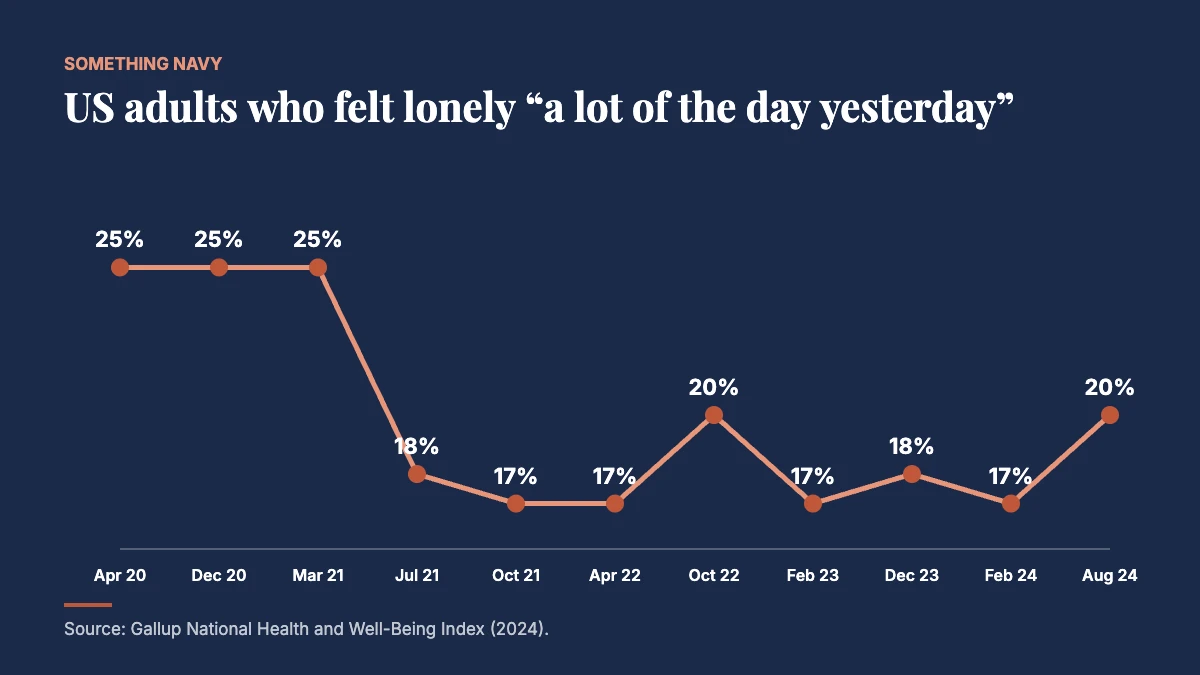
Loneliness hit 25% at three points in the pandemic: April 2020, December 2020 and March 2021. It then dropped back sharply, to 17% by October 2021, and has bobbed between 17% and 20% ever since. The August to September 2024 wave, based on 6,289 adults, put it at 20%.
That is not the shape of a spreading epidemic. It is the shape of a stubborn, fairly stable problem with a pandemic spike in the middle.


Loneliness in Britain: the ONS and Community Life Survey figures
Britain measures loneliness unusually often, and two official sources are worth knowing.
The ONS Opinions and Lifestyle Survey
The Office for National Statistics asks adults in Great Britain how often they feel lonely as part of its Opinions and Lifestyle Survey. Answers of “often or always” are generally treated as chronic loneliness.
In January 2025 (fieldwork from 8 January to 2 February, with 3,556 people responding), 7% of adults said they felt lonely often or always, and a further 18% some of the time. That makes a quarter of adults lonely at least some of the time.
England’s Community Life Survey
The Department for Culture, Media and Sport’s Community Life Survey is much larger, with more than 175,000 responses in 2024/25, and it asks the direct question: how often do you feel lonely? In the survey year from October 2024 to March 2025, 6.6% of adults in England felt lonely often or always.
That figure carries both halves of the argument. It was a small but statistically significant fall from 7.1% the year before. But it was still higher than the 4.9% to 5.6% recorded between 2013/14 and 2017/18. Chronic loneliness in England does appear to have edged up over a decade, by roughly one or two percentage points. Real, but hardly explosive.
The age pattern here matches the WHO’s. Chronic loneliness was highest among 16 to 24 year olds, at 9%, followed by 8% of 25 to 34 year olds. It was lowest among 65 to 74 year olds, at 4%, and only 5% for people aged 75 and over.
The comparison problem: why surveys disagree
The share of people said to be lonely ranges from about 7% to about 50%. Nobody is lying; they are asking different questions.
| Source | Year | Sample | % lonely | How they asked |
|---|---|---|---|---|
| US Surgeon General advisory | 2023 | Summary of recent US surveys | About 50% | Reported experiencing loneliness |
| WHO Commission on Social Connection | 2025 (data 2014–2023) | Global estimate across WHO regions | 16% | Self-reported loneliness, global modelling |
| Gallup World Poll | 2024 (data 2023) | About 1,000 adults aged 15+ in each of 142 countries and areas | 23% | Felt lonely “a lot of the day yesterday” |
| Gallup National Health and Well-Being Index | 2024 | 6,289 US adults | 20% | Felt lonely “a lot of the day yesterday” |
| ONS Opinions and Lifestyle Survey | 2025 | 3,556 adults, Great Britain | 7% chronic (25% at least some of the time) | How often they feel lonely; “often or always” counts as chronic |
| DCMS Community Life Survey | 2025 (data 2024/25) | More than 175,000 responses, England | 6.6% chronic | “How often do you feel lonely?” |
Ask people whether they have ever experienced loneliness and you get a big number, because almost everyone has. Ask whether they felt it a lot yesterday and roughly one in five say yes. Ask whether they feel lonely often or always, the closest thing to a chronic condition, and the figure in Britain drops to about one in fourteen.
All of these are legitimate, but they describe different experiences. “Half of adults” includes your Sunday evening with the contacts list. “7% chronically lonely” is closer to a state that shapes someone’s whole week.
The “15 cigarettes a day” claim: where it comes from and its limits
Now back to that cigarette line, usually repeated as “loneliness is as bad as smoking 15 cigarettes a day”. The trail leads to a 2010 paper in PLOS Medicine by Julianne Holt-Lunstad, Timothy Smith and J. Bradley Layton.
What the 2010 meta-analysis actually measured
Holt-Lunstad’s team pooled 148 studies covering 308,849 people, followed for an average of seven and a half years. They found that people with stronger social relationships had a 50% greater likelihood of survival over the study periods than those with weaker ones.
The 2010 study did not measure loneliness. It measured social relationships, such as marital status, network size, community involvement and perceived support. Feeling lonely is a different thing, so applying the results to loneliness is a stretch.
Later research that looked at loneliness directly, cited in the Surgeon General’s advisory, put the increased risk of early death at 26% for loneliness and 29% for social isolation. Those are meaningful numbers, but they come from different studies, and they are not the source of the famous smoking comparison.
How the cigarettes got in
In its discussion, the 2010 paper included a figure setting the size of the social relationships effect beside effects taken from other meta-analyses of conditions linked to mortality. The paper’s summary concluded that the influence of social relationships was comparable to well-established risk factors such as smoking and alcohol consumption, and greater than physical inactivity and obesity.
So the comparison is real. The problems come in the translation.
First, the Surgeon General’s own wording was “up to 15 cigarettes a day”. That describes a comparison with light smoking, not a precise exchange rate of 15 cigarettes for one lonely life. Somewhere along the chain, “up to” quietly vanished.
Second, the chart stacks effect sizes from entirely different bodies of research side by side. That gives a rough sense of scale, not a precise measurement.
Third, the authors themselves listed the weaknesses. The studies varied enormously (a statistical heterogeneity of 81%), most relied on single questions about social ties, most did not capture whether relationships were good or bad, and the data came mainly from North America and Western Europe. Above all, the studies were observational, so they could not establish cause and effect. Lonely or isolated people may die earlier partly because illness both isolates people and shortens lives.
None of that makes the finding worthless. But “as deadly as 15 cigarettes a day” turns a careful, hedged comparison into a slogan, and slogans tend to lose their caveats on the way.

Young adults versus older people: who is actually lonelier?
In the WHO’s global estimates, England’s Community Life Survey and Gallup’s US data, younger people report loneliness at least as often as older people. In England, 16 to 24 year olds are more than twice as likely as 65 to 74 year olds to feel lonely often or always.
That does not mean older people are fine. Louise Hawkley of NORC at the University of Chicago and colleagues, writing in Psychology and Aging in 2019, used two large American studies of older adults (the National Social Life, Health and Aging Project and the Health and Retirement Study) and found that loneliness tends to fall between the ages of 50 and 74, then rise after 75.
Hawkley’s team also pointed out a quieter demographic issue. Because loneliness climbs after 75, and the baby boom generation is moving into those years, the number of lonely older people could grow even if the rate for any given age stays flat. That is a planning problem for health services, but it is not evidence that people are becoming lonelier.
For young adults, part of the story may be how friendships form. School and university supply ready-made contact; after that, friends have to be made deliberately. Our piece on how many close friends adults have looks at how those circles change.
The researchers who say loneliness has not risen much
An epidemic implies spread: more people affected now than before. On that question, the long-run evidence is surprisingly modest.
Older adults: no lonelier than previous generations
Hawkley’s 2019 study tested the idea directly. Comparing waves from 2005–2006, 2010–2011 and 2015–2016, involving between 3,005 and 4,777 adults per wave, the team found no evidence that older Americans had become lonelier than people of the same age a decade earlier. Baby boomers were no lonelier at a given age than earlier generations.
Young adults: a small rise over four decades
For young adults, the most thorough analysis comes from Susanne Buecker, Maike Luhmann and colleagues at Ruhr University Bochum and Friedrich Schiller University Jena. Their 2021 paper in Psychological Bulletin pooled 345 studies covering 124,855 people aged 18 to 29, collected between 1976 and 2019. They found that loneliness among young adults had risen, by about 0.56 of a standard deviation on the UCLA Loneliness Scale over 43 years.
The authors described that rise as relatively small, and in their press release they said calling it an epidemic was overdramatising. The data also stop in 2019, before the pandemic spike that Gallup recorded.
Put together, the picture is fairly consistent. Older adults are not lonelier than earlier generations at the same age. Young adults may be somewhat lonelier than in the 1970s, but the change is gradual. England’s chronic loneliness has edged up by a point or two over a decade, Gallup’s US line has been roughly flat since 2021, and the WHO says it cannot tell whether loneliness is rising globally.
So is it an epidemic or not?
It depends on what you want the word to do.
If “epidemic” means a problem that affects a very large number of people and causes measurable harm, the case is strong. Roughly one in six people worldwide are affected by loneliness on the WHO’s figures, about one in five Americans felt it a lot on a given day in 2024, and around one in fourteen British adults live with it often or always. The links with early death, heart disease and dementia come from large bodies of research, even if they cannot prove cause and effect.
If “epidemic” means a sudden surge, a disease spreading through a previously healthy population, the evidence is thin. Most long-run studies find loneliness either flat or rising slowly, with a temporary jump during the pandemic.
There is a reasonable worry that the alarmist version backfires. If you feel lonely and keep hearing that you are as doomed as a heavy smoker, that is hardly an invitation to pick up the phone. A more accurate message is gentler: loneliness is common, and it is not a personal failure. Our look at talking to strangers shows how far even brief, low-stakes conversations can go.
Which brings us back to the Sunday evening and the contacts list. The data cannot tell you whether you are part of an epidemic. They can tell you that the feeling is shared by hundreds of millions of people, that it can ease as circumstances change, and that the person whose name you scrolled past may well be sitting on their own sofa, wondering whether to text you.
If loneliness has become persistent and is affecting your health or mood, it is worth speaking to a GP or another health professional. Charities such as Samaritans in the UK also offer someone to talk to.
Frequently asked questions
The WHO Commission on Social Connection estimated in 2025 that about one in six people, or 16%, were affected by loneliness between 2014 and 2023. Gallup’s 2023 World Poll found 23% of adults felt lonely a lot of the previous day.
The comparison comes from a 2010 meta-analysis that set the mortality effect of weak social relationships beside other risk factors, including smoking. It did not measure loneliness directly, its studies were observational, and the Surgeon General’s actual wording was “up to” 15 cigarettes a day.
In several large surveys, yes. The WHO found the highest rates among 13 to 17 year olds, and in England 9% of 16 to 24 year olds feel lonely often or always, compared with 4% of 65 to 74 year olds. Loneliness among older adults does tend to rise again after about 75.
The long-run evidence suggests only modest change. Studies find older adults no lonelier than earlier generations and a small rise among young adults since the 1970s, while the WHO says global trend data are too limited to tell.
Official links and research
- World Health Organization. (2025). From loneliness to social connection: charting a path to healthier societies. Report of the WHO Commission on Social Connection. World Health Organization. Official report
- Office of the Surgeon General. (2023). Our epidemic of loneliness and isolation: The U.S. Surgeon General’s advisory on the healing effects of social connection and community. U.S. Department of Health and Human Services. Official advisory (PDF)
- Office for National Statistics. (2025). Public opinions and social trends, Great Britain: January 2025. ONS
- Department for Culture, Media and Sport. (2025). Community Life Survey 2024/25: Loneliness and support networks. GOV.UK. GOV.UK
- Gallup. (2024, July 9). Over 1 in 5 people worldwide feel lonely a lot. Gallup
- Gallup. (2024, October 14). Daily loneliness afflicts one in five in U.S. Gallup
- Vigers, B. (2025, May 20). Younger men in the U.S. among the loneliest in West. Gallup. Gallup
- Holt-Lunstad, J., Smith, T. B., & Layton, J. B. (2010). Social relationships and mortality risk: A meta-analytic review. PLOS Medicine, 7(7), e1000316. DOI
- Hawkley, L. C., Wroblewski, K., Kaiser, T., Luhmann, M., & Schumm, L. P. (2019). Are U.S. older adults getting lonelier? Age, period, and cohort differences. Psychology and Aging, 34, 1144–1157. DOI
- Buecker, S., Mund, M., Chwastek, S., Sostmann, M., & Luhmann, M. (2021). Is loneliness in emerging adults increasing over time? A preregistered cross-temporal meta-analysis and systematic review. Psychological Bulletin. DOI
Cover photo: Polina Lavor on Unsplash. Charts and graphics: Something Navy, with photography by Gadiel Lazcano and Aysegul Aytören on Unsplash.
How we reported this. Every figure was checked against the 10 sources above. Reviewed by Brooke Hilland, Senior Content Editor. Report an error · How we work