
You did the quiz on the sofa, phone tilted so your partner could see. Thirty pairs of choices later, the result flashed up: Quality Time. They got Acts of Service, and suddenly years of small arguments about who empties the dishwasher made a strange kind of sense.
If that moment felt like a revelation, you are in good company. Gary Chapman’s The Five Love Languages came out in 1992 and became one of the best-selling relationship books ever written.
It has also become one of the most tested. Over the past two decades, relationship scientists have taken the book’s central promises and put them through surveys, couple studies and statistical stress tests.
The verdict is more interesting than “it’s a myth”. Some of Chapman’s ideas wobble badly under scrutiny. One of them holds up better than the theory itself.
From a pastor’s notebooks to 20 million bookshelves
Chapman is a Baptist pastor from North Carolina who spent years counselling married couples. According to a 2021 profile in Christianity Today, he went back through 12 years of counselling notes and noticed a pattern: unhappy partners were often showing love in ways the other person did not register. He sorted those ways into five categories.
Words of affirmation. Quality time. Receiving gifts. Acts of service. Physical touch.
The book sold 8,500 copies in its first year, then kept climbing. Today it has sold more than 20 million copies, and the online quiz has been taken by more than 30 million people, according to figures gathered in a 2024 review of the research. On TikTok, the #lovelanguages hashtag has passed 500 million views.
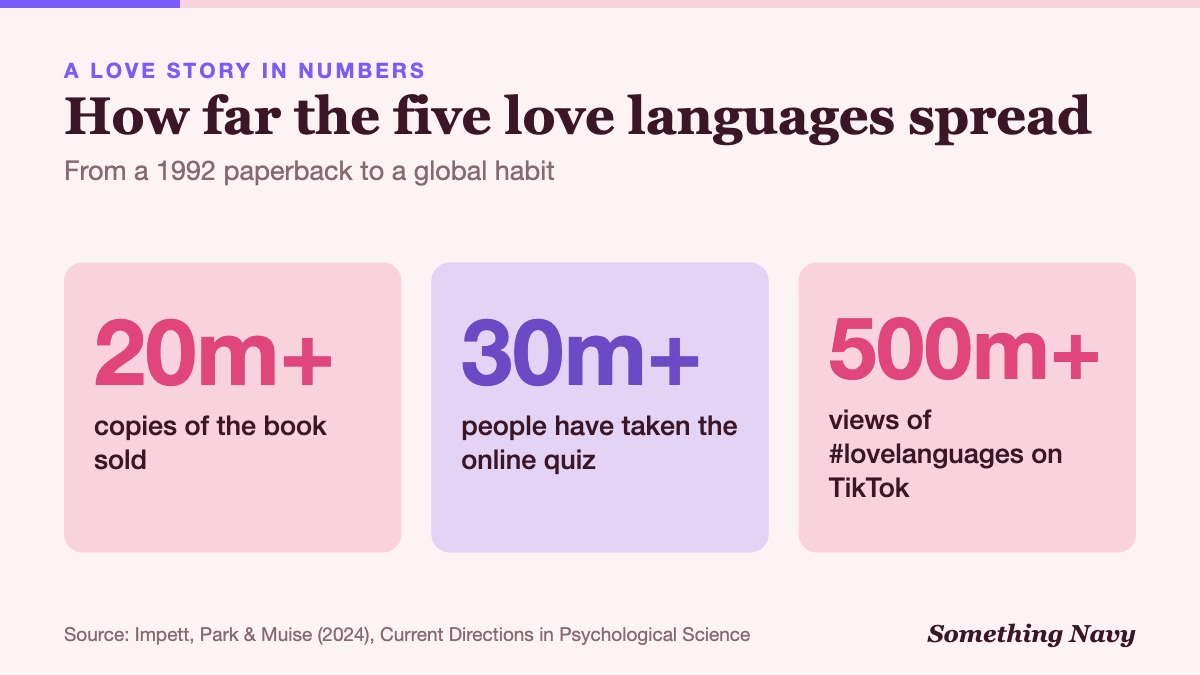
That reach is exactly why scientists became curious. When an idea shapes how millions of people read their partner’s behaviour, it is worth asking whether it describes something real.
Three promises, put on trial
In 2024, Emily Impett of the University of Toronto Mississauga, her graduate student Haeyoung Gideon Park and Amy Muise of York University published a review in Current Directions in Psychological Science. They pulled together the published studies on love languages and boiled the book down to three core assumptions.
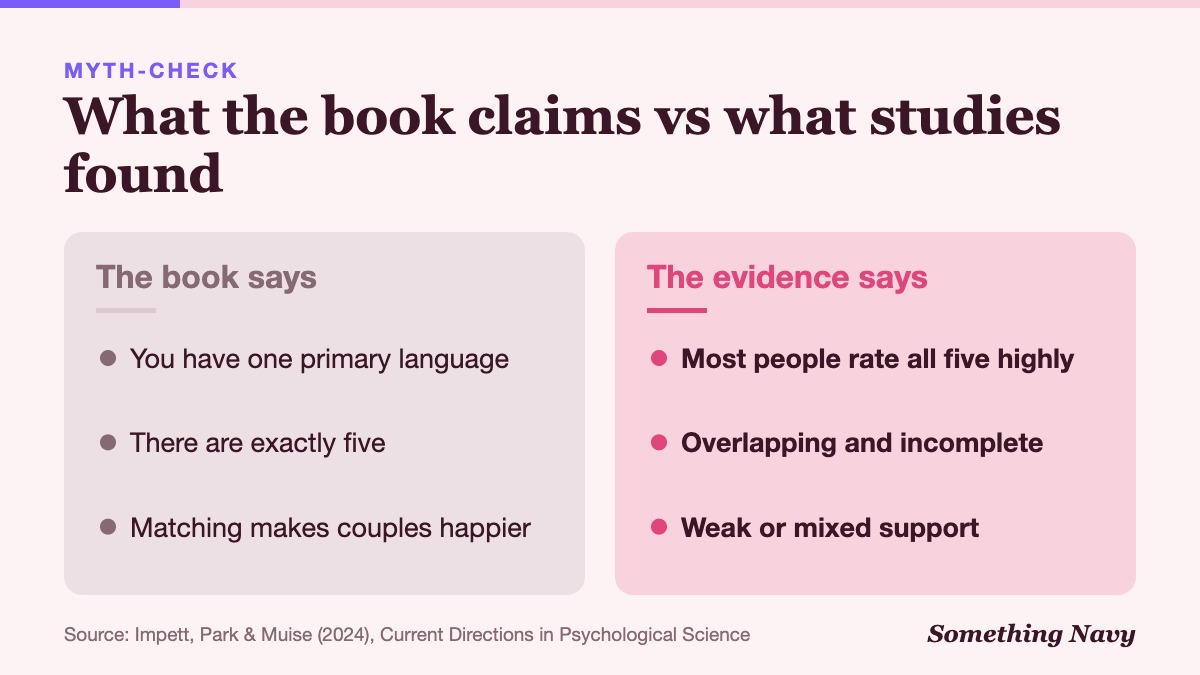
- Each person has one primary love language.
- There are five love languages.
- Couples are happier when partners speak each other’s language.
Their summary was blunt. “None of the 10 studies supported Chapman’s claims,” Impett told University of Toronto News.
That headline travelled fast. The details are kinder, and more useful, so let’s take the claims one at a time.


Claim one: you have a single primary language
Chapman describes love languages almost like mother tongues. In the book he says they can be “as different as Chinese from English”, and that most of us naturally speak only one.
The research paints a different picture. When people rate each of the five behaviours separately, they tend to rate all of them highly. Across studies, the average sits around 4 on a 5-point scale for every single language, according to the Impett review.
In other words, most people want all five.
The official quiz hides this, because of how it is built. It is forced choice: you must pick between pairs such as a hug and a compliment. Choose one and the other loses a point. That design will always produce a “winner”, even for someone who would happily take both.
The gap shows up starkly with gifts. On the forced-choice quiz, studies have found that only 0–4% of people come out with gifts as their primary language. But in a 2017 study by Selena Bunt and Zoe Hazelwood, when the language a person rated highest was counted instead, gifts came top for more than half the sample.
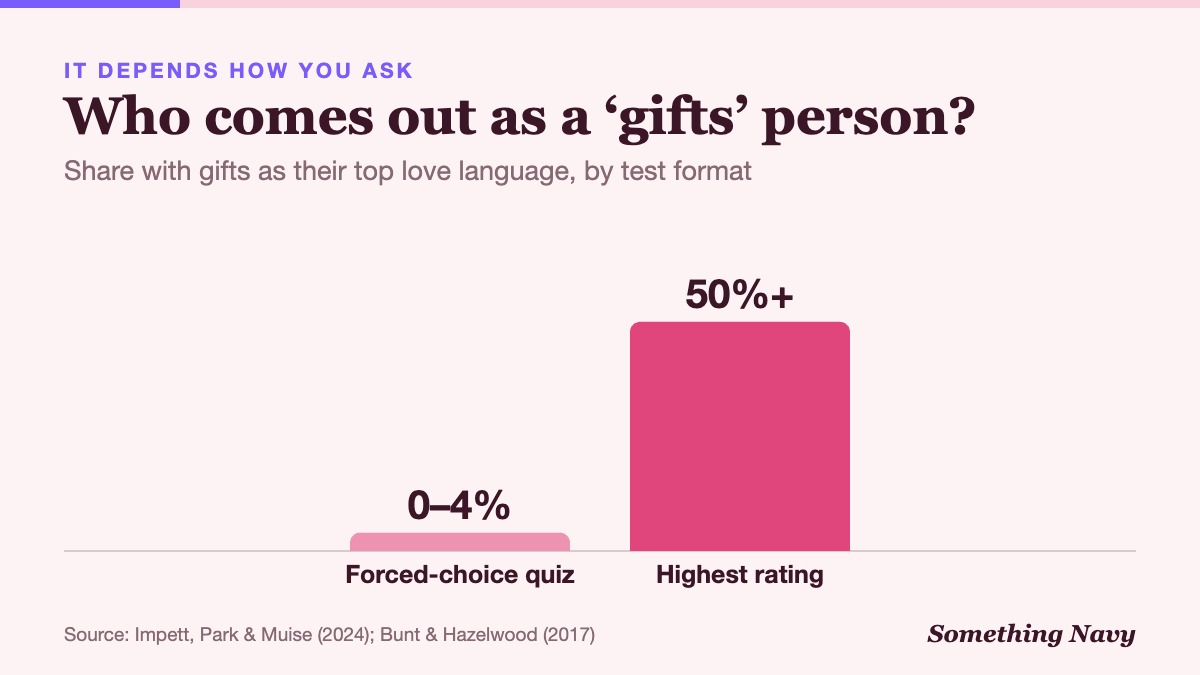
That does not mean half of us are secretly materialistic. It means the label you get depends heavily on the format of the question, which is a warning sign for any personality-style test.
It also ignores how needs shift. The review points to evidence that people under stress benefit from more physical affection, the way a marathon runner needs extra carbohydrates before a race. Your “language” in a gruelling month at work may not be your language on holiday.
Verdict: not supported. Preferences are real, but they look more like a mix of tastes than a single native tongue.
Claim two: love comes in exactly five flavours
If the five languages are truly distinct, a well-designed questionnaire should sort people’s answers into five clean clusters. Researchers have tried this several times.
The first serious attempt came in 2006, when Nichole Egbert and Denise Polk built a love languages questionnaire and compared it with established measures of “relational maintenance”, the everyday things people do to keep a relationship healthy. They found some support for Chapman’s categories and links with those maintenance behaviours. But the five scores were also strongly related to one another, which suggests they overlap more than the book implies.
Later studies did not settle the matter. Depending on the sample, researchers have found three factors, four factors, or five factors that do not line up neatly with Chapman’s five.
There is also the question of what the list leaves out. Relationship scientists who mapped maintenance behaviours from the ground up found things like weaving your partner into your social circle and handling conflict well. Supporting a partner’s personal goals, outside the relationship, is missing too.
The Impett team suggests one reason. Chapman built his framework from couples he counselled, who were largely married, religious, mixed-gender and traditional. Couples with more equal, career-sharing lives may care about behaviours his notebooks never captured.
Verdict: partly supported. The five behaviours are all genuine ways people show love. They are just not the complete list, and they are not as separate as the book claims.
Claim three: matching languages makes happier couples
This is the heart of the book, and the most practical promise. Learn your partner’s language, speak it fluently, and the relationship improves. Get it wrong and you are shouting into the void.
Bunt and Hazelwood tested this directly with 67 heterosexual couples. Couples whose primary languages matched were not measurably more satisfied than couples whose languages differed. What did predict satisfaction better was self-regulation: how much effort people put into managing their own behaviour in the relationship.
Their headline result fits in a sentence. The evidence that love language alignment boosts satisfaction was, in their words, “limited”.
A larger test arrived in 2024. Sharon Flicker of California State University, Sacramento, and Flavia Sancier-Barbosa of Colorado College surveyed 696 people in relationships, average age 43.8, most of them married. Chapman’s idea would predict that being satisfied with how your partner speaks your top language matters most.
It did not. Satisfaction with a partner’s primary language predicted relationship quality no better than satisfaction with lower-ranked languages. Two languages stood out regardless of what people said their favourite was: words of affirmation and quality time.
Like most work in this area, it relied on people describing their own relationships in an online survey, so it shows associations rather than cause and effect. Still, it is a sizeable sample, and its results echo the earlier couple studies.
The study that did find a match effect
It would be unfair to stop there, because one well-known study pointed the other way.
In 2022, Olha Mostova of the University of Warsaw, working with Maciej Stolarski and Gerald Matthews, studied 100 heterosexual couples who had been together anywhere from six months to 24 years. Rather than just comparing quiz labels, they measured how well each partner’s way of expressing love fitted what the other person said they preferred.
The closer the fit, the more satisfied people were, both with the relationship and with their sex life. Mostova told reporters that people “who better match each other’s preferences for love languages are more satisfied”.
An earlier study, published in 2020 by Jennifer Hughes and Abigail Camden, found something similar: people who felt their partner was speaking their primary language reported more love and more satisfaction.
So who is right? Possibly both, once you look closely.
These were correlational snapshots, so they cannot show which came first. Happy couples may simply be more generous with every kind of affection, and better at noticing it. The Impett review also argues that the designs could not separate “my partner speaks my language” from “my partner shows me love, full stop”.
When researchers have checked that second possibility, it tends to win. Impett put it simply: “People are basically happier in relationships when they receive any of these expressions of love.”
Myth-check scorecard
- One primary language: not supported. People rate all five highly, and quiz results shift with the question format.
- Exactly five languages: partly supported. Real behaviours, but overlapping and incomplete.
- Matching makes you happier: mixed at best. Two studies found a link; others found none once general affection was considered.
- Showing love in many ways helps: well supported, across nearly every study.


What actually survives the evidence
Read the studies together and a clear thread runs through them. Every one of Chapman’s five behaviours is linked to feeling loved. The problem was never the behaviours. It was the idea that you should pick one and specialise.
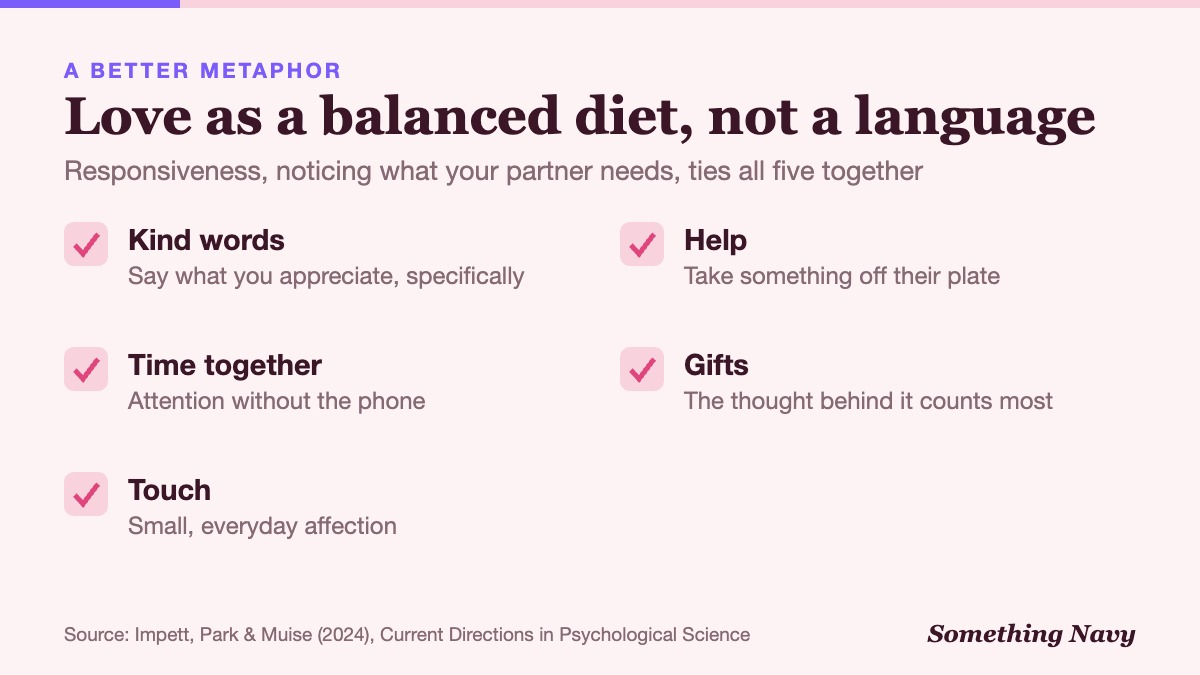
Impett, Park and Muise offer a different metaphor. Love, they argue, is less like a language and more like a balanced diet. You need a range of nutrients. You can survive for a while without some of them, but the healthiest relationships get a bit of everything.
Your partner does not need you to become fluent in one language. They need you to keep the whole menu on the table.
The diet idea also allows for change. Needs rise and fall with circumstances, and they differ between people in ways the five categories miss. The review highlights research showing that people who are uncomfortable with closeness, a pattern psychologists call avoidant attachment, respond especially well to expressions of appreciation.
And underneath it all sits a concept with decades of research behind it: responsiveness. That is the sense that your partner understands you, values you and acts on what you need. It is not a category of behaviour. It is the attention that makes any behaviour land.
Why the idea still feels so true
If the core claims are shaky, why do so many couples swear by love languages? The researchers do not dismiss that experience, and neither should we.
The framework gives people words. Saying “I need more quality time” is far easier than explaining a vague, aching sense of distance. It also reminds partners that love is something you do, not just something you feel.
And it reframes conflict. When one person keeps washing the car while the other longs for a compliment, the book offers a gentle explanation that does not involve anyone being selfish. That is the same insight behind research on why couples fight about chores: often the argument is really about feeling noticed.
The trouble comes when the label hardens into a rule. “My love language is gifts, so you have failed me” is a very different conversation from “I felt so loved when you brought me that book”.
The quiz is a great conversation starter. It makes a poor contract.
How to use love languages without the baggage
None of this means binning the book or deleting the quiz result screenshot. It means using it the way relationship research suggests.
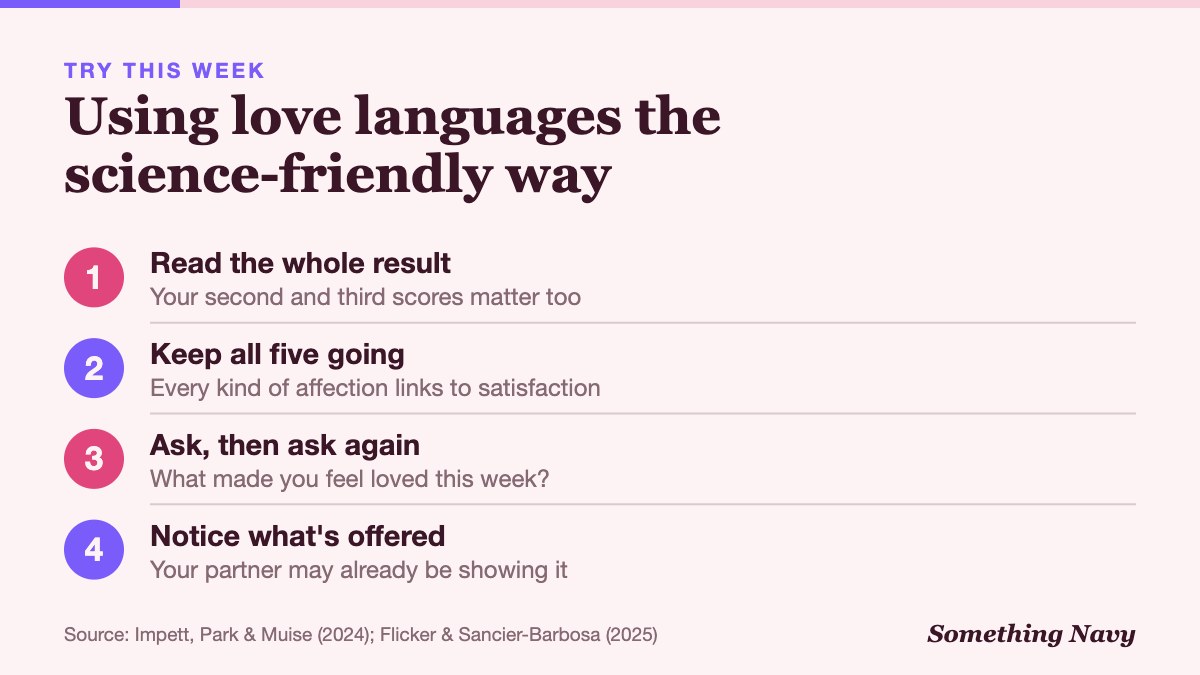
Treat your result as a starting point, not a diagnosis. Look at your second and third scores too. If they are close to your top one, they probably matter just as much.
Do not drop the other four. Studies consistently show that every kind of expression is linked to satisfaction. Words of affirmation and quality time came out especially strong in the 2024 study of 696 people, so they are worth keeping in the rotation even if neither of you scored them first.
Ask, and keep asking. What made you feel loved this week? What would help right now? The answer will change, and that is normal. A regular check-in does more than any one-off quiz.
Notice what is already being offered. Part of the matching problem is perception. Your partner may be speaking love fluently in a dialect you have learned to overlook.
Look beyond the five. Cheering on your partner’s own goals, bringing them into your friendships and handling disagreements with care are all forms of love that the book’s list leaves out.
If you like structured prompts, the 36 questions designed to build closeness work on the same principle: curiosity about the other person, repeated over time.
The smaller, warmer truth
There is something touching about the image at the start of this piece: two people bent over a phone, trying to work each other out. That instinct is the valuable part.
The science does not say your quiz result is meaningless. It says you are bigger than one word. You can love a hug and a handwritten note and a Saturday with no plans, and you are allowed to need different things in different seasons.
So keep the vocabulary. Lose the idea that there is only one right way to say it.
Love, it turns out, is less a language you master than a meal you keep cooking, together, with whatever is in the cupboard that week.
Frequently asked questions
The quiz has not published standard reliability and validity data. Its forced-choice design also guarantees a “top” language even if you value several equally, so treat the result as a prompt for conversation rather than a measurement.
Not on current evidence. Studies of couples with mismatched primary languages, including Bunt and Hazelwood’s 2017 work, found they were not measurably less satisfied than matched couples.
There is no single winner, but in a 2024 study of 696 people, words of affirmation and quality time predicted relationship quality better than whatever language people ranked first.
Yes, as a shared vocabulary. Naming the ways you feel cared for helps partners talk about needs, as long as you stay open to all five and to needs that change over time.
Sources
- Impett, E. A., Park, H. G., & Muise, A. (2024). Popular psychology through a scientific lens: Evaluating love languages from a relationship science perspective. Current Directions in Psychological Science, 33(2), 87–92. DOI
- Bunt, S., & Hazelwood, Z. J. (2017). Walking the walk, talking the talk: Love languages, self-regulation, and relationship satisfaction. Personal Relationships, 24(2), 280–290. DOI
- Mostova, O., Stolarski, M., & Matthews, G. (2022). I love the way you love me: Responding to partner’s love language preferences boosts satisfaction in romantic heterosexual couples. PLOS ONE, 17(6), e0269429. DOI
- Flicker, S. M., & Sancier-Barbosa, F. (2025). Testing the predictions of Chapman’s five love languages theory: Does speaking a partner’s primary love language predict relationship quality? Journal of Marital and Family Therapy, 51(1), e12747. DOI
- Egbert, N., & Polk, D. (2006). Speaking the language of relational maintenance: A validity test of Chapman’s (1992) Five Love Languages. Communication Research Reports, 23(1), 19–26. DOI
- Hughes, J. L., & Camden, A. A. (2020). Using Chapman’s five love languages theory to predict love and relationship satisfaction. Psi Chi Journal of Psychological Research, 25(3), 234–244. DOI
- Easton, M. (2024, January 4). Little evidence linking five “love languages” to healthy relationships, researchers say. University of Toronto News. Link
Cover photo: Priscilla Du Preez on Unsplash. Charts and graphics: Something Navy.
How we reported this. We went back to the original research for this story, 7 sources in all, listed above, and checked every figure against them. If you think we have got something wrong, tell us and we will look at it. Read more about how we work.