
It is 3.07am. The house is silent, you have work in five hours, and your brain has chosen this moment to show you, in high definition, the evening in 2016 when a waiter said “enjoy your meal” and you said “you too”.
Your face goes hot. In the dark. Alone. About a sentence nobody else at that table has thought about since.
If that sounds familiar, you are in very large company. Psychologists have a name for the experience, and it is far less mysterious, and far less damning, than it feels at 3am.
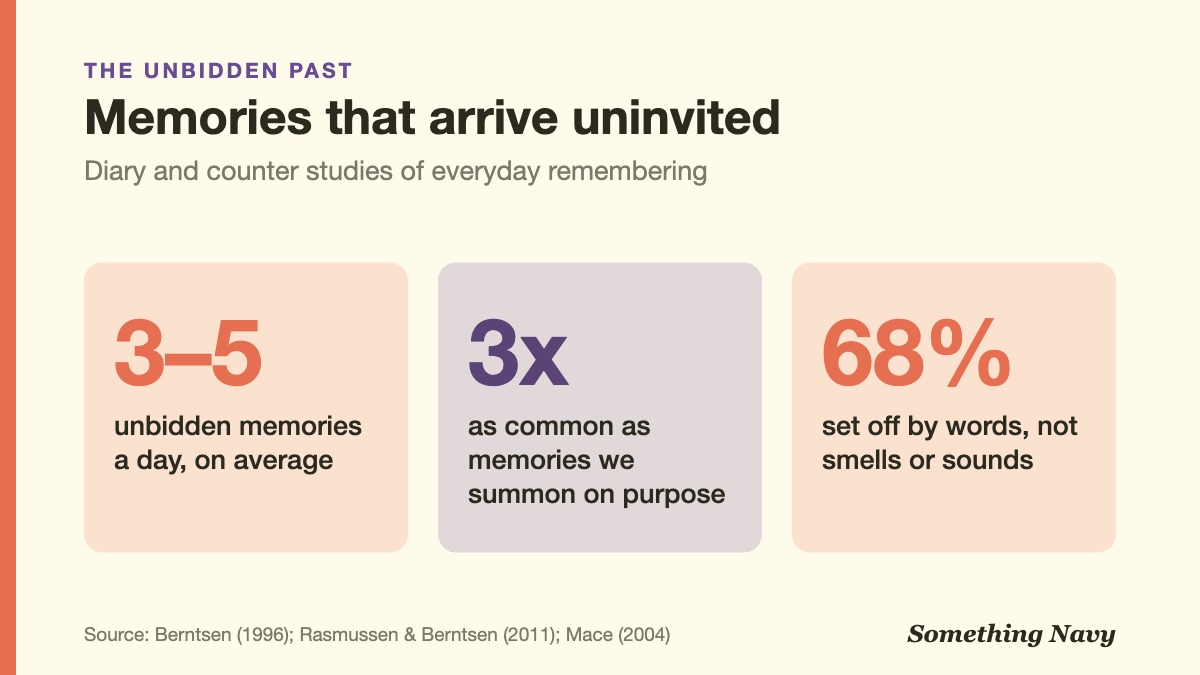
These ambushes are called involuntary autobiographical memories: personal memories that arrive without you trying to retrieve them. They are not a glitch. One study found they turn up three times as often as the memories we go looking for on purpose.
Your memory has a back door
For decades, memory researchers mostly studied deliberate remembering. The memories that drift in while you brush your teeth were left to novelists.
The Danish psychologist Dorthe Berntsen, now at Aarhus University, changed that in the 1990s. She asked people to keep diaries of memories that popped up uninvited, noting what they were doing and what seemed to set the memory off. Her 1996 work produced an estimate that has been quoted ever since: these unbidden memories occur, on average, three to five times a day, as a review in The Psychologist by Bradley, Moulin and Kvavilashvili summarises.
Later work suggests that may be an underestimate. In a 2011 study, Rasmussen and Berntsen gave 48 Danish undergraduates a mechanical tally counter and asked them to click it through one day, every time a personal memory came to mind, sorting them by whether they had summoned the memory or it had simply arrived. Involuntary memories were reported three times as often as voluntary ones.
That was a small sample on a single day, and counting your own thoughts is imperfect. But the direction is consistent. Most of your remembering is not something you decide to do.
Your past, in other words, is constantly talking. The cringe moments are just the bits you hear loudest.
What actually pulls the trigger?
It can feel as if cringe memories come from nowhere. Usually they do not.
Researchers who study these memories find that most are set off by a cue, something in your surroundings or in your own stream of thought that overlaps with the original event. The surprise is how often that cue is a word rather than a smell or a sound. In a two-week diary study of adults aged 21 to 58, the psychologist Mace found that 68% of involuntary memories were triggered by abstract verbal or linguistic cues, compared with 30% by sensory ones, according to the review in The Psychologist.
So the trigger for “you too” might be a menu, a TV chef, or a colleague saying “enjoy” in an email. You will rarely notice the link, because the memory arrives faster than your awareness of what summoned it.
Timing matters too. In the Rasmussen and Berntsen study, involuntary memories were linked to daydreaming, boredom and unfocused attention, and less to solving problems or chatting with others. Lying awake with nothing to do is close to the perfect setting: a mind with slack attention, wandering freely, with no task to keep old associations in check.
Unbidden memories hit harder
There is a reason the 3am version feels worse than if you had deliberately recalled the same scene over coffee.
In a 2010 review in Current Directions in Psychological Science, Berntsen concluded that involuntary memories rely on the same memory system as deliberate ones, but because they are retrieved by association rather than by plan, they tend to be more specific and to produce more emotional reaction when they arrive.
Earlier work by Berntsen and Hall, cited in The Psychologist review, found that involuntary memories were more likely than deliberate ones to come with bodily reactions and a shift in mood. That is the flush in your cheeks, the urge to pull the duvet over your head, the involuntary wince.
When you choose to remember something, you get a moment to brace. When the memory chooses you, you do not.
Embarrassment is a social alarm, not a verdict
Embarrassment belongs to a family psychologists call self-conscious emotions, along with shame, guilt and pride. What they share is an audience. You feel them when you picture how you look in someone else’s eyes.
That is why a cringe memory rarely involves a stubbed toe in an empty room. It almost always involves a witness: the waiter, the class, the date, the group chat. The pain is about a crack in your social standing, however tiny, and humans are built to take those seriously.
Yet embarrassment seems to work in your favour with other people. In a 2012 paper in the Journal of Personality and Social Psychology, Matthew Feinberg, Robb Willer and Dacher Keltner at the University of California, Berkeley ran five studies. In one, students were filmed describing embarrassing moments, and coders rated how embarrassed they looked. Those who showed more embarrassment were more generous when given raffle tickets to share in an economic game.
In another, participants watched a partner react to praise with either embarrassment or pride, and then trusted and cooperated more with the embarrassed one. The authors are careful to note limits: economic games in a lab are not real life, and the results may differ across cultures. Still, the pattern is striking.
The flush you feel is, to onlookers, a sign that you care what they think. That is not a flaw. It is part of what makes you easy to trust.
Why the bad ones seem to last longer
Here is the good news that cringe attacks hide from you: across most of your memories, the sting fades faster than the glow.
In a 2003 review, W. Richard Walker, John Skowronski and Charles Thompson pulled together diary research on what they called the fading affect bias. In general, the unpleasant feelings attached to memories weakened faster over time than the pleasant ones. In eight diary studies with 229 participants, only 17 people logged more unpleasant events than pleasant ones. The authors also noted that in people with mild depression, pleasant and unpleasant feelings faded at similar rates.
So why does the waiter moment still burn? One plausible explanation, consistent with Berntsen’s point that unbidden memories follow ordinary memory rules, is rehearsal. Each 3am replay is another retrieval, and memories that are retrieved often tend to stay easy to reach. You are, without meaning to, keeping the file near the top of the pile.
There is also a selection effect. Nobody replays the thousand dinners where they said “thank you” normally, so the mortifying outliers start to look like your whole history.
And as our piece on the spotlight effect explains, other people notice your slips far less than you assume. The waiter has almost certainly forgotten. You are the only archive.
When cringe tips into something heavier
For most people, cringe attacks are an annoying but harmless feature of a normal memory. For some, they are more persistent and more painful.
Clinical researchers have found that people with social anxiety disorder often carry recurring images of themselves looking foolish or anxious, seen as if from the outside. In a 2000 study by Hackmann, Clark and McManus, as described in later work, all the patients with social phobia reported that these images recurred, and the images were linked in meaning to earlier unpleasant social events: being criticised, humiliated or bullied.
If your embarrassing memories are frequent enough to stop you going to events, speaking up at work or sleeping, that is worth raising with a GP or a therapist. Cognitive therapy for social anxiety has good evidence behind it, and nobody needs to just tough it out.
The kinder response actually works better
When a cringe memory lands, the reflex is to pile on: “Idiot. Why are you like this?” It feels like accountability. The research suggests it mostly adds a second layer of pain to the first.
Mark Leary, a psychologist then at Duke University, tested an alternative. In five studies published in 2007, he and his colleagues looked at self-compassion, which they described as treating yourself kindly when things go badly. It has three parts: being understanding rather than harsh with yourself, recognising that mistakes are part of being human, and noticing painful feelings without being swallowed by them.
People higher in self-compassion reacted less negatively to real, remembered and imagined unpleasant events. In an experiment, participants who were guided into a self-compassionate frame of mind could acknowledge their own part in a negative event without being overwhelmed by bad feelings about it.
That last point matters, because the usual fear is that being kind to yourself means letting yourself off the hook. Leary’s team found the opposite: self-compassionate people were more willing to own their mistakes, not less. Most of the studies used mild events in a lab, and the effects of a single exercise were short-term, so think of this as a skill to practise rather than a cure.
Being kind to yourself is not letting yourself off. It is what makes it bearable to look.
What to do when the 3am replay starts
You cannot stop involuntary memories from arriving. They are part of how a healthy memory works. What you can change is the second half of the experience: what you say to yourself once the memory is in the room.
Try this tonight
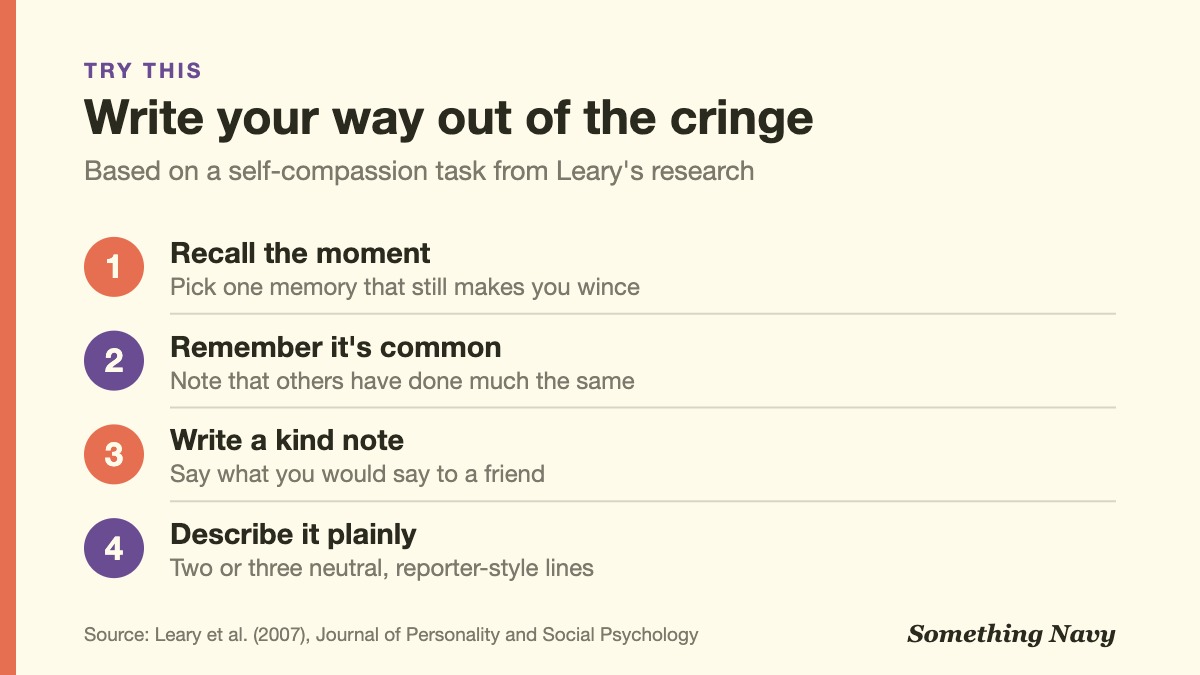
- Name it. Say, silently, “That’s a cringe memory.” Labelling it as a memory, not a current emergency, is the mindful part of self-compassion.
- Zoom out to everyone. Remind yourself that millions of people have said “you too” to a waiter. That is the common humanity step, and it is simply true.
- Talk to yourself like a friend. What would you say if a friend told you this story? Probably that it was funny and that nobody cares. Say that to yourself.
- Tell it plainly. In the morning, write two or three neutral sentences about what happened, as if you were a reporter. Leary’s exercise included describing the event objectively.
- Do not argue with it at 3am. Replaying the scene to “fix” it is more rehearsal. Note it, be kind, then turn your attention to your breath or a boring mental list.
If writing helps you, our look at whether journaling actually helps covers which kinds of writing seem to ease difficult feelings and which tend to stir them up.
Rewriting the scene, gently
There is an intriguing hint, from clinical research, that you can also change how an old embarrassing memory feels, not just how you respond to it.
In a 2008 pilot study, Wild, Hackmann and Clark worked with 11 adults with social phobia. In a single session, each person revisited the early, humiliating memory linked to their recurring image, this time with their adult self stepping into the scene to offer compassion and a new perspective. A week later, the distress and vividness of their recurring images had fallen, as had their social anxiety scores. After a comparison session, in which a therapist simply listened, these measures had not changed.
One detail stands out. The images did not come any less often. They just hurt less when they came.
It was a tiny study with only a week of follow-up, and it was done by trained therapists with a clinical group, so it is not a do-it-yourself technique. But it echoes the self-compassion research nicely. The goal is not a mind that never shows you the waiter again. It is a mind that can watch the clip and shrug.
The memory is proof you care
It is easy to read a cringe attack as evidence against you: proof that you are awkward, or that people secretly remember. The science points somewhere kinder.
Your brain throws up old memories several times a day, mostly prompted by passing words and idle moments. The embarrassing ones feel bigger because they arrive unannounced, carry a body-level jolt and concern your place among other people. And the capacity to feel embarrassed is, by some evidence, one of the things that makes others trust you.
So the next time you are lying awake replaying “you too”, try a different ending. Picture the waiter, who was probably hiding a smile and has said something equally daft to a customer since. Then tell yourself what you would tell them.
Yes. You too.
Sources
- Berntsen, D. (2010). The unbidden past: Involuntary autobiographical memories as a basic mode of remembering. Current Directions in Psychological Science, 19(3), 138–142. DOI
- Bradley, R. J., Moulin, C. J. A., & Kvavilashvili, L. (2013). Involuntary autobiographical memories. The Psychologist. British Psychological Society. Link
- Feinberg, M., Willer, R., & Keltner, D. (2012). Flustered and faithful: Embarrassment as a signal of prosociality. Journal of Personality and Social Psychology, 102(1), 81–97. DOI
- Leary, M. R., Tate, E. B., Adams, C. E., Batts Allen, A., & Hancock, J. (2007). Self-compassion and reactions to unpleasant self-relevant events: The implications of treating oneself kindly. Journal of Personality and Social Psychology, 92(5), 887–904. DOI
- Rasmussen, A. S., & Berntsen, D. (2011). The unpredictable past: Spontaneous autobiographical memories outnumber autobiographical memories retrieved strategically. Consciousness and Cognition, 20(4), 1842–1846. Link
- Walker, W. R., Skowronski, J. J., & Thompson, C. P. (2003). Life is pleasant, and memory helps to keep it that way! Review of General Psychology, 7(2), 203–210. DOI
- Wild, J., Hackmann, A., & Clark, D. M. (2008). Rescripting early memories linked to negative images in social phobia: A pilot study. Behavior Therapy, 39(1), 47–56. DOI
Cover photo: engin akyurt on Unsplash. Charts and graphics: Something Navy.
How we reported this. We went back to the original research for this story, 7 sources in all, listed above, and checked every figure against them. If you think we have got something wrong, tell us and we will look at it. Read more about how we work.