You are in a supermarket aisle, reaching for the oat milk, when the ceiling speakers start a song you have not heard in twenty years. Two bars in, you are not in the supermarket any more.
You are in the back of a friend’s car with the windows down. Or in a bedroom with the door shut and the volume too high. You know every word, including the ones you got wrong at the time.
Nothing you have heard this year does that. You might even like this year’s music more, on paper. It still does not reach the same place.
That is not you getting old and sentimental. It is one of the more robust patterns in the psychology of memory, and researchers have been measuring it, scanning it and arguing about its exact age for more than three decades.
Two bars in, you are somewhere else
Psychologists have a name for the way our memories cluster around one stretch of life. It is called the reminiscence bump: ask older adults to recall events from their lives, and an unusually large share come from late adolescence and early adulthood.
Music, it turns out, has its own bump. And it may be the sharpest one we have.
To see why, follow that supermarket song backwards. First comes the pull of familiarity, then a flash of a place, then a feeling that arrives before you can name it. Each of those steps has been studied, and the trail starts with two marketing professors and a stack of old chart hits.
The professors who put an age on your taste
In 1989 the consumer researchers Morris Holbrook and Robert Schindler published a short paper in the Journal of Consumer Research with a deliberately modest title: “Some exploratory findings on the development of musical tastes.”
They played people excerpts of hit songs from the Billboard charts across several decades and asked how much they liked each one. The trick was in the analysis. Instead of looking at the year each song came out, they looked at how old each listener had been when it was a hit, a measure they called “song-specific age”.
Plot liking against that age and the results formed an upside-down U. Preference climbed through childhood, peaked and then fell away. In their sample of 108 people, the top of the curve sat at roughly 23 and a half, or as the authors put it, “about the 24th year”.
Holbrook and Schindler offered two possible explanations. One was intrinsic: perhaps there is a sensitive period for taste, loosely like the imprinting seen in young animals. The other was social: perhaps peer pressure about what to like simply peaks at that stage of life. They did not settle it, and nobody fully has since.
The 38-year-old men who still love “Creep”
Almost three decades later, the data scientist Seth Stephens-Davidowitz came at the same question with a much bigger dataset. In a 2018 opinion piece for The New York Times, he described how Spotify had given him data on how often every song was played, broken down by the age of the listener.
His showcase example was Radiohead’s “Creep”, released in 1993. At the time of writing, it was the 164th most popular song among men aged 38: men who had been about 14 when it came out. Among men a decade older or younger it was far less popular.
Repeat that for hit after hit and a pattern appears. By his analysis, the songs that matter most to men are the ones released when they were around 14. For women the age was even earlier, around 13.
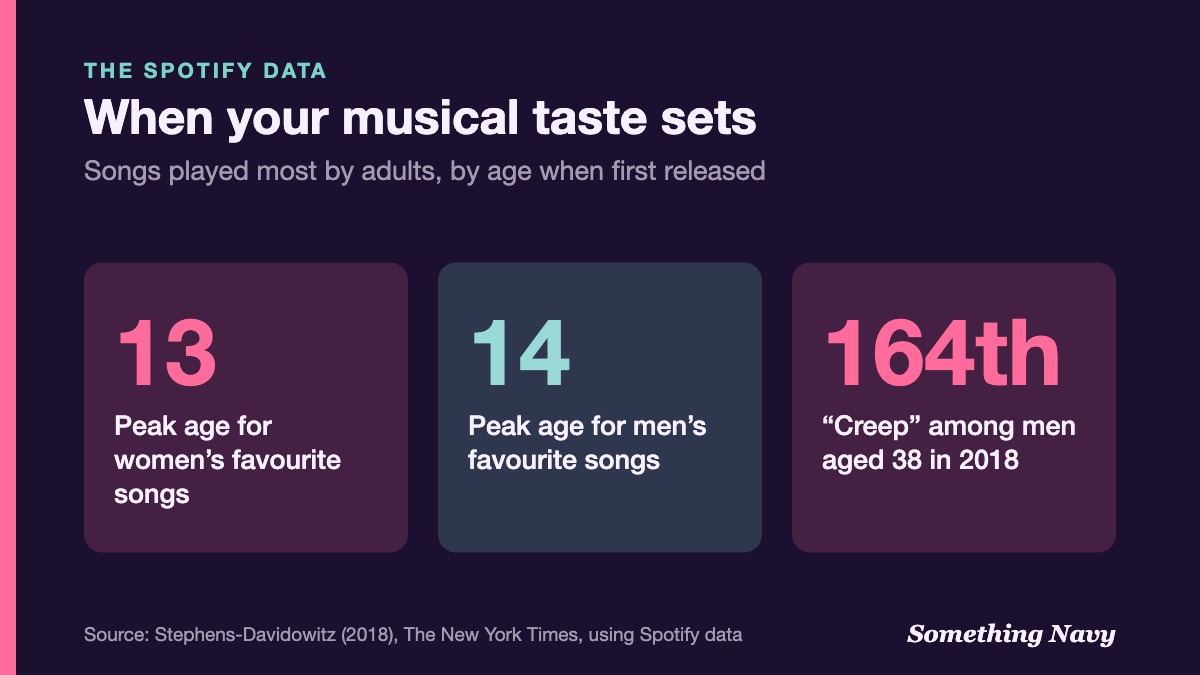
It is worth being clear about what this is. It is a newspaper analysis of commercial data, not a peer-reviewed study, and Spotify users are not a random slice of humanity. But it pointed in a striking direction: younger than the 1989 paper suggested.


The peak keeps sliding younger
Holbrook and Schindler’s curve was always built on a small convenience sample, so other researchers have tried to rebuild it. One German replication by Jan Hemming in 2013 challenged the curve outright; Holbrook and Schindler replied that the reanalysis was flawed, and the two sides did not agree.
The most thorough attempt came in 2022 from Callum Davies and colleagues at the Ehrenberg-Bass Institute, University of South Australia, in the journal Marketing Letters. They recruited 1,036 Americans aged 18 to 84, chosen to resemble the US census, and played each of them 30-second clips of 34 Billboard Top 10 songs released between 1950 and 2016. Each clip was rated from 0 (“I dislike it a lot”) to 10.
The upside-down U was there again. But its peak had moved. Depending on the statistical model, preference topped out somewhere between about 16.8 and 17.6 years old.
| Study | Who was asked | Peak age of musical preference |
|---|---|---|
| Holbrook & Schindler (1989) | 108 people, convenience sample | About 23.5 |
| Stephens-Davidowitz (2018) | Spotify listening data | About 13 (women), 14 (men) |
| Davies et al. (2022) | 1,036 US adults aged 18–84 | About 17 |
Why the shift? The authors suggest, cautiously, that children now hear more music earlier and have easier access to music of every era. They also say plainly that more research is needed. What has held up across the decades is the shape: a window, somewhere in the teens or early twenties, when music gets stamped in harder.
Your taste was not built over a lifetime. It was mostly built in a few loud years.
Your parents’ records got in too
Here is the twist that makes this more than a story about adolescence.
In 2013 Carol Lynne Krumhansl, a psychology professor at Cornell University, and Justin Zupnick, a recent Cornell graduate, played 62 college-age participants two top Billboard hits from every year between 1955 and 2009. For each song, participants rated whether it brought back personal memories, whether they recognised it, how much they liked it and how it made them feel. They also said whether they had heard it alone, with friends or with their parents.
As expected, memories linked to songs climbed steadily the closer the music came to the present. But there was a bump nobody had predicted. Music from the early 1980s, when these students’ parents would have been about 20 to 25, scored unusually high for memories, recognition, liking and emotional connection.
There was a second, smaller bump for 1960s music, released decades before most participants were born. The researchers suggest it might have been handed down from grandparents via parents, or that the music is simply very good. They called the pattern “cascading reminiscence bumps” in their paper in Psychological Science.
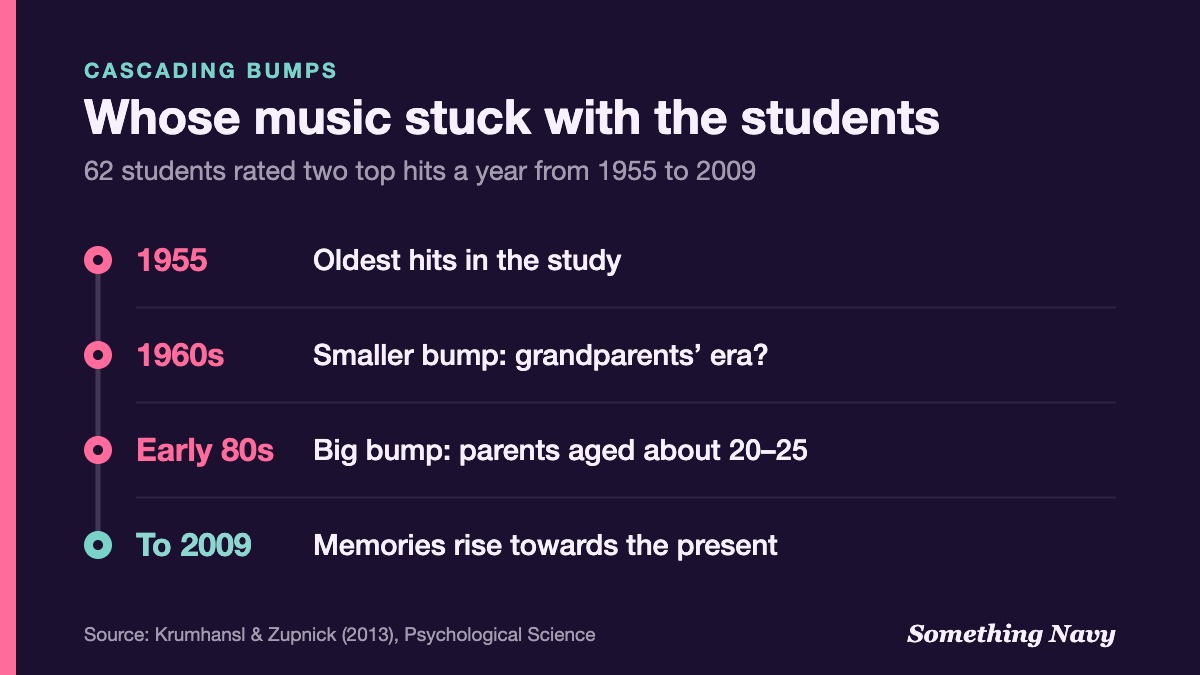
Think about what that means. The songs your mum played while cooking, or your dad sang badly on long drives, were not just background. They were her reminiscence bump, and some of it was copied into yours.
Every family has a soundtrack, and part of yours was recorded before you were born.
Something Navy
A caution: 62 students at one university is a small group, and their parents’ early 1980s happened to be a vivid era for pop. The finding needs testing with other generations, which Krumhansl’s team set out to do with a wider online survey.
The patch of brain just behind your forehead
So the song from your teens has a privileged place. But where, physically, does that happen?
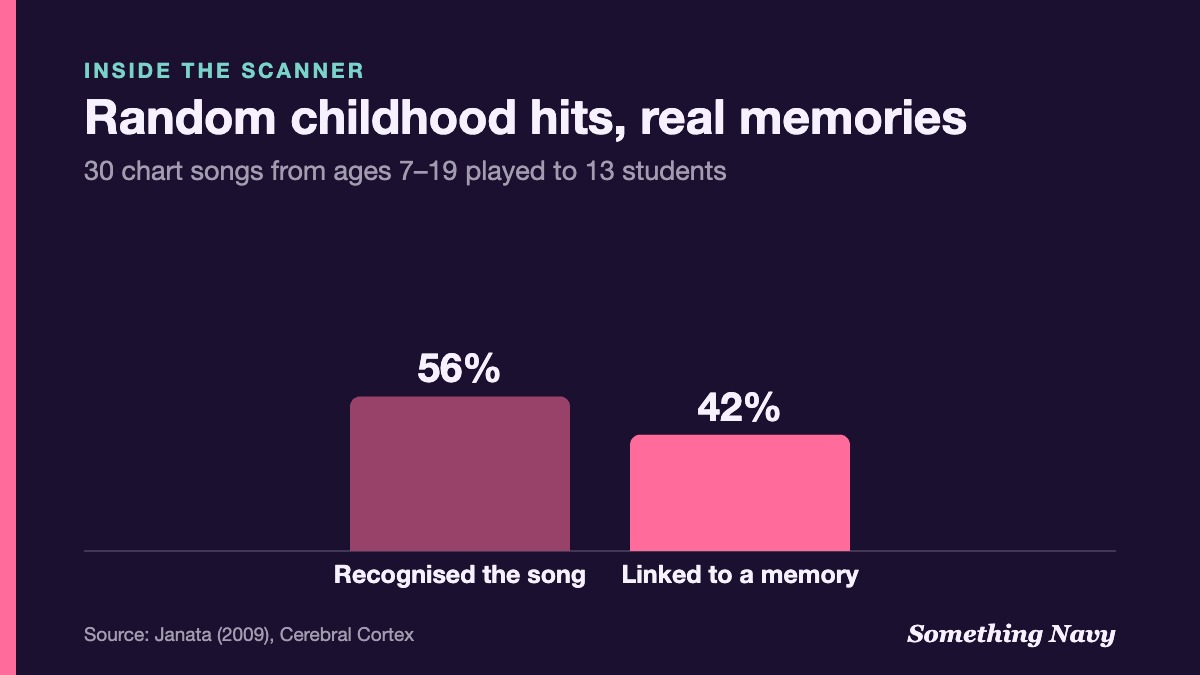
In 2009 Petr Janata, a cognitive neuroscientist at the University of California, Davis, put 13 undergraduates into an fMRI scanner and played each of them 30 excerpts of pop and R&B hits. The songs were picked at random from the Billboard charts for the years when each student had been aged 7 to 19.
After each clip, the students rated how familiar it was and whether it was linked to a memory from their own lives. On average they recognised 56% of the songs. And 42% of the clips were rated as somewhat or strongly linked to a personal memory, even though the songs were picked at random rather than chosen as favourites.
The scans pointed to the dorsal medial prefrontal cortex, a region towards the front of the brain, just behind the forehead. Its activity rose in step with how strongly a song was tied to a memory. It also tracked the melody itself as it moved through musical keys, and that tracking was stronger for the songs that carried memories.
In his paper in Cerebral Cortex, Janata framed the region as a candidate “hub at which music, memories, and emotions are associated”. In plain terms: the same patch of tissue is following the tune, fetching the memory and colouring it with feeling, all at once.
It is one scanning study of 13 young people, most of them women, so it is a map of where to look rather than a final answer. But it helps explain why the supermarket song felt less like remembering and more like being transported.
A song beats a photograph
If you have ever flicked through old photos and felt mildly interested, then heard one chorus and felt your throat tighten, there is evidence for that difference too.
At the University of Iowa, Amy Belfi, Brett Karlan and Daniel Tranel asked people to listen to 30 popular songs and look at 30 famous faces, then describe whatever memories came to mind. Each memory was transcribed and scored for vividness using an established coding system.
Published in Memory in 2016, the results favoured the songs. Music-evoked memories contained more internal detail, the stuff of experience such as what you saw and felt, and more sensory detail. Face-evoked memories leaned towards external detail: facts and general knowledge.
A face reminds you of what happened. A song reminds you what it was like.
Why the teenage years, of all years
Nobody has a complete answer, but the pieces fit a plausible story.
Adolescence is when we hear a lot of music for the first time, and novelty helps memories stick. It is also when music becomes social currency: what you listen to signals who your friends are and who you might become. Holbrook and Schindler’s “peer pressure” idea belongs here. And familiarity breeds liking, as the mere exposure effect shows, so songs heard on repeat at 14 get a head start that later music rarely catches up with.
Then there is sheer emotional intensity. First crushes, first heartbreaks, first nights out: the teenage years pack a lot of firsts into a short span, which is part of why that era also feels longer in hindsight, an effect we explored in why time seems to speed up as you get older. Music played during those moments gets bound up with them.
None of this has been proven as the single cause. Treat it as the leading explanation, not a settled law.
What the research cannot tell you yet
A few honest limits. Most of these studies use chart hits, which miss the album tracks, film scores and local music that may matter most to you. Samples are often small or skewed towards students. Different methods give different peak ages, from 13 to 24.
And none of it says your taste is frozen. Plenty of people fall hard for new music at 40 or 70. The research describes averages and tendencies, not a rule that shuts the door on everything released after your GCSEs.
Use your soundtrack on purpose
Knowing how this works makes it surprisingly useful. A few ideas you can try today.
Try this
- Build a time capsule playlist. Look up the charts from the years you were roughly 13 to 18 and listen through. Note which songs bring back a specific place or person, not just a vague “oh, this one”.
- Ask for your parents’ songs. Ask a parent, aunt or grandparent what they played at 16. If Krumhansl is right, some of those tracks may already live in your memory too.
- Swap playlists with a friend from that time. Shared songs tend to bring back shared moments, and comparing notes is a good excuse to get back in touch.
- Pick a song for a moment you want to keep. If music binds tightly to emotional experiences, choosing a track for a trip or a celebration and saving it for later is a cheap way to make a future memory easier to find.
One gentle warning. The same doorway works for sad memories as well as happy ones, so if a particular album still knocks you flat, you are allowed to skip it.
Next time a song from your teens ambushes you in a shop, let it play. That rush is not nostalgia being silly. It is your brain doing exactly what it was built to do: holding on to the soundtrack of the years when you were working out who you were, and handing it back to you, intact, three minutes at a time.
Sources
- Holbrook, M. B., & Schindler, R. M. (1989). Some exploratory findings on the development of musical tastes. Journal of Consumer Research, 16(1), 119–124. DOI
- Stephens-Davidowitz, S. (2018, February 10). The songs that bind. The New York Times. Link
- Davies, C., Page, B., Driesener, C., Anesbury, Z., Yang, S., & Bruwer, J. (2022). The power of nostalgia: Age and preference for popular music. Marketing Letters, 33(4), 681–692. DOI
- Krumhansl, C. L., & Zupnick, J. A. (2013). Cascading reminiscence bumps in popular music. Psychological Science, 24(10), 2057–2068. DOI
- Janata, P. (2009). The neural architecture of music-evoked autobiographical memories. Cerebral Cortex, 19(11), 2579–2594. DOI
- Belfi, A. M., Karlan, B., & Tranel, D. (2016). Music evokes vivid autobiographical memories. Memory, 24(7), 979–989. DOI
Cover photo: Yohan Marion on Unsplash. Charts and graphics: Something Navy.
How we reported this. We went back to the original research for this story, 6 sources in all, listed above, and checked every figure against them. If you think we have got something wrong, tell us and we will look at it. Read more about how we work.