
The phone lights up at 11.40pm. It is a long message, three screens of it, about a bad day at work, a half-formed worry about the future and a memory from the last visit that still makes the sender laugh. In the other city, the reply takes twenty minutes to write. It is careful, warm and a little more open than either of them would be across a kitchen table.
Couples who live apart know this rhythm well. Friends tend to treat it as a holding pattern, something to be endured until real life begins. The research tells a stranger and more interesting story.
Over the past two decades, psychologists and communication scientists have followed long-distance couples through the whole arc: the months apart, the visits and the day the suitcases finally stay unpacked. What they found does not fit the usual script. Distance, it turns out, is often not the part that breaks people. The trouble tends to arrive later, when it ends.
So let us follow one imaginary couple through those stages, and set each one against what the studies actually show.
Timeline one: the months apart
Picture them at the start. One partner has taken a job in Manchester; the other is finishing a degree in Edinburgh. They see each other once a month if trains and money allow. Everyone they know is quietly sceptical.
The sceptics have a point about prevalence, at least: this is not an unusual arrangement. In a US study of 870 unmarried adults aged 18 to 35, published in 2013, 161 people (18.5%) said they lived more than 50 miles from their partner. That is close to one in five relationships in that age group, and it excludes married couples who live apart for work or military service.
What the sceptics get wrong is the quality of those relationships. That same study, led by Gretchen Kelmer with Galena Rhoades, Scott Stanley and Howard Markman at the University of Denver, compared long-distance partners with people whose partners lived nearby. The long-distance group reported better relationship adjustment, more love, more fun and better conversations, along with less psychological aggression. They also scored higher on dedication to the relationship and lower on the sense of feeling trapped in it. Sexual satisfaction was no different between the groups.
That is a surprising picture. The couples who see each other least were, on several measures, the happiest.
Why fewer conversations can feel like more
The most detailed look at how this happens comes from L. Crystal Jiang of City University of Hong Kong and Jeffrey Hancock, then at Cornell University. In a study published in the Journal of Communication in 2013, they asked dating couples, some long-distance and some living near each other, to keep a diary of every interaction with their partner, across face-to-face meetings, phone calls, video chats, texts, instant messages and email.
According to Cornell’s summary of the work, the diaries logged 3,024 interactions. Time magazine’s report on the study described the sample as 63 heterosexual couples, mostly students of around 21, with the long-distance partners separated for an average of 17 months.
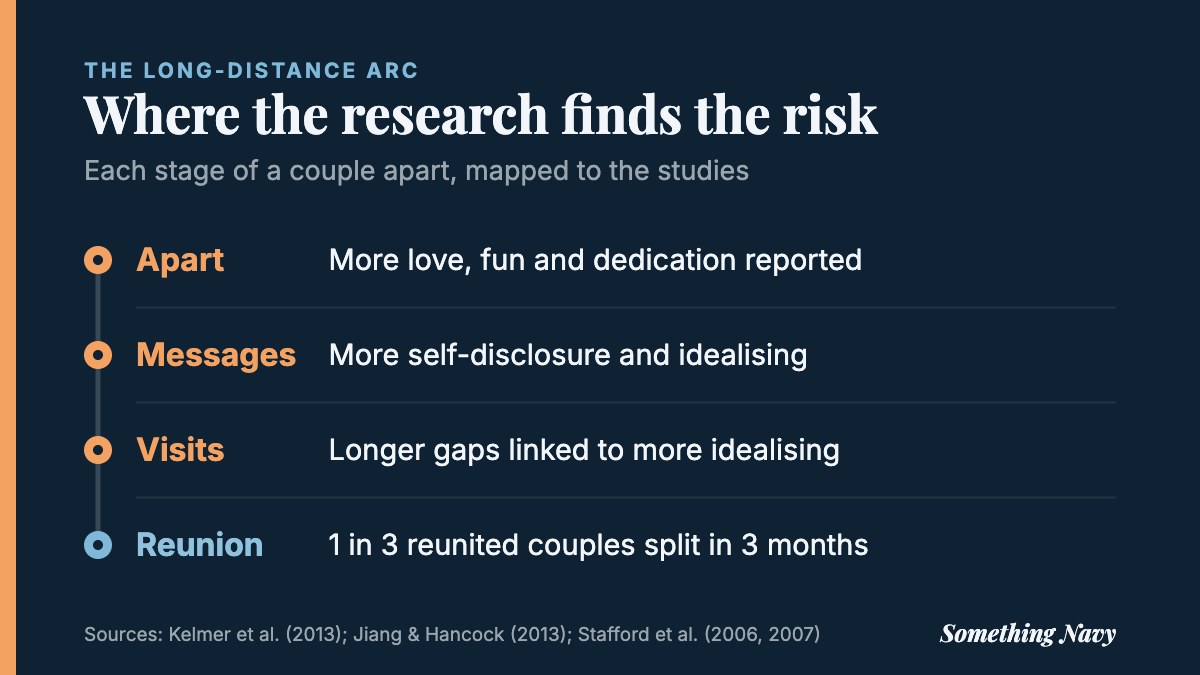
Unsurprisingly, the long-distance couples interacted less often each day. They leaned more heavily on calls, video, texts and instant messages, and hardly anyone in either group used email. But per interaction, something else was going on. Long-distance partners reported feeling more intimate. Two habits explained the difference: they disclosed more about themselves, and they idealised what their partner said and did.
Both effects were strongest in text-based, asynchronous and mobile media, the long late-night messages rather than the quick calls. Hancock linked this to what communication researchers call the “hyperpersonal” effect: when the channel is narrow, people put more into it, and the person reading fills the gaps generously.
The long-distance couples try harder than geographically close couples in communicating affection and intimacy.
L. Crystal Jiang, quoted by Cornell University (2013)
This is not a fluke of technology. Deliberate, escalating self-disclosure is one of the most reliable ways strangers grow close in the lab, which is the principle behind the 36 questions said to make people fall in love. Long-distance couples seem to stumble into the same mechanism by necessity. With no shared sofa to sit on in silence, words have to carry the relationship.


The quiet engine of idealisation
Here the story starts to turn, because the second ingredient, idealisation, has a cost.
Laura Stafford and Andy Merolla of Ohio State University set out to explain an odd pattern in earlier research: long-distance dating couples appeared more stable than couples nearby even though they spent far less time together. In two studies published in the Journal of Social and Personal Relationships in 2007, they measured idealisation in several forms: idealistic distortion (seeing the relationship as flawless), romantic love, reminiscing about the relationship and believing that you and your partner agree on everything.
Long-distance couples scored higher on these measures and were more satisfied with their communication. The less often couples saw each other face to face, the more they idealised. And while they stayed apart, the long-distance couples were indeed more stable.
Idealisation, in other words, works as a kind of glue during the separation. The partner you text at midnight is partly a person and partly a portrait, curated by both of you. That portrait is easy to love.
Timeline two: the visits
Back to our couple. Every few weeks, one of them gets on a train. The weekend has been anticipated for days. Restaurants are booked, rows are postponed, the washing up is somebody else’s problem.
Visits like these are emotionally loaded in a particular way. They are short, special and remembered mainly for their high points and their goodbyes, a pattern psychologists recognise from the peak-end rule. Little about them resembles an ordinary Tuesday.
Stafford and Merolla’s work hints at why this matters. Longer gaps between visits went hand in hand with more idealisation, and both predicted trouble later. The visits are where reality gets a chance to check the portrait. When they are rare and stage-managed, the portrait goes unchallenged.
It is worth being careful here. These are correlations from surveys of mostly American students, not experiments. Couples who visit less often may differ in money, commitment or circumstance in ways the studies cannot fully separate. But the direction of the finding is consistent with a simple idea: the less you see someone in ordinary conditions, the more of them you have to imagine.
What the optimism hides
The Kelmer team noticed something similar from another angle. At the first survey, long-distance partners rated their chance of breaking up within the next year as lower than people with nearby partners did, and their chance of eventually marrying as higher.
About four months later, the researchers checked back with 763 of the original participants. The long-distance couples had broken up at almost exactly the same rate as everyone else: 20.4% compared with 23.0% for couples living nearby, a difference that was not statistically meaningful.
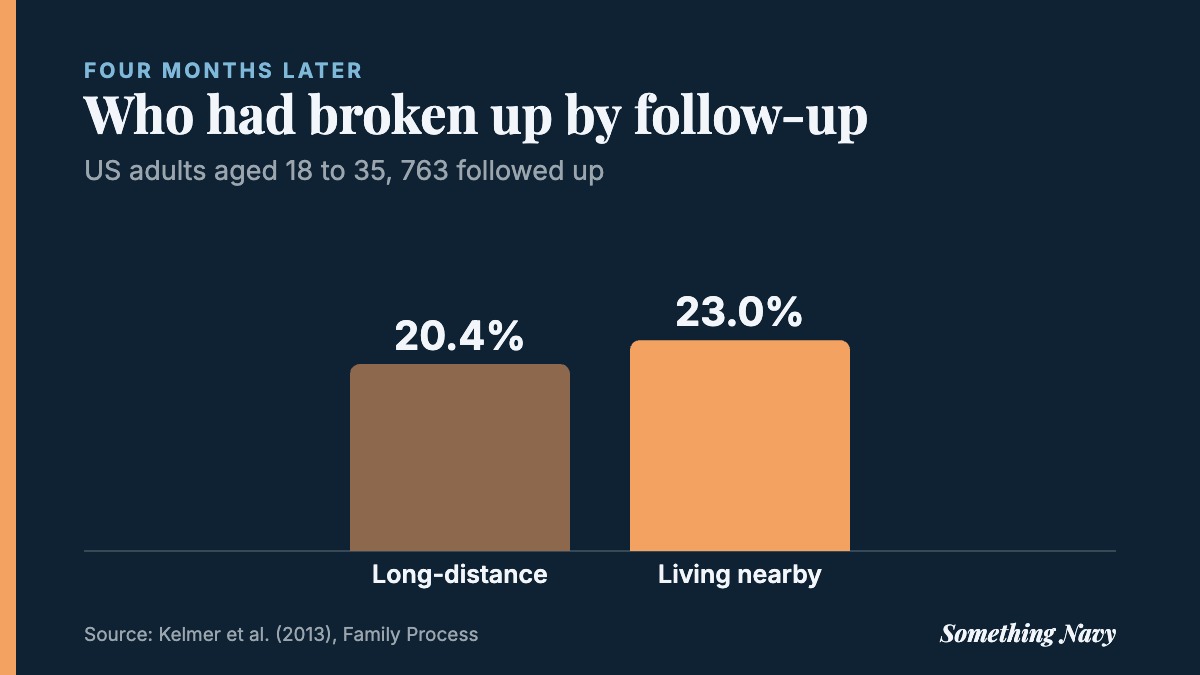
So long-distance relationships were not more fragile. But they were not more durable either, despite their members believing they were. The authors concluded that long-distance partners were more optimistic about their relationship’s stability than the outcomes justified, and suggested that therapists working with such couples watch for idealisation, conflict avoidance and “honeymoon effects”.
The study has limits the authors acknowledge. Only one partner in each couple answered. The distances ranged from 52 to 10,000 miles, and nobody recorded how often couples visited or why the ones who split did so. Some long-distance couples may have moved closer before breaking up, which is exactly the transition the next set of studies examined.
Not every dataset is so kind
Before reaching the reunion, one honest caveat. Most of the encouraging findings come from American students and young adults who volunteered for relationship research. Larger population samples do not always agree.
Sandra Krapf of the University of Cologne used seven waves of the German Family Panel (pairfam), covering 2008 to 2015, to follow couples aged 20 to 40 who lived in separate homes. In her 2018 paper in the European Journal of Population, partners who had to travel an hour or more to see each other were more likely to separate, and less likely to move in together, than those living closer. The exception was couples in which neither partner was employed, for whom distance seemed to make little difference.
Krapf’s definition of distance (an hour’s travel) is not the same as Kelmer’s 50 miles, and the samples differ in age and country. Still, the contrast is a useful corrective. “Long-distance couples are happier” is a finding about how people feel, mostly measured in students. Whether the relationship lasts is a separate question, and the answer depends on who you ask and how.
Timeline three: the reunion
Our couple has done it. A job comes through, a lease is signed, and for the first time in two years they live in the same city. Friends send congratulations. This, surely, is the finish line.
The research suggests it is closer to the hardest stretch of the course.
In a study published in 2006, Stafford and Merolla, with Janessa Castle, followed long-distance dating partners to see what happened when they became geographically close. They reported in the Journal of Social and Personal Relationships that about half of long-distance dating partners went through this transition. Of the couples who reunited, one third broke up within three months.
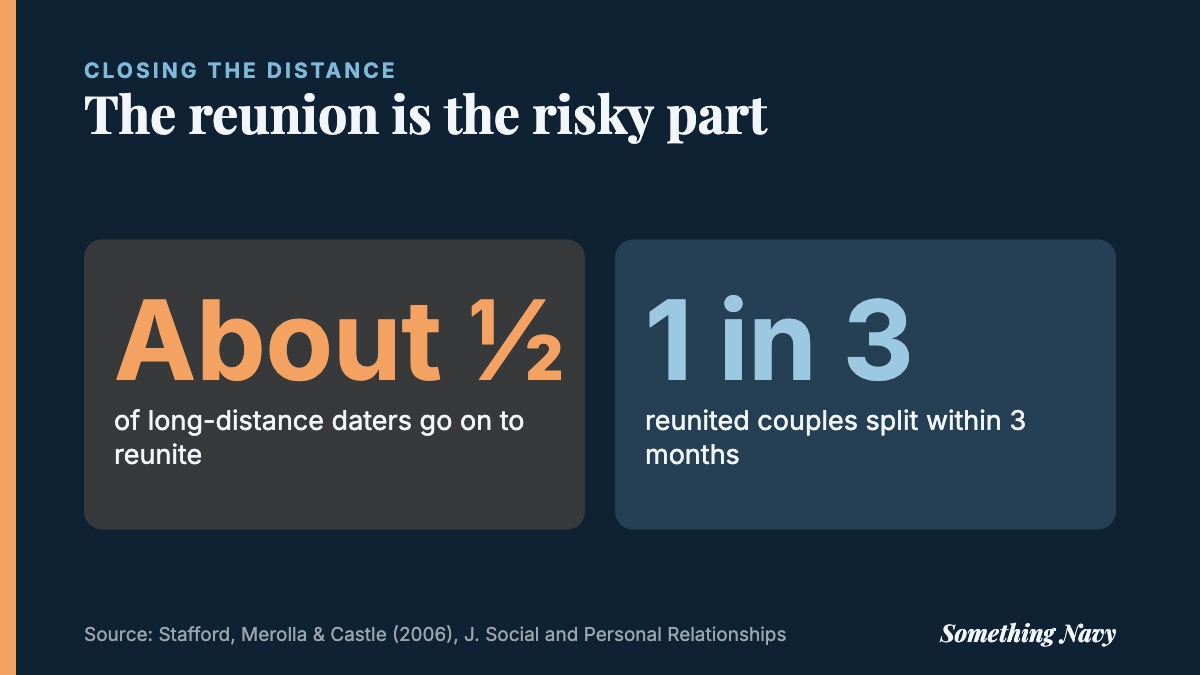
Their 2007 paper sharpened the point. Long-distance couples were stable while they were apart, but many relationships ended once the partners were living near each other. The couples most at risk were the ones who had gone longest between visits and idealised each other most heavily during the separation.
The glue, in other words, had a shelf life.


What changes when the suitcase stays unpacked
When Stafford and colleagues asked reunited partners to describe what had changed, the answers were strikingly ordinary. People spoke of losing autonomy. They talked about learning new things about their partner, both good and bad. Time became harder to manage, now that a partner wanted a share of every evening. Conflict and jealousy rose.
Some of what had made the long-distance phase appealing simply disappeared: the freedom to organise your own week, and the novelty of every meeting. Couples who broke up after reuniting were more likely to say they missed aspects of the time apart.
None of this means the relationship was false. It means it had been running on a different operating system. Apart, a couple’s main shared task is communication, and long-distance partners tend to be good at it. Together, the tasks multiply: whose turn it is to cook, how much time to spend with friends, who notices the dishes and who does them. None of that was ever tested by video call.
Stafford’s team framed reunion as a period in which partners acquire knowledge about each other, idealised expectations fade, and the two people become genuinely interdependent. That process is uncomfortable by design. A third of couples in their study did not get through the first three months of it. Most did.
Lessons for the time apart
If you are currently living apart, the research points in a fairly consistent direction, though most of these are reasonable inferences from correlational studies rather than tested interventions.
Keep the depth, but add the mundane. The long, reflective messages are doing real work; Jiang and Hancock found that text-based and asynchronous channels were where disclosure and intimacy ran highest. But idealisation thrives on curated material. Sending the boring bits too (the grim lunch, the irritable mood, the argument with a flatmate) gives your partner a more accurate picture to love.
Make some visits ordinary. Long gaps between visits were linked with stronger idealisation and later instability. Where you can, see each other more often rather than more lavishly, and spend part of the time doing errands, working side by side or meeting friends. A weekend with a supermarket run in it is more informative than one built entirely around a restaurant booking.
Do not mistake confidence for evidence. Kelmer’s long-distance couples felt safer than couples nearby but split at a similar rate. Feeling certain about the future is pleasant; it is not a forecast.
Practise disagreeing. Short visits make it tempting to postpone conflict so the weekend is not spoiled. But avoided arguments do not vanish; they wait. Learning how you both fight, and recognising the patterns that do lasting damage, such as the contempt and stonewalling described in Gottman’s four horsemen, is far easier to do in small doses before you share a lease.
If you are about to close the distance
- Expect a dip. In one study, a third of reunited couples broke up within three months. Difficulty after moving in together is common, not a verdict.
- Protect some autonomy. Loss of independence was one of the changes reunited partners mentioned most. Keep your own friends, routines and evenings.
- Talk about logistics early. Time management, money and chores replace communication as the main shared tasks. Agree on them before resentment does it for you.
- Let the portrait go. You will learn new things about each other, good and bad. Treat the bad ones as information, not betrayal.
- Keep some of the rituals. The deliberate effort couples put into staying close at a distance is worth keeping, even when you share a sofa.
So, do they work?
On the measures researchers have used, long-distance relationships are not the doomed compromise their reputation suggests. In American samples, partners apart report as much or more love, intimacy and satisfaction as partners nearby, and in at least one national US study they broke up at about the same rate over four months. A larger German panel was less encouraging, which is a reminder that “it depends” is the scientifically honest answer.
What the studies agree on is where the risk sits. It is less in the miles than in the moment the miles disappear, when a relationship built on words and weekends has to learn the slower skill of ordinary life together.
The long message at 11.40pm was real intimacy. So, eventually, is the conversation about whose turn it is to take the bins out. The couples who last seem to be the ones who manage to value both.
Sources
- Jiang, L. C., & Hancock, J. T. (2013). Absence makes the communication grow fonder: Geographic separation, interpersonal media, and intimacy in dating relationships. Journal of Communication, 63(3), 556–577. DOI
- Kelmer, G., Rhoades, G. K., Stanley, S., & Markman, H. J. (2013). Relationship quality, commitment, and stability in long-distance relationships. Family Process, 52(2), 257–270. DOI
- Stafford, L., & Merolla, A. J. (2007). Idealization, reunions, and stability in long-distance dating relationships. Journal of Social and Personal Relationships, 24(1), 37–54. DOI
- Stafford, L., Merolla, A. J., & Castle, J. D. (2006). When long-distance dating partners become geographically close. Journal of Social and Personal Relationships, 23(6), 901–919. DOI
- Krapf, S. (2018). Moving in or breaking up? The role of distance in the development of romantic relationships. European Journal of Population, 34(3), 313–336. DOI
- Cornell University. (2013, August 14). New media allows requited love to know no distance. Cornell Chronicle. Link
Cover photo: Vitaly Gariev on Unsplash. Charts and graphics: Something Navy.
How we reported this. We went back to the original research for this story, 6 sources in all, listed above, and checked every figure against them. If you think we have got something wrong, tell us and we will look at it. Read more about how we work.