
In January 2015, a writer called Mandy Len Catron published an essay in The New York Times’ Modern Love column describing a slightly odd night out. She and a man she knew from university sat in a bar and took turns answering a list of 36 questions, each a little more personal than the last. Then, as her essay tells it, they stood on a bridge and stared into each other’s eyes for four minutes. They fell in love.
The essay, titled “To Fall in Love With Anyone, Do This”, became one of the most shared pieces in the column’s history. Within weeks, the 36 questions were everywhere: in magazine quizzes, on first-date checklists, in apps and on YouTube. But the questions had been sitting in a psychology journal for nearly two decades before that, and the researchers who wrote them were never trying to manufacture love. They were trying to answer a quieter question: can closeness between two strangers be created on purpose?
A lab, two strangers and 45 minutes
The questions come from a study led by the psychologist Arthur Aron, published in 1997 in Personality and Social Psychology Bulletin with colleagues at the State University of New York at Stony Brook. They needed a reliable way to make pairs of strangers feel close in a laboratory, so that they could study what closeness does to people.
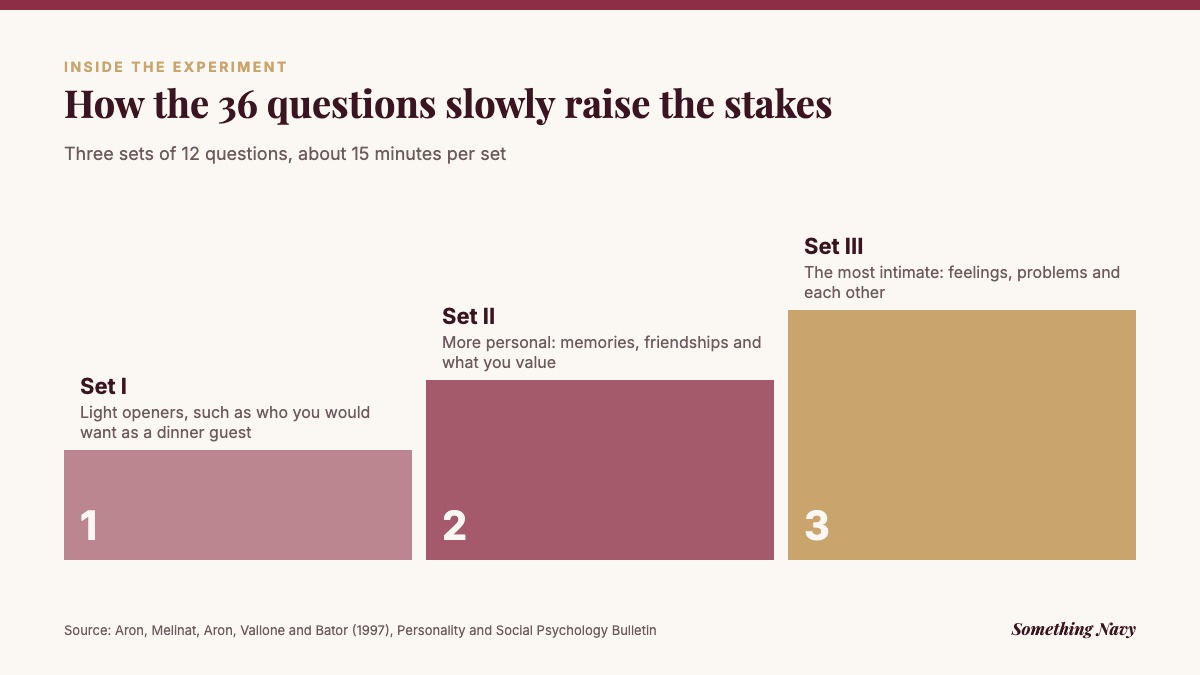
Their solution was a structured conversation. Pairs of students who had never met were given 45 minutes and three sets of 12 questions, spending about 15 minutes on each set. The early questions are gentle. The very first asks: “Given the choice of anyone in the world, whom would you want as a dinner guest?” The second: “Would you like to be famous? In what way?” By the third set, the questions reach into family, regrets, fears and the kinds of things people rarely say aloud to someone they have just met.
A comparison group spent the same time on small-talk questions. Afterwards, everyone rated how close they felt to their partner using a simple measure called the Inclusion of Other in the Self scale, which shows pairs of overlapping circles and asks people to pick the one that best represents the relationship.
In the first study, pairs who worked through the personal questions rated their closeness at 4.06 on average on a seven-point scale, compared with 3.25 for pairs making small talk. Later studies in the same paper found the effect held regardless of whether partners agreed on important issues, and even when pairs were not told that the aim was to become close.


Where the love story came from
So where did the idea of falling in love come from? Buried in the paper is a single, delightful aside. The authors mention that in their earlier, preliminary work with a longer version of the procedure, one pair of participants later married. That anecdote, not the data, is the seed of the legend.
Catron’s essay added a second ingredient that is often presented as part of the science: the four minutes of silent eye contact. That step does not appear in the 1997 study. It was part of her own experiment. Her essay ends with a line that captures the spirit of the exercise better than any headline: love, she concluded, did not simply happen to them, but was something they each chose. She went on to explore the idea at length in a 2017 book, How to Fall in Love with Anyone.
Why the questions work
The 36 questions are an applied version of an idea that psychologists had been developing for decades. In the 1970s, Irwin Altman and Dalmas Taylor proposed what they called social penetration theory: relationships deepen as people gradually share more personal information, moving from surface topics towards their inner lives. Too fast, and the other person feels overwhelmed. Too slow, and the relationship stalls.
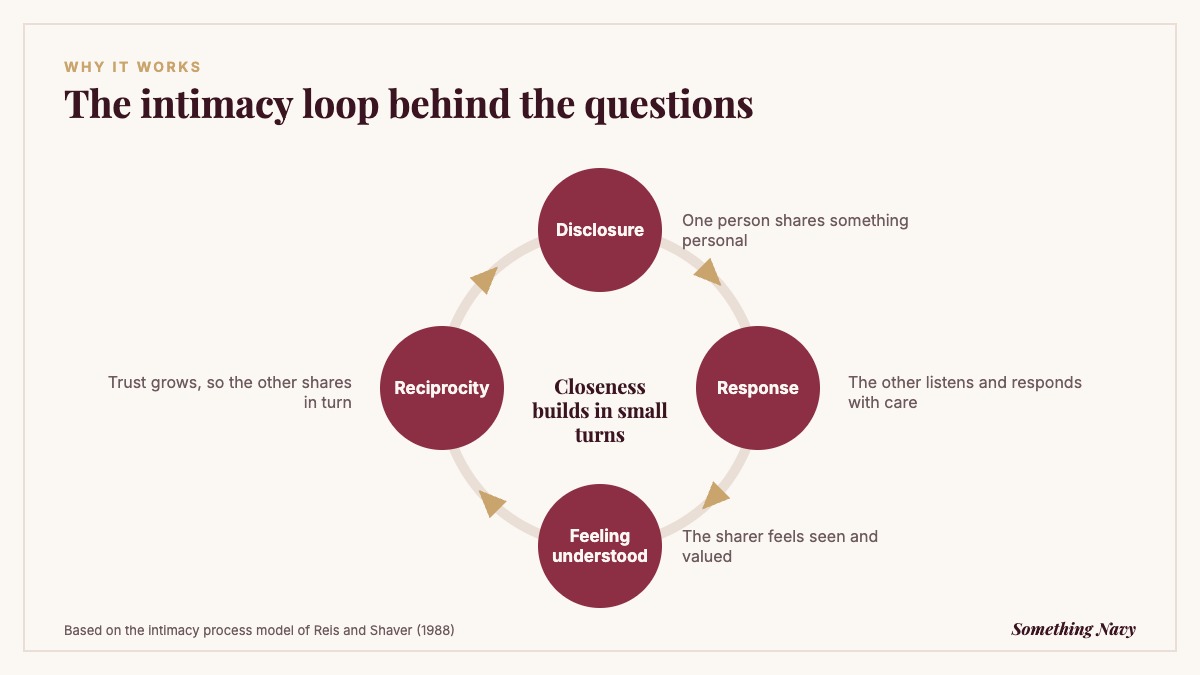
Later work refined the picture. Harry Reis and Phillip Shaver described intimacy as a process, not just a matter of what is shared. One person discloses something, the other responds, and closeness grows when the person who opened up feels understood, validated and cared for. In other words, it is not only what you say that matters, but how the other person receives it.
The 36 questions build both of those elements into a single conversation. They escalate gradually, so neither person is asked to reveal too much too soon. And they require turn-taking, so each disclosure is met with a response and then a disclosure in return.
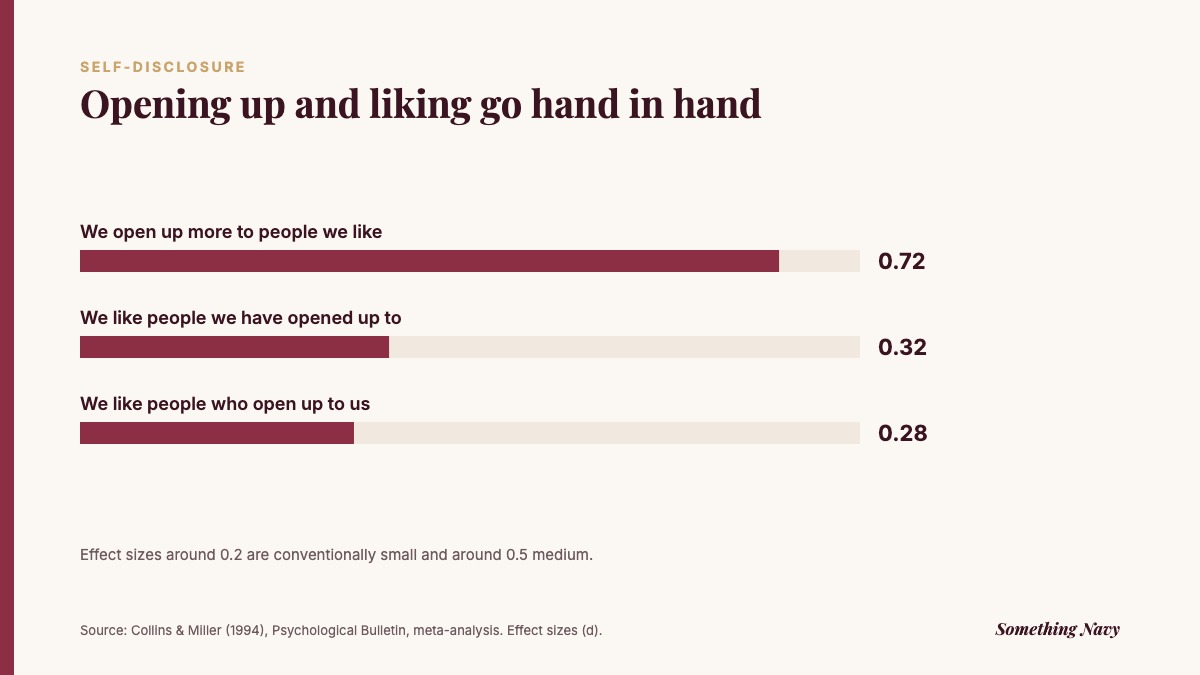
A major review of the evidence, published in 1994 in Psychological Bulletin by Nancy Collins and Lynn Carol Miller, found three connected effects. People who disclose intimate information tend to be liked more. People disclose more to those they already like. And people come to like those they have opened up to. The strongest of the three was the second: we open up most to the people we like, which means liking and disclosure tend to feed each other in an upward spiral.
What happened when other researchers used them
Because the procedure is so reliable, it has become a standard tool in relationship research, and it has been used in some surprising ways. In a 2008 study in the Journal of Personality and Social Psychology, Elizabeth Page-Gould, Rodolfo Mendoza-Denton and Linda Tropp paired 144 Latino and White students for three weekly meetings, the first of which used Aron’s questions. Some pairs were from the same background and some were not.
Among participants who were most anxious about rejection based on race, or who showed hidden prejudice on a reaction-time test, stress hormone responses fell over the course of the meetings when they were paired with someone from a different group. Making a cross-group friend was linked to less anxiety in later daily life. “People who are least likely to make a cross-race friend are the very ones who benefit the most from such friendships,” Page-Gould said in a University of California, Berkeley press release.
More recent studies have asked whether the method works outside the lab. In 2021, Susan Sprecher reported in the Journal of Social and Personal Relationships that the “fast friends” task produced more closeness than small talk and worked about as well over video chat as face to face. A 2025 study in the same journal, looking at 286 pairs who got to know each other by text, found that intimate conversation still built more connection than small talk, although people shared less about themselves over text, which weakened the effect.
We underestimate deep conversation
If deeper conversations are so powerful, why do we default to small talk? A series of experiments by Michael Kardas, Amit Kumar and Nicholas Epley, published in 2022 in the Journal of Personality and Social Psychology, offers an answer. Using questions partly adapted from Aron’s list, they found that people expected deep conversations with strangers to be more awkward and less rewarding than they actually were. They also underestimated how interested their partners would be in what they had to say.
Most of us are more ready for a real conversation than we think, and so is the person sitting opposite.
What the questions cannot do
For all its success, the 36-question procedure has clear limits, and it is worth being honest about them. The original study measured how close people felt immediately after a single 45-minute conversation. It did not follow participants for months or years to see whether those feelings lasted, and it did not measure romantic love at all.
Closeness and attraction are also not the same thing. Two people can feel a genuine bond after a deep conversation without any romantic spark, and that is exactly what happened to many participants in the original research, who were simply strangers assigned to talk to each other. Attraction depends on many other factors, from physical chemistry to timing to whether two people want the same things from life. No list of questions can supply those.
There is also the question of setting. In a laboratory, participants are given permission to talk about personal things and a clear structure to follow. Outside it, launching into question 24 on a first date can feel forced, and some people find the whole exercise uncomfortable. The principles behind the questions, gradual and mutual openness, are more portable than the list itself.
Why closeness feels so good
If anything, the research on the 36 questions is a reminder of how much people want to be known. In study after study, participants expected that opening up to a stranger would be awkward, and were surprised by how meaningful it felt. Being asked a real question, and having someone listen to the answer, is a rare experience in a busy life.
That may be the most useful takeaway. You do not need to follow a script to build closeness with a partner, a friend or someone you have just met. You need curiosity, a willingness to share something real in return, and enough time for the conversation to go somewhere. The 36 questions simply make those ingredients impossible to skip.
How to use the 36 questions
You do not need a date, a lab or a bridge to try the idea. The research suggests a few principles that matter more than the exact wording of each question.
- Keep the escalation. The questions work because they build gradually. Skipping to the most personal ones tends to feel like an interrogation.
- Take turns properly. Both people answer each question. One-sided disclosure is a confession, not a conversation.
- Respond, do not just wait. The intimacy process depends on feeling understood. Follow-up questions and genuine reactions matter as much as answers.
- Give it time. The original study used 45 minutes. Rushing through in ten tends to keep things on the surface.
- Use it with people you already know. Couples and old friends often find that a few deeper questions bring back a sense of discovery that routine wears away.
- Let people pass. Some questions touch on painful subjects. It is fine to skip one.
If you are wondering how long it takes for a connection like this to become a real friendship, our article on how many hours it takes to make a friend looks at the research. And if starting conversations with new people feels daunting, read about why we are so wrong about talking to strangers.
Frequently asked questions
They are a set of questions created by psychologist Arthur Aron and colleagues for a 1997 study. Pairs work through three sets of 12 increasingly personal questions over about 45 minutes.
Not reliably. The study showed the questions made strangers feel closer than small talk did. One couple from the researchers’ earlier work later married, but the research did not measure love.
No. The eye contact comes from Mandy Len Catron’s 2015 New York Times essay, not from the original experiment.
Yes. The questions are designed to build closeness through gradual, mutual disclosure, which can work for existing couples and friends as well as strangers.
More in our Relationships section.
Sources
- Aron, A., Melinat, E., Aron, E. N., Vallone, R. D., & Bator, R. J. (1997). The experimental generation of interpersonal closeness: A procedure and some preliminary findings. Personality and Social Psychology Bulletin, 23(4), 363–377. DOI
- Altman, I., & Taylor, D. A. (1973). Social penetration: The development of interpersonal relationships. Holt, Rinehart and Winston.
- Reis, H. T., & Shaver, P. (1988). Intimacy as an interpersonal process. In S. Duck (Ed.), Handbook of personal relationships (pp. 367–389). Wiley.
- Collins, N. L., & Miller, L. C. (1994). Self-disclosure and liking: A meta-analytic review. Psychological Bulletin, 116(3), 457–475. PDF
- Page-Gould, E., Mendoza-Denton, R., & Tropp, L. R. (2008). With a little help from my cross-group friend: Reducing anxiety in intergroup contexts through cross-group friendship. Journal of Personality and Social Psychology, 95(5), 1080–1094. DOI
- Sprecher, S. (2021). Closeness and other affiliative outcomes generated from the Fast Friends procedure. Journal of Social and Personal Relationships, 38(5), 1452–1471. DOI
- Kardas, M., Kumar, A., & Epley, N. (2022). Overly shallow?: Miscalibrated expectations create a barrier to deeper conversation. Journal of Personality and Social Psychology, 122(3), 367–398. DOI
- Leckfor, C. M., Wood, N. R., Slatcher, R. B., & Orehek, E. (2025). Not such fast friends? Journal of Social and Personal Relationships, 42(11). DOI
- Catron, M. L. (2017). How to Fall in Love with Anyone: A Memoir in Essays. Simon & Schuster.
How we reported this. We went back to the original research for this story, 9 sources in all, listed above, and checked every figure against them. If you think we have got something wrong, tell us and we will look at it. Read more about how we work.
Cover photo: GESPHOTOSS on Unsplash. Charts and graphics: Something Navy.