At about ten o’clock every night, millions of phone screens quietly turn the colour of weak tea. Night Shift on an iPhone, Eye Comfort Shield on a Samsung, Night Light on a Pixel: the warm tint arrives on schedule, and with it a small feeling of virtue. You are still scrolling, but at least you are scrolling responsibly.
The idea behind that amber glow has become one of the most widely repeated pieces of health advice of the smartphone era. Screens emit blue light, blue light tells your brain it is daytime, and so the phone in your hand at midnight is chemically keeping you awake. It sounds tidy and scientific. It has sold a lot of orange-tinted glasses.
It is also, on closer inspection, a much shakier story than most of us assume. The research is real, but it is narrower than the headlines, and the studies that tested the everyday version of the claim have mostly come back underwhelming. Below are five popular beliefs about phones and sleep, each rated against what the evidence actually shows.
(This is a look at the research, not medical advice. If you have persistent trouble sleeping, a GP is a better first stop than a settings menu.)
The Harvard study that launched a thousand warnings
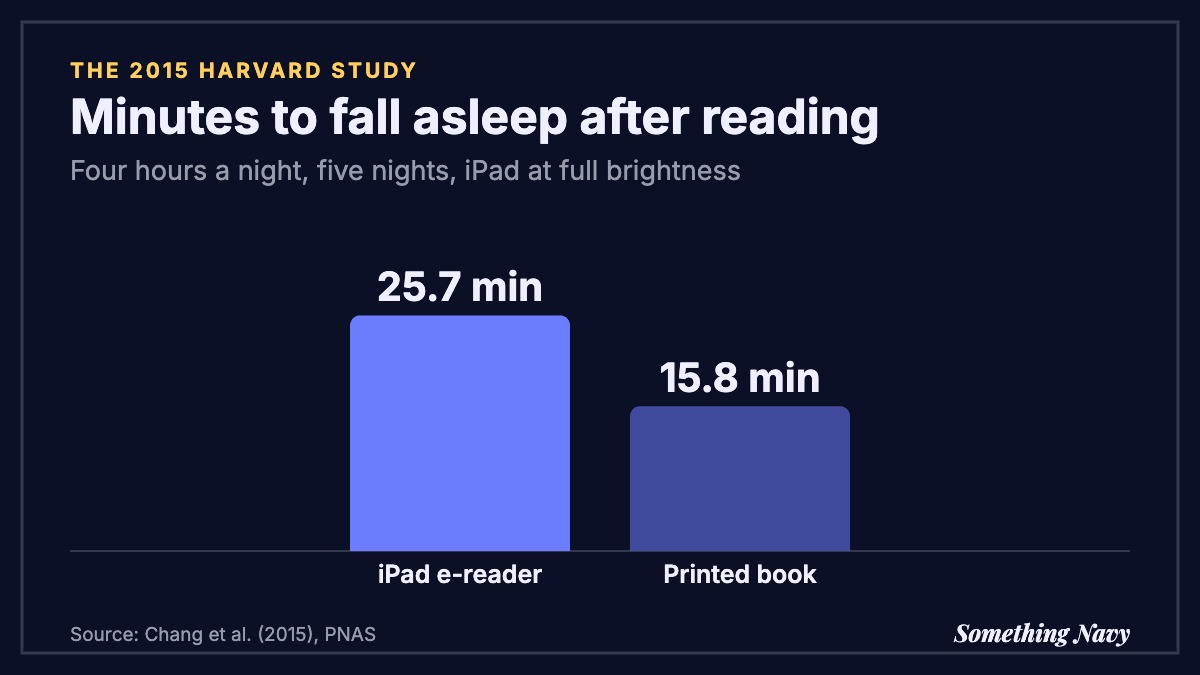
Most blue light advice traces back, directly or indirectly, to one elegant experiment. In 2015, Anne-Marie Chang, Daniel Aeschbach, Jeanne Duffy and Charles Czeisler at Brigham and Women’s Hospital and Harvard Medical School published a study in the Proceedings of the National Academy of Sciences comparing an iPad e-reader with an ordinary printed book.
What the study did
- 12 healthy young adults (six women, six men, average age about 25) lived in a hospital research unit for 14 days.
- On five consecutive evenings they read for about four hours, from 6pm to 10pm, either on an iPad set to maximum brightness or from a printed book in dim light. Then they swapped.
- Lights out was fixed at 10pm, and the team measured melatonin, body clock timing, sleep stages and next-morning alertness.
The results were striking. After the e-reader, volunteers took an average of 25.7 minutes to fall asleep, against 15.8 minutes after the book, a difference of roughly ten minutes. By the fifth night their evening melatonin was suppressed by about 55%. The timing of their melatonin rise, a marker of the body clock, shifted around an hour and a half later. They had about 12 fewer minutes of REM sleep, felt less sleepy at bedtime and were groggier the following morning.
That is a genuine biological effect, measured carefully under controlled conditions. It is also worth reading the small print before applying it to your own bedtime.
Claim 1: “Screen light suppresses your melatonin”
Verdict: true in the lab, at a dose few of us take.
Chang’s volunteers were not glancing at a phone. They were staring at a tablet held close to the face, at full brightness, for four hours a night, five nights in a row, in a room otherwise kept dim. By the paper’s own light measurements, the iPad delivered about 32 lux at eye level compared with under 1 lux from the printed book. It was a deliberately strong contrast, designed to answer whether the effect exists at all.
It does. The harder question is how much of it survives in ordinary life, and the closest test of that is less dramatic. In 2014, Michael Gradisar’s group at Flinders University in Adelaide ran a study with 16 teenagers, average age 17, who used a tablet for one hour before their usual bedtime on three occasions: on a bright screen, a dim screen and a screen filtered with the f.lux app.
The brightness of the screen made no significant difference to how long the teenagers took to fall asleep. There were small differences in a reaction-time task (about 23 milliseconds in speed), which the authors judged to be of minimal clinical significance.
Sixteen people is a tiny sample, so this does not settle anything. But it fits a broader pattern: the light-alone effect shows up most clearly when the exposure is long and bright, and fades when it looks more like a normal evening.
Claim 2: “Night Shift fixes the problem”
Verdict: not supported by the one good trial we have.
If light were the main villain, warming the screen should help. In 2021, researchers Kara Duraccio, Chad Jensen and colleagues put that to the test in a study published in Sleep Health. They recruited 167 iPhone users aged 18 to 24 and randomly assigned them to one of three conditions for seven nights: use the phone in the hour before bed with Night Shift on, use it with Night Shift off, or do not use the phone at all.
Sleep was tracked with wrist-worn activity monitors rather than self-report, and phone use with a tracking app. Across the whole sample, there were no significant differences in how quickly people fell asleep, how long they slept, or how much they woke in the night. Night Shift users did no better than those with ordinary screens.
The more revealing result came from an exploratory split. Among participants who were already sleeping relatively well (above the group median of about 6.8 hours a night), the no-phone group had better sleep efficiency than the Night Shift group and woke less during the night. As the authors put it, “not using a smartphone was superior to use of phone with Night Shift for emerging adults obtaining adequate sleep.”
Note what that sentence does not say. It does not say the warm tint was the problem. It says the phone was, colour filter or not. The researchers themselves suggested the cause may lie in what people were doing on their phones rather than the light coming off them.
The study had real limitations. Only 62% of those randomised completed the protocol, Night Shift settings could not be verified all week, and the subgroup analysis was exploratory. It is one trial, not a verdict for all time. But it is the most direct test of the feature that has been run, and it found nothing.

Claim 3: “Blue-blocking glasses will help you sleep”
Verdict: unproven, and the best review says the evidence is very weak.
Blue-light filtering spectacles are now sold everywhere from opticians to online fashion shops, often with promises of better sleep and less eye strain. In August 2023, a team led by Sumeer Singh and Laura Downie at the University of Melbourne published a Cochrane systematic review, the gold standard for weighing up clinical evidence.
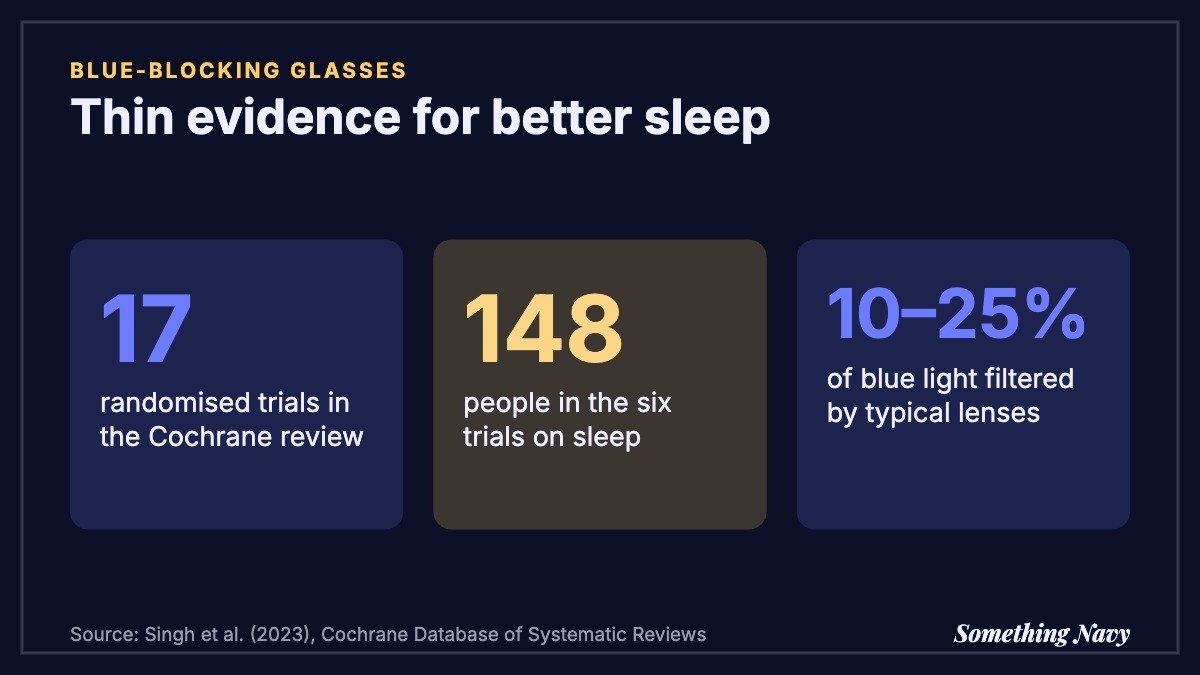
They found 17 randomised controlled trials from six countries. Only six trials, with 148 participants in total, looked at sleep, and their results pointed in different directions: three found better sleep scores with blue-filtering lenses and three found no significant difference. The reviewers could not pool the data and rated the certainty of the evidence on sleep as very low.
On eye strain from computer use, the picture was slightly clearer and no more flattering. Downie summarised it in a Cochrane press release: “there may be no short-term advantages with using blue-light filtering spectacle lenses.” The same release pointed out that typical lenses filter only about 10–25% of blue light, and that blocking much more would require an amber tint that visibly changes how colours look.
None of this proves the glasses are useless for everyone. Very low certainty means we genuinely do not know. But “we do not know” is a long way from the confident sleep claims printed on the packaging.
Claim 4: “Any screen time before bed is bad for sleep”
Verdict: partly true, though probably not for the reason you think.
Here the evidence of an association is strong. In 2015, Lauren Hale of Stony Brook University and co-author S. Guan reviewed 67 studies of screen use and sleep in school-aged children and teenagers, published between 1999 and early 2014. In 90% of them, more screen time was linked to worse sleep, mostly later bedtimes and shorter sleep.
That is a consistent finding, but most of those studies were surveys taken at one point in time, and the review itself stressed that a causal link had not been confirmed. Teenagers who already struggle to sleep may simply reach for their phones more. Hale and Guan laid out three possible explanations side by side: screens may push sleep later by eating into the time available for it; the content, from games to group chats, may be arousing; or the light may disturb the body clock.
Light was only ever one of three suspects. Interestingly, the review noted that computer use was more consistently linked to poor sleep than television, which hints that interactive screens may matter more than passive ones. That is hard to explain with light alone, since a television fills a darkened room with plenty of it.
Claim 5: “It’s the light, not what you’re doing”
Verdict: mostly the reverse.
If you take one idea from the research, it should be this: the hour you spend on your phone in bed is first and foremost an hour you are not asleep.
Liese Exelmans and Jan Van den Bulck at KU Leuven in Belgium have spent years studying what they call “shuteye latency”: the gap between getting into bed and actually trying to sleep. In a 2018 study with Michael Gradisar, they surveyed a representative sample of 584 adults aged 18 to 96. Only about one in five tried to sleep as soon as they got into bed. Around 16% spent more than 30 minutes in bed before attempting sleep on both weeknights and weekends.
Longer shuteye latency went hand in hand with poorer sleep quality, longer time to drop off and more fatigue. People who delayed sleep by half an hour or more used both passive media, such as television, and interactive media, such as smartphones, more often. Non-screen activities like reading a book showed no such difference.
It is still survey data, so cause and effect run both ways. But it describes something most of us recognise. The problem is not that a feed glows blue. It is that it never ends, and that every message and video is engineered to make you want the next one. That pull is close cousin to revenge bedtime procrastination, where people trade sleep for a sliver of time that feels like their own.
Content matters too. An argument in a group chat, a work email at 11pm or a tense episode will raise your heart rate whatever colour the screen happens to be. Even a silent phone can tug at attention: research on the mental drain of a phone that is merely nearby suggests our devices claim focus simply by being within reach.
Why the light story is so sticky
Part of the appeal is that the blue light explanation lets us off the hook. If the culprit is a wavelength, the fix is a setting or a pair of glasses, and we can keep scrolling. If the culprit is the scrolling itself, the fix is harder, and it involves putting the phone down.
There is also a kernel of solid science at the centre. Light really is the most powerful signal for setting the human body clock, and short-wavelength light really does suppress melatonin most strongly. The Cochrane press release noted that artificial light sources emit roughly a thousandth of the blue light found in natural daylight, which helps explain why a phone’s contribution can be modest compared with a bright room or a sunny morning. The leap from “light affects the body clock” to “your phone’s colour is what keeps you awake” is where the evidence thins out.
| Claim | Verdict | Key evidence |
|---|---|---|
| Screen light suppresses melatonin | True, at high doses | Chang et al. (2015) |
| Night Shift fixes it | Not supported | Duraccio et al. (2021) |
| Blue-blocking glasses help sleep | Unproven | Singh et al. (2023) |
| Any screen time before bed is bad | Partly true | Hale & Guan (2015) |
| It’s the light, not the activity | Mostly false | Exelmans et al. (2018) |
What actually seems worth trying
None of this means phones are harmless at bedtime. It means the useful changes are mostly about time and attention rather than colour temperature.
The simplest is to separate getting into bed from going to sleep as little as possible. If shuteye latency is the hidden cost, then the biggest win is shortening the gap: deciding on a time when the phone goes down, not a time when you get into bed. Charging the phone outside the bedroom, or at least out of arm’s reach, turns “one more video” from a reflex into a decision.
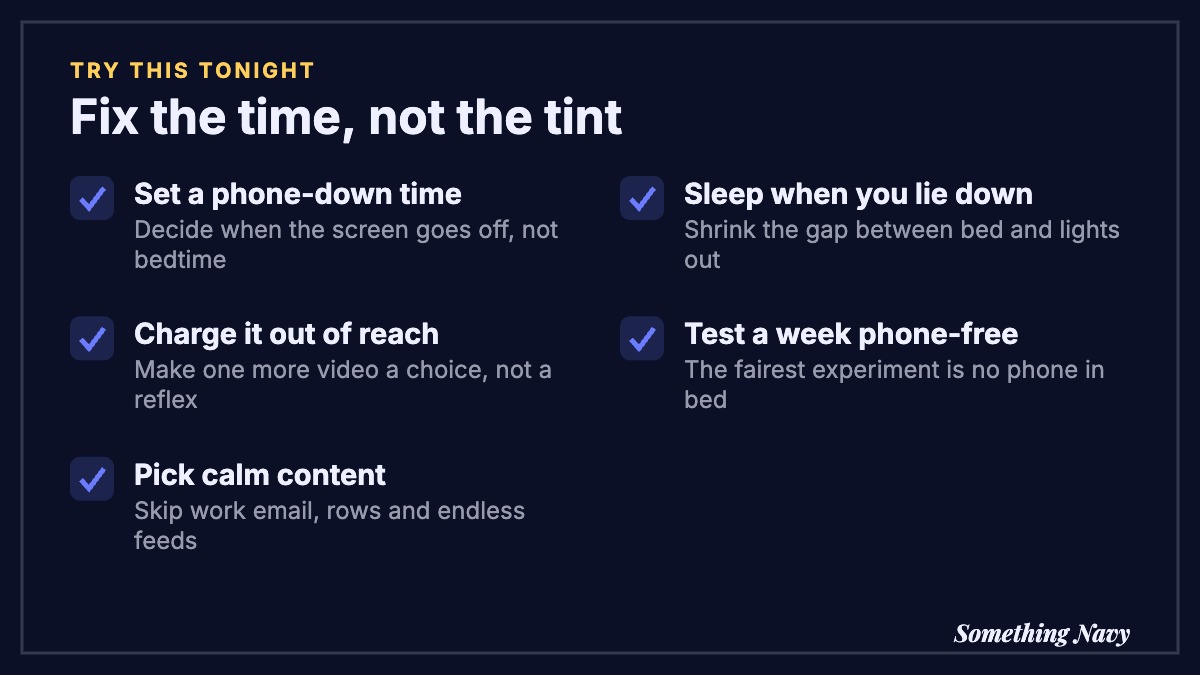
What you do in that last half hour matters as well. A calm podcast, a familiar show or a chapter of a paper book is a different proposition from a work inbox or a heated thread. And if you are curious whether your phone is costing you sleep, the most honest experiment is not a filter but a week without the phone in bed, a smaller version of what people report when quitting social media altogether.
Keeping Night Shift on does no harm, and dimmer screens are kinder on the eyes in a dark room. Just do not mistake it for the solution. In the one trial that tested it directly, the warm glow made no measurable difference.
The amber glow is a placebo for the conscience
Chang’s study was never wrong. It showed what bright screens can do to a body clock under the right conditions, and it remains a useful reminder that light at night is not neutral. What went wrong was the translation, from four hours on a full-brightness tablet in a dim hospital room to a ten-minute scroll under a bedside lamp.
The sleep researchers’ message, read across all these studies, is less technological and more old-fashioned. Sleep needs time, and it needs a mind that has stopped being entertained. The tint on your screen can’t give you either. Only putting the phone down can.
Frequently asked questions
It reduces the blue portion of the screen’s light, and some people find it more comfortable in a dark room. But in a randomised trial of 167 young adults, using Night Shift did not improve any measured sleep outcome compared with ordinary phone use.
A 2023 Cochrane review found the evidence on sleep to be of very low certainty, with trials disagreeing. The reviewers concluded that the findings do not support prescribing these lenses to the general population.
Chang’s 2015 study used an iPad, a backlit tablet at full brightness, for four hours. Devices and settings vary, and reading is usually less stimulating than an endless feed, so the comparison with phones is not straightforward.
There is no well-tested magic number. A practical goal is simply to stop using it once you get into bed, since time spent on screens in bed before trying to sleep is linked to poorer sleep quality and more fatigue.
Sources
- Chang, A.-M., Aeschbach, D., Duffy, J. F., & Czeisler, C. A. (2015). Evening use of light-emitting eReaders negatively affects sleep, circadian timing, and next-morning alertness. Proceedings of the National Academy of Sciences, 112(4), 1232–1237. DOI
- Duraccio, K. M., Zaugg, K. K., Blackburn, R. C., & Jensen, C. D. (2021). Does iPhone night shift mitigate negative effects of smartphone use on sleep outcomes in emerging adults? Sleep Health. DOI
- Singh, S., Keller, P. R., Busija, L., McMillan, P., Makrai, E., Lawrenson, J. G., Hull, C. C., & Downie, L. E. (2023). Blue-light filtering spectacle lenses for visual performance, sleep, and macular health in adults. Cochrane Database of Systematic Reviews, (8), CD013244. DOI
- Hale, L., & Guan, S. (2015). Screen time and sleep among school-aged children and adolescents: A systematic literature review. Sleep Medicine Reviews, 21, 50–58. DOI
- Exelmans, L., Gradisar, M., & Van den Bulck, J. (2018). Sleep latency versus shuteye latency: Prevalence, predictors and relation to insomnia symptoms in a representative sample of adults. Journal of Sleep Research, 27(6), e12737. DOI
- Heath, M., Sutherland, C., Bartel, K., Gradisar, M., Williamson, P., Lovato, N., & Micic, G. (2014). Does one hour of bright or short-wavelength filtered tablet screenlight have a meaningful effect on adolescents’ pre-bedtime alertness, sleep, and daytime functioning? Chronobiology International, 31(4), 496–505. DOI
Cover photo: Shane on Unsplash. Charts and graphics: Something Navy.
How we reported this. We went back to the original research for this story, 6 sources in all, listed above, and checked every figure against them. If you think we have got something wrong, tell us and we will look at it. Read more about how we work.