

You are scrolling through your phone and a photo stops you. Your old best friend, at a birthday dinner you were not invited to, laughing with people you have never met.
Nobody told you it was over. There was no row, no final message, no door slammed. Just a slow thinning of texts until, one day, you realised the last one was yours and it had been sitting there, unanswered, since March.
If that stings more than you think it should, you are not being dramatic. A romantic split comes with a script: friends rally round, someone brings wine, there are songs written for exactly this. A friendship ending usually gets nothing. No one sends flowers because you and your closest friend from university stopped speaking.
And yet the research on how friendships end suggests it is one of the most common losses of adult life. One study cited in a 2025 review found that more than half of young adults had lost a close friend in the previous five years.
It is ordinary. That does not make it small.
The quiet grief of a friendship break-up
Psychologists have long noticed that we do not grieve all relationships equally in public. Losing a partner is recognised loss. Losing a friend often is not, which means people tend to carry it alone and wonder why they cannot just “get over it”.
Part of the answer is that a close friend is rarely only a friend. They may be the person who knew you at 19, the keeper of your in-jokes, the first number you would ring with bad news. When the friendship goes, a whole version of you goes with it: the shared history, the person who remembers the old flat, the future plans that quietly assumed they would be there.
There is also the matter of ambiguity. A romantic relationship usually has a clear end point, even when it is messy. Many friendships simply stop, so you are left with an open question rather than a closed door. Was it something I did? Are they just busy? Should I message again? Uncertainty keeps the wound open, much as it does when someone ghosts you after a few dates.
It is worth being honest about the evidence here. There is very little research that directly measures whether a friend break-up hurts as much as a romantic one, and nobody has a neat scale that ranks them. What the research does show is that social rejection of any kind registers powerfully, and that losing friends has real costs for wellbeing.
A friendship can end without a single argument, and still leave a gap the exact shape of one person.
What rejection does in the brain
In 2003, Naomi Eisenberger and Matthew Lieberman at UCLA, with Kipling Williams of Macquarie University, put 13 undergraduates into a brain scanner and had them play a simple online ball-tossing game called Cyberball. Participants believed they were playing with two other students. Partway through, the other “players” (in fact, a computer program) stopped throwing them the ball.
The study, published in Science, found that being left out increased activity in the anterior cingulate cortex, a region linked to the distress of physical pain. The more distressed people said they felt, the more active that area tended to be.
The finding became famous, and you will often see it summarised as “rejection hurts like a broken arm”. That goes too far. The sample was tiny, the game lasted minutes, and later neuroscience work has argued that physical pain and social pain overlap less neatly in the brain than early studies suggested.
The more modest takeaway still matters. Being excluded is not a trivial event for a social species. Your brain treats it as information worth paying attention to, and a lost friendship is a long, drawn-out version of being left out of the game.


The loneliness numbers behind lost friendships
Friend break-ups also land in a context where many people are already short of connection.
In May 2023, the then US Surgeon General, Vivek Murthy, issued a public health advisory on loneliness and isolation. It reported that approximately half of US adults say they experience loneliness. It also noted that lacking social connection can raise the risk of early death about as much as smoking up to 15 cigarettes a day, a comparison drawn from large reviews of observational studies, which show association rather than proof of cause.
In Great Britain, the Office for National Statistics asks about loneliness regularly. In its survey covering 13 December 2023 to 1 January 2024, 7% of adults said they felt lonely often or always, and 27% said they felt lonely at least some of the time.
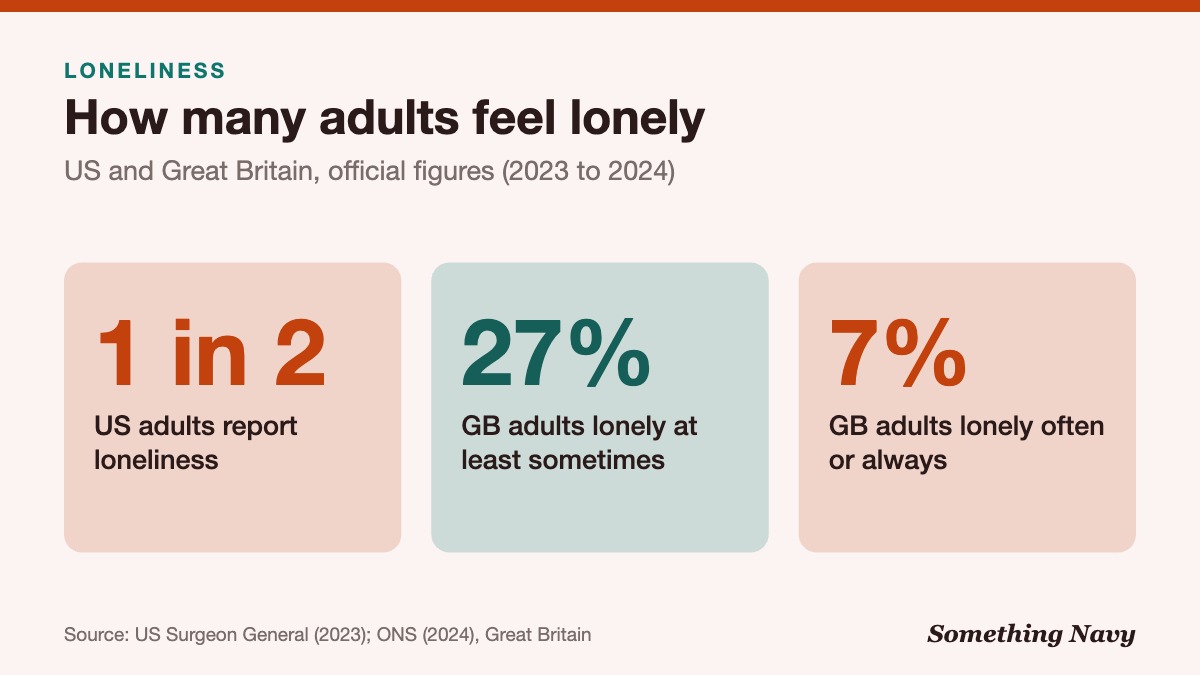
Seven per cent sounds small until you remember it means millions of people. For someone who has just lost their closest friend, the gap is not abstract. It is the empty Saturday, the funny thing you saw with no one to send it to.
Time with friends has been shrinking for years
The Surgeon General’s report includes one chart that tends to stop people mid-scroll. Drawing on the American Time Use Survey, it shows that the time Americans spent socially with friends in person fell from about 60 minutes a day in 2003 to 20 minutes a day in 2020.
For people aged 15 to 24, the drop was steeper: from roughly 150 minutes a day to 40, a fall of nearly 70%. The 2020 figures were collected during the pandemic, so the full size of the drop should be read with some care.
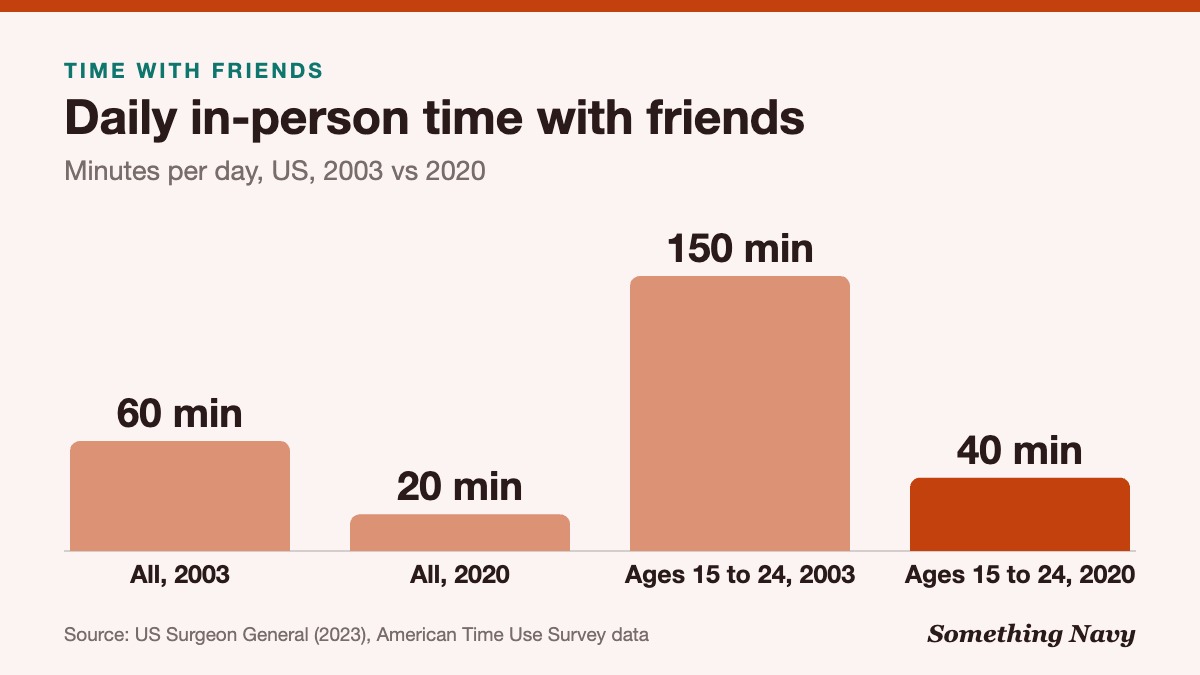
This matters for break-ups because friendships, unlike families, run on maintenance. When that time disappears, the bonds it was holding up start to sag.
If you have ever wondered how much effort it takes to build a friendship in the first place, we looked at how many hours it takes to make a friend. The short version: a lot more than one coffee.
How adult friendships end: fading versus falling out
Most of us picture a friendship ending in a blazing row. The research suggests that is the exception.
Back in 1984, the psychologist S. M. Rose asked college students to describe close same-sex friendships that had recently ended or deteriorated. In her paper in the Journal of Social and Personal Relationships, she identified four common routes out: physical separation, being replaced by new friends, growing to dislike the friend, and interference from dating or marriage. Only one of those four involves anyone falling out.
More recent work adds detail. In 2021, Thomas Khullar, Miriam Kirmayer and Melanie Dirks at McGill University interviewed 179 emerging adults, average age 20 and mostly university students, and asked how they would respond to 53 tricky scenarios with a same-gender friend. Their analysis of 9,487 responses found three main ways people let friendships go.
- Ending the friendship outright.
- Distancing: replying less, suggesting fewer plans, letting it cool.
- Compartmentalising: keeping the person in one part of life (the gym, the office) and out of the rest.
Betrayals and other transgressions were more likely to trigger ending or distancing than ordinary disagreements were. People who placed more weight on asserting themselves were more likely to end things. People who wanted to stay friends were less likely either to end or to distance.
A 2025 review by Katya Santucci, Melanie Dirks and John Lydon pulled this literature together and reached a clear conclusion: friendships end both actively, through rejection, mistreatment or ghosting, and gradually, through distancing and lack of upkeep. Gradual endings, they note, are especially common among young adults.
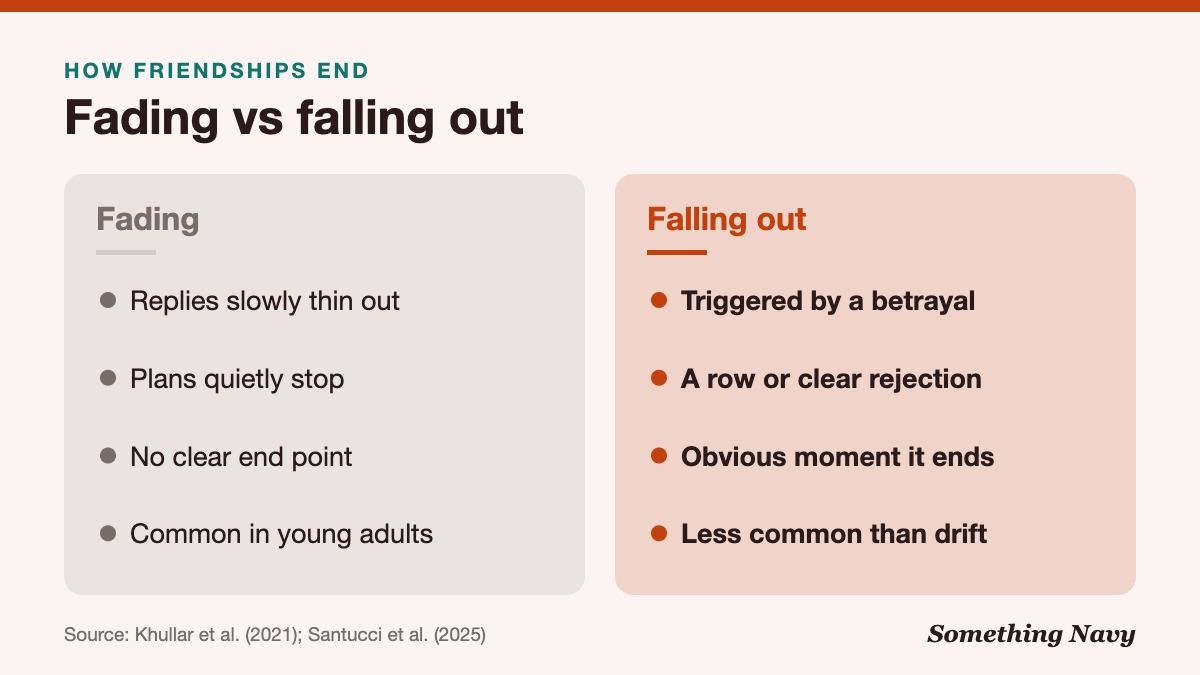
So when your friendship faded rather than exploded, you were not uniquely abandoned. You were probably on the most travelled road out.
Why the slow fade can hurt more than a fight
A falling out is painful, but at least it is legible. You know what happened, even if you disagree about whose fault it was. A fade gives you nothing to hold.
That is partly why people replay old messages looking for the moment it turned. Our minds dislike unfinished business (psychologists have a name for the itch of incomplete tasks, the Zeigarnik effect), and an unexplained ending is the definition of unfinished.
It also makes guilt and blame harder to place. In a fade, both people usually stopped trying at slightly different speeds. The one who noticed first tends to feel left. The one who drifted first may not have noticed anything ended at all.
Both can be true at once.


What keeps a friendship from fading
The researchers Sam Roberts and Robin Dunbar followed people’s entire active social networks for 18 months across a major life transition. In their 2015 paper in Human Nature, family ties and friendships behaved quite differently: relatives held up, while friendships needed work.
The decline in friendship quality was offset when people put in more effort. Interestingly, what counted as effort differed by gender in their sample. For women, talking more often was most protective. For men, doing more activities together mattered most.
The study was not large and it followed one kind of transition, so treat the gender split as a hint rather than a law. But the core message is hard to argue with.
Friendships do not usually die. They starve.
That can feel bleak, but it is also oddly hopeful. If a friendship faded through neglect rather than hatred, it is sometimes recoverable. And if you are worried about losing one now, the fix is often unglamorous: a voice note, a walk, a standing plan. If you are not sure how many close friends is “normal” to keep up with, our piece on how many close friends adults really have is reassuring.
By the numbers
- About 1 in 2 US adults report experiencing loneliness (US Surgeon General, 2023).
- 7% of adults in Great Britain felt lonely often or always in late 2023 (ONS).
- 60 to 20 minutes: daily in-person time with friends in the US, 2003 vs 2020.
- 3 ways young adults let friendships go: ending, distancing, compartmentalising (Khullar et al., 2021).
When ending a friendship is the healthy choice
None of this means every friendship should be saved. The 2025 review is careful on this point: ending a friendship can help when the relationship is harmful, and can hurt wellbeing when it strips away support you genuinely needed.
Signs a friendship may be costing more than it gives include feeling drained or anxious after every meeting, being regularly belittled or made the butt of jokes, finding that confidences are shared, or carrying all the effort for years with nothing coming back. Wanting distance from that is not cruelty. It is self-respect.
Leaving a friendship kindly and being left by one are different skills, and almost nobody is taught either.
How to handle a friendship break-up, from either side
What follows is not therapy, and if a lost friendship has tipped into lasting low mood, a GP or counsellor is a good next step. But these are practical moves grounded in what the research says about how friendships end.
If you are the one leaving
Decide what you actually want. The McGill work is a useful reminder that ending is not the only option. You might want distance, or a friendship that lives in one compartment of your life rather than all of it. Be honest with yourself before you say anything to them.
Match the exit to the friendship. A newer, lighter friendship can often be allowed to cool naturally. A close, long friendship usually deserves words. Silence after ten years tends to be read as a verdict, and the other person will fill the gap with the worst explanation available.
Keep it short and about you. Something like “I’ve realised I need some distance, and I didn’t want to just disappear on you” is kinder than a list of grievances. You are not trying to win the argument. You are trying to end the relationship with as little damage as possible.
Do not recruit the group. Shared friends are not jurors. Let them keep their own relationship with the person if they want to.
Expect to feel bad anyway. Choosing to leave does not make you immune to grief. You can be right to go and still miss them.
If you were left
Name it as a loss. Saying “I lost a close friend” out loud, to someone you trust, does a surprising amount of work. It gives you permission to grieve something the world tends to treat as minor.
Send one clear message, then stop. If you genuinely do not know what happened, one calm, open message is reasonable: “I’ve missed you. If something’s changed, I’d rather know.” If there is no reply, take the silence as the answer, painful as that is. Repeated chasing rarely brings anyone back.
Resist the forensic replay. Rereading old chats looking for the turning point feels productive but usually is not. Most fades have no single moment. Rose’s four routes out (distance, new friends, growing to dislike each other, new partners) are mostly about life, not about you.
Feed the friendships you still have. The Roberts and Dunbar findings cut both ways: neglect lets friendships wither, but effort keeps them alive. Use the energy to text someone you have been meaning to see. People are often more pleased to hear from you than you expect, a pattern psychologists call the liking gap.
Leave the door unlocked, not open. Some friendships come back years later, after the jobs, babies and house moves settle. You do not need to wait for that. But you also do not need to burn anything down to move on.
Rewriting the story you tell yourself
One of the cruellest things about a friendship ending is that it can retroactively poison the good years. If they could leave so easily, the logic goes, perhaps it never meant much.
That logic is wrong. A friendship that lasted through your twenties and then faded is not a failure. It was a real thing that did its job for a season of your life. Rose found back in 1984 that big transitions, like starting university, reshape friendship networks. Adulthood is a series of those transitions: new cities, new jobs, partners, children, illness, caring for parents.
Some friendships stretch to cover all of it. Many do not. That is less a judgement on either of you than a description of how human lives move.
Not every ending is a betrayal. Some are simply the point where two paths stopped running side by side.
So if that photo of a dinner you were not at still catches in your throat, let it. Then put the phone down, think of the friend you still have who would love to hear from you this week, and send the message. Grief for the friendship you lost and care for the ones you have can sit in the same evening.
Frequently asked questions
Yes. Close friends often hold shared history and parts of your identity, so losing one can bring sadness, anger and rumination much like a romantic split, even though it gets far less public sympathy.
Research suggests most end gradually rather than with a fight: people move, get busy, form new relationships or simply reply less until contact stops. Outright falling out is less common than slow distancing.
For close, long-standing friendships a short, kind message is usually better than disappearing, because silence tends to be read as the harshest possible explanation. Lighter friendships can often be allowed to cool naturally.
Often, yes, especially if it ended through drift rather than hurt. A low-pressure message that acknowledges the gap, followed by a simple plan, gives the other person an easy way back in.
Sources
- Eisenberger, N. I., Lieberman, M. D., & Williams, K. D. (2003). Does rejection hurt? An fMRI study of social exclusion. Science, 302(5643), 290–292. DOI
- Khullar, T. H., Kirmayer, M. H., & Dirks, M. A. (2021). Relationship dissolution in the friendships of emerging adults: How, when, and why? Journal of Social and Personal Relationships, 38(11), 3243–3264. DOI
- Office for National Statistics. (2024). Public opinions and social trends, Great Britain: 13 December 2023 to 1 January 2024. Link
- Office of the US Surgeon General. (2023). Our epidemic of loneliness and isolation: The US Surgeon General’s advisory on the healing effects of social connection and community. US Department of Health and Human Services. Link
- Roberts, S. B. G., & Dunbar, R. I. M. (2015). Managing relationship decay: Network, gender, and contextual effects. Human Nature, 26(4), 426–450. DOI
- Rose, S. M. (1984). How friendships end: Patterns among young adults. Journal of Social and Personal Relationships, 1(3), 267–277. DOI
- Santucci, K., Dirks, M. A., & Lydon, J. E. (2025). With or without you: Understanding friendship dissolution from childhood through young adulthood. Journal of Social and Personal Relationships, 42(9), 2675–2699. DOI
Cover photo: Vitaly Gariev on Unsplash. Charts and graphics: Something Navy.
How we reported this. We went back to the original research for this story, 7 sources in all, listed above, and checked every figure against them. If you think we have got something wrong, tell us and we will look at it. Read more about how we work.