
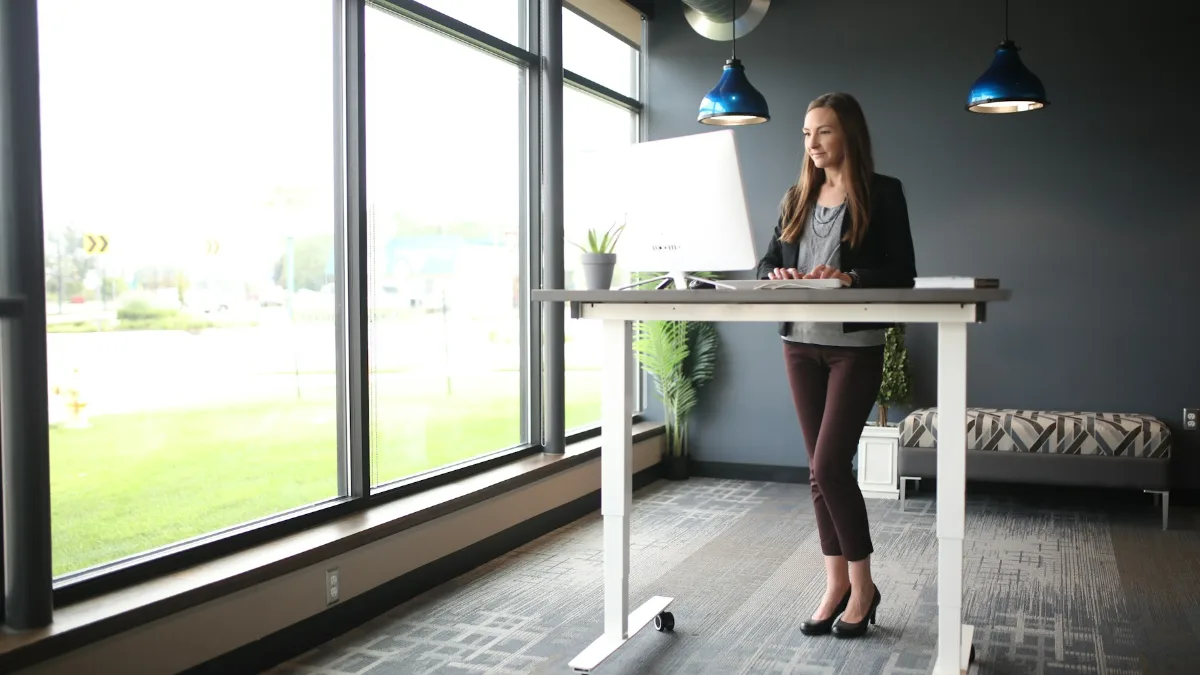
The box arrived on Monday. You spent Sunday evening clearing the old desk, and this morning you pressed the little arrow and watched your laptop rise to chest height with a soft electric hum. You felt faintly heroic, like someone in an advert for oat milk.
By half past nine you had shifted your weight from one foot to the other about forty times. By ten you were leaning on your elbows. At ten to eleven, during a video call nobody could see below your shoulders, you quietly pressed the other arrow and sat down.
The desk now spends most of its life at sitting height, with a coffee ring where your keyboard should be. You feel a bit guilty about it. Should you?
Why standing desks became the default health upgrade
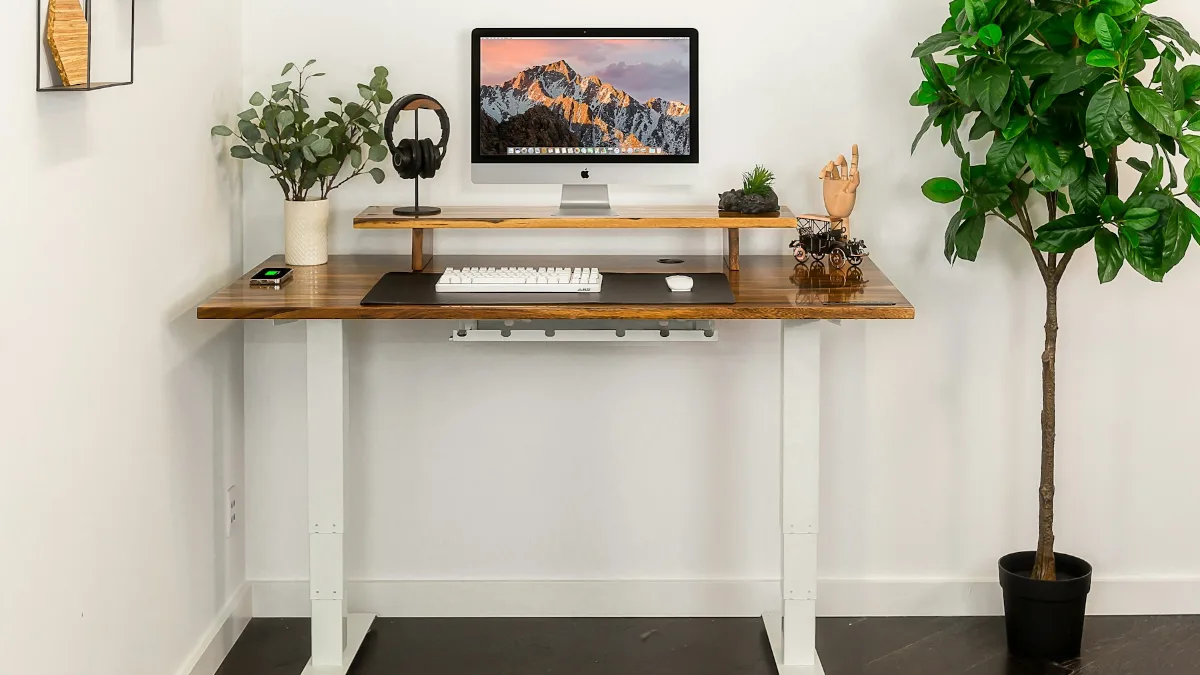
The pitch was simple. Sitting is bad for you, so stand instead. Height-adjustable desks have become a familiar sight in offices and spare bedrooms, sold on the promise that getting out of your chair is good for your body.
Part of that story is solid. Very long, unbroken sitting does look harmful, and the research covered below backs much of that up. The weaker link in the chain is the assumption that standing is the cure. Standing is not sitting, but it is not moving either, and for the heart that difference turns out to matter.
So the real question splits in two. Do standing desks reduce sitting, and is standing itself good for you? The research answers each quite differently.
Do standing desks actually cut sitting time?
Yes, at least for a while.
In 2018 a Cochrane team led by Nipun Shrestha of Victoria University in Melbourne pooled the research on workplace efforts to reduce sitting. The update, published in the Cochrane Database of Systematic Reviews, covered 34 studies with 3,397 participants, all from high-income countries.
Over the first three months, across 10 studies, people with the adjustable desks sat roughly 100 minutes less per workday, with the plausible range running from 84 to 116 minutes. Over three to twelve months, the reduction fell to about 57 minutes a day, though that came from only two studies and the range was wide. On the long term, the reviewers found no evidence at all.
The reviewers rated that evidence as low quality, mainly because of small samples and weaknesses in study design, so the true figure could be quite different. And “sitting less” is a behaviour, not a health outcome. Nobody was followed long enough to see whether fewer hours in a chair meant fewer heart attacks.
The SMArT Work trial in NHS offices
One of the better-designed trials came out of Leicester. Charlotte Edwardson, an associate professor at the University of Leicester’s Diabetes Research Centre, and colleagues ran a cluster randomised trial with 146 office workers in 37 office groups at the University Hospitals of Leicester NHS Trust. Their results appeared in The BMJ in 2018.
The intervention, called SMArT Work, was a lot more than a desk. Workers got a height-adjustable workstation plus a short seminar, feedback on their own sitting, a goal-setting booklet, a cushion that vibrated after long sitting, and regular coaching. The control group carried on as usual.
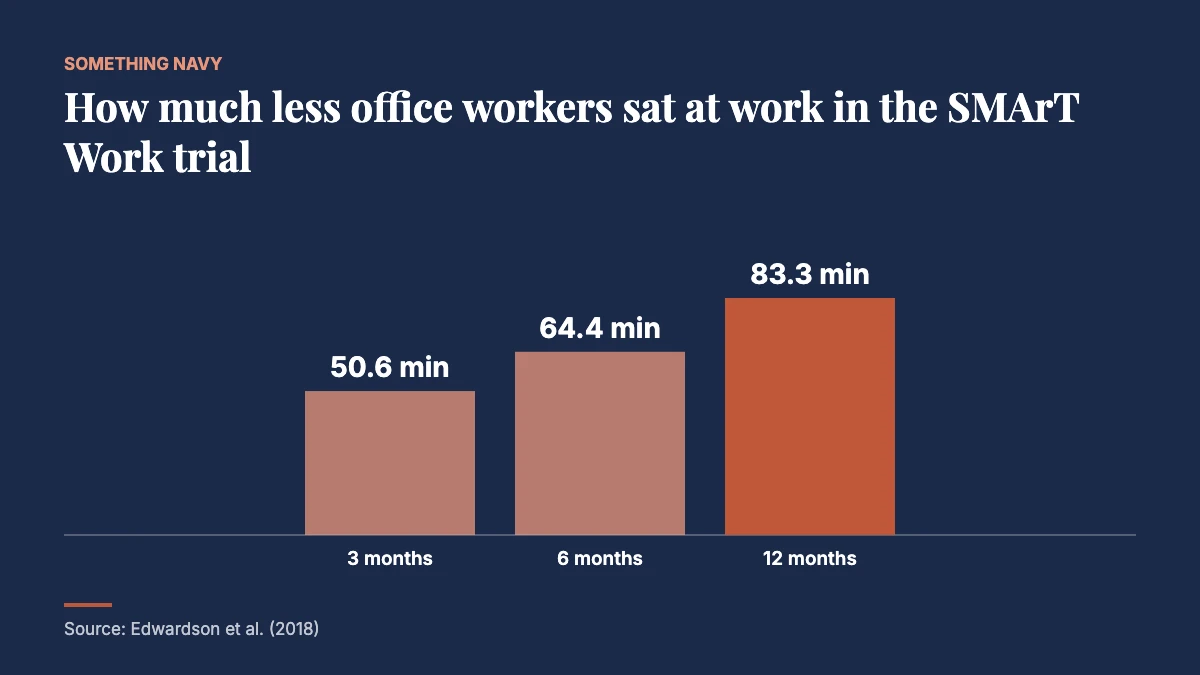
Compared with controls, the SMArT Work group sat about 51 fewer minutes per workday at three months and 83 fewer at twelve. Across the whole day, sitting was about 82 minutes lower at the one-year mark. Most of that time became standing. Stepping time and moderate-to-vigorous activity did not change.
The softer outcomes were encouraging: better job performance and work engagement, less work fatigue, less presenteeism (turning up but not functioning) and lower daily anxiety. Job satisfaction and sickness absence did not change. Measures like these rely on how workers rate themselves, so some enthusiasm for the shiny new kit may be baked in.
Does the desk matter, or the coaching?
A later trial by the same Leicester-led group helps untangle that. Published in The BMJ in 2022, it followed 756 desk-based employees in 78 office clusters. One arm got a behaviour change programme called SMART Work and Life, another got the same programme plus a height-adjustable desk, and a third carried on as normal.
After a year, the programme alone cut sitting by about 22 minutes a day compared with controls. With a desk added, the cut was about 64 minutes. The authors described that as roughly three times as effective. The desk does real work, but in both trials it came wrapped in nudges and coaching. A desk delivered in a box with no plan looks more like the scene at the top of this article.


Is standing good for your heart? The UK Biobank study
This is where the story turns. In October 2024 a team led by Matthew Ahmadi, at the University of Sydney’s Charles Perkins Centre, asked in the International Journal of Epidemiology whether more standing actually protects the heart.
They used data from 83,013 adults in UK Biobank, a long-running health study, who had worn research-grade activity trackers on their wrists. None had heart disease at the start. The average participant was 61, just over half were women, and they were followed for an average of 6.9 years. On an average day they spent about 10.7 hours sitting and 2.1 hours standing.
Two kinds of outcome were tracked. One was major cardiovascular disease, defined as coronary heart disease, heart failure and stroke. The other was what the researchers called orthostatic circulatory disease, a group of problems linked to blood pooling in the legs when you are upright: orthostatic hypotension (feeling faint on standing), varicose veins, chronic venous insufficiency and venous ulcers.
What the researchers found
Standing time had no link with major cardiovascular disease in either direction. It did show up elsewhere. Once standing passed about two hours a day, each extra 30 minutes was linked with an 11% higher risk of orthostatic circulatory disease.
Sitting, meanwhile, behaved the way the headlines had warned. Beyond about 10 hours a day, each extra hour of sitting was linked with around a 15% higher risk of major cardiovascular disease and a 26% higher risk of the orthostatic conditions.
“Standing for too long will not offset an otherwise sedentary lifestyle,” Ahmadi said when the study was released. The paper concluded that prescribing more standing may not lower cardiovascular risk and could raise the risk of circulatory problems.
What this study can and cannot tell you
This is an observational study, so it shows associations, not cause and effect. People who stand a lot may differ from people who sit a lot in ways the analysis could not fully capture. Wrist trackers estimate posture rather than measuring it directly. And the study did not look at standing desks at all. It measured total standing across the day, and the University of Sydney’s own release noted that desk use probably accounts for only a small slice of that.
What happens to people who stand all day at work
If standing were reliably healthy, jobs that keep people on their feet should show it. A Canadian study suggests otherwise.
Peter Smith of the Institute for Work & Health in Ontario led a team that linked answers from the 2003 Canadian Community Health Survey to health records. They followed 7,320 workers aged 35 to 74, all free of heart disease at the start, for about 12 years, up to 2015. The study was published online in the American Journal of Epidemiology in 2017 and in print in January 2018.
Nobody wore a tracker. Each worker’s main posture was estimated from their job title, using a Canadian government occupational handbook. About 9% of workers were in jobs classed as mainly standing.
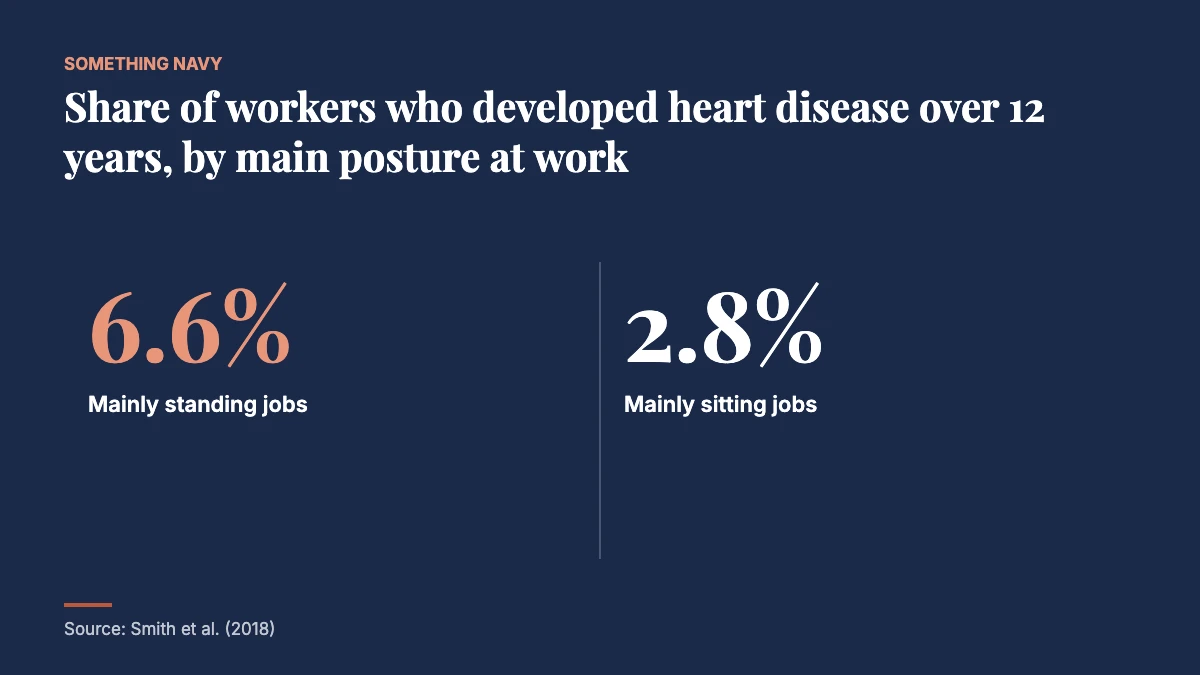
Over the follow-up, 6.6% of people in mainly standing jobs developed heart disease, against 2.8% in mainly sitting jobs. After accounting for personal, health and work factors, the standing group still had roughly double the risk.
One wrinkle rarely made the headlines. In the fullest model, which also adjusted for body weight and health behaviours, the estimate stayed close to double, but it fell fractionally short of statistical significance. The authors also acknowledged that job titles are a blunt way to measure posture: two people with the same job may spend their days quite differently, with very different chances to take a break.
Smith’s conclusion was not that everyone should sit down. “A combination of sitting, standing and moving” was likely best for heart health, he said, and he argued that workplaces should pay attention to people who stand all day, not only to those who sit. An office worker choosing to stand for an hour after lunch is also in a very different position from someone on their feet for a whole shift.
How many calories does standing really burn?
Part of the appeal was weight loss: standing burns more energy than sitting, so in theory the weight would fall off while you answered email.
In 2018, a team at the Mayo Clinic led by Farzane Saeidifard put numbers on that in the European Journal of Preventive Cardiology. Pooling 46 studies with 1,184 participants, they found standing burned about 0.15 kilocalories per minute more than sitting.
The authors did the arithmetic: swapping six hours of sitting for standing each day would burn about 54 extra kilocalories for a 65 kg person. If that person ate exactly the same as before, it would add up to roughly 2.5 kg of body fat over a year.
That assumes six hours of standing every day and no creep in appetite. In the Leicester trial, the desk group cut daily sitting by about 82 minutes, mostly by standing, a long way short of six hours. That makes the energy effect for most people close to a rounding error.
What helps more than standing still
The most consistent answer from recent research is movement, and it does not have to be much.
Light walking beats standing breaks
In 2022, researchers at the University of Limerick led by Aidan Buffey published a meta-analysis in Sports Medicine comparing two ways of interrupting long sitting sessions. They pooled seven randomised crossover trials in which the same people tried uninterrupted sitting, sitting broken up with standing, and sitting broken up with light walking.
Standing breaks did help a little. They lowered the rise in blood sugar after meals compared with sitting straight through. Light walking breaks did better, reducing both blood sugar and insulin after meals, and they beat standing breaks head to head. Neither kind of break changed systolic blood pressure in those pooled trials. Seven small lab studies measuring short-term markers is not a huge evidence base, but the direction is clear.
Five minutes every half hour
A small experiment at Columbia University looked for the minimum dose. Keith Diaz and colleagues asked 11 adults in their 40s, 50s and 60s to sit in an ergonomic chair for eight hours on five separate days. Each day used a different routine: no walking, or a treadmill walk of one or five minutes, every 30 or every 60 minutes. The trial was published in Medicine & Science in Sports & Exercise in 2023, with Andrea Duran as first author.
Only one routine, five minutes of walking every half hour, significantly cut both blood sugar and blood pressure. After big meals, blood sugar spikes were 58% lower than on the all-day sitting day. Every walking routine lowered blood pressure by around 4 to 5 mmHg. Walking once an hour gave no blood sugar benefit, even at five minutes.
The mood results may matter most in practice. Most of the walking routines left people less tired and in a better mood, and none of them hurt performance on thinking tasks. “People tend to repeat behaviors that make them feel good,” Diaz said. Eleven people in a lab is a tiny sample, so treat the exact numbers as a starting point, not a rule.
There is a creative bonus too: walking has been linked with better idea generation, which we covered in our piece on walking and creativity.

What the Cochrane review found on walking at work
There is a gap between the lab and the office. In the Cochrane review, policies that simply encouraged walking did not significantly reduce sitting, and treadmill or cycling desks had unclear effects. One small study found that breaks of one to two minutes every half hour, rather than fewer long ones, cut sitting by about 40 minutes a day. Getting people to do it, day after day, is the hard part.
| Workplace approach | Change in sitting compared with usual practice | Strength of evidence |
|---|---|---|
| Sit-stand desk, up to 3 months | About 100 fewer minutes per workday (range 84 to 116) | Low quality, 10 studies |
| Sit-stand desk, 3 to 12 months | About 57 fewer minutes per day (range 15 to 99) | Low quality, 2 studies |
| Computer prompts plus information, 3 to 12 months | About 55 fewer minutes per day | 1 study |
| Short breaks every half hour vs fewer long breaks | About 40 fewer minutes per day | Low quality, 1 study |
| Counselling and information, 3 to 12 months | About 28 fewer minutes per day | Low quality, 2 studies |
| Policies encouraging walking | No significant change | Low quality, 1 study |
So should you keep your standing desk?
Probably, but with different expectations.
The desk is good at one thing: making it easy to change position. It reduces sitting, at least while it is new and especially with some kind of plan around it. If long, unbroken sitting is a problem for you, that is a real gain.
What it is not is a heart health intervention or a weight loss tool. The best long-term data, from more than 83,000 people, found no cardiovascular benefit from extra standing, and the extra calories are close to trivial.
The more useful mental model is variety. Sit for a while, stand for a while, and above all, get up and walk on a regular schedule. The Canadian and Sydney teams reached roughly that conclusion from very different data.
A better workday routine
- Set a half-hour reminder and walk for a few minutes when it goes off. In the Columbia trial, five minutes every 30 minutes was the only routine that lowered both blood sugar and blood pressure.
- Use the standing setting to break up sitting, not to replace it. Swap position every so often rather than standing for hours.
- Take short breaks often instead of one long one. In the Cochrane review, frequent mini-breaks cut sitting more than fewer, longer ones.
- Walk after your biggest meal. Light walking blunted the rise in blood sugar after meals more than standing did.
- Keep your usual exercise. The University of Sydney team stressed structured exercise on top of everyday movement.
If a half-hour reminder feels unrealistic, start smaller and tie it to something you already do, such as finishing a meeting. Our look at how long it takes to form a habit explains why cued routines stick, and our piece on whether you need 10,000 steps asks how much daily walking you actually need.
The bottom line on standing desks and health
That standing desk lowered back to sitting height at 11am is not a moral failure. You have probably not missed out on much heart protection by sitting down again. What you might have missed is the walk to the kitchen or the lap of the block between calls.
Across these studies, very long stretches of sitting look bad and very long stretches of standing do not look great either. The thing most clearly linked with better short-term markers is breaking up the day with light movement, often and without fuss.
None of this is personal medical advice. If you have a circulation problem, heart condition or pain when standing or sitting, a GP or physiotherapist can tell you what makes sense for your body.
Frequently asked questions
Not by much. A 2018 meta-analysis found standing burns about 0.15 kcal more per minute than sitting, so six hours of standing a day adds only around 54 kcal for a 65 kg person.
Long stretches of standing have been linked with circulation problems. In a UK Biobank study, each extra 30 minutes beyond about two hours a day was associated with an 11% higher risk of conditions such as varicose veins.
There is no proven ideal figure. The research favours switching positions regularly and adding short walking breaks.
Lab studies say yes. A 2022 meta-analysis found light walking breaks lowered post-meal blood sugar and insulin more than standing breaks did.
Official links and research
- Ahmadi, M. N., Coenen, P., Straker, L., & Stamatakis, E. (2024). Device-measured stationary behaviour and cardiovascular and orthostatic circulatory disease incidence: A population cohort study of 83,013 adults. International Journal of Epidemiology, 53(6), dyae136. DOI
- Buffey, A. J., Herring, M. P., Langley, C. K., Donnelly, A. E., & Carson, B. P. (2022). The acute effects of interrupting prolonged sitting time in adults with standing and light-intensity walking on biomarkers of cardiometabolic health in adults: A systematic review and meta-analysis. Sports Medicine, 52(8), 1765–1787. DOI
- Duran, A. T., Friel, C. P., Serafini, M. A., Ensari, I., Cheung, Y. K., & Diaz, K. M. (2023). Breaking up prolonged sitting to improve cardiometabolic risk: Dose-response analysis of a randomized crossover trial. Medicine & Science in Sports & Exercise, 55(5), 847–855. DOI
- Edwardson, C. L., Yates, T., Biddle, S. J. H., Davies, M. J., Dunstan, D. W., Esliger, D. W., Gray, L. J., Jackson, B., O’Connell, S. E., Waheed, G., & Munir, F. (2018). Effectiveness of the Stand More AT (SMArT) Work intervention: Cluster randomised controlled trial. BMJ, 363, k3870. DOI
- Edwardson, C., Biddle, S., Clemes, S., Davies, M., Dunstan, D. W., Eborall, H., Granat, M., Gray, L., Healy, G., Jaicim, N., Lawton, S., Maylor, B., Munir, F., Richardson, G., Yates, T., & Clarke-Cornwell, A. (2022). Effectiveness of an intervention for reducing sitting time and improving health in office workers: Three arm cluster randomised controlled trial. BMJ, 378. DOI
- Saeidifard, F., Medina-Inojosa, J. R., Supervia, M., Olson, T. P., Somers, V. K., Erwin, P. J., & Lopez-Jimenez, F. (2018). Differences of energy expenditure while sitting versus standing: A systematic review and meta-analysis. European Journal of Preventive Cardiology, 25(5), 522–538. DOI
- Shrestha, N., Kukkonen-Harjula, K. T., Verbeek, J. H., Ijaz, S., Hermans, V., & Pedisic, Z. (2018). Workplace interventions for reducing sitting at work. Cochrane Database of Systematic Reviews, 2018(12), CD010912. DOI
- Smith, P., Ma, H., Glazier, R. H., Gilbert-Ouimet, M., & Mustard, C. (2018). The relationship between occupational standing and sitting and incident heart disease over a 12-year period in Ontario, Canada. American Journal of Epidemiology, 187(1), 27–33. DOI
- University of Sydney. (2024, October 17). Standing more may not reduce cardiovascular disease risk, could increase circulatory disease [Press release]. https://www.sydney.edu.au/news-opinion/news/2024/10/17/standing-more-may-not-reduce-cardiovascular-disease-risk–could-.html
Cover photo: TheStandingDesk on Unsplash. Charts and graphics: Something Navy, with photography by EFFYDESK and Vitaly Gariev on Unsplash.
How we reported this. Every figure was checked against the 9 sources above. Reviewed by Brooke Hilland, Senior Content Editor. Report an error · How we work