
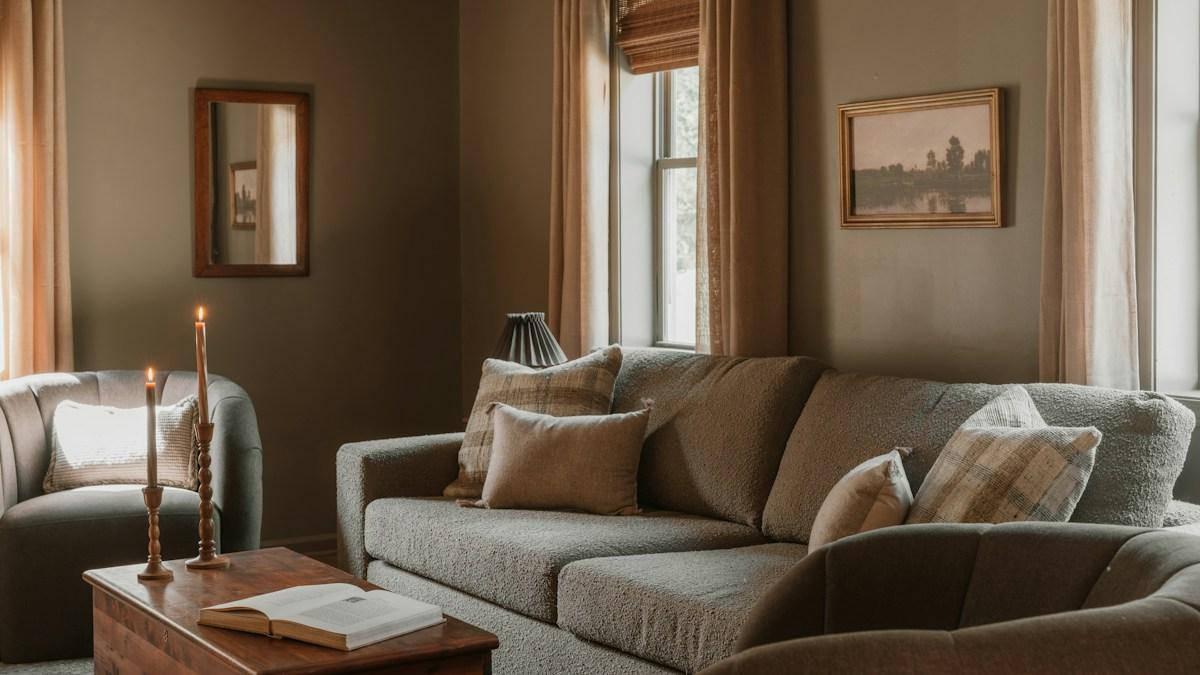
It is half past five in late October and already dark. You come in from the rain, kick off your shoes, and before you have even found the switch for the big ceiling light, you know which room you are heading for.
Not the biggest one. Not the tidiest. The one with the lamp in the corner, the chair with its back to the wall, the blanket that never quite gets folded.
Most of us can name that room instantly. What is harder to explain is why it works, and why another room with the same sofa and the same paint can feel like a dentist’s waiting area after dark.
Researchers in neuroscience, architecture and lighting have been chipping away at that question for decades. Their answers are less about buying things and more about how your brain reads a space for comfort, control and safety. That is good news, because most of what they point to costs very little.
Hominess: the quality your brain scores in every room
In 2020, a team led by Alexander Coburn and Anjan Chatterjee, working with the Penn Center for Neuroaesthetics at the University of Pennsylvania, set out to map how people respond to interiors. They showed 200 photographs of architectural interiors to 798 participants, who rated each one on 16 different measures, from beauty to how much they would like to spend time there.
When the researchers ran the numbers, three underlying dimensions explained about 90% of the variation in ratings. Two were already familiar from studies of landscapes and art. Coherence is how easily you can make sense of a space. Fascination is how rich and interesting it is to look at.
The third was new to architecture. The team called it hominess, which they defined as the extent to which a scene looks like a personal space. A second, independent group of 614 people produced the same three-part pattern, so this was not a quirk of one sample.
The work, published in the journal Cortex, went a step further. Reanalysing brain-scan data from 18 people, the researchers found that hominess tracked activity in a visual region called the left cuneus, but only when people were deciding whether they would enter or leave a space. Not when they were judging beauty.
That small detail matters. It suggests hominess is less an aesthetic verdict and more a practical one: would I go in here?
A cosy room is not a beautiful room. It is a room that looks lived in, and looks like it would let you in.
The study used photographs and a modest scanning sample, so it cannot say what happens when you are actually sitting in a room on a cold night. But it gives a name to something most of us feel and rarely put into words.
Prospect-refuge theory: why you always want the corner seat
Watch people come into a café. Many will pass up the table in the middle of the room for one by the wall or in a nook, ideally facing the door. In a pub it is the same story with the booth.
The British geographer Jay Appleton offered an explanation in his 1975 book The Experience of Landscape. He argued that we are drawn to places that offer prospect, a clear view out, and refuge, somewhere to be sheltered and partly hidden. A ledge above a valley. A cave mouth. An armchair in an alcove facing the door.
The idea is intuitive and widely quoted by architects. The evidence is messier, and it is worth being honest about that.
In 2016, Annemarie Dosen and Michael Ostwald at the University of Newcastle in Australia reviewed 34 quantitative studies that had tested prospect, refuge and related ideas. Prospect held up fairly well: of 31 findings, 19 supported it, 10 were neutral and 2 ran against it. Refuge did much worse, with only 8 of 27 findings supportive, 14 neutral and 5 contrary.
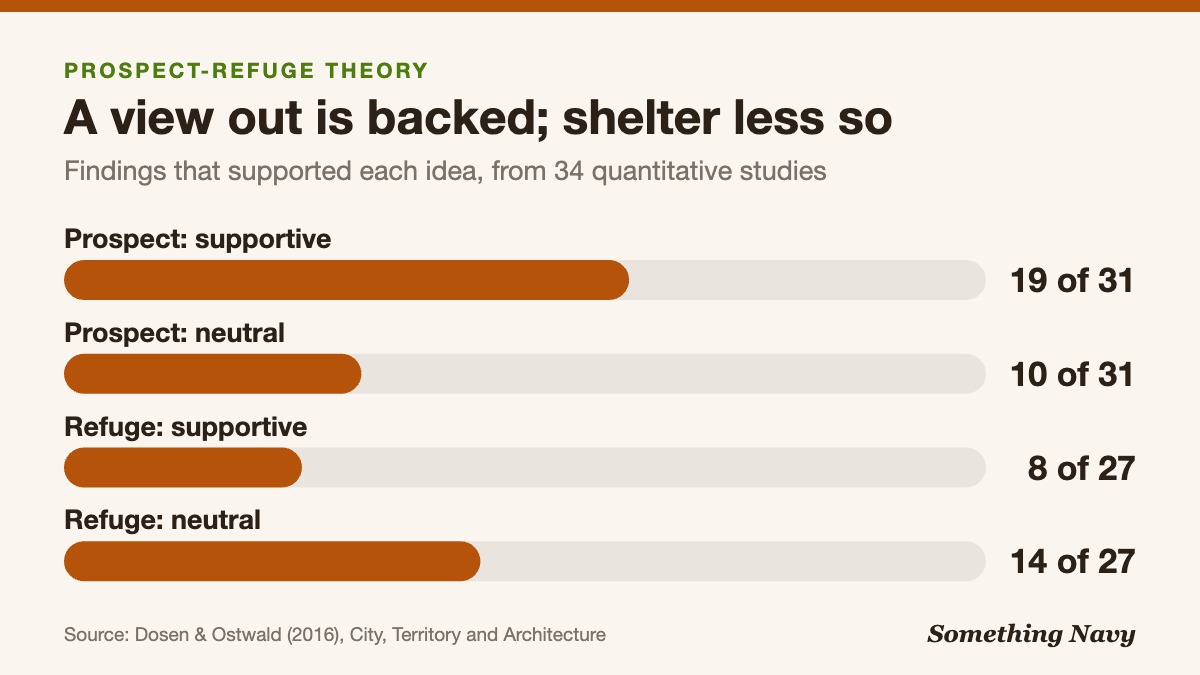
The authors concluded that the quantitative evidence for prospect-refuge theory remains inconsistent, and that results tend to hold in particular settings rather than everywhere. The evidence for refuge was weakest of all in interiors.
So treat it as a useful rule of thumb rather than a law. In practice, it squares with what many people report: we relax when our backs are covered and we can see what is coming. A high-backed chair, a sofa against a wall rather than floating mid-room, a reading spot that faces the door. Small cues that tell an old part of the brain it can stand down.
Warm, low light and the 1941 curve everyone still quotes
If you ask anyone what makes a room cosy, lighting will come up within seconds. The science here is surprisingly old, and surprisingly shaky.
In 1941, the Dutch physicist Arie Andries Kruithof, working for Philips as fluorescent tubes were arriving, sketched a curve linking how bright a light is with its colour temperature (how warm or blue it looks). His chart suggested that dim light only looks pleasant if it is warm, and that bright light looks odd if it is too orange. Lighting designers have quoted it ever since.
The trouble is that Kruithof never published his method, his observers or his data. When later researchers tested interior lighting properly, they generally found colour temperature had less effect than his curve implied. In a 2017 paper in the journal LEUKOS, the lighting researcher Steve Fotios gathered the experimental evidence to build a revised version of the graph from actual data.
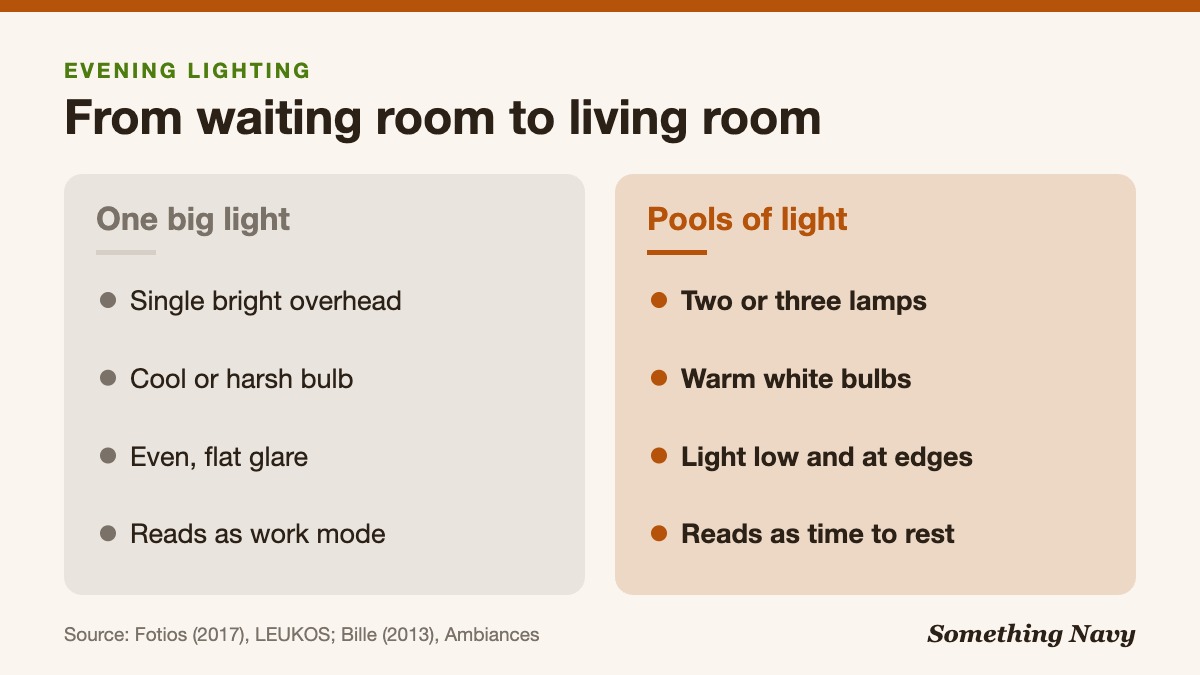
What does seem to survive is the general pattern people feel at home in the evening. Lower, warmer, more scattered light reads as relaxed. A single bright overhead source reads as functional, like a kitchen at work or an office.
Culture matters too. The Danish anthropologist Mikkel Bille studied how Danes reacted to energy-saving light bulbs and found that much of the resistance was not about cost or the environment. It was about the light itself, and what it did to people’s efforts to create cosy spaces at home. In a country that has turned cosiness into a national word, hygge, a lamp is never just a lamp.
The lesson is useful. Cosy light is less about one perfect bulb and more about where the light sits: low, in pools, at the edges of the room rather than blasting down from the middle.
Cosy light is not one perfect bulb. It is pools of warmth at the edges of a room.


Soft edges: what brain scans say about curved rooms
There is one more design cue with decent laboratory support, and it is about shape.
In a 2013 study in PNAS, Oshin Vartanian and colleagues, including Chatterjee, scanned 18 adults while they looked at 200 photographs of interiors. Half the rooms were full of curves, half were angular. Participants were more likely to call the curvy rooms beautiful, and that judgement was linked to higher activity in the anterior cingulate cortex, a region involved in emotion.
Interestingly, the curves did not change whether people said they would enter or leave. Curves made rooms more beautiful, not necessarily more welcoming. Combine that with the hominess research and a picture emerges: shape makes a room pleasing, but signs of life make it inviting.
At home, nobody is rebuilding their walls. But round tables, a curved armchair, an oval mirror, a bowl rather than a box, a draped throw that breaks a hard sofa line: these soften what you see without costing much.
Cosiness is really about feeling safe
It is easy to treat cosiness as a decorating style. The research keeps pointing somewhere deeper.
A large German study, published in Frontiers in Psychology in January 2024, looked at 8,886 adults from the Hamburg City Health Study, average age around 62. Sandra Weber, Simone Kühn and colleagues compared how people rated their homes with their scores on a standard anxiety questionnaire.
People who felt safer at home reported less anxiety. Those more bothered by noise reported more. Brighter homes, and satisfaction with the view from the window, were also linked to lower anxiety. Together, these home ratings explained about 6% of the differences in anxiety, on top of age, income, lifestyle and other factors. For anxiety at a clinically relevant level, people more disturbed by noise had 1.74 times the odds.
This is a snapshot, not an experiment, so it cannot tell us whether a calmer home lowers anxiety or anxious people rate their homes more harshly. Probably a bit of both. But it fits the pattern: what we call cosy may be what a nervous system feels when it has stopped scanning for trouble.
Noise, glare, a door you cannot see, a pile of unopened post. None of them looks dangerous. All of them keep part of you on duty.
That is also why mess can work against you. Visual clutter keeps giving the eye things to process, which is part of why clutter can feel stressful even when it is not dirty. The goal is not a showroom. A cosy room still looks lived in. It just doesn’t ask anything of you.
By the numbers
- 798 people rated 200 interior photographs in the Penn hominess study; a second group of 614 confirmed the pattern.
- 3 dimensions (coherence, fascination, hominess) explained about 90% of how people rated rooms.
- 34 quantitative studies of prospect-refuge theory were reviewed in 2016. Prospect was supported in 19 of 31 findings, refuge in 8 of 27.
- 1941: the year Kruithof drew the warm-light curve that designers still quote, without publishing his data.
- 8,886 Hamburg adults linked feeling safe, quiet and well lit at home with lower anxiety.
A room-by-room guide to a cosier home this autumn and winter
Put the research together and you get four practical principles. Light low and warm, in several pools. Give yourself a protected spot with a view. Soften hard lines. Show signs of the people who live there. Here is how that plays out in each room, without a big budget.
Living room: build a refuge with a view
Start by turning off the ceiling light after dark and seeing what is left. Most living rooms need two or three lower sources instead: a floor lamp beside the sofa, a table lamp at the far side of the room, perhaps a string of lights on a shelf. Light at different heights makes a room feel deeper and gentler.
Swap the bulbs you already own for ones sold as “warm white” (the box usually says around 2,700K). It is the cheapest change in this article and often the most noticeable.
Then look at the furniture. If the sofa floats in the middle of the room with its back to the door, try it against a wall or angled so you can see the entrance. Create one proper nook: an armchair, a side table, a lamp and a blanket within reach. That is your refuge.
Finally, put life on show. Books you are actually reading, a photo from last summer, a plant. The hominess research suggests rooms feel inviting when they look personal, and houseplants are one of the easiest ways to make a corner look lived in.
Bedroom: dim, quiet and enclosed
The bedroom is where the safety research matters most. Noise was one of the strongest factors in the Hamburg study, so tackle it first: a thick curtain, a rug on a bare floor, a draught excluder at the door. All absorb sound as well as cold.
Keep the brightest lights for the morning. In the evening, rely on a bedside lamp with a warm bulb and keep screens out of bed where you can, since light before bed affects more than mood.
A headboard, even a padded one you make yourself, adds a sense of enclosure. So do heavier textiles as the weather turns: a wool throw at the foot of the bed, flannel or brushed cotton sheets. Touch is part of cosiness too.
Kitchen: warm the edges, not the worktops
Kitchens need bright, clear light for chopping. They do not need it all evening. Under-cabinet strips or a single lamp on a shelf let you switch off the overheads once dinner is on, which turns a workspace back into a place to sit.
If you have a table, make it the cosy anchor: a cloth, a candle or a small lamp, chairs pulled in rather than pushed back. Round tables suit the curve research and also make conversation easier. Clear the worktop nearest the table, since the eye goes there first.
Smell and warmth help as well. A pan of soup on a cold Sunday does more for the atmosphere than any scented candle, and it feeds you.
Workspace: make the desk a refuge, not a cell
The Hamburg authors point out that the home matters more as people spend more working hours in it. A desk that faces a blank wall, under a single overhead light, can feel like a cell by four in the afternoon in December.
If you can, turn the desk so you face into the room or towards a window, with a wall behind you. That is prospect and refuge in miniature. Add a desk lamp so the overhead light can go off, and use a cooler, brighter bulb only for the hours you need to concentrate.
At the end of the day, change the scene. Close the laptop, switch to a warm lamp, pull a throw over the chair. A clear ritual helps the room, and you, shift from work to home. Colour can help too. If you are repainting anyway, our guide to how wall colour affects mood covers what the evidence does and does not support.
Cosy on a budget: small changes with the most effect
None of this requires a new sofa. The research points to cues your brain is already reading: how light falls, whether your back is covered, whether the room looks like someone lives in it, whether anything is nagging for attention.
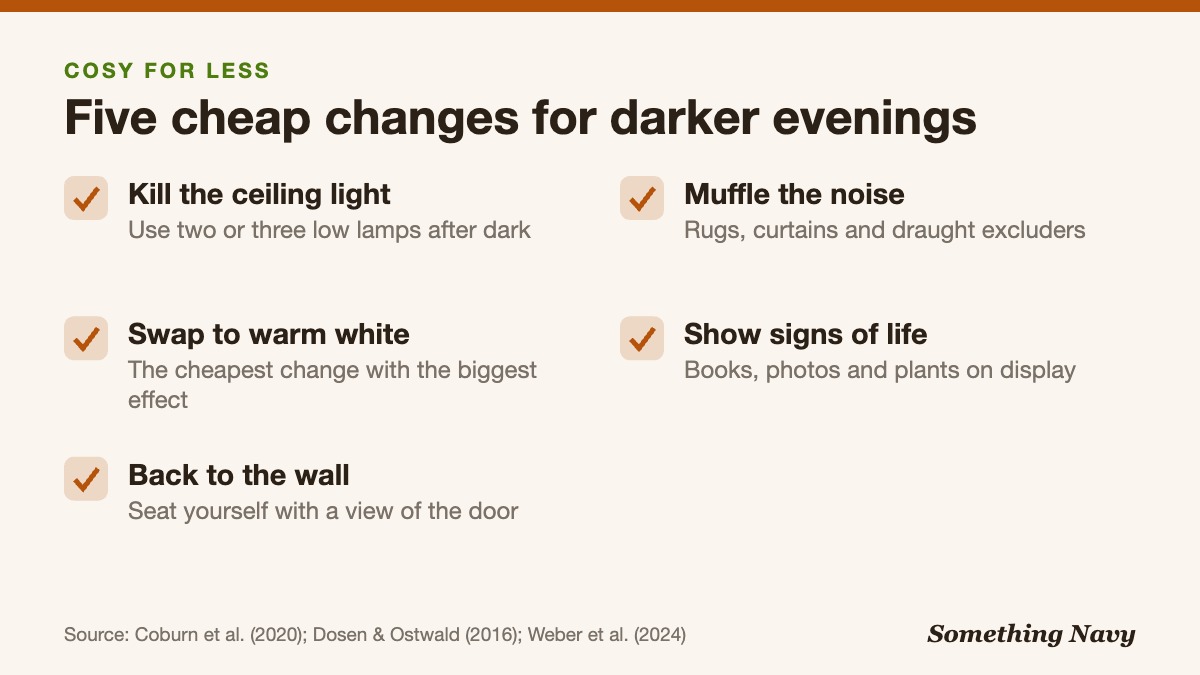
If you only do a handful of things this week, do these.
One caution. Cosiness is personal and partly cultural, as the Danish light-bulb debate shows. The point is not to copy a Scandinavian catalogue. It is to notice which room you already drift towards on a dark evening, and work out what it is doing right.
The room that lets you stand down
The researchers would put it more precisely, but the idea is simple. A cosy room is one where you are not on guard. The light is low enough that nothing is glaring. Your back is to a wall. The noise of the street is muffled. There is a cup on the side table and a book face down where you left it.
It looks like a person lives here. It looks like that person could be you.
On the next cold evening, try it. Turn off the big light, switch on two lamps, take the chair in the corner. Then notice how quickly your shoulders drop.
Sources
- Coburn, A., Vartanian, O., Kenett, Y. N., Nadal, M., Hartung, F., Hayn-Leichsenring, G., Navarrete, G., González-Mora, J. L., & Chatterjee, A. (2020). Psychological and neural responses to architectural interiors. Cortex, 126, 217–241. DOI
- Dosen, A. S., & Ostwald, M. J. (2016). Evidence for prospect-refuge theory: A meta-analysis of the findings of environmental preference research. City, Territory and Architecture, 3, 4. DOI
- Fotios, S. (2017). A revised Kruithof graph based on empirical data. LEUKOS, 13(1), 3–17. DOI
- Bille, M. (2013). Luminous atmospheres. Ambiances. DOI
- Vartanian, O., Navarrete, G., Chatterjee, A., Fich, L. B., Leder, H., Modroño, C., Nadal, M., Rostrup, N., & Skov, M. (2013). Impact of contour on aesthetic judgments and approach-avoidance decisions in architecture. Proceedings of the National Academy of Sciences, 110, 10446–10453. DOI
- Weber, S., Mascherek, A., Augustin, J., Cheng, B., Thomalla, G., Hoven, H., Harth, V., Augustin, M., Gallinat, J., & Kühn, S. (2024). My home, my castle? Self-reported anxiety varies in relation to the subjective evaluation of home environment. Frontiers in Psychology, 14, 1267900. DOI
Cover photo: Clay Banks on Unsplash. Charts and graphics: Something Navy.
How we reported this. We went back to the original research for this story, 6 sources in all, listed above, and checked every figure against them. If you think we have got something wrong, tell us and we will look at it. Read more about how we work.