You walk into the kitchen with total purpose, stop in the middle of the floor, and have no idea why you came. You retrace your steps, sometimes literally, back to the sofa, where the reason instantly comes back to you. Almost everyone has done it, and almost everyone blames age, tiredness or a bad night’s sleep.
Psychologists have a more interesting suspect: the doorway. A series of experiments suggests that walking from one room into another can make it harder to remember what you were doing a moment ago. The newer research adds an important twist, though. The doorway effect is real under some conditions, but it is not the memory-wiping force that the headlines made it sound.
The experiments that started it
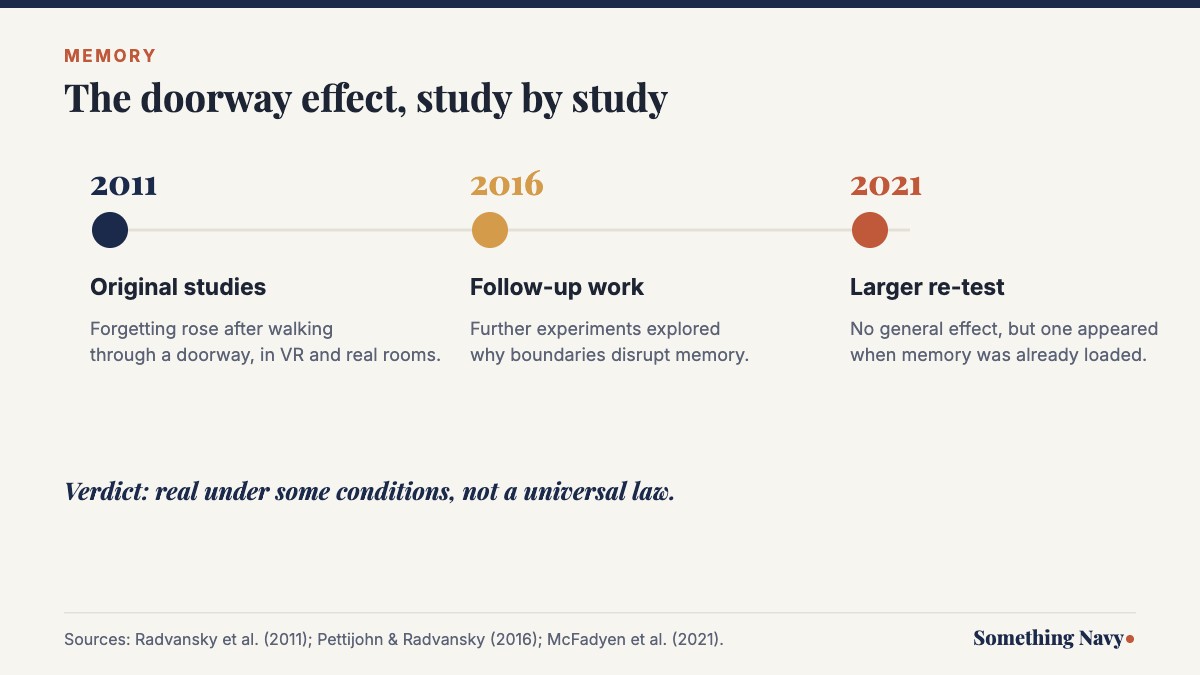
The idea comes from Gabriel Radvansky, a cognitive psychologist at the University of Notre Dame. In a set of studies published in 2011 in the Quarterly Journal of Experimental Psychology, he and his colleagues asked students to carry out a simple, repetitive task. They walked through a series of rooms, picked up an object from one table, carried it to the next, put it down and picked up something else.
Every so often, a word appeared on the screen and participants had to say whether it was the object they were carrying or the one they had just put down. Some of the time, they had just walked through a doorway into a new room. Other times, they had walked the same distance without leaving the room.
Memory was worse after passing through a doorway. The effect showed up in a virtual environment on a computer screen and, in a follow-up, in real rooms in a lab, where people carried objects hidden in boxes.


Why would a doorway matter?
Radvansky’s explanation draws on what psychologists call event models. Our minds do not record life as one continuous stream. They chop it into chunks, or events, and doorways are natural boundaries between them. Crossing one tells the brain that a new episode has begun, and the details of the previous one are, in Radvansky’s words, filed away.
Filing is useful. It keeps the brain from being cluttered with every detail of every room you have been in today. The cost is that the reason you got up off the sofa may have been filed with the sofa.
One of the original experiments added a neat test. If forgetting were simply about being in a different place from where you formed the memory, then walking back to the original room should bring it back. It did not reliably help, which suggested the boundary itself, rather than the location, was doing the damage.
What happened when others put it to the test
As with many striking findings, later researchers wanted to know how far it held up. In a 2021 study in BMC Psychology, Jessica McFadyen, Oliver Baumann and colleagues ran four experiments, using immersive virtual reality, passive video and real-world walking.
Across their experiments, they found no general effect of doorways on forgetting. But one condition stood out. When participants were also holding other information in mind, a kind of mental multitasking, walking through a doorway did make their memory more vulnerable. They were more likely to falsely recognise things they had not seen.
That fits everyday experience surprisingly well. You rarely forget why you walked into the kitchen when you are calm and focused on a single thing. It tends to happen when you are juggling the shopping list, a message you need to reply to and the pan on the stove.
So is it the doorway or the multitasking?
Probably both, in combination. The current evidence suggests that event boundaries such as doorways can disrupt memory, but mainly when your working memory is already stretched. A doorway alone is unlikely to wipe your mind. A doorway plus a busy head makes the familiar blank moment much more likely.
This is also a good reason not to read too much into the experience. Forgetting why you entered a room is common at every age and is not, on its own, a sign that anything is wrong with your memory. If you are worried about memory changes that are new, frequent or affecting daily life, that is worth discussing with a doctor.
How to stop forgetting what you came in for
Because the effect seems strongest when your mind is crowded, the most useful tricks reduce the load or carry the intention across the boundary with you.
- Say it out loud. Muttering “scissors, scissors” on the way to the drawer keeps the goal active in working memory.
- Picture it. Imagining yourself picking up the item creates a stronger memory than the bare intention.
- Carry a cue. Taking the empty glass with you to refill it, or holding the letter you need to post, makes the reason hard to lose.
- Finish one thing first. If you are halfway through a message, finish it before you get up. Fewer open loops means more room for the one you are acting on.
- Go back. It is not foolish. Returning to the spot where you formed the intention often brings it back, even if the research is mixed on why.
Unfinished tasks tend to tug at us in their own way, as we explore in our piece on the Zeigarnik effect. And if a blank moment in front of other people makes you cringe for the rest of the day, you are probably experiencing the spotlight effect as well.
Frequently asked questions
Research suggests that doorways act as event boundaries. Crossing one signals the start of a new episode, which can make details from the previous one, such as why you got up, harder to retrieve, especially when your mind is busy.
The original studies found an effect in both virtual and real rooms. A larger 2021 study found no general effect, but did find that doorways made memory more vulnerable when people were already holding other information in mind.
On its own, no. It is very common at all ages. New, frequent or worsening memory problems that affect daily life are worth raising with a doctor.
Say the goal aloud, picture yourself doing it, carry a related object, finish one task before starting another, or simply go back to where you were.
More in our Psychology section.
Sources
- Radvansky, G. A., Krawietz, S. A., & Tamplin, A. K. (2011). Walking through doorways causes forgetting: Further explorations. Quarterly Journal of Experimental Psychology, 64(8), 1632–1645. University of Notre Dame summary
- Pettijohn, K. A., & Radvansky, G. A. (2016). Walking through doorways causes forgetting: Event structure or updating disruption? Quarterly Journal of Experimental Psychology. doi.org/10.1080/17470218.2015.1101478
- McFadyen, J., Nolan, C., Pinocy, E., Buteri, D., & Baumann, O. (2021). Doorways do not always cause forgetting: A multimodal investigation. BMC Psychology, 9, 41. UCL Discovery
How we reported this. We went back to the original research for this story, three sources in all, listed above, and checked every figure against them. If you think we have got something wrong, tell us and we will look at it. Read more about how we work.
Cover photo: Clay Banks on Unsplash. Charts and graphics: Something Navy.