You are standing in a baby shop with a gift to buy. On the left, a wall of pink. On the right, a wall of blue. You reach for one without thinking.
That reflex feels ancient. It is younger than you might think.
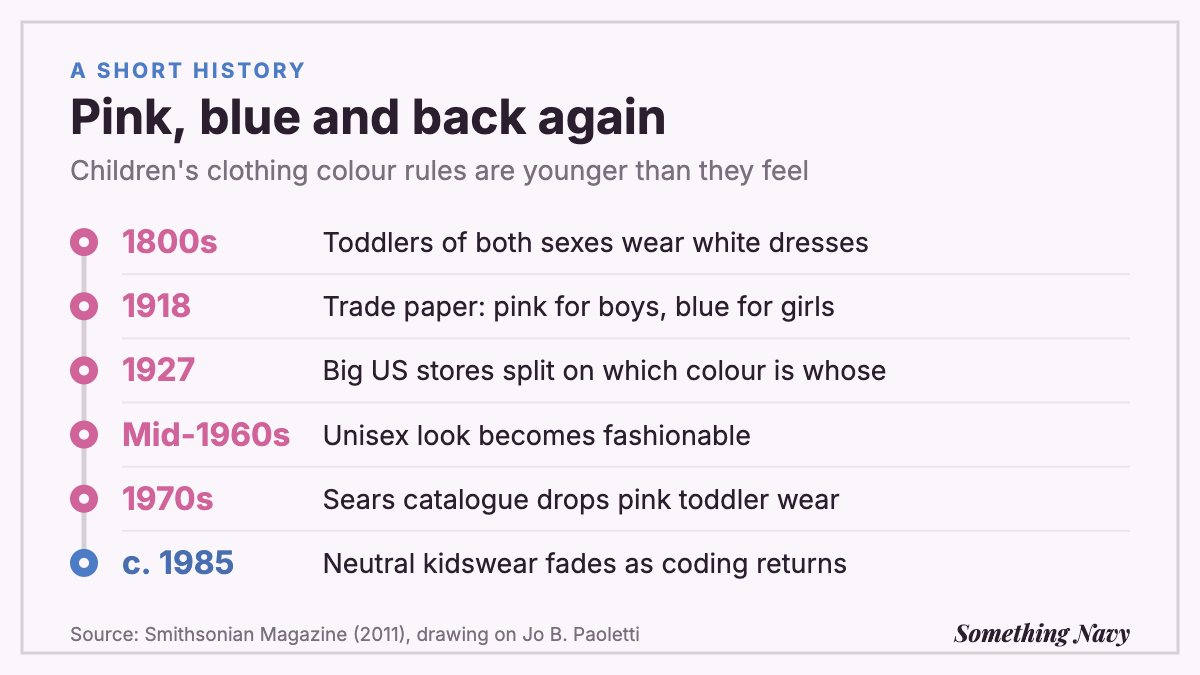
In June 1918 an American trade publication called Infant’s Department advised shops that “the generally accepted rule is pink for the boy and blue for the girl.” The line is quoted in a 2011 Smithsonian magazine feature on the work of Jo B. Paoletti, a dress historian at the University of Maryland.
So when people argue today about “gender-neutral” or “inclusive” clothing, they are often arguing about a convention that is barely a century old. Here are the questions readers actually ask, one at a time.
Did boys and girls always dress differently?
Not for very small children. For much of the 19th century, babies and toddlers of both sexes wore white cotton dresses. According to Paoletti’s research, boys usually stayed in dresses until about the age of six or seven, when they were “breeched” and moved into trousers, a small coming-of-age ritual.
Colour rules arrived slowly and messily. In 1927 Time magazine printed a chart of what leading American department stores recommended. Filene’s in Boston, Best & Company in New York, Halle Brothers in Cleveland and Marshall Field’s in Chicago all said pink for boys. Other stores said the opposite.
In other words, there was no consensus at all. The pink-for-girls rule, Paoletti argues in her 2012 book Pink and Blue: Telling the Boys from the Girls in America, did not settle until the middle of the 20th century.
It is worth adding one note of caution. The Smithsonian piece also mentions a later analysis by the psychologist Marco Del Giudice, who looked at historical texts and found more consistency in gender colour coding over time than the popular story suggests. Historians still debate how sharp the switch really was. What nobody disputes is that the rule was never as fixed, or as old, as it feels.
What was the 1970s unisex boom really about?
From the mid-1960s, as the women’s movement gained ground, the unisex look became fashionable. Paris designers such as Pierre Cardin and André Courrèges pushed a space-age style that played down the body altogether.
Children’s clothing followed. According to Paoletti, for two years in the 1970s the Sears, Roebuck catalogue showed no pink toddler clothing at all. Gender-neutral clothes for young children stayed popular until about 1985.
Then it swung back. Paoletti points to prenatal testing as a big reason: once parents could learn a baby’s sex before birth, shops could sell them a whole themed nursery in advance. Colour coding became a marketing tool, and a very profitable one.
Paoletti has also noted a twist in the adult version of the trend. In her later book, Sex and Unisex (2015), she describes much of that era’s clothing as delivering “uniformity with a masculine tilt.” Women gained trousers. Men, by and large, did not gain skirts.
That asymmetry is still with us.
What do we actually mean by “inclusive” clothing now?
The word has stretched. In shops and fashion reporting it usually covers three separate ideas, and it helps to pull them apart.
- Gender-neutral or unisex: garments, labels or store sections not assigned to men or women.
- Size-inclusive: ranges that run across a wide span of sizes, in the same styles, at the same prices.
- Adaptive: clothing designed so that people with disabilities, or anyone with limited grip or mobility, can dress more easily, using features such as magnetic fastenings, side openings or seated cuts.
They overlap in spirit. All three ask the same plain question: who was this garment designed for, and who was quietly left out?
What have retailers really changed?
| Year | Retailer | What it did |
|---|---|---|
| 2015 | Selfridges, London | Opened Agender, a gender-neutral shopping space across three floors of its Oxford Street store, designed by Faye Toogood |
| 2015 | Target, US | Phased out gender-based signs in kids’ toys, bedding and books, but kept them in kidswear because of sizing and fit |
| 2015 | Nike | Launched FlyEase shoes, prompted by a 2012 letter from a teenager with cerebral palsy |
| 2017 | Tommy Hilfiger | Released a 22-piece adaptive kidswear range with hidden magnetic closures, at regular prices |
| 2017 | John Lewis, UK | Removed “boys” and “girls” labels from its own-brand childrenswear |
The John Lewis move drew the biggest headlines in Britain. In a statement reported by FashionUnited, Caroline Bettis, the store’s head of childrenswear, said the aim was to let “the parent or child” choose. Labels changed to “Girls & Boys” or “Boys & Girls”, and the range added non-gender-specific collections with prints such as dinosaurs and spaceships.
Target’s version is a useful reality check. Fortune reported that the chain dropped gendered signs in toys and bedding, yet kept them in children’s clothing because cuts and sizes differ. Neutral labels are easy. Neutral fit is hard.
The adaptive examples are quieter but arguably more practical. Nike’s FlyEase began when Matthew Walzer, then 16, wrote to the company in 2012 asking for a shoe he could put on himself. Tommy Hilfiger’s 2017 kids’ range, developed with the nonprofit Runway of Dreams, hid magnets behind what look like ordinary buttons, so the clothes match the standard collection.
Neutral labels are easy. Neutral fit is hard.
Do shoppers actually want this, or is it a marketing story?
The honest answer is: some do, and the figures are softer than the headlines.
The most widely cited numbers come from research by the payments company Klarna (fieldwork with the panel firm Dynata in 2022), featured in McKinsey and the Business of Fashion’s State of Fashion 2023 report. The Business of Fashion reported that about 50% of Gen Z shoppers globally said they had bought fashion outside their gender identity, and around 70% of consumers said they were interested in buying gender-fluid fashion in future.
Country figures charted by Statista from the same survey show 36% of respondents in the United States had done so, 33% in Sweden, 31% in the UK, 21% in Italy and 19% in Poland.
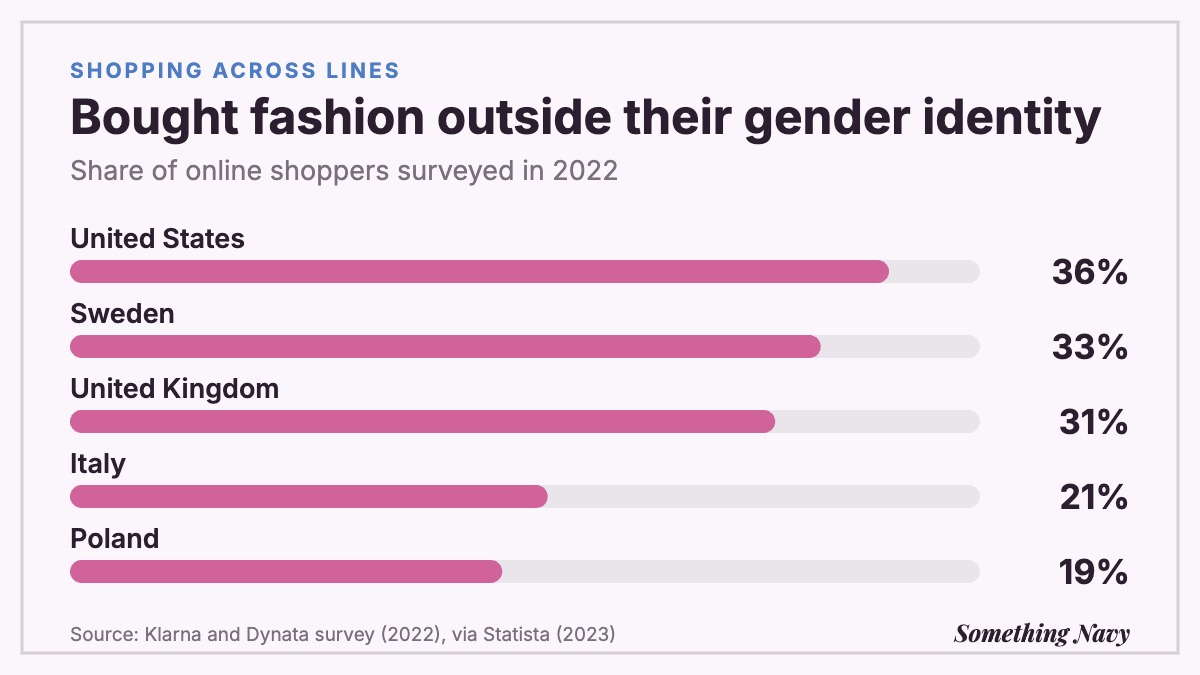
Read those numbers with care. This was a survey of online shoppers, run by a company with an interest in shopping trends, and the published summaries do not give full sample details. “Bought outside your gender identity” could mean a woman buying a men’s jumper because it was longer, which people have done for decades. It tells you behaviour is fluid. It does not tell you why.


Why does size inclusivity keep coming up?
Because the numbers on the label and the bodies in the street drifted apart.
Deborah Christel and Susan Dunn, apparel researchers at Washington State University, compared body measurements from the US National Health and Nutrition Examination Surveys, covering 1988 to 2010, with the industry’s standard size charts. Their study, published in the International Journal of Fashion Design, Technology and Education, concluded that the average American woman wears between a Misses size 16 and 18. Average waist size had risen from 34.9 to 37.5 inches over two decades.
There is a catch. US sizing is voluntary, and one brand’s 16 can be another brand’s 12. So “average size” is a statistical estimate against a standard chart, not a promise about what will fit you in any given shop. That is, in itself, the argument for inclusive ranges and better size guides.
If you have ever stood in a fitting room feeling that every eye is on you, you are probably overestimating how much others notice, a bias psychologists call the spotlight effect. The fault is usually with the pattern, not the person.
Adaptive clothing is for more people than you think
More people than most shoppers assume. The World Health Organization estimates that about 1.3 billion people, or roughly 1 in 6 of the world’s population, live with a significant disability.
Not all of them need special clothing. But anyone who has had a broken wrist, a stroke in the family, arthritic fingers or a toddler who will not stand still knows how much a fiddly button matters. Features first designed for disabled customers, such as magnetic closures, pull-on waists and slip-in shoes, often turn out to be simply better design for everyone.
Good design rarely announces itself. It just stops getting in the way.
Does what you wear change how you feel?
Researchers have explored this under the label enclothed cognition, the idea that the symbolic meaning of a garment can affect the wearer. The evidence is still debated, and the effects in lab studies are modest. But the everyday version is uncontroversial: clothes that fit, move and feel like you tend to stop you thinking about your clothes at all.
How can you use any of this in your own wardrobe?
You do not need to overhaul anything. A few small habits widen your options.
Try this: shop the whole store
- Ignore the floor signs. Check both sections for basics such as knitwear, shirts, coats and trainers. Cuts, lengths and pocket sizes vary more between sections than within them.
- Shop by measurement. Note your chest, waist, hip and inside-leg in centimetres and compare against each brand’s size guide rather than trusting the number on the tag.
- Look for easy fastenings. Magnetic or popper closures, elasticated waists and slip-on shoes save time for anyone in a hurry, not only those with limited grip.
- Hand clothes down sideways. For children, neutral colours and simple prints pass easily between siblings and cousins.
- Build a small core. A handful of shared-style staples cuts the morning decision fatigue of picking an outfit.
Five pieces that have long been shared
These garments have been genuinely shared for generations. They make an easy starting point.
- The oversized shirt. Crisp cotton or soft flannel, worn open over a T-shirt or tucked into trousers.
- Straight-leg jeans. A mid-rise, straight cut sits well on many body shapes and avoids the extremes of skinny or very wide styles.
- The crew-neck jumper. Merino or lambswool in navy, grey or camel, sized up for a relaxed fit.
- Workwear jackets. Chore coats and field jackets were designed around tasks, not gender.
- White trainers. Probably the most shared item of footwear in modern wardrobes.
For children, the 1970s offer a practical template: dungarees, striped tops, primary colours and sturdy fabrics that survive being handed on.
Is this a trend that will pass again?
History says fashions swing. The unisex moment of the 1970s faded, and colour coding came roaring back within a decade.
But two things look different this time. Adaptive design and wider size ranges solve concrete, measurable problems, which makes them harder to drop. And shoppers, particularly younger ones, already move freely between sections whether or not the signs change.
The pink and blue walls in that baby shop are not a law of nature. They are a sales decision from the last century, and like any sales decision, they last only as long as people keep reaching for them.
Sources
- Maglaty, J. (2011, April 7). When did girls start wearing pink? Smithsonian Magazine. Link
- Christel, D. A., & Dunn, S. C. (2017). Average American women’s clothing size: comparing National Health and Nutritional Examination Surveys (1988–2010) to ASTM International Misses & Women’s Plus Size clothing. International Journal of Fashion Design, Technology and Education, 10(2). DOI
- World Health Organization. (2023). Disability [Fact sheet]. Link
- The Business of Fashion & McKinsey & Company. (n.d.). The State of Fashion 2023: gender-fluid fashion and Gen Z consumers. Link
- Statista. (2023). Respondents that have purchased fashion outside of their gender identity [Chart; data from Klarna and Dynata]. Link
- FashionUnited. (2017, September 4). John Lewis remove gender labels from childrenswear. Link
- FashionNetwork. (2017, July 27). Tommy Hilfiger launches adaptive clothing line for differently-abled children. Link
Updated 17 October 2026: we rewrote this article with new research, figures and sources. Cover photo: Fujiphilm on Unsplash. Charts and graphics: Something Navy.
How we reported this. We went back to the original research for this story, 7 sources in all, listed above, and checked every figure against them. If you think we have got something wrong, tell us and we will look at it. Read more about how we work.