
You notice it first in the small things. The reply that usually arrives within the hour has not arrived by evening. The next morning you check whether your last message was “delivered” or “read”, and then you check again. By the third day you are rereading the whole thread, looking for the line where you got it wrong.
Nobody has told you anything. That is the point. There was no argument, no difficult conversation, no message saying “I don’t think this is working.” There is just a silence where a person used to be.
If that has happened to you, you are in large company, and the strength of what you feel is not an overreaction. Psychologists have spent more than two decades studying what it does to people to be ignored, and the short version is this: being left without an explanation hits several basic human needs at once. Here is what the research says, where it is solid, where it is shakier, and what you can actually do with it.
One in four, or nearly three in four, depending on who you ask
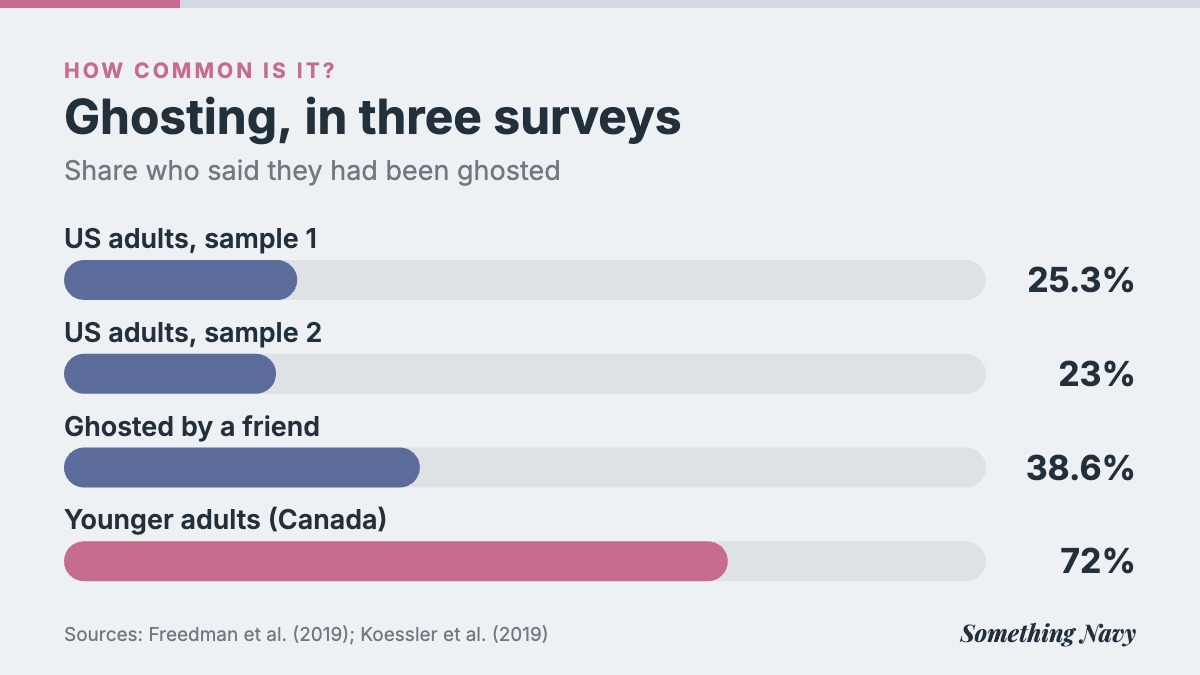
“Ghosting” entered everyday speech in the mid-2010s, but the first proper studies of it are more recent. One of the most cited comes from Gili Freedman, Darcey Powell, Benjamin Le and Kipling Williams, published in the Journal of Social and Personal Relationships in 2019. They ran two online surveys of American adults, 554 people recruited through Amazon’s Mechanical Turk and 747 through the platform Prolific.
In the first sample, 25.3% said a romantic partner had ghosted them and 21.7% said they had ghosted someone. The second sample was strikingly similar: 23% and 18.9%. The second survey also asked about friends, and here the numbers were higher still. As reported by the social psychologist Gwendolyn Seidman, 38.6% said a friend had ghosted them and 31.7% admitted ghosting a friend.
Other samples give very different answers. A 2014 YouGov poll of 1,000 US adults, cited by Koessler’s team, found only about 13% had been ghosted. Yet an exploratory study by Rebecca Koessler, Taylor Kohut and Lorne Campbell at Western University in Canada, which focused on younger adults and asked about ghosting directly, found that 72% of 332 respondents had been ghosted and 64.5% had done it themselves. The authors suggest the gap reflects the younger age of their sample and the explicit focus of the questions.
So nobody can give you a precise figure. What the numbers do say is that this is not a rare cruelty reserved for unlucky people. It is a common way that relationships, especially new ones, now end.
Most people have been on both sides
It is tempting to picture ghosters as a separate tribe of careless people. The data do not support that. In a qualitative study published in 2019 in Imagination, Cognition and Personality, Leah LeFebvre and colleagues asked 99 emerging adults to describe, in their own words, their experiences of ghosting and being ghosted. Most had been in both roles.
That matters for you in two ways. It means the person who disappeared on you is probably not a monster, just someone who chose the easy exit. And it may mean that, at some point, you took the easy exit too. Neither fact makes the silence hurt less, but both make it easier to see it for what it usually is: a common, low-effort way of ending things rather than a verdict on your worth.
What a ball-tossing game revealed about being ignored
To understand why ghosting stings, it helps to go back to an older body of research on ostracism, the experience of being ignored and excluded. Its central figure is Kipling Williams, a social psychologist now at Purdue University and, as it happens, one of the authors of the ghosting study above.
Around the turn of the millennium, Williams and his honours students Christopher Cheung and Wilma Choi built a simple online game called Cyberball. You see two or three other “players” on screen, represented by little figures, and you toss a virtual ball between you. In the inclusion condition, you get the ball a fair share of the time. In the ostracism condition, after a couple of throws, the others simply stop passing to you. That is all that happens.
Their first big online study, published in 2000 in the Journal of Personality and Social Psychology, drew 1,486 participants from 62 countries. People who were left out for just a few minutes reported feeling worse, with lower levels of belonging, self-esteem and control. Later studies pushed the point further. As Scientific American has summarised, being told the exclusion came from a computer did not make it hurt less, and neither did being excluded by members of a group most people despise, the Ku Klux Klan.
Read that again. A cartoon game, with strangers, for a few minutes, and people still felt it. Now imagine the same thing coming from someone you kissed last week.
The four needs that silence attacks
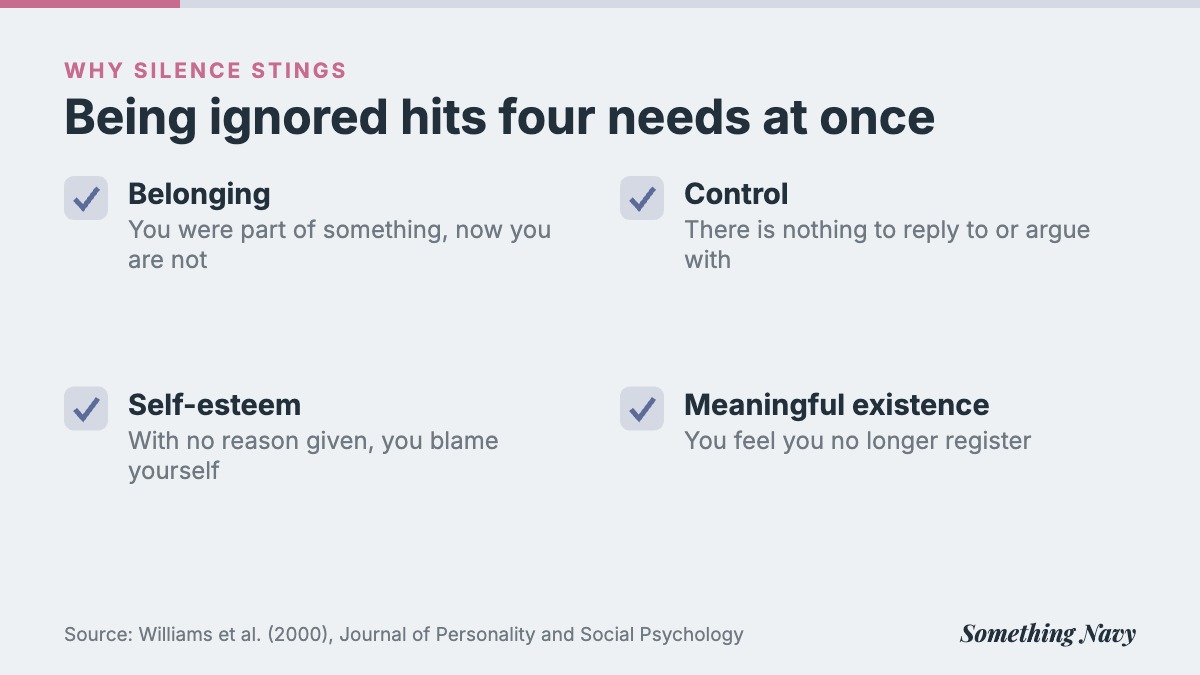
Williams’s explanation is known as the temporal need-threat model. Being ignored, he argues, threatens four fundamental needs: belonging, self-esteem, a sense of control, and the feeling that your existence is meaningful and noticed. Most kinds of rejection hit one or two of these. Ostracism tends to hit all four.
Ghosting is a near-perfect example. Your sense of belonging takes the obvious knock: you thought you were part of something, and now you are not. Your self-esteem suffers because, without a reason, you go looking for one, and the most available suspect is you.
The other two are where ghosting differs from an ordinary break-up. You have no control: there is nothing to reply to, argue with, accept or reject. And the silence quietly attacks your sense of meaningful existence, the feeling that you register in another person’s world. Someone who dumps you to your face at least acknowledges that you are there. Someone who ghosts you treats you, in effect, as if you were not.
There is also the problem of the open loop. Because nothing has been said, nothing feels finished. Your mind keeps returning to the conversation, a little like the way unfinished tasks tend to nag at us more than completed ones. You may find yourself picking up your phone at every buzz, or even feeling vibrations that are not there. That is not weakness; it is a mind trying to close a story that the other person left open.


Does rejection really hurt like a burn?
You may have read that social rejection “lights up the same brain regions” as physical pain. That idea comes largely from a 2003 paper in Science led by Naomi Eisenberger and Matthew Lieberman at the University of California, Los Angeles, with Kipling Williams. They scanned 13 UCLA undergraduates with fMRI while they played Cyberball. During exclusion, activity rose in the anterior cingulate cortex, a region previously linked to the distress of physical pain, and people who showed more activity there reported feeling more excluded.
It was an elegant study and it shaped a decade of research. It was also small, and an overlap in brain activity does not prove that two experiences share a mechanism. Brain regions do many jobs at once.
In 2014 a team led by Choong-Wan Woo and Tor Wager at the University of Colorado Boulder tested the idea more directly, publishing in Nature Communications. Their 60 participants had all gone through an unwanted break-up in the previous six months. In the scanner, they looked at photos of their ex and, separately, received painful heat on the arm. Using pattern analysis rather than simple activation maps, the researchers concluded that “separate representations underlie pain and rejection despite common fMRI activity”.
So the honest summary is this. Rejection and physical pain overlap in the brain more than you might expect, which may be why we reach for words like “hurt” and “heartbroken”. But it is not true that a break-up is literally the same as a burn. You do not need a brain scan to validate what you feel. The ache is real either way.
Being excluded or ostracized is an invisible form of bullying that doesn’t leave bruises.
Kipling Williams, Purdue University (2011)
Why the other person went quiet
When you are the one left waiting, the hardest question is usually “why?” The research cannot answer it for your particular case, but it can tell you what tends to be going on.
In LeFebvre’s study, people who had ghosted described five broad kinds of reason. Convenience: it was easier than a conversation that might get emotional. Attraction: they had met someone else, often through dating apps. A negative interaction: something the other person did put them off. The state of the relationship: one or two dates did not seem to warrant a formal break-up. And safety: for some, disappearing felt like the safest way out, a reason that deserves to be taken seriously.
Koessler and her colleagues then ran a more rigorous test, published in Collabra: Psychology in 2019. They surveyed 595 people aged 18 to 35 in the US and Canada who had been through a non-mutual break-up in the previous six months, split them into two halves, explored the data in one and tested pre-registered predictions in the other. Relationships that ended by ghosting were shorter (around 25 weeks against 37 in the exploratory half) and less committed. People who ghosted rated simply losing interest as a bigger reason than the people they ghosted believed it to be.
That is a useful thing to know at 2am. The most common reason for a disappearance is not that you said the wrong thing. It is that the other person’s interest faded and they chose the route with the least friction.
Believers in “the one” ghost more
Freedman’s team found one more pattern worth knowing. People differ in their implicit theories of relationships. Some hold strong destiny beliefs: a partner is either right for you or not, and you can tell fairly quickly. Others hold growth beliefs: relationships are built over time and problems can be worked through.
Across both surveys, people with stronger destiny beliefs found ghosting more acceptable and were more likely to say they had done it. Growth beliefs were linked to more negative views of ghosting in long-term relationships. The study was correlational and relied on self-report, so it cannot show that destiny beliefs cause ghosting. But the logic is easy to follow: if you think a relationship is either meant to be or not, there is little point in explaining why it is not.
Most people also draw lines. In the first survey, 28% found ghosting acceptable after a single date, 19.5% in a short-term relationship and only 4.7% in a long-term one. And 69.1% said learning that someone had ghosted a partner would make them think less of that person.
Being the one left behind is the harder role
There is an important nuance in Koessler’s data. Unsurprisingly, the people who were broken up with reported more distress than the people who did the leaving. But the researchers note that how committed the relationship had been explained much of the difference in distress. In other words, being the one left, and how much you had invested, mattered more than the method alone.
The researchers did find one asymmetry that is hard to ignore. Those who ghosted reported less distress than those who ended things face to face or with a message. Ghosting is, among other things, a way of outsourcing the discomfort of a break-up to the person on the receiving end.
What actually helps when the silence is yours to deal with
There is no clinical trial of “ghosting recovery”, so be wary of anyone selling a programme. What the ostracism research does offer is a map: if being ignored drains those four needs, then recovery means topping them back up, deliberately.
If it has just happened to you
- Name it. Say to yourself, or a friend, “I’ve been ghosted.” Putting a plain label on it stops the endless search for hidden meanings.
- Send one message, at most. If you want closure, something short such as “I’m guessing you’re not interested any more, which is fine. Take care” lets you end the story on your terms. Then stop.
- Take back a little control. Mute or archive the chat so you are not checking it. You decide when it leaves your screen.
- Restore belonging quickly. Message or see someone who is reliably glad to hear from you, today rather than next week.
- Do not write the missing explanation yourself. The research points to fading interest and convenience far more often than to anything you did.
- Watch the length. If you are still low weeks later, or it has stirred up older hurts, talk to your GP or a counsellor.
Williams has described ostracism as unfolding over time: an immediate sting, then a period of trying to cope and make sense of it, and, if the exclusion goes on long enough, resignation. Much of the box above is about moving through the second stage quickly so you do not slide into the third. The single message gives you back a sense of control. Muting the chat stops the open loop from being reopened a dozen times a day. The friend restores belonging. And refusing to fill the silence with self-blame protects your self-esteem.
None of this makes the feeling vanish. But it shifts you from waiting for someone else to end the story to ending it yourself.
How to leave without becoming a ghost
Here is the uncomfortable mirror: if most people have been on both sides, you will probably want to end something one day too. The good news is that the kind alternative takes far less than you might fear.
It does not require a long meeting or a detailed post-mortem. After a date or two, a short, clear message is enough. The research on ostracism suggests why that small effort matters so much: it gives the other person an ending, a reason that is not about their worth, and the dignity of being acknowledged. In Koessler’s data, direct break-ups involved more open communication and a more positive tone than ghosting did.
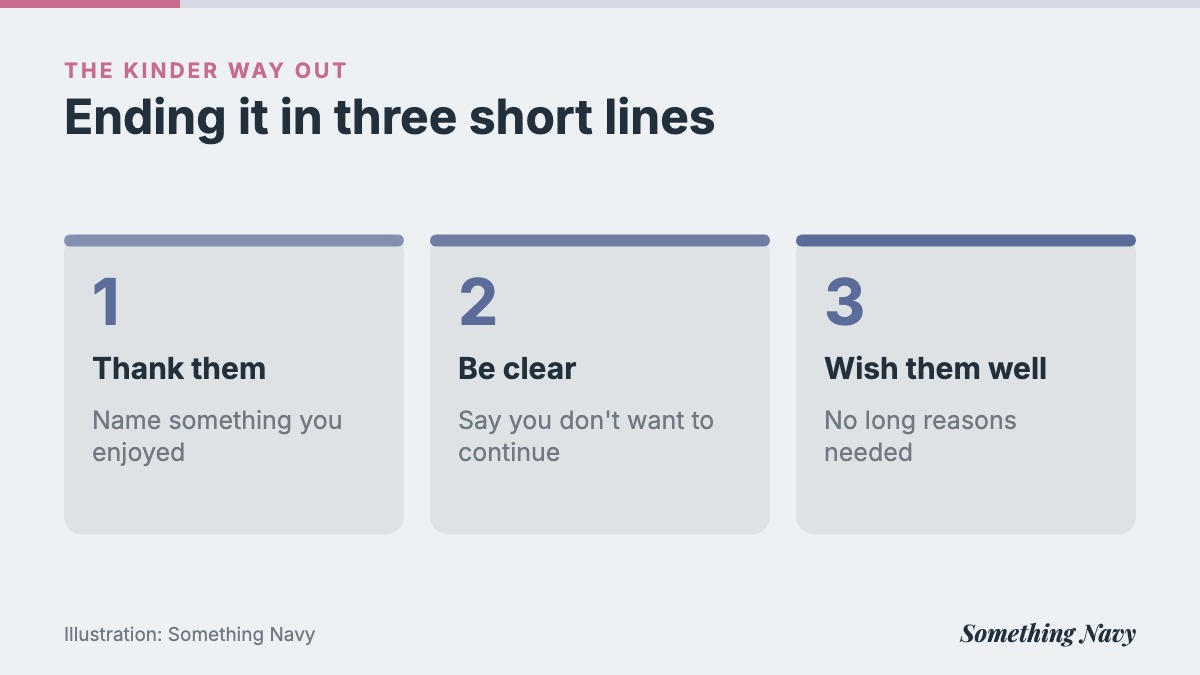
If you are worried about the reply, you do not have to enter a debate. You can be clear, kind and brief, and then leave it. If you are ending things with a long-term partner, you owe them more than a text. And the one real exception, the one LeFebvre’s participants named, is safety. If someone frightens you, you do not owe them a conversation.
In longer relationships, withdrawing into silence is a familiar warning sign. The relationship researcher John Gottman calls it stonewalling, and it does damage there too. Ghosting is, in a sense, stonewalling made permanent.
The silence says more about them
It is worth returning to that Cyberball finding. People felt excluded by a computer. They felt excluded by people they would never want to belong with. The pain of being ignored, in other words, is not a precise measure of what you have lost. It is an ancient alarm that goes off whenever we are left out, whether or not the person doing the leaving was worth keeping.
That alarm is worth listening to, because it tells you that you need connection. It is not worth believing when it tells you that you did something unforgivable. Most of the time, the silence is simply the sound of someone choosing the easy way out.
You can choose the other way. Not just in how you end things with others, but in how you end this one: one last message, or none, and then your attention back on the people who reply.
Sources
- Freedman, G., Powell, D. N., Le, B., & Williams, K. D. (2019). Ghosting and destiny: Implicit theories of relationships predict beliefs about ghosting. Journal of Social and Personal Relationships, 36(3), 905–924. DOI
- LeFebvre, L. E., Allen, M., Rasner, R. D., Garstad, S., Wilms, A., & Parrish, C. (2019). Ghosting in emerging adults’ romantic relationships: The digital dissolution disappearance strategy. Imagination, Cognition and Personality, 39(2), 125–150. DOI
- Koessler, R. B., Kohut, T., & Campbell, L. (2019). When your boo becomes a ghost: The association between breakup strategy and breakup role in experiences of relationship dissolution. Collabra: Psychology, 5(1), 29. DOI
- Williams, K. D., Cheung, C. K. T., & Choi, W. (2000). Cyberostracism: Effects of being ignored over the Internet. Journal of Personality and Social Psychology, 79(5), 748–762. DOI
- Eisenberger, N. I., Lieberman, M. D., & Williams, K. D. (2003). Does rejection hurt? An fMRI study of social exclusion. Science, 302(5643), 290–292. DOI
- Woo, C.-W., Koban, L., Kross, E., Lindquist, M. A., Banich, M. T., Ruzic, L., Andrews-Hanna, J. R., & Wager, T. D. (2014). Separate neural representations for physical pain and social rejection. Nature Communications, 5, 5380. DOI
How we reported this. We went back to the original research for this story, 6 sources in all, listed above, and checked every figure against them. If you think we have got something wrong, tell us and we will look at it. Read more about how we work.
Cover photo: Priscilla Du Preez on Unsplash. Charts and graphics: Something Navy.