
You are halfway through telling your partner about your day when you notice their eyes drop to the screen in their hand. They are still nodding. They might even say “mm-hm” at the right moment. But you know, and they probably know, that you have lost them.
There is a word for this now. “Phubbing”, a blend of “phone” and “snubbing”, describes ignoring the person in front of you in favour of your phone. It sounds like a trivial modern irritation, the sort of thing people grumble about and then do themselves ten minutes later. A growing body of research suggests it is a little more serious than that, especially between couples.
What the research found
The study most often cited on the subject was carried out by James Roberts and Meredith David, marketing researchers at Baylor University, and published in 2016 in the journal Computers in Human Behavior. They surveyed 453 adults in the United States across two samples, first building a short scale to measure “partner phubbing” and then using it to look at how phone snubbing related to the health of people’s relationships.
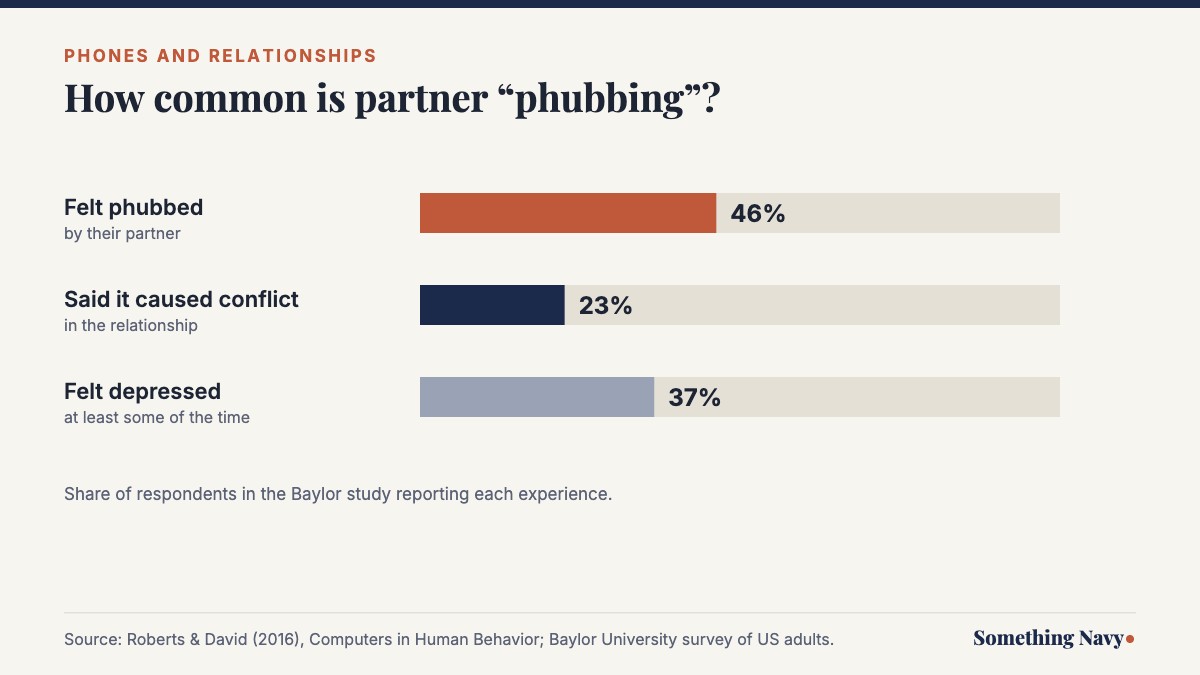
The numbers were striking. Of the people in the second, larger part of the study:
- 46.3% said their partner had phubbed them;
- 22.6% said this had caused conflict in their relationship;
- 36.6% said they had felt depressed at least some of the time;
- only 32% said they were very satisfied with their relationship.
More importantly, the researchers traced a chain linking these things together. Being phubbed was associated with more conflict over phone use. That conflict was associated with lower relationship satisfaction. And lower relationship satisfaction was in turn linked to lower life satisfaction and more symptoms of depression.
It is worth being clear about what this does and does not show. This was a survey, not an experiment, so it captures associations rather than proving that phones cause unhappiness. People in strained relationships may also be more likely to escape into their phones, or more likely to notice when their partner does. Still, the pattern was consistent, and it has held up in other countries.


It is not just an American finding
A follow-up study of 243 married adults in China, published in 2017 in Personality and Individual Differences, found much the same thing. People who felt phubbed by their spouse reported lower marital satisfaction, and lower marital satisfaction was linked to more symptoms of depression. The researchers also found that how long a couple had been married changed the strength of that link, a reminder that small habits play out differently over the years.
The pattern also fits older work on what phones do to conversation. In a set of experiments published in 2013 in the Journal of Social and Personal Relationships, Andrew Przybylski and Netta Weinstein asked pairs of strangers to sit down and get to know each other. For some pairs, a mobile phone sat nearby on the table; for others, it was replaced by a notebook. When the phone was present, people reported feeling less close to their conversation partner and rated them as less trustworthy and empathetic, particularly when the topic was meaningful. Nobody was even using the phone.
What a decade of studies adds up to
By 2025 there was enough research on the subject to pool. A team led by Nie Ni and Zeinab Zaremohzzabieh, working across universities in China, Iran and Malaysia, combined 52 studies covering 58 samples and 19,698 people in a meta-analysis published in Frontiers in Psychology. The samples came from the US, Britain, Germany, the Netherlands, China, Türkiye, Pakistan and more than a dozen other countries.
The headline result backs up the earlier work. Across 30 samples and more than 9,000 people, feeling phubbed by a partner went hand in hand with lower relationship satisfaction. The link was modest, a correlation of about −0.22, which means phone snubbing accounts for only a small slice of why some couples are happier than others. The links were a little stronger for intimacy, for jealousy and for how responsive people felt their partner was. Arguments showed the strongest link of all.
| What was measured | Link with feeling phubbed |
|---|---|
| Relationship satisfaction | Lower (r ≈ −0.22, 30 samples) |
| Intimacy | Lower (r ≈ −0.27) |
| Feeling your partner responds to you | Lower (r ≈ −0.29) |
| Jealousy | Higher (r ≈ 0.29) |
| Conflict | Higher (r ≈ 0.57) |
Two other details stood out. Culture seemed to shape the damage: in Western samples phubbing was tied more closely to conflict, while the one Eastern study of married couples in the review found a much bigger dent in marital satisfaction. And the people most likely to phub were those with the most compulsive relationship with their screens. Problematic media use was the strongest predictor the team found.
The authors are frank about the limits. Nearly all the studies they pooled were snapshots taken at a single point in time, so they cannot say whether phubbing damages relationships or whether unhappy couples simply reach for their phones more. It is the same caveat that applies to the Baylor study, only now it rests on far more data.
Why it stings more than it should
On paper, glancing at a message for a few seconds is a small thing. The reason it lands harder is that attention is one of the main ways we show people they matter. Each time someone turns to their screen mid-conversation, they are making a tiny, visible choice about what is more interesting right now. Repeated often enough, those choices add up to a message.
Roberts and David also found that people who were anxious about their relationships, the sort who worry about being rejected or not loved enough, were more affected by phubbing than people who felt secure. For them, a partner’s distraction is easier to read as a sign of something deeper.
Newer work suggests the feeling of being ignored may matter more than the minutes actually spent on the phone. A 2022 daily diary study of couples in Switzerland, by Frackowiak, Hilpert and Russell, found that a partner’s perception of phubbing mattered more than the behaviour itself. A 2023 British study of couples led by Katherine Carnelley reached a similar conclusion: perceived partner phubbing predicted lower relationship quality, while the amount of phubbing partners reported doing themselves did not.
A 2025 study from the University of Connecticut offers a clue as to why. Amanda Denes and colleagues surveyed 51 couples who were living together during the early months of the pandemic in 2020. People who felt phubbed were more likely to feel short of affection, the hugs, smiles and small signs of fondness, and that sense of going without was linked to lower satisfaction, and not only for the person who felt it. One result surprised the researchers. Couples who were on their phones about equally fared no better. Matching each other’s habits did not cancel out the sting.
There is also the matter of fairness. Most of us phub and get phubbed in roughly equal measure, but we judge the two very differently. When we check our own phone, we know it was urgent, or quick, or harmless. When our partner does it, all we see is the back of the phone.
What couples can do about it
Nobody seriously expects couples to give up their phones, and the research does not suggest that. What it does suggest is that the problem is less the phone itself than the moments when it interrupts connection. Some practical ideas:
- Agree on phone-free moments. Meals, the first few minutes after getting home and the last half hour in bed are common choices. A shared rule removes the need to police each other.
- Keep it out of sight. Given the 2013 findings, simply putting the phone in a pocket or another room during a proper conversation may help.
- Say what you are doing. “Sorry, I need to answer this from my mum” turns a snub into a brief, shared interruption.
- Raise it gently. “I miss your attention” tends to go further than “you are always on that thing”, which invites defensiveness.
That last point matters. The Gottman Institute’s research on couples suggests that how a complaint is raised can matter as much as the complaint itself. Our piece on the four horsemen of relationship conflict explains why criticism and contempt are so corrosive. And if you want to understand why a phone can pull at your attention even when it is face down, read our article on the “brain drain” of having a phone nearby.
Frequently asked questions
Phubbing means snubbing someone you are with by paying attention to your phone instead. The word combines “phone” and “snubbing”.
Studies in the US and China have linked being phubbed by a partner to more conflict, lower relationship satisfaction and more symptoms of depression. A 2025 review pooling 52 studies found the same pattern, though the links are modest and the research shows associations rather than proof of cause.
In a 2016 Baylor University study, 46.3% of adults said their partner had phubbed them and 22.6% said it had caused conflict.
Agree on phone-free times such as meals, keep your phone out of sight during conversations, and say out loud when you need to check something.
More in our Relationships section.
Sources
- Roberts, J. A., & David, M. E. (2016). My life has become a major distraction from my cell phone: Partner phubbing and relationship satisfaction among romantic partners. Computers in Human Behavior, 54, 134–141. DOI
- Wang, X., Xie, X., Wang, Y., Wang, P., & Lei, L. (2017). Partner phubbing and depression among married Chinese adults: The roles of relationship satisfaction and relationship length. Personality and Individual Differences, 110, 12–17. DOI
- Przybylski, A. K., & Weinstein, N. (2013). Can you connect with me now? How the presence of mobile communication technology influences face-to-face conversation quality. Journal of Social and Personal Relationships, 30(3), 237–246. DOI
- Ni, N., Ahrari, S., Zaremohzzabieh, Z., Zarean, M., & Roslan, S. (2025). A meta-analytic study of partner phubbing and its antecedents and consequences. Frontiers in Psychology, 16, 1561159. DOI
- Denes, A., Guest, C., Webber, K. T., Gorin, A. A., & Cornelius, T. (2025). Phone or affection?: Assessing dyadic perceptions of partner phubbing, affection deprivation, and relationship satisfaction. Journal of Social and Personal Relationships. DOI
- Frackowiak, M., Hilpert, P., & Russell, P. S. (2022). Partner’s perception of phubbing is more relevant than the behavior itself: A daily diary study. Computers in Human Behavior, 134, 107323. DOI
- Carnelley, K. B., Vowels, L. M., Stanton, S. C., Millings, A., & Hart, C. M. (2023). Perceived partner phubbing predicts lower relationship quality but partners’ enacted phubbing does not. Computers in Human Behavior, 147, 107860. DOI
How we reported this. We went back to the original research for this story, 7 sources in all, listed above, and checked every figure against them. We updated it on 29 October 2026 to add a 2025 meta-analysis of 52 studies and newer research on why being phubbed hurts. If you think we have got something wrong, tell us and we will look at it. Read more about how we work.
Cover photo: Vitaly Gariev on Unsplash. Charts and graphics: Something Navy.