

You turn the last page somewhere between two stations. The carriage is warm, someone nearby is eating crisps, and the train slows for a signal that never seems to change. You close the book and look out at a car park in the rain.
And you are still thinking about her. Not the plot, which wrapped up neatly enough, but one particular character: the way she kept quiet when she should have spoken, and what it must have cost her. You find yourself wondering what she would make of the woman opposite you, who is staring at her phone with an expression you cannot quite read.
It is a familiar feeling, and it comes with a flattering explanation. Fiction, the theory goes, is a gym for empathy. Spend enough time inside other people’s heads on the page and you get better at reading the ones on the train. For a few years in the 2010s, that idea looked like it had hard science behind it. The real story is more interesting, and a little humbler.
The 2013 study that made reading fiction an empathy booster
In October 2013, David Comer Kidd and Emanuele Castano of The New School in New York published a short paper in Science with a headline-ready title: reading literary fiction improves theory of mind. Theory of mind is the psychologist’s term for the ability to work out what other people think, feel and intend.
Across five experiments, they had volunteers read either a piece of literary fiction, a piece of popular fiction, some non-fiction, or nothing at all. Then came tests of social understanding, most famously the Reading the Mind in the Eyes Test, where you look at photographs of people’s eyes and pick the word that best fits their mental state. According to Scientific American, each study had between 86 and 356 participants, and the texts pitted Louise Erdrich’s The Round House against Danielle Steel’s The Sins of the Mother.
The literary fiction readers did better. Kidd and Castano’s explanation was elegant: literary writing leaves gaps. Characters are ambiguous and motives go unstated, so as Kidd put it to Scientific American, “we’re forced to fill in the gaps.” Popular fiction, in this account, tends to hand you characters whose inner lives are spelled out.
The study travelled fast. It told readers what they wanted to hear, in one of the world’s most prestigious journals. The catch was the dose: a single short text, producing a change in a basic social skill.
When the replications came in
Three labs, 792 readers, no advantage
By 2016 the follow-up evidence was arriving, and it was not kind. In the Journal of Personality and Social Psychology, Panero and colleagues, a group that included Ellen Winner, reported a large replication attempt run by three independent research teams. They randomly assigned 792 participants to literary fiction, popular fiction, non-fiction or no reading, then gave everyone the Reading the Mind in the Eyes Test.
Literary fiction produced no significant advantage over any of the other conditions. A few pages of carefully ambiguous prose, it seemed, did not reliably sharpen anyone’s reading of faces.
There was a twist, though. People who scored higher on the Author Recognition Test, a measure of lifetime reading in which you tick real authors from a list salted with made-up names, did better on the eyes test whatever they had just read. The passage did not matter. Something about habitual readers did.
The big replication project
Two years later, the result faced a second test. In 2018, Colin Camerer and a large team published the Social Sciences Replication Project in Nature Human Behaviour. They took 21 experimental social science studies published in Nature and Science between 2010 and 2015 and re-ran them with pre-registered plans and samples roughly five times larger than the originals.
Thirteen of the 21 replicated, and on average the replication effects were about half the size of the originals. Kidd and Castano’s literary fiction study was on the list, and the FORRT replication database records it among the failures. It joins a long line of catchy findings, from power poses onwards, that shrank or vanished once larger samples were brought in.
One short story is a lovely afternoon, but it is a very small dose to expect to rewire a lifetime of social habits.
It is not a total wipe-out. The same database lists a 2018 replication in Collabra: Psychology with results largely consistent with the original, and a 2018 paper by Kidd and Castano themselves reported mixed results. But the strong claim, that one literary story sharpens your mind-reading within minutes, no longer stands on solid ground.

Lifelong readers and the chicken-and-egg problem
Years before the 2013 study, Raymond Mar, Keith Oatley and colleagues at the University of Toronto asked a slower question: do lifelong fiction readers differ from people who mostly read non-fiction? Their 2006 paper in the Journal of Research in Personality, cheerfully titled “Bookworms versus nerds”, tested 94 people from the university community. Using a version of the Author Recognition Test that split fiction writers from non-fiction writers, they found that fiction exposure was positively linked with performance on the eyes test, while non-fiction exposure, once fiction was accounted for, was linked with poorer social performance. People who tended to get absorbed in stories also reported more empathy. The pattern held after the team controlled for age, English fluency and general intelligence.
The authors were candid about the limits. This was a correlation in a small sample drawn from a university community, and it could not tell which way the arrow pointed. Perhaps fiction trains social skill. Or perhaps people who are already curious about other minds are drawn to novels in the first place. Panero’s replication team raised exactly the same two possibilities, along with a third: verbal ability, which helps with both reading and with picking the right word in the eyes test.
Getting lost in the story may matter more than the genre
If a quick dose of fiction does not reliably work, is there anything about how we read that might? A 2013 study in PLOS ONE by Matthijs Bal of VU University Amsterdam and Martijn Veltkamp pointed to one candidate: transportation, the sense of being emotionally carried away by a story.
They ran two small experiments. In the first, 66 participants read part of an Arthur Conan Doyle Sherlock Holmes story or newspaper reports; in the second, 97 people read the opening chapter of José Saramago’s Blindness or newspaper articles. Empathy was measured before reading, straight afterwards, and again a week later.
There was no immediate effect. A week on, though, fiction readers who had been deeply transported reported more empathy, while fiction readers who had not been drawn in reported less. The authors suggested that ploughing through a story you are not engaged with may leave you disengaged or a little irritated. The samples were small and the second study only partly backed the first, so this is a lead rather than a law.
The book that changes you is probably the one you could not put down, not the one you felt you ought to finish.
Reading fiction and empathy: the best evidence from 2018 to 2024
Single studies swing about; meta-analyses, which pool many, are steadier. In 2018, Diana Tamir of Princeton University and David Dodell-Feder combined 53 effect sizes from 14 published and unpublished experiments in the Journal of Experimental Psychology: General. Reading fiction, compared with non-fiction or nothing, produced a small but statistically significant improvement in social cognition, with an effect size of g = .15 to .16. In plain English, if you lined up a fiction group and a comparison group, their score distributions would overlap almost completely, with the fiction readers nudged slightly ahead. The effect did not appear to be an artefact of publication bias.
The most comprehensive review so far came out in 2024, from Lena Wimmer and colleagues, including researchers at the University of Kent, in the same journal. They ran two pre-registered meta-analyses. The first pooled 70 experiments and 371 effect sizes and found that reading fiction produced small benefits overall (g = 0.14), significant only for empathy and mentalising. The effects were larger when fiction was compared with watching fiction or reading nothing, and smaller when it was compared with reading non-fiction.
The second meta-analysis pulled together 114 correlational studies and 559 effect sizes. Lifelong fiction reading was linked with small cognitive benefits (r = .16), strongest for verbal abilities and weaker for empathy and mentalising. Effects were bigger in correlational studies than in experiments, and bigger in community samples than student ones. The authors settled on a careful phrase: the evidence supports a “small-sized positive relationship” between reading fiction and these abilities, without claiming that fiction causes them.
So there probably is something there, but it is modest, it may build over years rather than minutes, and part of the correlation may simply reflect who chooses to read. Fiction is not an empathy pill. It is closer to a pleasant walk that, taken often enough, does you a bit of good.


Are we reading for pleasure less?
All of this matters more if fewer people read at all, and the UK data on young readers has been bleak. The National Literacy Trust’s Annual Literacy Survey asks tens of thousands of children each year whether they enjoy reading in their free time.
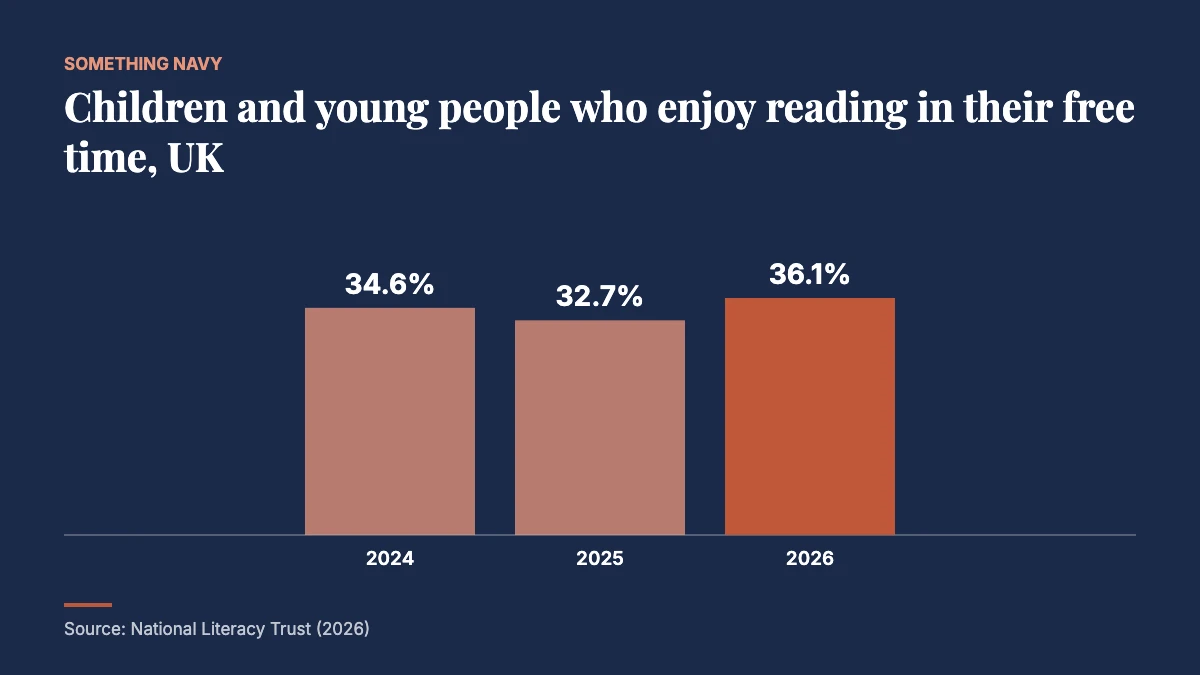
In 2024, just 34.6% of 8- to 18-year-olds said yes, a fall of 8.8 percentage points in a single year and the lowest since the Trust began asking in 2005. In 2025, from almost 115,000 responses, it fell to 32.7%, a 36% drop since 2005. Only 18.7% read something daily in their free time that year.
Then came a modest surprise. The Trust’s 2026 report, based on 125,375 children and young people from 479 schools across the UK, found enjoyment back up to 36.1% and daily reading at 20.3%. One year is not a trend, and enjoyment among the youngest children, aged 5 to 8, actually slipped slightly, from 62.6% to 61.6%. But it was the first rise in years.
Nothing in the empathy research says children who skip novels will grow up callous. But if fiction’s slow benefits are real, they depend on people getting absorbed in books, which is exactly what has been slipping. Phones are the easy suspect, though as we found with doomscrolling, that evidence is messier than the headlines.
What to take from all this
If you finish a novel on a train and keep thinking about a character, something has happened: you have spent hours practising the habit of wondering what someone else wants and why. Repeated over a lifetime, that habit is weakly but genuinely linked with understanding people a little better.
What the research does not support is the idea that one story read this morning makes you a kinder colleague by lunchtime. For that, putting the book down and talking to the stranger opposite might do more. Then pick the novel back up. The best reason to read fiction was always that you wanted to, and nothing in the evidence takes that away.
Frequently asked questions
The best current evidence, including a 2024 meta-analysis of 70 experiments, points to a small positive effect on empathy and mentalising. It is real but modest, and much of the link between heavy reading and social skill may come from who chooses to read.
Largely, yes. A 2016 replication with 792 participants found no advantage for literary fiction, and the 2018 Social Sciences Replication Project also recorded it as a failure, although one 2018 replication found broadly consistent results.
That was the original claim, but replications have not reliably supported it. Studies on emotional transportation suggest how absorbed you are in a story may matter more than its genre label.
The National Literacy Trust’s 2026 survey found 36.1% of children and young people enjoy reading in their free time, up from 32.7% in 2025, the lowest point in 20 years of the survey.
Official links and research
- Bal, P. M., & Veltkamp, M. (2013). How does fiction reading influence empathy? An experimental investigation on the role of emotional transportation. PLOS ONE, 8(1), e55341. DOI
- Camerer, C. F., Dreber, A., Holzmeister, F., Ho, T.-H., Huber, J., et al. (2018). Evaluating the replicability of social science experiments in Nature and Science between 2010 and 2015. Nature Human Behaviour, 2(9), 637–644. DOI
- Dodell-Feder, D., & Tamir, D. I. (2018). Fiction reading has a small positive impact on social cognition: A meta-analysis. Journal of Experimental Psychology: General, 147(11), 1713–1727. DOI
- Kidd, D. C., & Castano, E. (2013). Reading literary fiction improves theory of mind. Science, 342(6156), 377–380. DOI
- Mar, R. A., Oatley, K., Hirsh, J., dela Paz, J., & Peterson, J. B. (2006). Bookworms versus nerds: Exposure to fiction versus non-fiction, divergent associations with social ability, and the simulation of fictional social worlds. Journal of Research in Personality, 40(5), 694–712. DOI
- National Literacy Trust. (2024). Children and young people’s reading in 2024. https://literacytrust.org.uk/research-services/research-reports/children-and-young-peoples-reading-in-2024/
- National Literacy Trust. (2025). Children and young people’s reading in 2025. https://literacytrust.org.uk/research-services/research-reports/children-and-young-peoples-reading-in-2025
- National Literacy Trust. (2026). Children and young people’s reading in 2026. https://literacytrust.org.uk/research-services/research-reports/children-and-young-peoples-reading-in-2026/
- Panero, M. E., Weisberg, D. S., Black, J., Goldstein, T. R., Barnes, J. L., Brownell, H., & Winner, E. (2016). Does reading a single passage of literary fiction really improve theory of mind? An attempt at replication. Journal of Personality and Social Psychology, 111(5), e46–e54. DOI
- Wimmer, L., Currie, G., Friend, S., Wittwer, J., & Ferguson, H. J. (2024). Cognitive effects and correlates of reading fiction: Two preregistered multilevel meta-analyses. Journal of Experimental Psychology: General, 153(6), 1464–1488. DOI
Cover photo: Will Tarpey on Unsplash. Charts and graphics: Something Navy, with photography by Yanhao Fang on Unsplash.
How we reported this. Every figure was checked against the 10 sources above. Reviewed by Valentino Adkins, Senior Content Manager. Report an error · How we work