It is 2.47am. The snoring beside you has found a new gear, the duvet has migrated to the other side of the bed, and you are lying very still, doing the maths on how many hours are left before the alarm.
Then you do the thing you have quietly done before. You pick up your pillow and tiptoe to the spare room, the sofa or the child’s bed with the glow-in-the-dark stars on the ceiling.
In the morning, nobody mentions it. It can feel like a small failure, a crack in the picture of what a couple is supposed to look like.
It turns out you are in very large company. And the science on sleeping apart is far gentler, and more interesting, than the slightly brutal nickname it has picked up: the “sleep divorce”.
More than a third of people are already doing it
In March 2023 the American Academy of Sleep Medicine commissioned Atomik Research, an independent market research agency, to survey 2,005 adults across the United States. The results, published by the academy that summer, found that more than a third of respondents said they occasionally or consistently slept in another room to accommodate a bed partner.
The split by sex was striking. Some 45% of men said they did it, compared with 25% of women. That may partly reflect who gets banished and who does the banishing: the person who decamps to the sofa is often the one whose snoring or fidgeting is the problem.
Age mattered too, though not in the direction most people would guess.
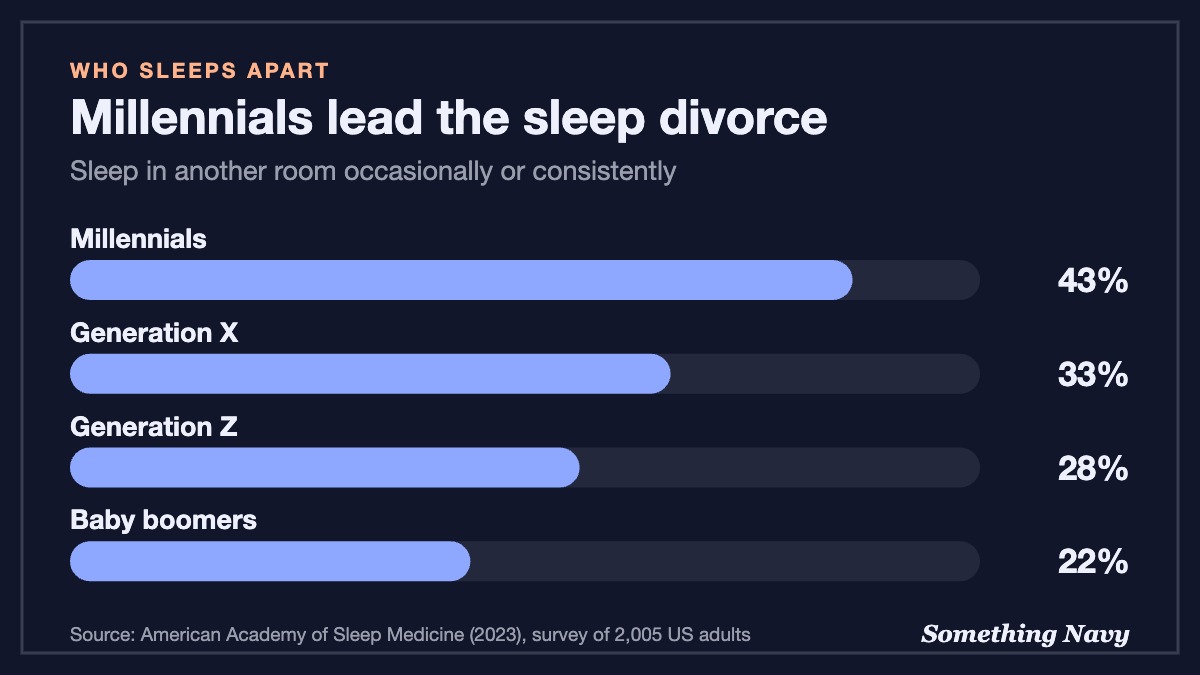
You might expect long-married older couples, worn smooth by decades of compromise, to be the ones with separate rooms. In fact, millennials led the way at 43%, followed by Generation X at 33%, Generation Z at 28% and baby boomers at 22%.
A few caveats belong here. This was a commercial online poll, not a peer-reviewed study, and it asked about a behaviour that ranges from one night a month to a permanent arrangement. It tells us the practice is common and not shameful to admit. It does not tell us whether the couples who do it are happier.
Still, the younger skew suggests something has shifted. For a generation raised on sleep trackers and wellness apps, protecting a good night may simply feel like a reasonable thing to ask for, rather than a confession.
The usual reasons are not romantic, just physical
Ask couples why they sleep apart and the answers are rarely about the relationship. They tend to be about bodies, and about bodies that simply do not keep the same hours.
Snoring is the classic culprit. Seema Khosla, a pulmonologist and spokesperson for the academy, made a point worth underlining when the survey came out: if loud snoring is what pushes one partner out of the room, the snorer should talk to a doctor about obstructive sleep apnoea. A separate room can solve the noise while leaving a genuine health problem untreated.
Mismatched body clocks come next. One of you is a lark who is fading by 10pm; the other is an owl who comes alive at midnight and drifts in with a phone screen glowing. (If the owl is staying up to reclaim some “me time” after a crowded day, that pattern has a name: revenge bedtime procrastination.)
Restless legs and fidgeting matter more than people realise. So do temperature wars, where one partner sleeps hot and kicks off the covers while the other wants a heavy duvet and a closed window. Add shift work, a newborn, insomnia or a partner who gets up at 5am for the gym, and the list grows.
None of these is a verdict on love. They are logistics.
Your partner moves, and so do you
Researchers have known for decades that a shared bed is a noisier place than it feels. In a study published in the journal Sleep in 1994, Francesca Pankhurst and Jim Horne at Loughborough University fitted 46 couples with wrist movement monitors for eight nights.
About a third of the movements they recorded were shared, with both partners moving within the same 30-second window. People made more movements with a partner in the bed than comparable people who slept alone, and their movement dropped when the usual partner was away. Women reported being disturbed by their partner more often than men did.
And yet, here is the twist. Most of the couples said they slept better when their partner was there.
That gap between what a sleep monitor sees and what a person feels runs through the whole field. Objectively, a bedfellow can be a source of disturbance. Subjectively, many of us find the warm weight of another person deeply settling, and that sense of safety is not nothing.
What happens to your brain when you share a bed
The most intriguing recent evidence for bed-sharing comes from Germany. In 2020, Henning Johannes Drews and colleagues at the Center for Integrative Psychiatry in Kiel published a study in Frontiers in Psychiatry that went much further than wrist monitors.
What the Kiel study actually did
- Who: 12 young, healthy, heterosexual couples (24 people, average age about 23).
- Where: a sleep laboratory, over four nights: some sleeping together, some sleeping alone.
- How: full polysomnography on both partners at once, recording brain waves, breathing and movement, plus questionnaires about the relationship.
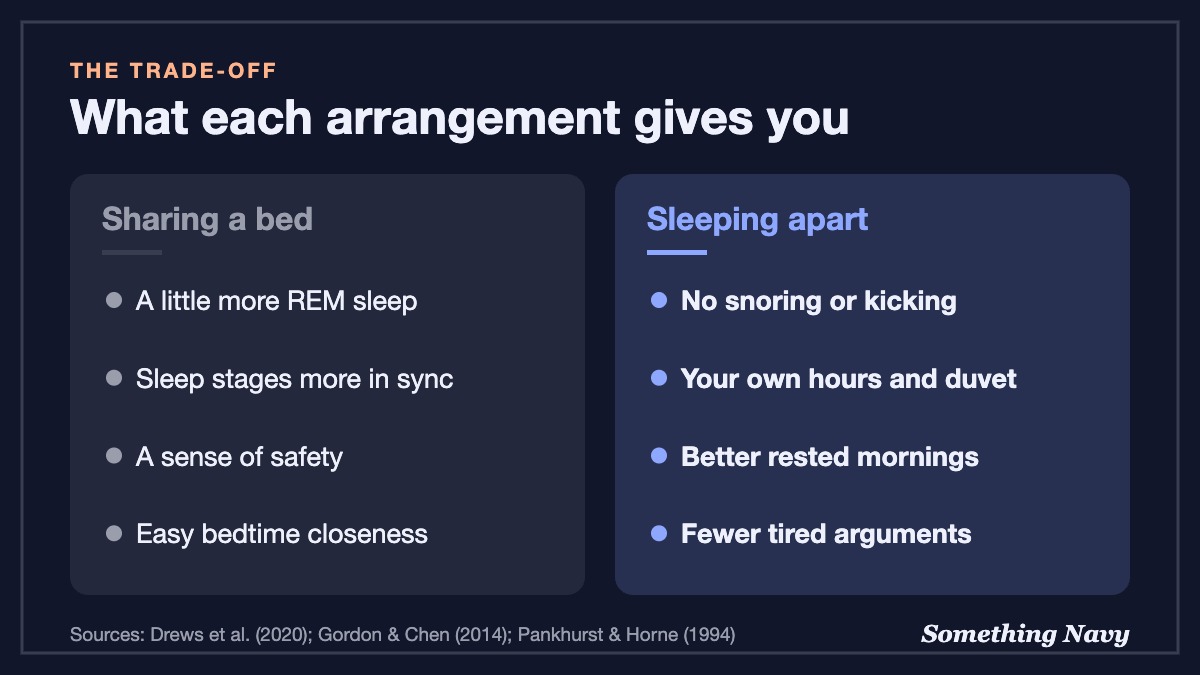
- Main finding: more REM sleep, fewer REM interruptions and more closely synchronised sleep stages when couples shared a bed.
When the couples shared a bed, REM sleep (the stage most associated with vivid dreaming and with processing emotions) made up about 23% of their sleep, compared with about 21% when they slept alone. That is roughly a tenth more REM in relative terms, and it was also less fragmented.
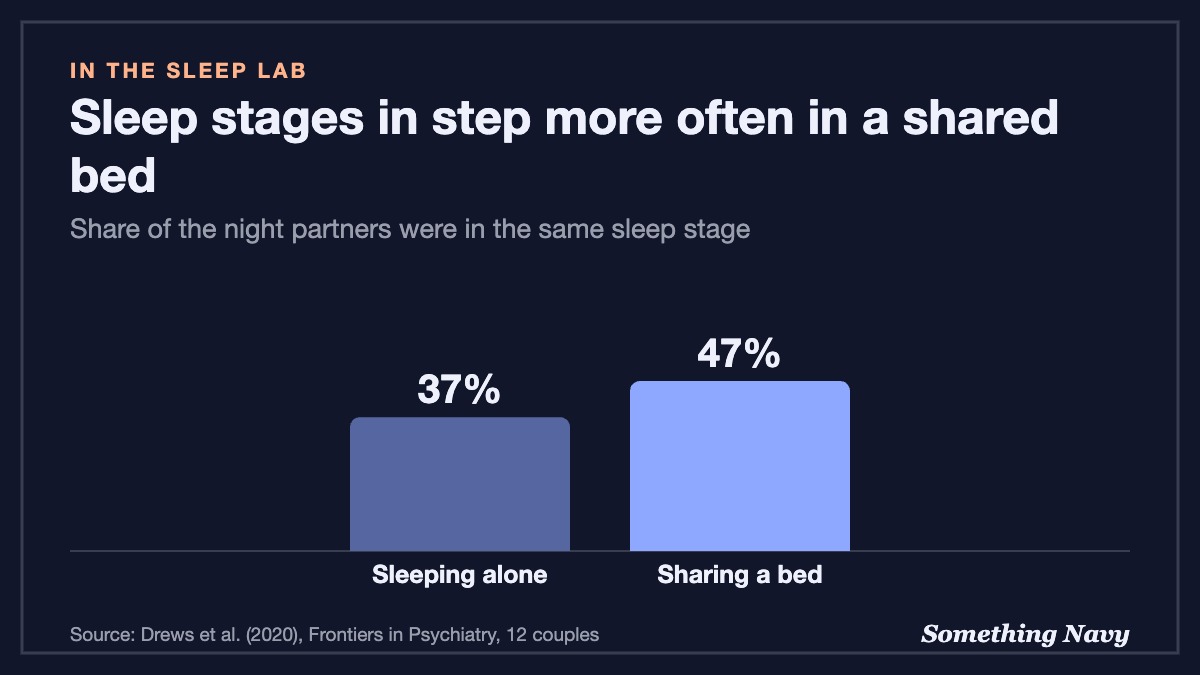
Their sleep also fell into step. Measured moment by moment, partners were in the same sleep stage about 37% of the time when they slept apart and about 47% of the time when they slept together. The deeper people rated their relationship, the more closely their sleep was synchronised.
There was a physical cost, though. Partners made more leg movements when sharing a bed. Drews summed it up neatly in the journal’s press release: “while your body is a bit unrulier when sleeping with somebody, your brain is not.”
Before anyone drags a mattress back into the main bedroom on the strength of this, look at the size of the study. Twelve couples, all young and healthy, sleeping in a lab with wires attached. The authors themselves flag the small sample and that some of their analyses were exploratory. It is a fascinating signal, not a prescription.
Tired partners fight worse, and it isn’t just in your head
If bed-sharing has subtle benefits, so does sleep itself, and the evidence that poor sleep sours relationships is fairly consistent.
Psychologists Amie Gordon and Serena Chen at the University of California, Berkeley ran two studies, published in Social Psychological and Personality Science in 2014. In the first, 78 people in relationships kept a daily diary for two weeks. They reported more conflict with their partner on days after a worse night’s sleep, even after the researchers accounted for stress, anxiety and how satisfied they were with the relationship.
In the second, 71 couples came into the lab, rated their previous night’s sleep and were filmed discussing a real source of disagreement. When one partner had slept badly, both of them showed less positive and more negative emotion during the conversation. Poor sleepers were also worse at reading what their partner was feeling.
The couples most likely to actually resolve the disagreement were the ones where both people had slept well.
These were correlational studies relying on people’s own reports of sleep, so they cannot prove that a bad night causes a row. But they fit with what Khosla said in 2023: “those who are sleep deprived are more likely to argue with their partners.” A sleepless partner is also more likely to slide into the defensive, contemptuous habits that relationship researchers treat as warning signs, the kind described in the Gottman “four horsemen”.
So the honest answer is that both camps have a point. Sharing a bed may bring a little more REM sleep, a quiet synchrony and a sense of security. Sleeping badly next to someone brings shorter tempers and worse arguments.
The best bed for your relationship is the one that lets you both wake up as yourselves.
The word “divorce” is doing a lot of unfair work
Wendy Troxel, a senior behavioural and social scientist at the RAND Corporation and author of Sharing the Covers: Every Couple’s Guide to Better Sleep (2021), has spent much of her career studying sleep in couples. She is not a cheerleader for separate rooms. In an interview with Washingtonian magazine, she noted that most people, if asked, “will say they prefer to sleep with their partner.”
But she is equally clear that the stigma around sleeping apart is misplaced. Of the feeling that separate beds signal a failing marriage, she told the magazine: “That’s a cultural shame with no scientific backing.”
Her point, and the point of much of the research above, is that couples sleep as a unit. What one partner does at night shapes the other’s night, and the morning after. Sometimes the kindest thing for that unit is two rooms.
Plenty of couples already sleep apart some of the time without anyone calling it a divorce: during a bout of flu, after a night shift, in the weeks after a baby arrives. The label only stings when the arrangement becomes permanent and goes unexplained.
The risk is drifting, not the separate room
Sleeping apart has a genuine downside, and it is worth naming plainly. Bedtime is often the only unhurried, screen-free, child-free moment a couple gets all day. It is where the small talk happens: the odd thing a colleague said, the worry about a parent, the plan for Saturday.
If the separate room quietly erases that moment, the cost is not really about sleep. It is about losing a daily point of contact. Troxel’s warning in the same interview applies here too: problems that go unspoken tend to fester, and “you just get increasingly resentful.”
The way someone leaves the bed matters as much as the fact that they leave it. Slipping out silently at 3am can feel like rejection to the person who wakes up alone, especially for anyone who tends towards an anxious attachment style. Agreeing on it together, in daylight, turns the same act into teamwork.
Leaving the bed is not leaving the relationship. Leaving without talking about it might be.
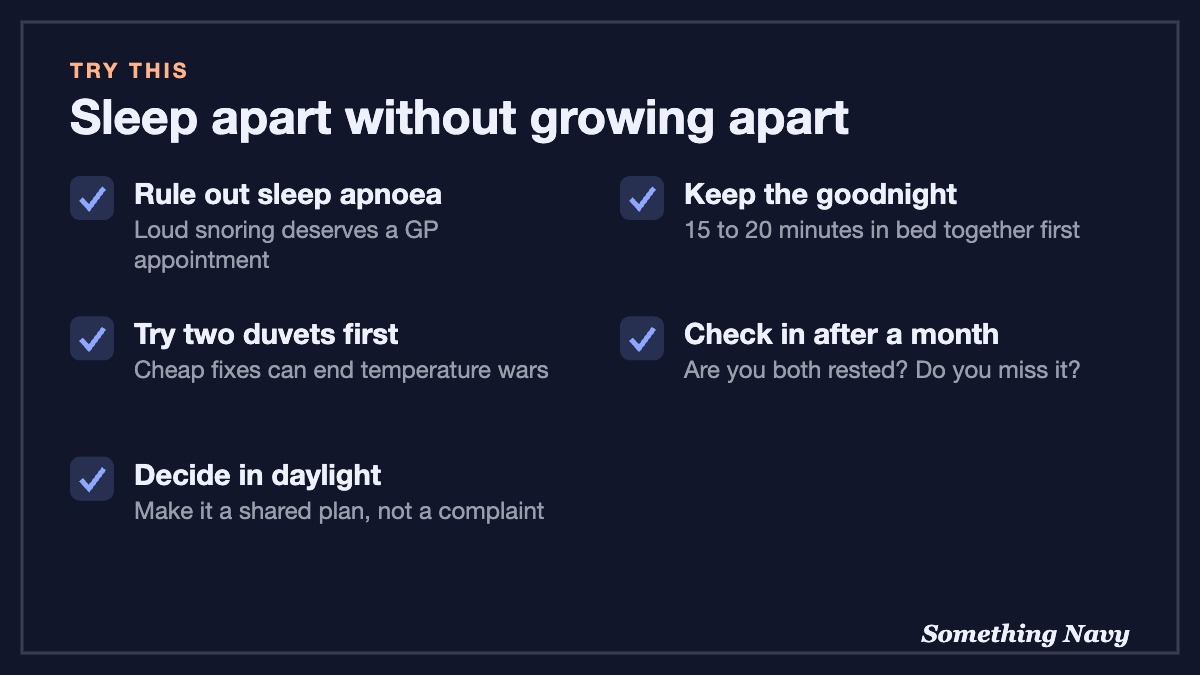
Try this: sleeping apart without growing apart
If you are considering it, or already doing it and feeling odd about it, these steps come up again and again in the advice from sleep researchers and clinicians.
- Rule out the medical stuff first. Loud, regular snoring, gasping or pauses in breathing deserve a GP appointment to check for sleep apnoea. Persistent restless legs or insomnia are treatable too.
- Try the cheap fixes. Two single duvets on one bed can end temperature wars overnight. Earplugs, a white noise machine or a bigger mattress may be enough.
- Decide together, in daylight. Talk about it as a shared plan to sleep better, not a complaint about the other person’s body. Agree what it means and what it does not.
- Keep the bedtime ritual. Get into bed together for 15 to 20 minutes to talk, read or cuddle before one of you moves. The goodnight is the part that matters.
- Make it flexible. Many couples sleep apart on work nights and together at weekends, or only when one of them is ill or jet-lagged. It does not have to be all or nothing.
- Protect intimacy on purpose. Sleeping in the same bed was never what kept physical closeness alive. Separate rooms just mean you choose it rather than default to it.
- Check in after a month. Are you both less tired? Less snappy? Do you miss each other? Adjust accordingly.
It also helps to be honest about the morning. If one of you wakes up rested and cheerful and the other has lain awake missing their person, the arrangement is not working for the couple yet, even if the sleep data look great.
A better kind of togetherness
The sleep science here does not crown a winner. Shared beds can bring a little more dreaming sleep and a quiet, unconscious synchrony. Separate beds can bring longer, deeper rest and kinder mornings. The right answer depends on whose snoring, whose shifts and whose stubborn cold feet are involved.
What the research does say, again and again, is that how well you sleep shapes how well you love. A rested person listens better, reads their partner’s face more accurately and fights more fairly.
So if the spare room is what makes that possible, there is no need to sneak there at 2.47am with your pillow. Say goodnight properly, close the door gently, and see each other at breakfast, as the best version of yourselves.
Sources
- American Academy of Sleep Medicine. (2023, July 10). Over a third of Americans opt for “sleep divorce” [Press release; survey conducted by Atomik Research, n = 2,005]. Link
- Drews, H. J., Wallot, S., Brysch, P., Berger-Johannsen, H., Weinhold, S. L., Mitkidis, P., Baier, P. C., Lechinger, J., Roepstorff, A., & Göder, R. (2020). Bed-sharing in couples is associated with increased and stabilized REM sleep and sleep-stage synchronization. Frontiers in Psychiatry, 11, 583. DOI
- Gordon, A. M., & Chen, S. (2014). The role of sleep in interpersonal conflict: Do sleepless nights mean worse fights? Social Psychological and Personality Science, 5(2), 168–175. DOI
- Pankhurst, F. P., & Horne, J. A. (1994). The influence of bed partners on movement during sleep. Sleep, 17(4), 308–315. DOI
- Troxel, W. M. (2021). Sharing the covers: Every couple’s guide to better sleep. Hachette Go. Link
- Goldstein, J. M. (2019, November 5). Sleep divorce is a thing, and it’s on the rise. Washingtonian. Link
Cover photo: Vitaly Gariev on Unsplash. Charts and graphics: Something Navy.
How we reported this. We went back to the original research for this story, 6 sources in all, listed above, and checked every figure against them. If you think we have got something wrong, tell us and we will look at it. Read more about how we work.