
You have probably heard it at a dinner party, or seen it on a slide at work. Someone leans back and says, with total confidence, that money only makes you happier up to $75,000 a year. After that, nothing.
It is a lovely number. It sounds precise, it flatters people who earn less, and it gives people who earn more a ready excuse for still feeling flat on a Tuesday evening.
It also turned out to be only half the story. In 2023, the Nobel laureate who helped make the number famous sat down with the younger researcher who had challenged it, and together they worked out what the data actually said.
Their answer: for most people, more money goes with more happiness, with no ceiling in sight. The plateau is real, but only for a particular group of people. And who those people are is the most interesting part.
A number with a very long shelf life
The $75,000 figure comes from a paper published in September 2010 in the Proceedings of the National Academy of Sciences (PNAS). Its authors were Daniel Kahneman and Angus Deaton, both of Princeton University, and both Nobel prize winners in economics. Kahneman won in 2002; Deaton followed in 2015.
With names like that attached, the finding travelled fast, through business books, finance blogs and countless salary debates.
The trouble with a number that travels is that the small print stays at home.
What Kahneman and Deaton actually measured
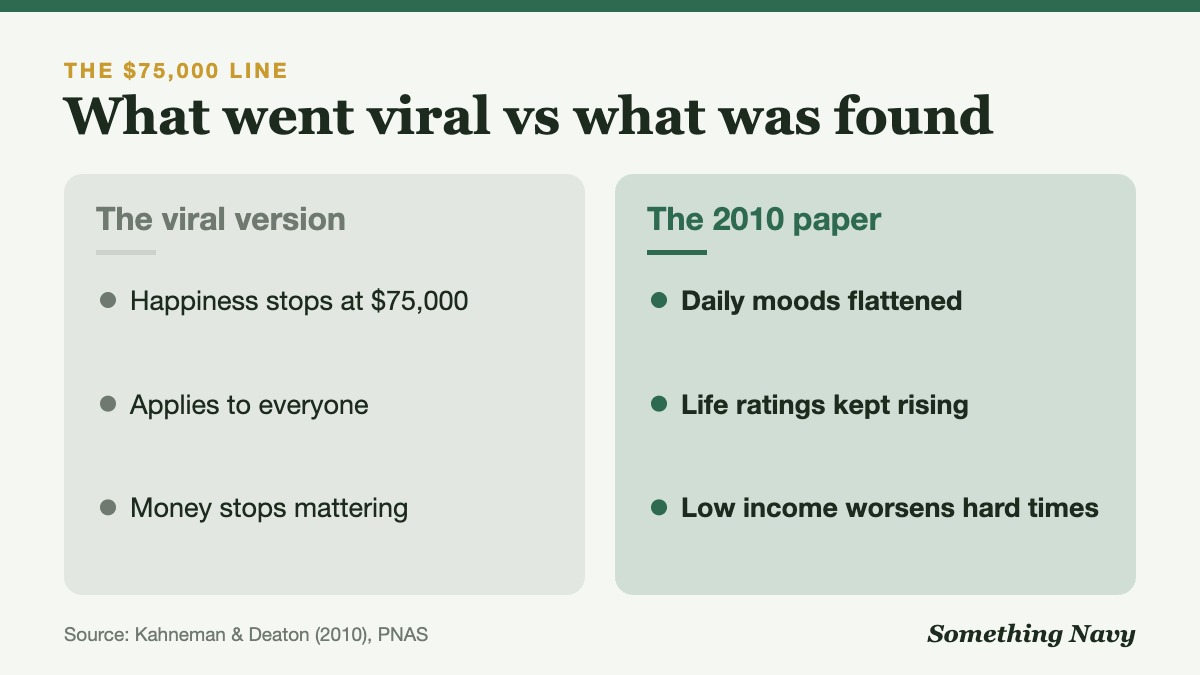
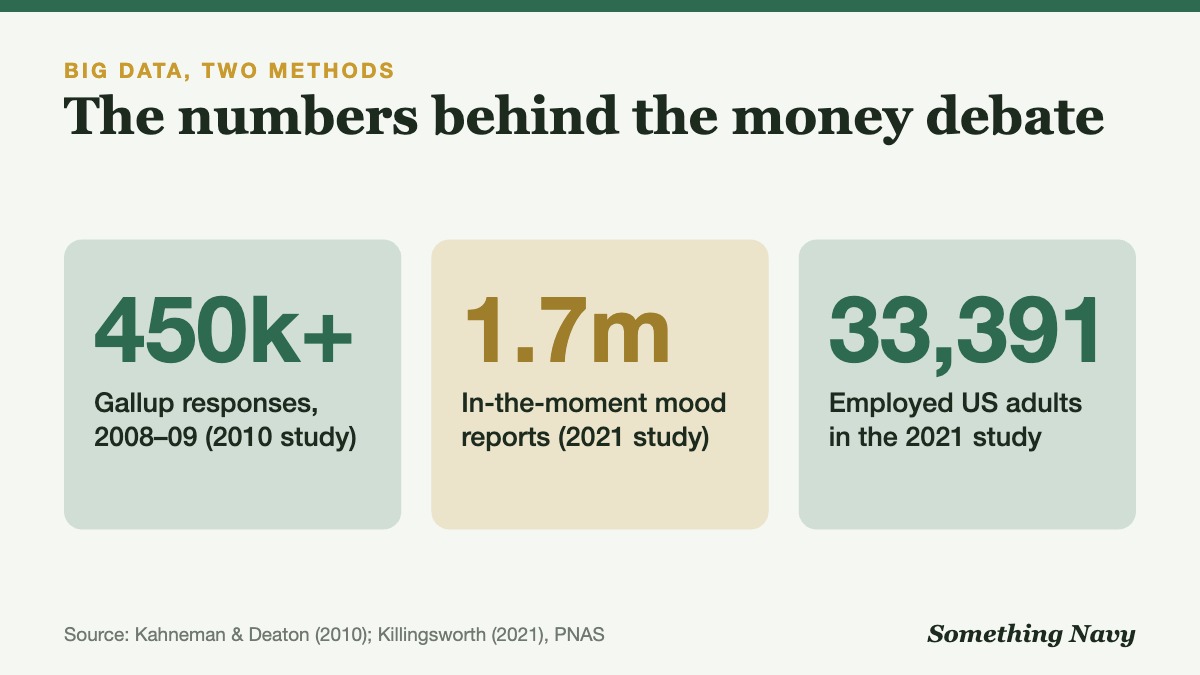
The pair analysed more than 450,000 responses to the Gallup-Healthways Well-Being Index, a daily survey of US residents carried out in 2008 and 2009. They looked at two quite different things.
The first was life evaluation: how people rate their life overall, on a ladder from 0 (the worst possible life) to 10 (the best). That kept rising steadily with income. There was no ceiling at all.
The second was emotional well-being: the quality of everyday experience. Here Gallup asked simple yes-or-no questions about the previous day. Did you smile or laugh a lot yesterday? Did you feel enjoyment, worry, sadness, a lot of stress?
It was on these day-to-day emotions that the curve flattened, at roughly $75,000 of household income a year. Above that point, the share of people saying yes to the good feelings stopped climbing.
Their own summary was careful: high income, they wrote, “buys life satisfaction but not happiness”. They also noted something far less quoted, and arguably more important. Low income, they found, made the emotional pain of divorce, ill health and being alone worse.
So even the original paper never said money stops mattering. That subtlety did not survive the dinner-party version.


Then 1.7 million moments said otherwise
Matthew Killingsworth, a senior fellow at the Wharton School of the University of Pennsylvania, came at the question from a different angle. Instead of asking people to remember yesterday, he asked them how they felt right now.
His app, Track Your Happiness, sent people prompts at random moments of the day. Each time, they rated how they felt on a continuous scale running from “Very bad” to “Very good”. As he put it to the university’s press office, he was trying to get “a representative sample of the moments of people’s lives”.
In a 2021 PNAS paper, he analysed 1,725,994 of these reports from 33,391 employed adults in the United States, aged 18 to 65.
The result was blunt. Both how people felt in the moment and how they rated their lives rose steadily as income rose, measured in proportional terms. Crucially, the slope above $80,000 a year was just as steep as the slope below it. There was no kink, no plateau.
He also found two clues about why. People with higher incomes reported a greater sense of control over their lives, and that feeling accounted for most of the link between income and moment-to-moment happiness. Meanwhile, people who equated money with success were, on average, less happy than those who did not.
Two rivals, one referee
So who was right? This is where the story gets unusually civilised.
Instead of trading rebuttals in journal letters, Killingsworth and Kahneman agreed to an adversarial collaboration, an approach Kahneman had championed for years. Rivals work together on a shared analysis, with a neutral third party to keep things honest. The referee here was Barbara Mellers, a psychologist at the University of Pennsylvania.
The trio reanalysed Killingsworth’s experience-sampling data. Rather than looking only at the average person at each income level, they looked across the whole spread of happiness, from the least happy to the happiest people in each income band.
Their 2023 paper in PNAS, titled “Income and emotional well-being: A conflict resolved”, found that both earlier results were partly right.
The unhappy fifth
For the least happy people in each income group, happiness rose with income up to about $100,000 a year and then flattened. The authors placed this pattern in roughly the least happy 15 to 20% of the distribution.
For everyone else, happiness kept climbing. Among the happiest people, it actually rose faster above $100,000 than below it.
So why did the original study see a plateau for everyone? The answer lies in those yes-or-no questions. Once most people in an income band already say yes to “Did you smile or laugh a lot yesterday?”, there is nowhere further for the answer to go. The researchers called this a ceiling effect. Gallup’s questions were good at spotting unhappiness, but they could not tell a fairly happy day from a great one.
In the paper’s own words, Kahneman and Deaton might have reached the right conclusion had they framed it “in terms of unhappiness rather than happiness”.
That reframe matters. The 2010 finding was really saying that money eases misery up to a point. The 2023 finding adds that it does not stop adding to good days.
Killingsworth summed up the exception in a line that sticks.
If you’re rich and miserable, more money won’t help.
Matthew Killingsworth, University of Pennsylvania
If extra money does nothing for the unhappiest group, then whatever is weighing on them, whether grief, depression, loneliness or a failing relationship, is something a pay rise cannot reach.
Money can soften a hard life. It cannot, on its own, mend an unhappy one.
| Study | What it measured | Who and how many | What it found |
|---|---|---|---|
| Kahneman & Deaton (2010) | Yes/no questions about yesterday’s feelings, plus a 0–10 life rating | 450,000+ Gallup responses, US, 2008–09 | Life rating kept rising; daily emotions flattened at about $75,000 |
| Killingsworth (2021) | “How do you feel right now?” at random moments | 33,391 employed US adults; 1.7 million reports | Both measures kept rising, as steeply above $80,000 as below |
| Killingsworth, Kahneman & Mellers (2023) | Reanalysis across the whole happiness spread | Killingsworth’s data, refereed by Mellers | Plateau at about $100,000 only for the least happy 15–20%; the happiest rose faster |
How big is the money effect, really?
Here is the part that rarely makes the headlines. Even when money does track happiness, the link is weak.
The 2023 paper notes that the relationship, while statistically solid, is small. In the experience-sampling data, the correlation between average happiness and income (on a proportional scale) was just 0.09. The difference in median happiness between households on $15,000 and on $250,000 was about five points on a 100-point scale.
For comparison, the authors cite the 2010 paper’s own estimate. The emotional effect of roughly quadrupling your income was about the same as the effect of a weekend, and less than a third as large as the effect of having a headache.
So money matters, but it is one ingredient among many, and not the biggest.
It is also worth remembering what these studies are. They are large, careful snapshots that show income and happiness moving together. They cannot prove that the money is what causes the happiness. Healthier, more settled people may also find it easier to earn more.


Before you convert it into pounds
If you are reading this in Leeds or London, the obvious next step is to grab a currency converter. Resist it.
All three studies looked at US household income, not individual salary, measured in US dollars. The $75,000 figure is in 2008–09 prices; the 2023 paper itself adjusted the earlier threshold for inflation and used $100,000 as its dividing line. Run either number through today’s exchange rate and you get a figure in pounds, but not one that means anything for a British household.
Housing, healthcare and tax work very differently in the two countries, and none of this research measured UK earners. We would rather not invent a British “happiness salary” that no study has produced.
What does carry across is the shape of the finding. For most people, more income tends to go with somewhat better days. For people who are deeply unhappy, the answer is probably not a bigger number on a payslip.
And there is a second, more practical question hiding underneath all of this. Not how much money, but what you do with it.
Giving it away beat keeping it
In 2008, Elizabeth Dunn and Lara Aknin of the University of British Columbia, working with Michael Norton of Harvard Business School, published a short paper in Science with an attention-grabbing title: “Spending money on others promotes happiness”.
They started with a national survey of 632 Americans. Spending on bills and treats for themselves bore no relation to how happy people were, but spending on gifts and charity did.
They then followed 16 employees at a Boston firm who received bonuses of between $3,000 and $8,000. The ones who spent more of their bonus on other people were happier afterwards, regardless of how big the bonus had been.
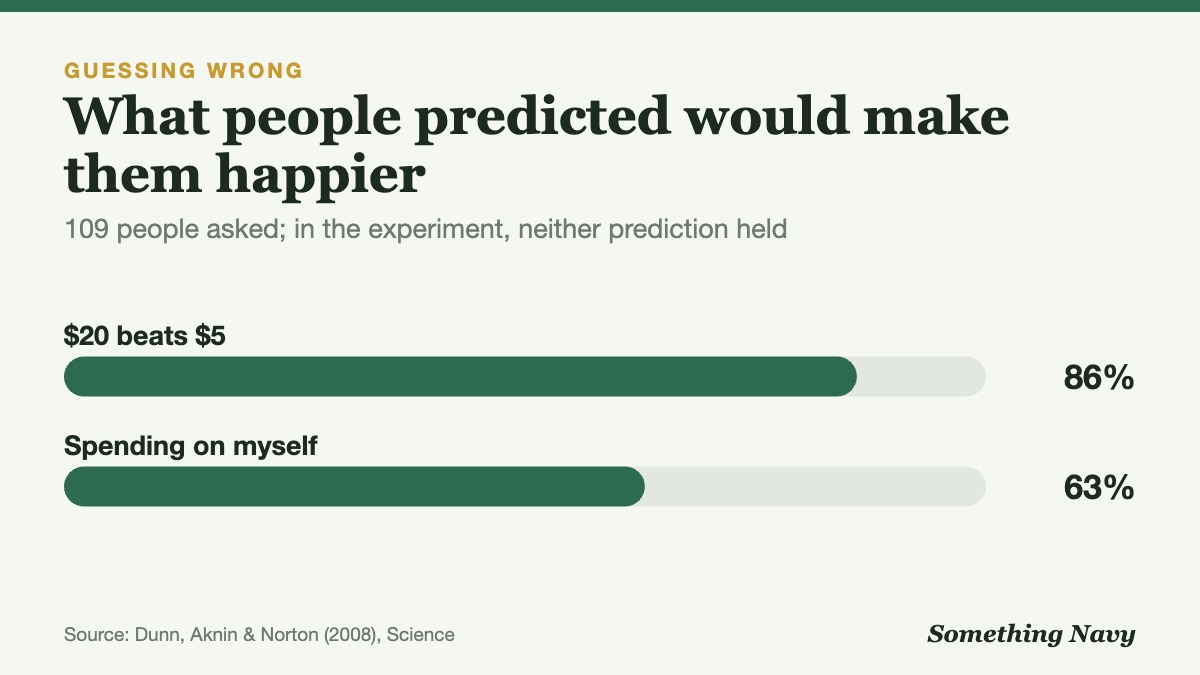
Finally, they ran an experiment. Forty-six people were handed either $5 or $20 in the morning and told to spend it by the evening, either on themselves or on someone else. By the end of the day, those who spent it on others were happier. The amount made no difference.
The twist came when the team asked a separate group of 109 people to predict the outcome. Most got it wrong: 63% expected spending on themselves to make them happier, and 86% expected the $20 to beat the $5.
That 2008 experiment was small, and the research team later put it to a much tougher test. In a registered replication published in 2020 in the Journal of Personality and Social Psychology, Aknin, Dunn and colleagues ran three large studies with 712, 1,950 and 5,199 participants.
The results were mixed. Students who were randomly assigned to buy something for a stranger in need felt happier than those who bought for themselves. A version in which adults simply recalled past spending found no effect at first, and only a small one when the task was made more engaging. The authors concluded that giving does promote happiness, but that how big the effect looks depends on how you test it.
That is the honest version: a real but modest effect, not a magic trick.
The purchase almost nobody thinks to make
Nearly a decade later, Dunn and Norton teamed up with Ashley Whillans, Paul Smeets and René Bekkers to test another idea: that you can use money to buy back time.
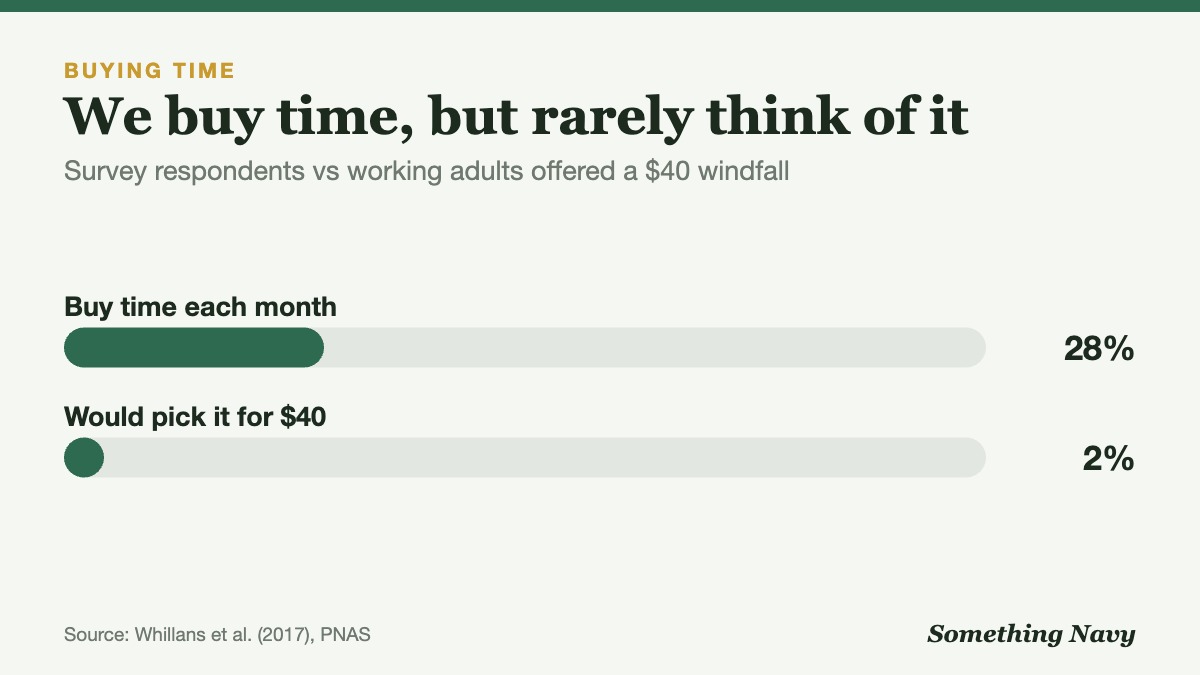
In their 2017 PNAS paper, they surveyed 6,271 people across the United States, Canada, Denmark and the Netherlands, including 818 Dutch millionaires. Across the first six surveys, about 28% of people spent money each month to buy time. Those who spent money to get out of tasks they disliked, such as cleaning, cooking or errands, reported greater life satisfaction.
They then ran a field experiment with 60 working adults in Vancouver. On one weekend, participants received $40 to spend on a material purchase. On another, they received $40 to spend on something that saved them time. After the time-saving purchase, people reported more positive feelings at the end of the day and less time stress.
And yet, when another 98 working adults were asked how they would spend a $40 windfall, only 2% spontaneously mentioned anything that would save them time.
The authors argued that rising wealth has brought a sense of time scarcity with it, and that paying to reduce that pressure acts as a buffer. Killingsworth’s data hint at something similar: higher earners in his study worked longer hours and felt more pressed for time, even as they felt more in control.
The pattern across all of these studies is surprisingly consistent. Money seems to help most when it buys you more control, more connection or more breathing room.
Spending it well, starting this week
None of this needs a pay rise. The experiments used $5, $20 and $40, which is to say, the kind of money most of us spend without thinking on a weekday lunch.
Try this
- Outsource one thing you dread. A cleaner for one afternoon, a grocery delivery, someone else ironing the shirts. Choose the task you resent most, not the one you mind least.
- Spend a small amount on someone else, on purpose. A coffee for a colleague, a book for a friend, a donation you can picture landing somewhere. The 2008 experiment found the $5 worked as well as the $20.
- Buy time with people, not just for yourself. Consider spending an hour freed from chores with someone you like. Friendships are built on hours together (see how many hours it takes to make a friend).
- Notice the control, not the cash. If extra income mostly helps by making you feel more in charge of your days, ask what you could take control of now, even without it.
- Watch the scoreboard thinking. People who treated money as a measure of success were less happy on average. Earn it, use it, but do not let it keep score for you.
One small caution: the gain from these choices is likely to be gentle rather than dramatic. That is still worth having. A bit less time pressure on a Sunday, a bit more warmth in a Wednesday, adds up over a year in a way a single splurge rarely does, partly because of how we remember experiences by their best moments and endings.
What the dinner-party version gets wrong
The $75,000 line lasted so long because it offered a simple moral: enough is enough. The newer picture is less tidy, and kinder.
For most people, more money is linked with better days, on average and modestly. For people who are struggling, it eases the hardest knocks. For the unhappiest, the real work lies elsewhere. And for all of us, the way we spend it may matter nearly as much as the amount.
The best thing the research offers is not a salary target. It is permission to spend a little differently this week: on an hour back, or on someone else, and to notice how it feels.
Frequently asked questions
Not for most people. The 2023 reanalysis found a plateau at around $100,000 a year (US household income) only for the least happy 15 to 20% of people; for everyone else, happiness kept rising.
There is no reliable one. The studies used US household income in US dollars and did not measure British earners, so a straight currency conversion would not tell you anything meaningful about life in the UK.
Probably, but modestly. Large replication studies in 2020 found that spending on others did lift happiness, though the size of the effect depended on how the study was run.
Not according to Whillans and colleagues. People who paid to avoid disliked chores reported greater life satisfaction, and in their experiment a time-saving purchase left people in a better mood than a material one.
Sources
- Kahneman, D., & Deaton, A. (2010). High income improves evaluation of life but not emotional well-being. Proceedings of the National Academy of Sciences, 107(38), 16489–16493. DOI
- Killingsworth, M. A. (2021). Experienced well-being rises with income, even above $75,000 per year. Proceedings of the National Academy of Sciences, 118(4), e2016976118. DOI
- Killingsworth, M. A., Kahneman, D., & Mellers, B. (2023). Income and emotional well-being: A conflict resolved. Proceedings of the National Academy of Sciences, 120(10), e2208661120. DOI
- Dunn, E. W., Aknin, L. B., & Norton, M. I. (2008). Spending money on others promotes happiness. Science, 319(5870), 1687–1688. DOI
- Aknin, L. B., Dunn, E. W., Proulx, J., Lok, I., & Norton, M. I. (2020). Does spending money on others promote happiness?: A registered replication report. Journal of Personality and Social Psychology, 119(2), e15–e26. DOI
- Whillans, A. V., Dunn, E. W., Smeets, P., Bekkers, R., & Norton, M. I. (2017). Buying time promotes happiness. Proceedings of the National Academy of Sciences, 114(32), 8523–8527. DOI
- University of Pennsylvania / ScienceDaily. (2023, March 7). Does more money correlate with greater happiness? Link
Cover photo: Vitaly Gariev on Unsplash. Charts and graphics: Something Navy.
How we reported this. We went back to the original research for this story, 7 sources in all, listed above, and checked every figure against them. If you think we have got something wrong, tell us and we will look at it. Read more about how we work.