
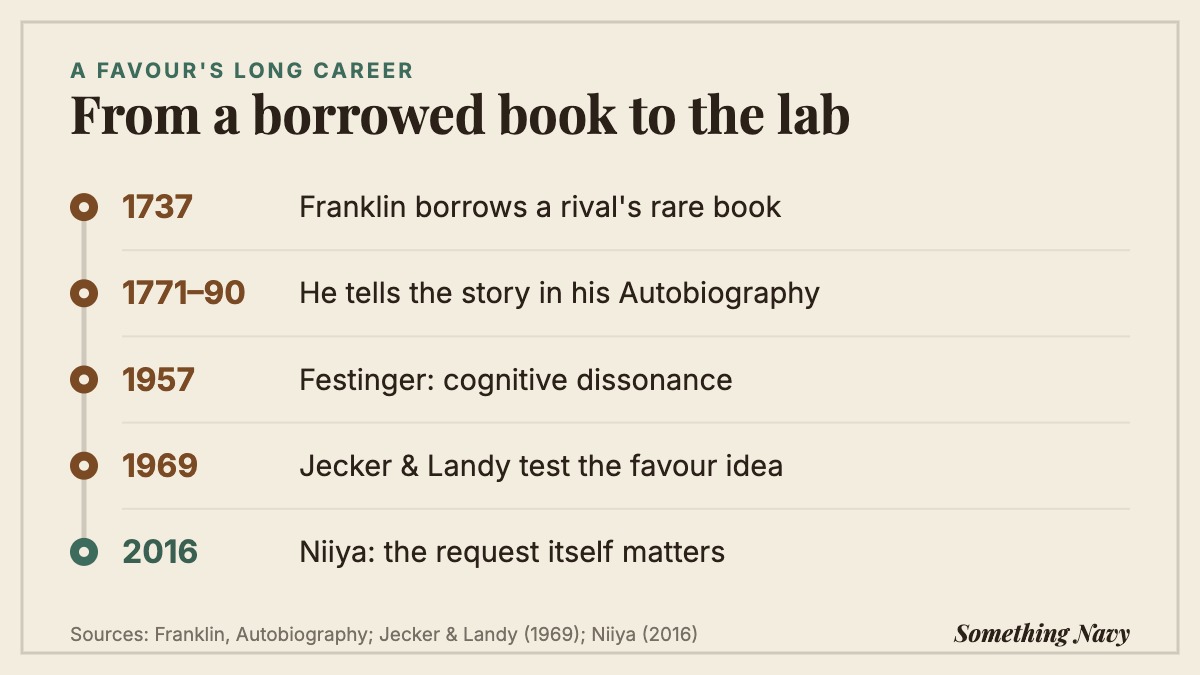
Philadelphia, 1737. Benjamin Franklin is 31, a printer with a newspaper, a growing reputation and a useful public job: clerk of the General Assembly of Pennsylvania. The House had chosen him the year before without a single objection. Now, as the members vote on whether to keep him, a newcomer stands up and makes a long speech against him, backing another candidate.
Franklin keeps the job anyway. But the speech worries him. The man is, as Franklin later put it, “a gentleman of fortune and education”, with the kind of talents likely to give him “great influence in the House”. An enemy like that could cost Franklin more than a clerk’s salary.
What he did next has become one of the most quoted episodes in his memoirs, and one of the oddest pieces of advice in popular psychology.
A rare book and a polite note
Franklin did not flatter the man. He wrote that he had no intention of gaining his favour by “paying any servile respect to him”. Instead, having heard that the new member owned a “very scarce and curious book”, he sent a note saying he would like to read it, and asking whether he might borrow it for a few days.
The book arrived straight away. Franklin returned it in about a week, with a second note expressing strongly his sense of the favour.
The next time they met in the House, the man spoke to him, “which he had never done before”, and with great civility. According to Franklin, he “ever after manifested a readiness to serve me on all occasions”. The two became great friends, and the friendship lasted until the other man’s death.
Franklin never named him. He recorded the story decades later in his Autobiography, which he wrote in stages between 1771 and 1790 and never finished. So we have one man’s recollection, polished by time and by a writer who liked a tidy moral.
And the moral he drew was this:
He that has once done you a kindness will be more ready to do you another, than he whom you yourself have obliged.
Benjamin Franklin, Autobiography
It runs against common sense. We usually assume that liking flows towards people who help us. Franklin was claiming the reverse: that it flows towards the people we help.
Why a clerk needed friends
It helps to know what was at stake. Franklin was candid that the clerkship mattered less for its pay than for what it brought with it. Being close to the members kept him in line for the Assembly’s printing work: in his words, “the votes, laws, paper money, and other occasional jobs for the public”, which on the whole were very profitable.
A wealthy, articulate opponent could have steered that business elsewhere. Seen this way, the borrowed book was not a charming quirk. It was a cheap, low-risk move by a sharp operator who needed a rival to stop being one.
It also worked partly because it was so small. Lending a book costs almost nothing, flatters the lender’s taste and asks for no public climbdown. The rival could be generous without admitting he had been wrong.
The theory that made sense of it
For more than two centuries Franklin’s story stayed a story. What turned it into a testable idea was a theory published in 1957 by the American psychologist Leon Festinger: cognitive dissonance.
Festinger’s claim, set out in his book A Theory of Cognitive Dissonance, was that holding two clashing thoughts is uncomfortable, and that people tend to ease the discomfort by adjusting one of them. Often the thing that gets adjusted is an attitude, because behaviour, once done, cannot be undone.
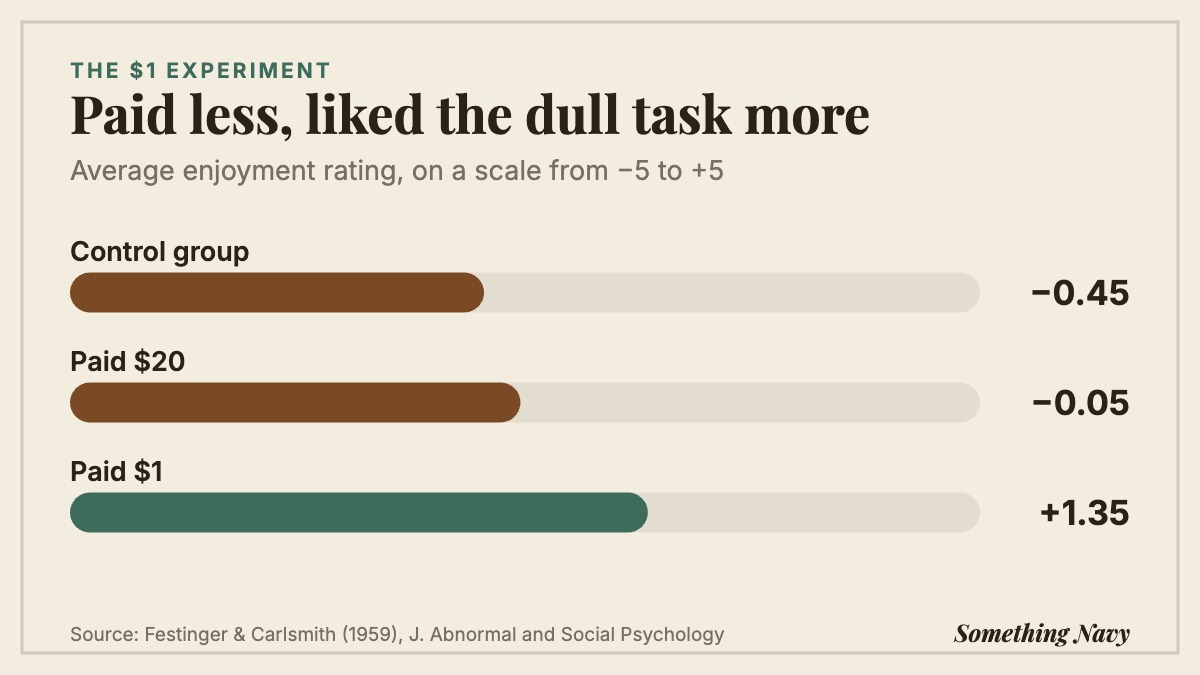
The best-known demonstration came two years later. Festinger and James Carlsmith at Stanford recruited 71 male students and had them spend an hour on deliberately tedious tasks, such as turning pegs on a board a quarter turn at a time. Some were then paid to tell a waiting student (actually part of the study) that the tasks had been enjoyable. Some got $1 for the lie, some got $20, and a control group told no lie at all. After 11 were excluded, 60 were analysed, 20 in each group.
Asked afterwards how enjoyable the tasks had really been, on a scale from −5 to +5, the $1 group gave an average of +1.35. The $20 group gave −0.05, barely above the control group’s −0.45.
The explanation Festinger and Carlsmith offered was that $20 was a good enough reason to fib. One dollar was not. The underpaid students, left without a satisfying excuse, seem to have quietly decided the task was not so bad after all.
Apply that logic to Franklin’s rival. He had just done a kindness for a man he disliked. “I dislike Franklin” and “I went out of my way for Franklin” sit awkwardly together. The deed was done, so the dislike had to soften. Perhaps Franklin was not so bad after all.
Jecker and Landy put it to the test
In 1969 two psychologists, Jon Jecker and David Landy, published a short paper in the journal Human Relations with a title that could have come from Franklin himself: Liking a Person as a Function of Doing Him a Favour.
Their set-up was simple. Students took part in a question-and-answer contest run by a researcher, in which they could win money. Afterwards the winners were split three ways.
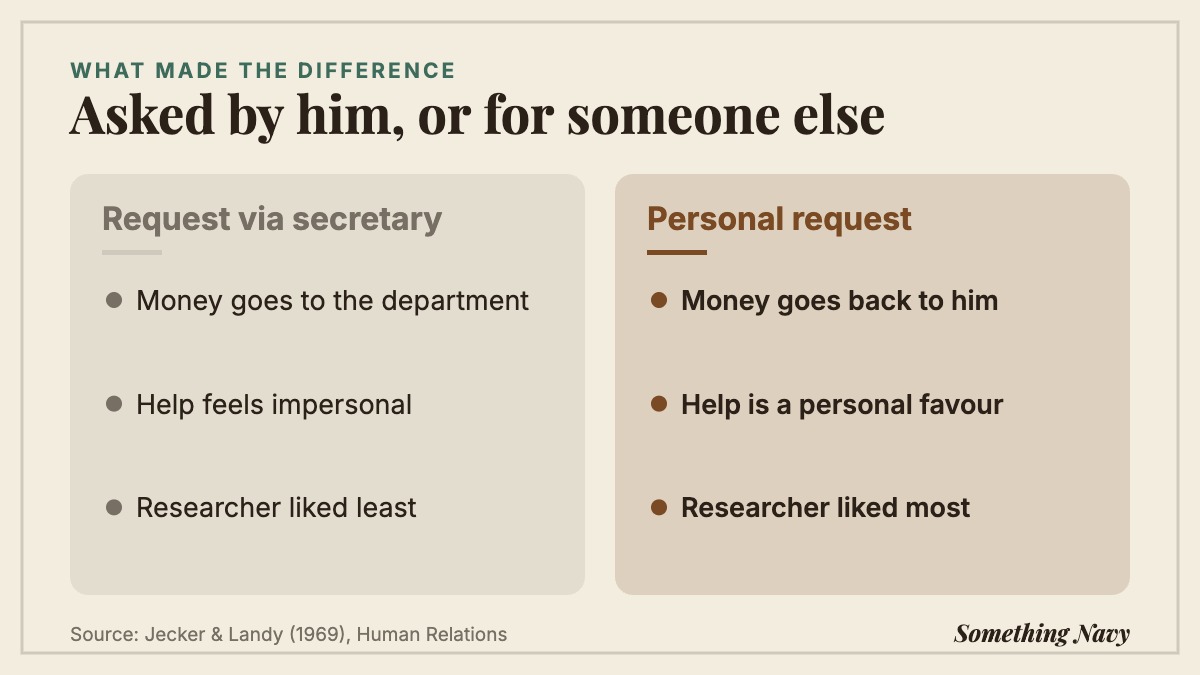
- One group was approached by the researcher himself, who said he had paid the prizes out of his own pocket, was running short and would be grateful to have the money back.
- A second group was approached by a secretary, who said the money had come from the psychology department, whose funds were low.
- A third group was not asked for anything.
Everyone then rated how much they liked the researcher. Those who had done him a personal favour liked him most. Those who had returned the money to the department, at the secretary’s request, liked him least, with the untouched group in between.
That pattern matters. Handing money back was not, on its own, what raised liking. The favour had to be for him, at his request. Giving the same money to an impersonal department, if anything, cooled feelings towards him.


Kindness and cruelty both shape the heart
Two years later, John Schopler and John Compere approached the question from the opposite side. Volunteers acted as “teachers” to two learners who were in fact working with the researchers. Each teacher treated one learner kindly, encouraging correct answers, and the other harshly, with insults and criticism for mistakes.
When the teachers later rated the learners, they found those they had been harsh to less likeable than those they had been kind to. The treatment came first; the feeling seemed to follow.
This is the darker relative of the Franklin effect, and it fits the same dissonance logic. If you have been cruel to someone, it is more comfortable to believe they deserved it.
Asking matters more than helping
For a long time, that was most of the evidence. Then, in 2016, Yu Niiya of Hosei University in Tokyo returned to the question with a sharper focus, in a study in The Journal of Social Psychology titled “Does a favor request increase liking toward the requester?”
Niiya tested Japanese and American participants. Those whom a confederate (someone working for the researcher) directly asked for help came to like that person more than they had at the start. They also saw the confederate as more sociable and felt closer to them.
The crucial comparison came from participants who did the same helpful thing without being asked by the confederate. Their liking did not rise.
That is awkward for a pure dissonance account, which should care only about what you did, not about who prompted it. Niiya drew instead on amae, a concept from the Japanese psychiatrist Takeo Doi, which describes the comfortable dependence people show towards those they feel close to. On this reading, a favour request works because it is a social signal. Asking someone for help tells them you trust them and would like to be closer, and people tend to answer that overture in kind.
Read this way, Franklin’s note was doing two jobs at once. It complimented his rival’s library and, more quietly, offered a truce.
Two explanations, one awkward truth
So which is it, dissonance or relationship signalling? Probably some of each, and there is a third contender. In 1967 Daryl Bem proposed self-perception theory: that we often infer our attitudes by watching our own behaviour, as an outside observer might. Seen through that lens, the rival needed no inner discomfort at all. He simply noticed himself lending Franklin a treasured book and concluded he must think well of him.
The honest answer is that the evidence is thin enough that nobody can confidently pick a winner. The classic studies are small, half a century old and run mainly with university students. Jecker and Landy’s paper is cited far more often than it has been repeated. We could not find a large, modern, pre-registered replication of the Franklin effect itself. Niiya’s study supports the core idea but, by design, says more about requests than about favours.
That should temper the confident tone of many online articles, which present the effect as a reliable “hack”. It is better described as a plausible, modestly supported tendency.
We think people will say no
If the effect is real, why don’t more people use it? One reason is that most of us hate asking. We assume the answer will be no, and that the asking will cost us.
In 2008 Francis Flynn of Stanford Graduate School of Business and Vanessa Lake of Columbia University measured how wrong that assumption is. Participants predicted how many strangers they would need to approach to get a certain number of people to agree to a request, such as filling in a questionnaire or lending a phone. Then they went out and asked.
They overestimated the number of people they would need to approach by about 50%. People who might help, it turned out, find saying no to a direct request harder than askers imagine.
It is a cousin of the spotlight effect: we picture our awkward request looming large in the other person’s mind, when to them it is often a small and slightly flattering moment.
Where the trick breaks down
Franklin’s story has limits that its fans tend to skip.
First, scale. A rare book for a week is a small ask. Nothing in the research suggests that piling on demands keeps the warmth growing. A request that feels like an imposition, or one in a long series, may simply breed resentment.
Second, sincerity. Niiya’s explanation rests on the request reading as a genuine bid for connection. If it feels like a tactic, the signal flips. People are quick to spot ingratiation, and a favour asked purely to be liked risks looking exactly like that.
Third, routing. In Jecker and Landy’s study, the indirect request through a secretary did nothing for the researcher and may have cost him. Asking a colleague to ask your rival on your behalf is not the same move.
Fourth, power and context. A senior manager asking a junior colleague for “a quick favour” on a Sunday is not offering a truce. Requests that the other person cannot comfortably refuse are pressure, not trust.
Asking well
- Make it small and specific. Franklin asked to borrow one book for a few days, not for open-ended help.
- Ask for something they are proud of. Their expertise, recommendation or opinion lets them be generous without losing face.
- Ask directly. In the experiments, requests passed through someone else did not raise liking.
- Close the loop. Return what you borrowed promptly and say thank you in a way that is specific and sincere.
- Make “no” easy. If they cannot comfortably refuse, it is not a favour.
A favour is an invitation
Most advice about winning people over is about giving: compliments, help, small gifts. Franklin’s instinct was that being on the receiving end could do more. Letting someone help you hands them a role in your life, and a story about themselves as the kind of person who helps.
This is also how many friendships start. Research on how long it takes to make a friend points to time spent together, and small requests (a lift, a recommendation, a hand with a move) are often the excuse for that time.
Franklin, characteristically, framed the lesson in terms of profit: it pays better to remove an enmity than to resent and return it. Strip away the commercial gloss, and what he did was offer a man who disliked him a chance to be generous, and let him take it.
The book went back after a week. The friendship lasted the rest of the man’s life.
Sources
- Franklin, B. (2006). Autobiography of Benjamin Franklin (F. W. Pine, Ed.). Project Gutenberg. (Original work written 1771–1790) Link
- Festinger, L., & Carlsmith, J. M. (1959). Cognitive consequences of forced compliance. Journal of Abnormal and Social Psychology, 58(2), 203–210. DOI
- Jecker, J., & Landy, D. (1969). Liking a person as a function of doing him a favour. Human Relations, 22(4), 371–378. DOI
- Schopler, J., & Compere, J. S. (1971). Effects of being kind or harsh to another on liking. Journal of Personality and Social Psychology, 20(2), 155–159. DOI
- Flynn, F. J., & Lake, V. K. B. (2008). “If you need help, just ask”: Underestimating compliance with direct requests for help. Journal of Personality and Social Psychology, 95(1), 128–143. DOI
- Niiya, Y. (2016). Does a favor request increase liking toward the requester? The Journal of Social Psychology, 156(2), 211–221. DOI
How we reported this. We went back to the original research for this story, 6 sources in all, listed above, and checked every figure against them. If you think we have got something wrong, tell us and we will look at it. Read more about how we work.
Cover photo: Fa Barboza on Unsplash. Charts and graphics: Something Navy.