

It is gone eleven and the night bus is half empty. You have the seat at the back, forehead near the cold window, one earbud in, the city sliding past in smears of orange. The song has been ticking along quietly for a couple of minutes, the kind you put on without thinking.
Then it opens up. The drums come in, a second voice climbs over the first, and the whole thing lifts like a wave about to break. Before you have decided to feel anything, the skin on your forearms tightens. The fine hairs stand up. A cold, pleasant shiver runs from the back of your neck down between your shoulder blades.
You glance round, faintly embarrassed, as if someone might have noticed. Nobody has. The man two rows ahead is asleep against his rucksack. The song moves on and the feeling drains away almost as quickly as it came.
Scientists call that moment a musical chill, or frisson. It lasts a few seconds, it cannot be summoned on demand, and some people say they have never felt it at all. For a quarter of a century it has also been one of the most useful tools researchers have for watching pleasure happen inside a living brain.
What music chills are, and why scientists take them seriously
A chill is a body response. Goosebumps, a shiver, a tingling that spreads across the scalp or back. It arrives at a particular moment in a particular piece, and unlike most shivers it is pleasant.
For researchers, that makes chills a gift. Pleasure is hard to measure, but a chill has a start and an end. People can press a button when it happens, and their bodies leave a trace in heart rate, breathing and skin conductance, the tiny electrical shifts in sweaty skin.
That pairing of report and signal is why chills keep turning up in brain-imaging studies. When Rémi de Fleurian and Marcus Pearce of Queen Mary University of London published a large systematic review of the field in Psychological Bulletin in 2021, they noted that the literature had doubled in size since the previous review. Their review covered 167 research reports published between 1980 and 2020.
How common are chills from music?
Here the honest answer is that estimates vary, and depend heavily on who is asked and how. Mitchell Colver of Utah State University, writing for The Conversation in 2016, summed up the published figures as ranging from 55 to 86 per cent of the population.
That band is wide for good reasons. Some studies recruit people who answered an advert for chill-prone listeners. Some ask “have you ever?” while others ask “how often?” Volunteers for a study about music are rarely a random slice of the public.
What the range does suggest is that frisson is common but far from universal, and that turns out to matter.
Inside the brain during a chill: the 2001 PNAS study
The landmark early study of the brain during musical chills came from Anne Blood and Robert Zatorre at the Montreal Neurological Institute, McGill University. It was published in the Proceedings of the National Academy of Sciences in September 2001.
Instead of playing everyone the same piece, they asked participants to bring music that reliably gave them chills, since the passage that floors one listener leaves another cold. People listened in a PET scanner, which tracks blood flow as a rough proxy for brain activity. Their chills came with changes in heart rate, muscle activity and breathing, so this was more than polite self-report.
The key result was about intensity. As chills grew stronger, blood flow changed in a set of regions involved in reward, emotion and arousal: the ventral striatum, the midbrain, the amygdala, the orbitofrontal cortex and the ventromedial prefrontal cortex.
The same circuitry responds to food, sex and drugs of abuse. Music, a pattern of air pressure with no obvious survival value, seemed to be plugged into the system the brain uses for things that keep us alive.

Dopamine, anticipation and the peak: Salimpoor’s 2011 study
Blood flow tells you a region is busy, not which chemical is doing the work. Valorie Salimpoor and colleagues in Zatorre’s group at McGill went after that question in a 2011 study in Nature Neuroscience. It was hard to assemble: 217 people responded to adverts seeking listeners who get chills from music. After five rounds of screening, ten were chosen, five women and five men aged 19 to 24. Two of the PET datasets had to be discarded, leaving eight people for the dopamine analysis.
Everyone chose their own highly pleasurable music. The control tracks were pieces picked by other participants that this listener rated as neutral, so the comparison was not dull music, just music that did not move them. Chills were checked against heart rate, breathing, skin conductance, blood volume pulse and skin temperature. In the PET sessions, people averaged 3.7 chills per pleasurable excerpt.
Two moments, two regions
The study used two kinds of scan. PET with a tracer called raclopride, which competes with dopamine for the same receptors, showed that the brain released its own dopamine in the striatum during peak emotional arousal. The change was greatest in the right caudate and the right nucleus accumbens.
Functional MRI, which is better at tracking timing, supplied the elegant part. In the 15 seconds before a chill, activity rose in the caudate. At the chill itself, the nucleus accumbens took over.
In other words, the brain was not only rewarding the climax. It was rewarding the build towards it. The caudate seemed to track anticipation, the sense that something good is on its way, while the nucleus accumbens responded to the payoff. The paper’s abstract notes that an abstract stimulus like music “can arouse feelings of euphoria and craving”, and craving is precisely what that pre-chill window looks like.
The shiver is the receipt. The real transaction happened in the fifteen seconds before it, while your brain was betting on what came next.
Eight people is a small study. But it offered direct evidence that dopamine, the chemical tied to food and drug reward, is released when music moves us.


Opioids enter the picture: new research from 2024 and 2025
Dopamine is often described as a “wanting” chemical, tied to motivation and anticipation. The brain’s own opioids are more closely linked to “liking”, the warm sense of pleasure itself.
In April 2025 a team at the Turku PET Centre in Finland, led by Vesa Putkinen and Lauri Nummenmaa, published a combined PET and MRI study in the European Journal of Nuclear Medicine and Molecular Imaging. Fifteen women listened to music they found intensely pleasurable while being scanned with a tracer that binds to mu-opioid receptors. Favourite music changed opioid activity in pleasure-related areas including the ventral striatum and orbitofrontal cortex. The women who reported more chills showed greater opioid release in the nucleus accumbens.
Putkinen said when the study was published that the results show music directly “activates the brain’s opioid system.” The caveats are real: fifteen people, all women, and PET imaging is complex and expensive, which keeps samples small. Still, it suggests the chill sits on top of two overlapping chemical systems, one for anticipation and one for enjoyment.
A second recent study looked at what the brain is doing before the music even starts. Kazuma Mori and Robert Zatorre, writing in PLOS Biology in August 2024, scanned 49 people during a short silence just before listening. Using a predictive model, they found that connections between the right auditory cortex and the striatum and orbitofrontal cortex in that quiet moment predicted how long people’s chills lasted, along with activity in the nucleus accumbens and insula. The model held up on a separate dataset with different music, but only when it used this pre-listening state rather than people’s stable, resting wiring. Your readiness to be moved shifts from moment to moment.
Why some people never get chills: brain wiring and the 2016 connectivity study
If a sizeable minority of people rarely feel frisson, is their brain built differently? Matthew Sachs, then at Harvard, and Psyche Loui of Wesleyan University, working with Robert Ellis and Gottfried Schlaug at Beth Israel Deaconess Medical Center and Harvard Medical School, set out to test exactly that.
Their study, published in Social Cognitive and Affective Neuroscience in 2016, began with an online survey completed by 237 people in the Boston area. From those answers they picked two extreme groups: ten people who often felt chills and ten who said they rarely did. Five people first placed in the chill group were dropped because they felt no chills in the lab.
Using diffusion tensor imaging, which traces the white-matter fibres that carry signals between regions, the team found that the chill group had greater volume in tracts linking the posterior superior temporal gyrus, part of the auditory cortex, with the anterior insula and the medial prefrontal cortex. The insula helps sense the body’s internal state; the medial prefrontal cortex helps evaluate emotion. The difference was present in both hemispheres and stronger on the right, where the median tract volume in the chill group was roughly double: 1,141.5 voxels against 541.5. In the left hemisphere the figures were 2,334 against 1,286.5. In other words, people who did not get chills had the same pathways, just smaller in volume.
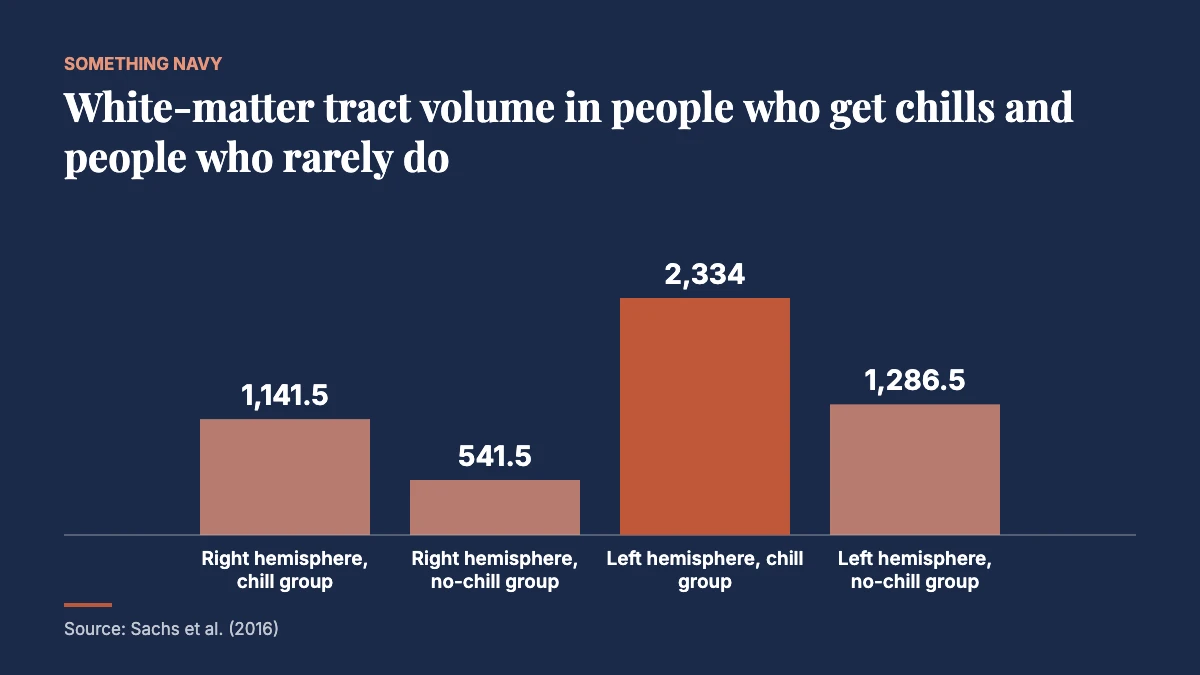
Loui described the link in social terms. “It’s an auditory channel toward socially and emotionally relating to other people,” she told her university’s newsletter.
What this does and does not show
It is tempting to read this as “chill-getters have special brains”. Twenty people is a very small sample, so the links between tract size and chill scores should be treated as preliminary. The study is correlational: it cannot say whether stronger connections cause chills, whether years of being moved by music strengthen the connections, or whether something else drives both. The groups were matched for musical training, gender and personality, which removes some obvious confounds.
| Study | What they did | Sample | Headline finding |
|---|---|---|---|
| Sloboda (1991) | Questionnaire on physical reactions to music | 83 listeners | Shivers most often linked to new or unexpected harmonies |
| Blood & Zatorre (2001) | PET scans during self-chosen chill music | Lab volunteers | Chill intensity tracked blood flow in reward and emotion regions |
| Salimpoor et al. (2011) | PET and fMRI with dopamine tracer | 8 in PET analysis | Dopamine in caudate before chills, nucleus accumbens at the peak |
| Sachs et al. (2016) | White-matter imaging of chill vs no-chill groups | 20 (from 237 surveyed) | Greater volume in auditory-to-insula and prefrontal tracts in chill group |
| Colver & El-Alayli (2016) | Personality test plus skin response and button presses | 97 students | Openness to experience, especially the Fantasy facet, predicted chills |
| Mori & Zatorre (2024) | fMRI of brain state just before listening | 49 | Auditory-reward connectivity predicted chill duration |
| Putkinen et al. (2025) | PET with opioid tracer plus fMRI | 15 women | More chills went with more opioid release in nucleus accumbens |
Personality: openness to experience and frisson
Brain scans are expensive. Personality questionnaires are not, and they point in a consistent direction. In their 2021 corpus paper, de Fleurian and Pearce described openness to experience as strongly linked to chills, drawing on their review of the field. Openness, one of the five broad personality traits, covers curiosity, imagination and a taste for art and new ideas.
Colver, then at Utah State University, and Amani El-Alayli of Eastern Washington University tested this directly. Their study, published in Psychology of Music in 2016, recruited 113 college students, of whom 97 made it into the final analysis. Participants filled in a personality test, then listened to five pieces chosen because they were likely to trigger frisson, while a sensor recorded their skin response and they pressed a button whenever they felt a chill.
The pieces ranged widely: the opening of Bach’s St John Passion, the second movement of Chopin’s first piano concerto, an Air Supply track, part of Vangelis’s Mythodea and Hans Zimmer’s “Oogway Ascends”. In the Bach, according to Colver, the orchestra builds tension for the first 80 seconds before the choir enters.
People higher in openness reported chills more often. More surprising was which part of openness carried the effect. When the researchers broke the trait into facets, only Fantasy, roughly a receptiveness to one’s own inner imagination, made a unique contribution. The authors read this as a sign that frisson may depend on paying close cognitive attention to the music, rather than on emotional sensitivity alone.
That fits the brain work: if the caudate is busy predicting the next moment, imaginative listeners may give it more to work with. It is an appealing link, but an inference across separate studies, not a tested result.
What the research suggests if you want more chills
- Choose your own music. Most of the brain-imaging studies here used tracks participants picked themselves.
- Listen to the build, not just the drop. In Salimpoor’s scans, caudate activity rose in the 15 seconds before the chill.
- Give it your attention. In Colver and El-Alayli’s study, the imagination-linked Fantasy facet of openness was the one that stood out.
- Do not panic if nothing happens. Published estimates suggest a substantial minority of people rarely or never get chills, and that is a normal variation.
The musical moments that trigger chills
So what is happening in the music itself? John Sloboda of Keele University offered the classic starting point in a 1991 study in Psychology of Music. He asked 83 listeners to identify specific passages that produced physical reactions such as shivers, tears, laughter or a lump in the throat. More than 80 per cent reported each of those reactions. When Sloboda examined the passages, patterns emerged. Tears were most reliably linked to sequences and appoggiaturas, those leaning notes that clash briefly before resolving. Shivers were most reliably linked to new or unexpected harmonies.
Sloboda concluded that his findings broadly supported theories in which emotion arises from expectations being confirmed or violated. The music sets up a pattern, you predict what comes next, and the chill arrives when that prediction is broken in a satisfying way.
Later work filled in the list. In a 2021 paper in i-Perception, de Fleurian and Pearce summarised the features earlier studies had tied to chills: sudden changes in loudness, an increase in roughness of the sound, crescendos and the entrance of a new instrument. They pointed out that these are all local events, short and sharp, which matches the fleeting nature of the chill itself.
Are chill songs sad songs?
Earlier studies disagreed on whether chills come more with cheerful or sad music. De Fleurian and Pearce took a big-data approach. They started with 988 mentions of chill-inducing music in the research literature and, after removing duplicates and tracks missing from Spotify, compared 722 of them with control tracks matched on artist, length and popularity, using Spotify’s audio features. The chill tracks came out slightly sadder in valence, and in exploratory analyses they were also slower, less intense and more instrumental.
The difference in sadness was small, just 0.033 on a scale from zero to one, so this is a nudge rather than a rule. The authors suggested that sad music may simply set up an emotional context in which chills are easier to trigger.
Familiarity plays its part too. Most of the brain-scanning studies in this piece relied on music people had chosen because they already loved it, which echoes the mere exposure effect, our tendency to warm to what we have met before. Knowing a piece well lets you anticipate its big moments, and anticipation, as the caudate results show, is half the pleasure.
How strong is the evidence on music chills?
Put together, the story is coherent. Chills track reward circuitry, dopamine is released with different striatal regions handling anticipation and peak, and opioids appear to join in at the moment of pleasure. Chill-prone people tend to score higher on openness and may have stronger links between hearing and emotion.
The weaknesses are just as clear. The most quoted brain studies used tiny samples: eight people for Salimpoor’s dopamine scans, twenty for the white-matter study, fifteen women for the opioid work. Nearly all of the research is correlational. Participants are usually young, often students, and often recruited specifically because they get chills, which inflates how common and how intense the experience looks. Prevalence figures depend so heavily on wording that the honest summary is “most people, but not everyone”. Researchers also mostly study pieces already known to cause chills, so we know little about how often they happen in everyday listening.
None of that undermines the core finding, which has held up across labs, methods and decades: music can engage the same reward systems as food and other basic pleasures. It does mean individual numbers should be held loosely.
Why the chill fades, and why that might be the point
Back on the night bus, the shiver passed within seconds. That brevity is not a flaw. The chill looks like the end point of a prediction game your brain has been playing for the whole song, paid out when the music finally delivers or swerves.
It may also be why the same track can lose its power after the hundredth play. Our minds get used to pleasures, a pattern familiar from research on hedonic adaptation, and a surprise you can predict perfectly is no longer much of a surprise.
And because memory leans heavily on the most intense moment of an experience, a pattern described by the peak-end rule, those few seconds of frisson may be what you remember most about a whole concert, album or journey home.
If you are one of the people who rarely feels it, nothing is broken. The evidence points to a spectrum of responses shaped by wiring, personality, attention and even the state of your brain in the moment before the music begins. If you are one of the people whose arms prickle at the right key change, you now know roughly what is happening: a reward system that has learned to treat a pattern of sound as something worth wanting.
Official links and research
- Blood, A. J., & Zatorre, R. J. (2001). Intensely pleasurable responses to music correlate with activity in brain regions implicated in reward and emotion. Proceedings of the National Academy of Sciences, 98(20), 11818-11823. DOI
- Colver, M. (2018, April 8). Here’s why some people get “skin orgasms” from listening to music. ScienceAlert (originally published in The Conversation, May 2016). https://www.sciencealert.com/why-some-people-get-skin-orgasms-chills-from-listening-to-music-science
- Colver, M. C., & El-Alayli, A. (2016). Getting aesthetic chills from music: The connection between openness to experience and frisson. Psychology of Music, 44(3), 413-427. DOI
- de Fleurian, R., & Pearce, M. T. (2021). Chills in music: A systematic review. Psychological Bulletin, 147(9), 890-920. DOI
- de Fleurian, R., & Pearce, M. T. (2021). The relationship between valence and chills in music: A corpus analysis. i-Perception, 12(4). DOI
- Mori, K., & Zatorre, R. J. (2024). State-dependent connectivity in auditory-reward networks predicts peak pleasure experiences to music. PLOS Biology, 22(8), e3002732. DOI
- Putkinen, V., Seppälä, K., Harju, H., Hirvonen, J., Karlsson, H. K., & Nummenmaa, L. (2025). Pleasurable music activates cerebral µ-opioid receptors: A combined PET-fMRI study. European Journal of Nuclear Medicine and Molecular Imaging, 52(10), 3540-3549. DOI
- Sachs, M. E., Ellis, R. J., Schlaug, G., & Loui, P. (2016). Brain connectivity reflects human aesthetic responses to music. Social Cognitive and Affective Neuroscience, 11(6), 884-891. DOI
- Salimpoor, V. N., Benovoy, M., Larcher, K., Dagher, A., & Zatorre, R. J. (2011). Anatomically distinct dopamine release during anticipation and experience of peak emotion to music. Nature Neuroscience, 14(2), 257-262. DOI
- Sloboda, J. A. (1991). Music structure and emotional response: Some empirical findings. Psychology of Music, 19(2), 110-120. DOI
Cover photo: ActionVance on Unsplash. Charts and graphics: Something Navy, with photography by Jahanzeb Ahsan on Unsplash.
How we reported this. Every figure was checked against the 10 sources above. Reviewed by Valentino Adkins, Senior Content Manager. Report an error · How we work