

It is Thursday afternoon and you are doing something slightly illicit: closing your laptop at five with the knowledge that you will not open it again until Monday. Your inbox is not empty. Nobody has told you it needs to be.
Then the nagging starts. Did you really fit five days of work into four? And is the colleague whose week still runs to Friday covering for you?
Is the four-day week a genuine fix for modern work, or a perk that only survives in tidy press releases? The evidence has piled up fast since 2022. Some is strong; some is thinner than the headlines suggest. Here is what the trials measured, as of November 2026.
In brief
- In the 2022 UK pilot, 56 of 61 companies kept the four-day week when the six months ended, and at least 54 were still running it a year later.
- A 2025 paper in Nature Human Behaviour, covering 2,896 employees in 141 organisations, found less burnout and better mental and physical health, with no similar change in 12 comparison companies.
- Iceland did not “switch to a four-day week”. Its trials cut hours to 35 or 36 a week for about 2,500 public-sector workers.
- The weakest link in most trials is who takes part: firms volunteer, and most measures are staff surveys.
- In England, the government still opposes four-day weeks in councils, and the Conservatives pledged in April 2026 to ban them on full pay.
What the four-day week trials are actually testing
The model tested in the big pilots is usually called “100-80-100”: full pay for 80% of the time, in exchange for keeping output at 100%. That is not a compressed week, where 40 hours are squeezed into four long days. Nor is it a shorter week spread across five days, which is mostly what Iceland did. When a headline says “the four-day week works”, ask which of the three it means.
The trials are not laboratory experiments either. Typically a company volunteers, spends a couple of months redesigning how work gets done, then runs the shorter week for six months while staff fill in surveys. That tells you a lot about whether people inside a willing organisation felt better, and much less about a reluctant one. Keep that in mind; it matters for almost everything that follows.


The 2022 UK pilot: 61 companies, about 2,900 staff
The trial that made the four-day week mainstream ran from June to December 2022, organised by the non-profit 4 Day Week Global with the think tank Autonomy, and evaluated by researchers including Juliet Schor and Wen Fan of Boston College, Brendan Burchell and David Frayne at the University of Cambridge, and Daiga Kamerāde at the University of Salford. Their report, published by Autonomy in February 2023, covered 61 organisations and around 2,900 employees.
What changed for staff
The wellbeing numbers were striking. By the end of the trial, 71% of employees reported lower burnout and 39% said they were less stressed. Forty per cent reported fewer sleep difficulties, against 15% who reported more. Sixty per cent found it easier to combine work with caring.
The quirkiest figure: 15% said no amount of money would get them back on a five-day schedule. But not everyone gained. Twenty-two per cent reported higher burnout at the end, a number easy to skip past. For roughly one person in five, cramming the work into fewer days seems to have made things worse.
What changed for the companies
On the business side, average sick and personal days fell from 2.0 to 0.7 per employee per month, compared with a matching period the year before. The number of staff leaving fell from 2 to 0.8 per 100 employees, a 57% drop. Revenue rose 1.4% from the start of the trial to the end, weighted by company size, and was about 35% higher than the same period a year earlier.
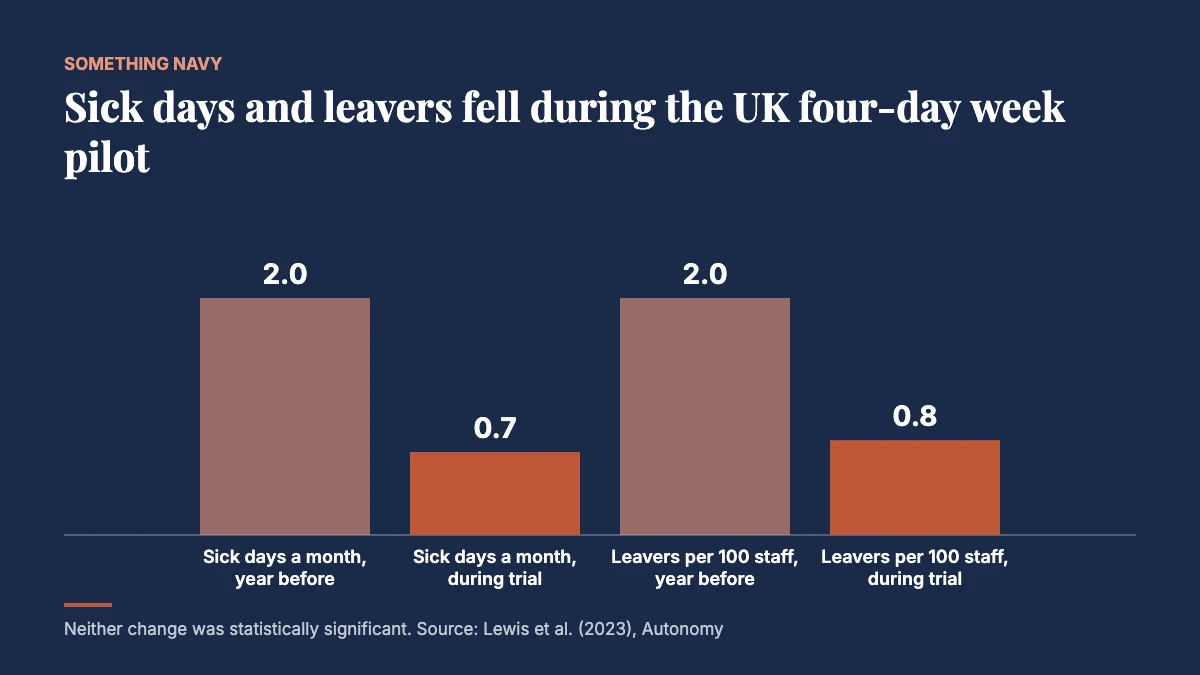
Now the small print, which the report deserves credit for printing. The sick day and resignation trends were not statistically significant, partly because only a few dozen companies supplied data. The revenue figures rest on 23 and 24 companies. Survey response slid from 77% at the start to 58% at the end, so the people still answering may have been the happiest. And there was no control group. Treat the 35% revenue jump as a curiosity: small firms grow by a third for plenty of reasons that have nothing to do with Fridays.
Did they keep it?
When the pilot ended, 56 of the 61 companies (92%) said they would carry on, and 18 called the change permanent. Of the other five, two extended their trials and three paused.
A year later, Autonomy’s follow-up report, Making It Stick, found that at least 54 of the original 61 (89%) were still running a four-day week, and at least 31 (51%) had made it permanent. Every manager and chief executive consulted called the impact positive or very positive, and half reported lower staff turnover.
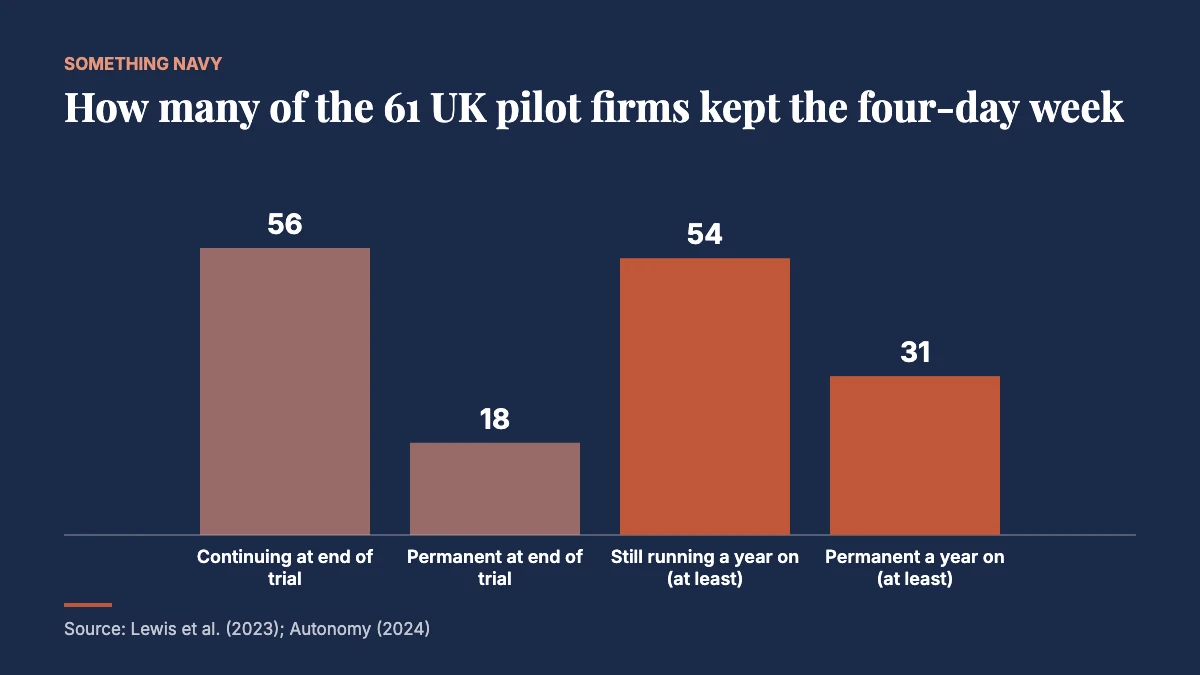
Two cautions. Only 28 organisations joined the deeper follow-up, so that “at least” is doing honest work. And interviews turned up a quieter problem: staff were uneasy where the day off felt weakly guaranteed or depended on hitting targets. Schor said the one-year results showed the benefits were “not due to novelty or short term impacts”. That is a fair reading of the surveys, though not proof the policy caused them.
The 2025 Nature Human Behaviour study: the strongest evidence so far
A 2025 paper in Nature Human Behaviour is the nearest thing to a peer-reviewed verdict. Wen Fan, Juliet Schor and Guolin Gu of Boston College, with Orla Kelly of University College Dublin, pooled data from 2,896 employees in 141 organisations across six countries that had run four-day week trials with no pay cut.
After a period of reorganising work and a six-month trial, employees reported less burnout, higher job satisfaction and better mental and physical health. The improvements appeared to run through three channels: people felt more able to do their jobs, they had fewer sleep problems and they were less fatigued.
Two things set this paper apart. First, it had a comparison group. Employees at 12 companies that did not shorten their hours were surveyed over the same period, and they showed no similar pattern. Twelve non-random firms is a modest control, but it rules out the simplest objection: that everyone just felt better that season.
Second, it looked at dose. Workers whose individual hours fell the most showed the biggest gains. The size of the cut at company level did not predict much. What seems to matter is whether your own week actually got shorter, not whether your employer announced that it had.
Even so, this remains a study of volunteers. The organisations chose to take part, and the outcomes are employees’ own reports of how they feel. Burnout is partly subjective by definition, but staff who want the trial to continue have a reason to answer generously, as the authors themselves acknowledge. Nobody has yet run a large trial in which companies are randomly assigned to a four-day week or the usual five, and until someone does, the honest phrase is “strong and consistent association”, not “proven effect”.
Iceland: the most misreported trial in the world
In 2021 a report called Going Public, by Guðmundur Haraldsson of the Icelandic research group Alda and Jack Kellam of Autonomy, set off a wave of headlines about Iceland’s “four-day week”. Much of the coverage got it wrong.
Between 2015 and 2019, Reykjavík City and the national government ran two large trials in which about 2,500 workers had their week reduced to 35 or 36 hours, with no cut in pay. That was more than 1% of the country’s working population. Productivity and service provision stayed the same or improved in most workplaces, and wellbeing improved on measures including stress, burnout and work-life balance.
Encouraging. But the trials were mostly not a four-day week, and the famous follow-up figure is not what it is often said to be.
The 86% problem
The report said that 86% of Iceland’s workforce were now working shorter hours or had gained the right to shorten them. That “or” is carrying an enormous load. It lumps together people whose hours had already fallen with people whose new labour agreements merely gave them the right to negotiate one. Plenty of articles turned it into “86% of Icelanders work a four-day week”, which the report never said.
A later report from the same groups, On Firmer Ground (October 2024), is more sober. In a 2021 to 2022 survey, 59% of workers said they had been offered reduced hours in the previous two years. The most common format was one shorter day a week, not a whole day off. Uptake was much higher in national government (71%) than in the private sector (41%).
Icelandic productivity grew an average of 1.5% a year over five years, the best in the Nordics, though the authors are careful not to claim the shorter week caused it. Yet 28% still felt too tired after work to enjoy private life.

Germany, councils and the rest of the evidence
The German pilot, with an in-company control
Germany’s 2024 pilot was run by the Berlin consultancy Intraprenör with 4 Day Week Global and evaluated by Julia Backmann’s team at the University of Münster. Of 45 organisations that started, two large companies dropped out and 41 had finished or nearly finished six months by October 2024.
Crucially, researchers surveyed control groups inside the organisations who kept their usual hours. Life satisfaction rose significantly. Employees reported less stress and fewer burnout symptoms, and slept about 38 minutes more per week than the control group. Productivity held steady or rose moderately, while turnover and profit rose slightly but were not significantly different from the year before. More than 70% of the organisations wanted to continue.
There were useful null findings too. Sick days fell, but not significantly, and the extra day off did not make anyone greener: domestic travel increased.
South Cambridgeshire: the public-sector test case
South Cambridgeshire District Council became the first English council to try the model, starting in early 2023 with a three-month trial later extended by a year. Staff do their full workload in about 80% of their contracted hours, choosing Monday to Thursday or Tuesday to Friday, so the council stays open five days.
Independent analysis by the Universities of Salford, Bradford and Cambridge found that 21 of the 24 services monitored improved or held steady; leaving aside variations linked to Covid-19, all 24 did. The number of staff leaving fell by more than 40%, and job applications rose by more than 120%. The council reported an annual saving of £399,263, mostly from filling posts permanently instead of paying for agency workers. On 17 July 2025, councillors voted to make it permanent.
The government was not persuaded. The Conservatives had told councils in 2023 to stop such trials. Under Labour, Communities Secretary Steve Reed wrote to South Cambridgeshire in October 2025 about declining performance in housing-related services, and in December 2025 told every council in England that the government would treat staff working part-time for full-time pay without compelling justification as a possible sign of failure. His letter rejected what he called “full-time pay for part-time work”. The council insists it remains exceptionally high-performing.
In April 2026 the Conservatives went further, pledging to outlaw council four-day weeks on full pay if they win the next general election. At the time of writing in November 2026, the four-day week in English councils is legal but politically exposed.
The famous Microsoft Japan figure
The claim that productivity jumped 40% when Microsoft Japan gave staff Fridays off deserves an asterisk. In August 2019, the company closed on Fridays for its roughly 2,300 employees as part of its Work Life Choice Challenge. Microsoft said sales per employee were 39.9% higher than in August 2018 and electricity use fell 23.1%. As CNBC reported, these were the company’s own figures.
There was no independent evaluation or control group, and it lasted one month. It is a fun anecdote about capping meetings at 30 minutes, not evidence.
| Trial | Who | Size | Design | Headline result | Main limitation |
|---|---|---|---|---|---|
| Iceland, 2015 to 2019 | Reykjavík City and national government | About 2,500 workers | Hours cut to 35 or 36 a week, no pay cut | Service held or improved; wellbeing up | Mostly shorter days, not a four-day week; figures often misquoted |
| UK pilot, 2022 | 61 private and third-sector organisations | About 2,900 employees | Six months, before-and-after surveys | 71% reported lower burnout; 56 firms continued | Volunteers, no control group, falling survey response |
| South Cambridgeshire, 2023 to 2025 | One district council | Council workforce | Extended trial, independent KPI review | 21 of 24 services held or improved | Single site; housing measures slipped |
| Germany, 2024 | 45 organisations | 41 finished | Six months, in-company control groups | Less stress, 38 more minutes’ sleep a week | Short, volunteer firms; productivity gains not significant |
| Nature Human Behaviour, 2025 | 141 organisations, six countries | 2,896 employees | Six months, 12 comparison firms | Less burnout, better health and job satisfaction | Not randomised; self-reported outcomes |
| Microsoft Japan, 2019 | One company | About 2,300 employees | One month of Fridays off | Sales per employee up 39.9% | Company-reported, no evaluation or control |
Where the four-day week evidence is still thin
Lay the trials side by side and a pattern appears. Every big study points the same way on wellbeing. None is a randomised controlled trial.
Self-selection
The firms in these pilots chose to be there. In the UK pilot, 70 organisations signed up and nine never started. Those that went ahead were, by definition, run by leaders open to the idea. That makes the results a good guide to what happens when an enthusiastic employer tries it, and a poor guide to a hospital trust or a warehouse being told to.
Measuring productivity is hard
In office work, output is slippery. Revenue moves with the economy, and firms’ own performance indicators vary wildly, which is partly why trials lean on wellbeing data. As our piece on the multitasking myth shows, people judge their own efficiency badly, so “managers felt productivity held up” is weaker than it sounds.
The work did not vanish
The model depends on removing waste: fewer and shorter meetings, less pointless email, fewer interruptions. Where there is no waste, the work has to go somewhere, which may be why more than one in five UK pilot employees reported higher burnout. Squeezing the same decisions into fewer hours can also sharpen decision fatigue.
Not everyone keeps it
The drop-outs tell their own story. Three UK firms paused. Two large German companies left before finishing. South Cambridgeshire, the clearest public-sector success, also saw rent collection and re-letting times slip. The research cannot yet tell you in advance whether your organisation will be a success story or one of those.
What the evidence means for you
If you are an employee hoping your company will try it, the most useful finding is the one from the 2025 paper: benefits track whether your personal hours actually fall. A four-day week on paper, with Friday spent on Slack, is just a five-day week with a guilty conscience.
A longer weekend will not fix a job that is fundamentally overloaded, and some people prefer a lighter five-day rhythm to four intense days. The Sunday scaries do not disappear just because Sunday moves; what helps is a working week that feels manageable while you are in it.
If you manage a team
- Start with the waste, not the calendar: audit meetings, recurring reports and approval chains for a month before cutting any hours.
- Decide how you will measure output before the trial starts, using numbers you already track, and keep a comparison period or team.
- Guarantee the day off. If it can be clawed back whenever targets slip, staff will treat it as a bonus, not a change.
- Cover the gaps deliberately. Customer-facing roles may need staggered days, as South Cambridgeshire did with Monday-to-Thursday and Tuesday-to-Friday rotas.
- Watch the minority it does not suit. Check burnout at the individual level, not just the team average.
- Run it for at least six months and set a review date, so the decision rests on data rather than enthusiasm.
The verdict on the four-day week in 2026
Four years after the UK pilot, the evidence has grown up. A peer-reviewed study with a comparison group now backs the campaign reports: people on a genuinely shorter week report less burnout, better sleep and better health, and most firms that try it keep it.
What we lack is proof that it works for employers who would never volunteer, or in sectors where output cannot be squeezed. And in England, the politics have hardened.
For an ordinary worker or manager, the lesson is less dramatic and more useful. The four-day week is not magic. It is a forcing device: it makes organisations find out which parts of the week were never really work. Some will find a whole day’s worth. Some will find an hour. The trials suggest it is worth finding out which you are.
Frequently asked questions
Not in the major trials. They tested 80% of the hours for 100% of the pay, with no cut in salary, which is different from compressing 40 hours into four longer days.
No. Its 2015 to 2019 trials cut hours to 35 or 36 a week for about 2,500 public-sector workers, usually through shorter days. The often-quoted 86% includes people who only gained the right to request shorter hours.
The best evidence says output generally held steady and sometimes rose a little, but most trials measured it loosely and none were randomised. The wellbeing findings are much stronger than the productivity ones.
At the end of the 2022 pilot, 56 of 61 continued. A year later at least 54 were still running it and at least 31 had made it permanent.
Councils are independent employers, so it is not banned, but the government has warned that full pay for reduced hours may be treated as a sign of failure. The Conservatives pledged in April 2026 to outlaw it if elected.
Official links and research
- Autonomy. (2024). Making it stick: The UK four-day week pilot one year on. Autonomy Institute. Link
- University of Münster. (2024, 18 October). First scientific results of the four-day week pilot in Germany [Press release]. Informationsdienst Wissenschaft. Link
- Eichler, W. (2026, 8 April). Conservatives pledge ban on council four-day work weeks. LocalGov. Link
- Fan, W., Schor, J. B., Kelly, O., & Gu, G. (2025). Work time reduction via a 4-day workweek finds improvements in workers’ well-being. Nature Human Behaviour, 9(10), 2153–2168. DOI
- Haraldsson, G. D., & Kellam, J. (2021). Going public: Iceland’s journey to a shorter working week. Alda and Autonomy. Link
- Haraldsson, G. D., Kellam, J., & Trickett, R. (2024). On firmer ground: Iceland’s ongoing experience of shorter working weeks. Alda and Autonomy. Link
- Lewis, K., Stronge, W., Kellam, J., Kikuchi, L., Schor, J., Fan, W., Kelly, O., Gu, G., Frayne, D., Burchell, B., Bridson Hubbard, N., White, J., Kamerāde, D., & Mullens, F. (2023). The results are in: The UK’s four-day week pilot. Autonomy. Link
- Local Government Lawyer. (2025, 23 December). Communities Secretary warns councils not to adopt a four-day working week. Link
- CNBC. (2019, 4 November). Microsoft Japan four-day work week experiment sees productivity jump 40% [News report]. Link
- University of Salford. (2025, 17 July). Council votes to permanently adopt four-day week following extensive independent analysis [Press release]. Link
Cover photo: LinkedIn Sales Solutions on Unsplash. Charts and graphics: Something Navy, with photography by Adolfo Félix on Unsplash.
How we reported this. Every figure was checked against the 10 sources above. Reviewed by Brooke Hilland, Senior Content Editor. Report an error · How we work