
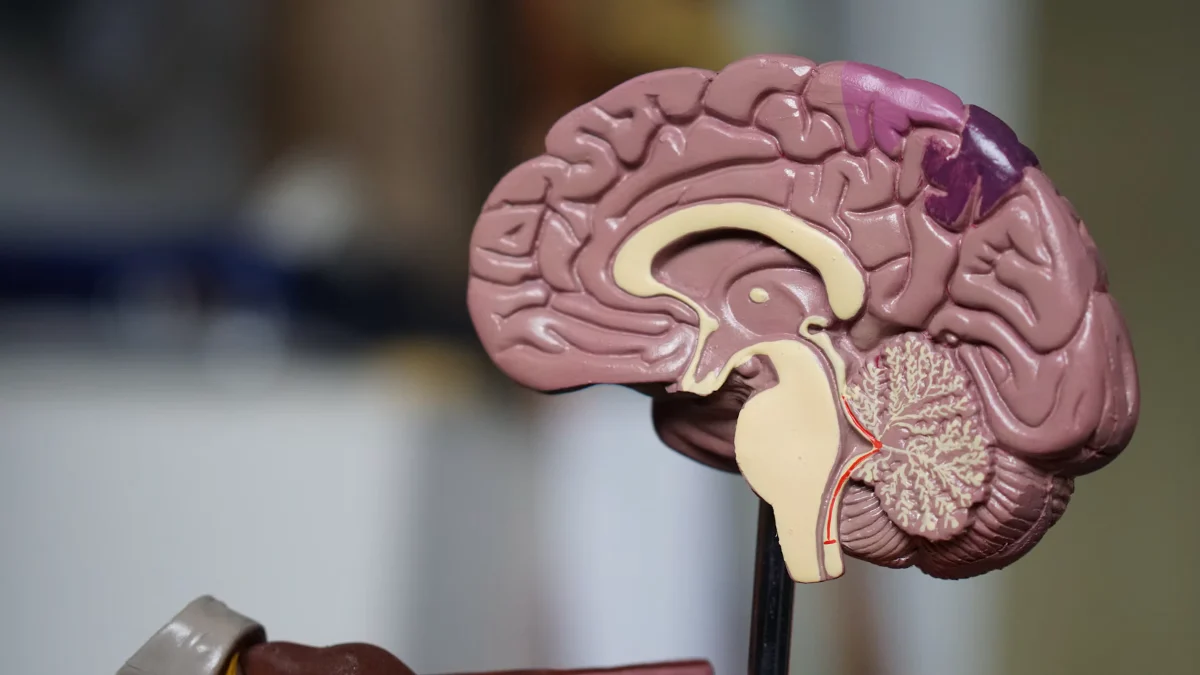
The quiz takes two minutes. Do you prefer lists or doodles? Do you trust facts or gut feelings? Then the verdict lands: you are right-brained, a creative soul, and that explains why spreadsheets make you wilt.
It feels oddly accurate. It also feels like science, because it borrows the language of neuroscience and points to a real organ split into two real halves.
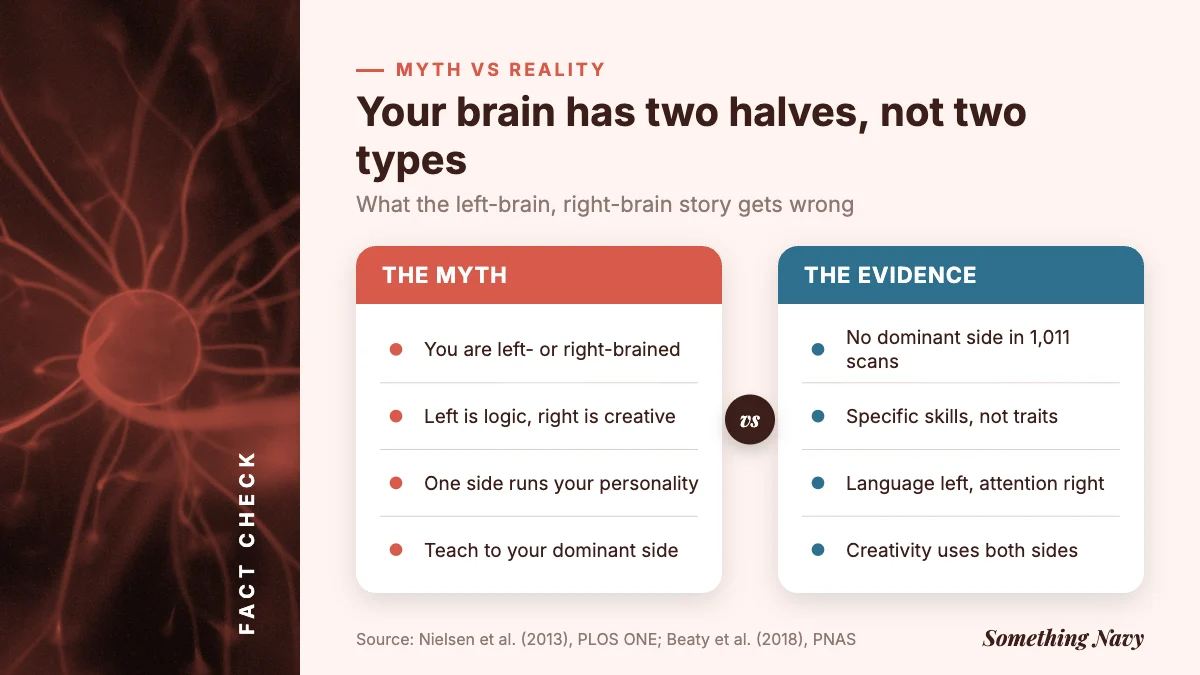
Here is the problem. When researchers at the University of Utah went looking for left-brained and right-brained people in more than a thousand brain scans, they did not find them.
The halves of your brain do specialise. People do not. That distinction is the whole story, and this fact-check takes the popular claims one at a time.
The left-brain, right-brain claims on trial
The idea arrives in several versions, and they are not equally wrong. So it helps to separate them before weighing the evidence.
- Claim 1: The left and right hemispheres handle different jobs.
- Claim 2: The left brain is logical and the right brain is creative.
- Claim 3: Each person is dominated by one hemisphere, and that shapes their personality.
- Claim 4: Teaching to a pupil’s dominant side, or doing exercises to “integrate” the hemispheres, improves learning.
The first claim is a scientific finding. The other three are what happened when that finding left the laboratory. Each gets a verdict below, based on what the original researchers measured and what later studies found.

Where it started: Roger Sperry’s split-brain patients
The story begins with a Nobel Prize. In 1981 the Nobel Prize in Physiology or Medicine was divided between three scientists. Half went to David Hubel and Torsten Wiesel for their work on vision. The other half went to Roger Sperry of the California Institute of Technology, cited by the Nobel committee “for his discoveries concerning the functional specialization of the cerebral hemispheres”.
Sperry’s route there was unusual. He first studied animals, including monkeys, in which the connections between the two halves of the brain had been cut. Later, a similar operation, called commissurotomy, was performed on people with severe epilepsy that did not respond to other treatment. For many patients it reduced seizures, and it caused no obvious change in everyday behaviour.
But carefully designed tests revealed something remarkable. With the bridge between the hemispheres cut, each half seemed to have its own experiences and memories, and neither could reach what the other had learned.
That gave Sperry a rare window. He could present information to one hemisphere at a time and see what each could do on its own.


What Sperry actually found, and what he did not
The Nobel press release from 1981 summarises the results. The left hemisphere handled speech, writing and calculation, and was the stronger analyst in logical tasks. The disconnected right hemisphere could not speak and was weak at calculation.
Yet the right side was far from idle. It outperformed the left on spatial perception, on understanding complex relationships, and on interpreting sounds and music, including recognising melodies and telling voices and intonations apart.
This is the part that tends to get lost. Before Sperry, the right hemisphere was widely thought to be “entirely subordinate” to the left, in the words of the press release. His big contribution was to show that both halves have real, distinct abilities.
Notice what the research was about. It described what each hemisphere could do in patients whose hemispheres had been surgically separated. It did not sort healthy people into types, and it did not say that one half runs anyone’s personality.
Verdict on Claim 1, that the hemispheres handle different jobs: true. This is solid, Nobel-recognised science.
Verdict on Claim 2, logic left and creativity right: a caricature. Sperry’s findings were about specific skills such as speech and spatial perception, not about broad traits like being “logical” or “creative”.
Language really does lean left, for most people
If you want proof that the hemispheres differ, language is the clearest case, and the evidence is far older than Sperry.
In 1861 the French physician Paul Broca examined the brain of Louis Victor Leborgne, a patient nicknamed “Tan” because it was the only syllable he could say. As Scientific American recounts, Broca found damage in the left frontal lobe. After studying more patients, he argued in 1865 that speech production depends on a specific part of the left frontal lobe, now called Broca’s area.
In 1874 the German neurologist Carl Wernicke described the mirror image: patients who spoke fluently but understood poorly, and whose speech lacked meaningful content. He linked this to damage further back, in the temporal lobe. That region became Wernicke’s area.
Modern brain imaging has kept the left-leaning picture, with a refinement. In 2014 Bernard Mazoyer and colleagues at the University of Bordeaux scanned 297 healthy adults, deliberately including 153 left-handers, while they generated sentences. Their PLOS ONE paper found that 88% of right-handers were typically lateralised, meaning language was dominant on the left. The other 12% were “ambilateral”, with no clear winning side.
Left-handers were more varied: 78% typical, 15% ambilateral and 7% strongly right-lateralised. Even so, the left-side pattern was still the norm. The authors estimated that strong right-side dominance for language occurs in fewer than 1% of the general population.
Language today is also understood as a network rather than two isolated spots. Current models describe frontal, temporal and parietal regions working with deep connecting pathways. Broca and Wernicke were right about where to look, but language is a team sport even inside one hemisphere.
Lateralisation is real. It just describes tasks, not temperaments.
The test of 1,011 brains at the University of Utah
If left-brained and right-brained people existed, you would expect to see it in the wiring. Some people’s left-hemisphere networks would be consistently stronger, others’ right. In 2013 a team at the University of Utah set out to check.
Jared Nielsen, Jeffrey Anderson and colleagues analysed resting-state brain scans from 1,011 people aged 7 to 29, drawn from a public data-sharing project. Participants simply lay in the scanner for 5 to 10 minutes. The researchers divided the brain into 7,266 regions and measured how strongly regions were connected within and across the two hemispheres.
They did find lateralised hubs. Language regions, including Broca’s and Wernicke’s areas, leaned left. Regions involved in controlling attention leaned right. So the specialisation Sperry described showed up clearly.
What they did not find was a left-brained or right-brained kind of person. Lateralisation turned out to be “a local rather than global property of brain networks”, as the paper put it. Someone could be strongly left-lateralised in one network and not in another. There was no whole-brain tilt that marked a person as one type.
Anderson summed it up plainly in the University of Utah announcement: “people don’t tend to have a stronger left- or right-sided brain network.”
The study measured connectivity at rest, not personality, and its participants were young. It cannot rule out every possible version of the idea. But it was a direct test of the core claim in a large sample, and the claim failed.
Verdict on Claim 3, that people are left-brained or right-brained: false.
Creativity uses the whole brain, not the right half
The most popular part of the myth is the idea of a creative right brain. So it is worth looking at what happens when scientists study creative thinking directly.
In a 2018 study in PNAS, Roger Beaty, then at Harvard University, and colleagues scanned 163 people while they came up with creative uses for everyday objects such as a brick, a knife or a rope. This is a classic test of divergent thinking, the kind of open-ended idea generation people usually mean by creativity.
The team identified a pattern of brain connections that could predict how original a person’s ideas were. That pattern spanned three large networks: the default mode network, often linked with spontaneous and self-generated thought; the executive control network, linked with focus; and the salience network, which helps decide what deserves attention. These networks run across both hemispheres.
In the study’s press release, carried by ScienceDaily, Beaty said he hoped the work would help dispel the left-versus-right myth about creative thinking. The picture is of networks cooperating, not one hemisphere taking over.
That makes intuitive sense. A good idea needs a spark, and then it needs checking.
Creative people are not running on half a brain. Nobody is.


How the myth got into classrooms
A personality quiz is harmless enough. The myth became more serious when it reached schools.
In 2002 the OECD, the international organisation that runs the PISA tests, published Understanding the Brain: Towards a New Learning Science, a report from its Brain and Learning project. It raised concern about the rapid spread of so-called “neuromyths”: misreadings or misquotings of real brain research that end up in education.
A decade later, Sanne Dekker and colleagues measured how far those myths had spread. Their 2012 study in Frontiers in Psychology surveyed 242 primary and secondary teachers, 137 in Dorset in the UK and 105 around Amsterdam in the Netherlands. Teachers rated 32 statements about the brain, 15 of them myths, as correct, incorrect or “do not know”.
One statement read: “Differences in hemispheric dominance (left brain, right brain) can help explain individual differences amongst learners.” In the UK, 91% of teachers judged it correct. In the Netherlands, 86% did.
Another said that short bouts of coordination exercises can improve integration of left- and right-hemisphere brain function. That was believed by 88% of UK teachers and 82% of Dutch teachers. Not one UK teacher in the sample correctly identified it as a myth.
Across all 15 myths, teachers believed 49% on average. The most widely believed were tied to commercial “brain-based” education programmes.
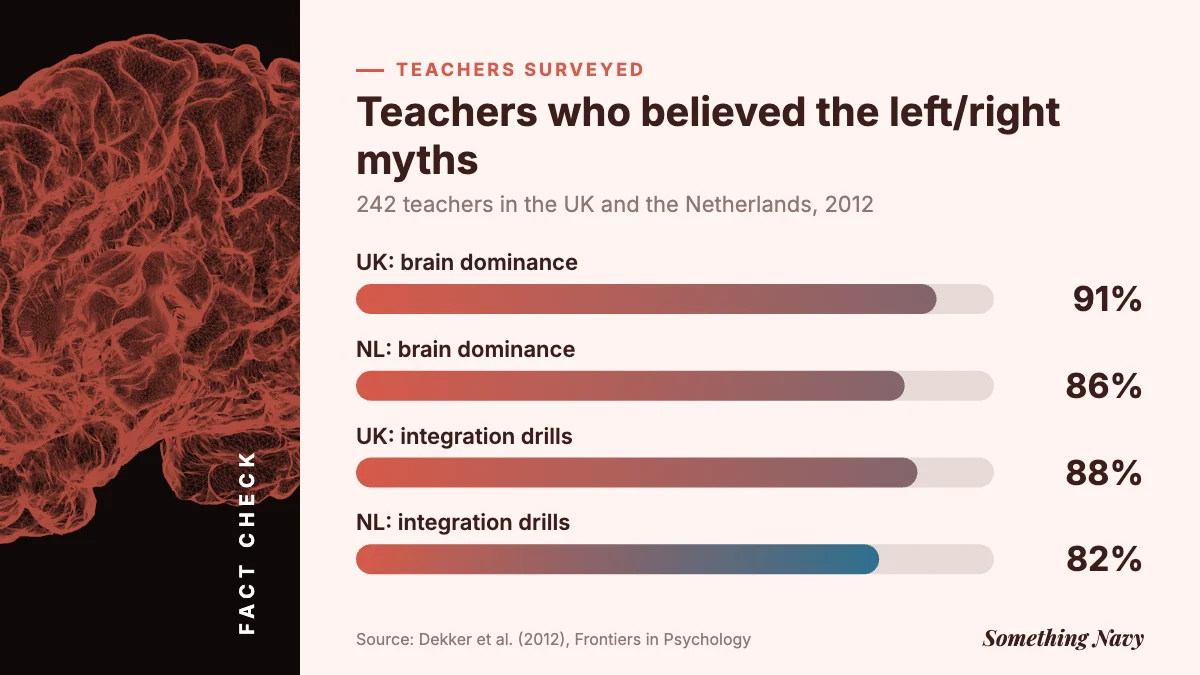
The most striking result was not about the myths themselves. Teachers who knew more general facts about the brain were more likely to believe neuromyths, not less. The authors suggested that enthusiasm for neuroscience, without a way to tell solid findings from marketing, can make people more susceptible.
There is a fair limit to note. The teachers volunteered, and 93% said they were interested in brain science, so they were not a random sample of the profession. The authors pointed out that less interested teachers might hold even more myths.
Verdict on Claim 4, teaching to a dominant hemisphere: no evidence. The premise, that learners have a dominant hemisphere that defines how they learn, is the part the Utah scans undermined.
The left-brain, right-brain report card
Here is each claim, with the evidence checked above and a final rating.
| Claim | What the evidence shows | Verdict |
|---|---|---|
| The two hemispheres do different jobs | Sperry’s Nobel-winning split-brain work; language leans left in most people, attention leans right. | True |
| Most right-handers process language on the left | 88% typically left-lateralised, 12% with no clear side, in a 2014 fMRI study of 297 adults. | True |
| The left brain is logical, the right is creative | Specialisation is for specific skills. Creative thinking draws on networks across both hemispheres. | Misleading |
| People are left-brained or right-brained | No whole-brain dominance found in scans of 1,011 people (Nielsen et al., 2013). | False |
| Teaching to a dominant hemisphere helps pupils learn | Built on a premise the scans did not support. Believed by 91% of UK teachers surveyed in 2012. | No evidence |
| Coordination drills “integrate” the hemispheres | Classed as a neuromyth by Dekker et al. (2012). Believed by 88% of UK teachers surveyed. | No evidence |
Fact-check verdict
- Claim: People are left-brained (logical) or right-brained (creative).
- Rating: False.
- Why: The hemispheres do specialise, as Roger Sperry showed, but in specific tasks such as language and attention. A 2013 study of 1,011 brains found no sign of people with a dominant hemisphere, and creativity relies on networks spread across both sides.
- What is true: Language is left-lateralised in most people, especially right-handers.
A myth this durable usually survives because it contains a true fact. Here, the true fact is lateralisation. Everything built on top of it, the personality types, the quizzes, the classroom labels, is the part that fails.
It is the same pattern seen in the Mozart effect: a careful laboratory result, retold until it promised far more than it ever found.
Why the label is worth dropping
If someone enjoys calling themselves right-brained, what is the harm?
The cost is the story it tells about what you cannot do. “I’m not a numbers person” and “I’m not the creative type” both sound like biology when they are dressed in brain language. That makes them feel fixed, which can quietly stop you trying.
In a classroom, the stakes rise. A child labelled as one type may be steered towards some subjects and away from others, on the basis of a difference that brain imaging did not find.
The research points somewhere more hopeful. Logic and creativity are not owned by opposite halves of your head. They are skills that draw on the whole brain, which means they can both be practised.
What actually helps creative and logical thinking
Drop the hemisphere idea and some useful, evidence-based habits come into view. None of them requires knowing which “side” you are.
Walk when you need ideas
At Stanford University, Marily Oppezzo and Daniel Schwartz ran four experiments with 176 people. In one, participants came up with creative uses for objects while sitting and then while walking on a treadmill facing a blank wall. Creative output rose by an average of 60% during walking, according to Stanford’s report on the study, and the boost lingered briefly after people sat back down.
There is a catch that makes the finding more useful, not less. Walking did not help with tasks that have one correct answer. On a word-association test that requires converging on a single solution, walkers did slightly worse. More on this in our piece on walking and creativity.
Sit down to solve and check
The flip side of the Stanford result is a practical rule. Use movement and a loose, wandering mind to generate options. Then sit at a desk to choose, test and refine. Think of these as two phases of one job, not two different brains.
Separate making from judging
In Beaty’s study, the people with the most original ideas showed stronger connections across networks linked with spontaneous thought and with focused control. That is a brain-scan finding, not a work method, but it suggests a sensible way to work. Write down every idea first without editing. Come back later, preferably after a break, and judge them with fresh eyes.
Breaks are part of the process. Many people know the feeling of an answer arriving in the bath or under the shower, the familiar experience of shower thoughts.
Practise the specific skill you want
If you want to reason more clearly about numbers, work with numbers. If you want to draw, draw. The Utah findings mean there is no hidden hemisphere holding you back from either. The bigger obstacle is often the belief that you are “not that sort of person”, and research on the Dunning-Kruger effect shows how poorly people can judge their own ability.
Be wary of anything “brain-based” that sells a type
Dekker’s survey found that the myths teachers believed most were tied to commercial programmes. A useful test: if a product promises to train “your right brain” or “balance your hemispheres”, it is selling the myth, not the science.
The fairer description of a mind is not left or right. It is a crowded, well-connected room where language, attention, memory and imagination are all talking to each other.
You are not half of anything. You get the whole brain, and so does everyone you know.
Frequently asked questions
Not in the sense the quizzes mean. A 2013 University of Utah study of 1,011 people found that lateralisation is specific to particular networks, with no evidence of people having a generally stronger left or right side.
His Nobel-winning research showed that each hemisphere has distinct abilities, based on tests of patients whose hemispheres had been surgically separated. It did not divide healthy people into personality types; that idea came later in popular retellings.
In most people, the left. A 2014 fMRI study found 88% of right-handers were typically left-lateralised for language and the rest had no clear dominant side, while left-handers were more varied.
You can train creativity, but not by targeting one hemisphere. Generating ideas freely, walking when brainstorming, taking breaks and evaluating ideas separately are practical habits with research behind them.
Official links and research
- NobelPrize.org. (n.d.). Roger W. Sperry: Facts. The Nobel Prize in Physiology or Medicine 1981. Link
- NobelPrize.org. (1981). Press release: The Nobel Prize in Physiology or Medicine 1981. Link
- Nielsen, J. A., Zielinski, B. A., Ferguson, M. A., Lainhart, J. E., & Anderson, J. S. (2013). An evaluation of the left-brain vs. right-brain hypothesis with resting state functional connectivity magnetic resonance imaging. PLOS ONE, 8(8), e71275. DOI
- Mazoyer, B., Zago, L., Jobard, G., Crivello, F., Joliot, M., Perchey, G., Mellet, E., Petit, L., & Tzourio-Mazoyer, N. (2014). Gaussian mixture modeling of hemispheric lateralization for language in a large sample of healthy individuals balanced for handedness. PLOS ONE, 9(6), e101165. DOI
- OECD. (2002). Understanding the brain: Towards a new learning science. OECD Publishing. Link
- Dekker, S., Lee, N. C., Howard-Jones, P., & Jolles, J. (2012). Neuromyths in education: Prevalence and predictors of misconceptions among teachers. Frontiers in Psychology, 3, 429. DOI
- Beaty, R. E., Kenett, Y. N., Christensen, A. P., Rosenberg, M. D., Benedek, M., Chen, Q., Fink, A., Qiu, J., Kwapil, T. R., Kane, M. J., & Silvia, P. J. (2018). Robust prediction of individual creative ability from brain functional connectivity. Proceedings of the National Academy of Sciences, 115(5), 1087–1092. DOI
- Wong, M. (2014, 24 April). Stanford study finds walking improves creativity. Stanford Report. Link
Cover photo: Robina Weermeijer on Unsplash. Charts and graphics: Something Navy, with photography by Hal Gatewood and Shawn Day on Unsplash.
How we reported this. Every figure was checked against the 8 sources above. Reviewed by Valentino Adkins, Senior Content Manager. Report an error · How we work