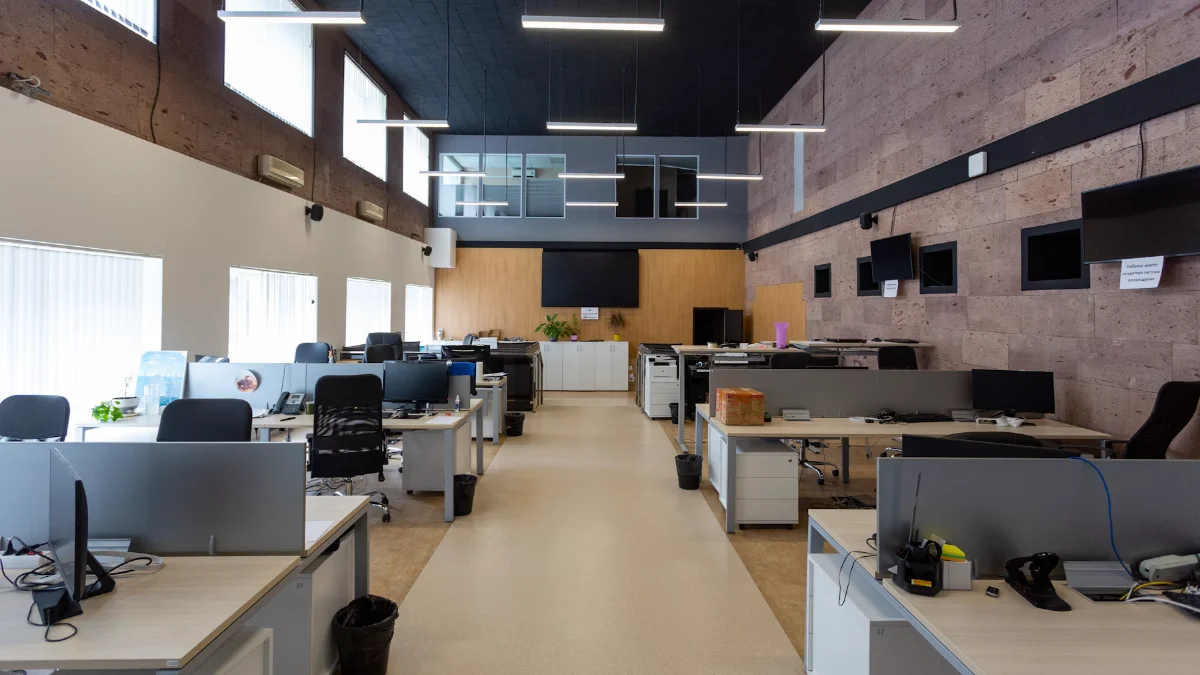
You look up from your screen to ask the colleague four metres away a quick question. Then you notice the headphones, and you open the chat window instead.
Nobody told you to do that. It simply felt more polite.
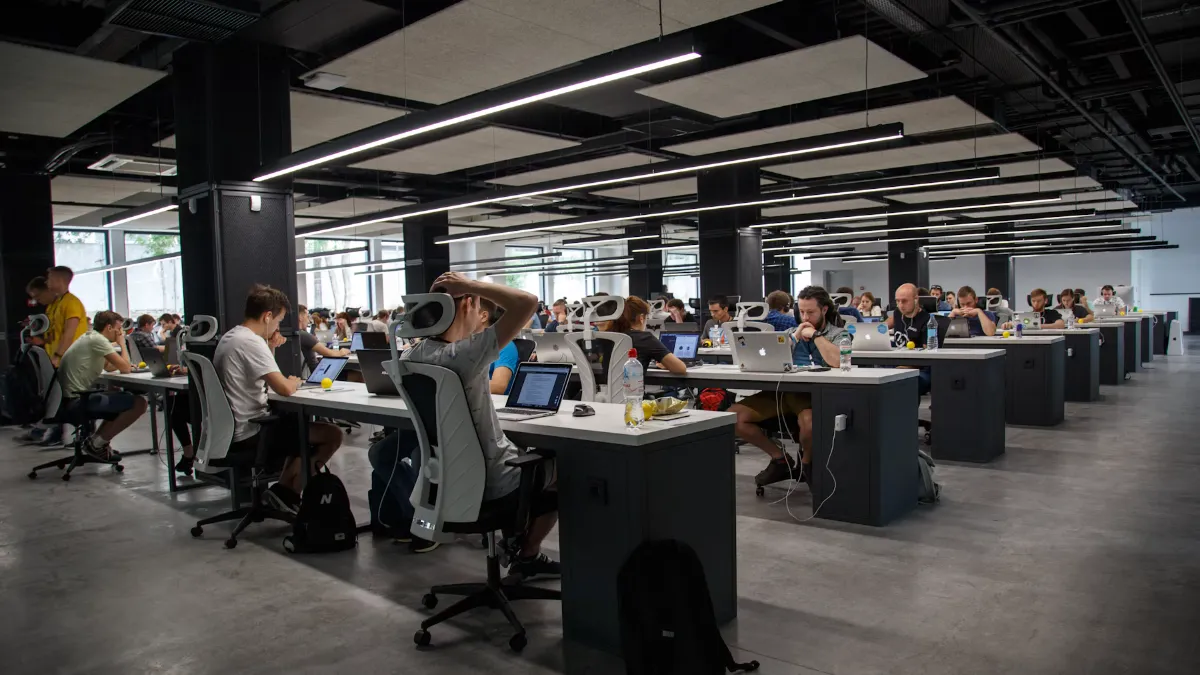
That small retreat is exactly what the open-plan office was supposed to cure. For more than 60 years, the pitch for knocking down walls has barely changed: put people in sight of each other and they will talk, share and spark ideas. Walls, the argument goes, are where collaboration goes to die.
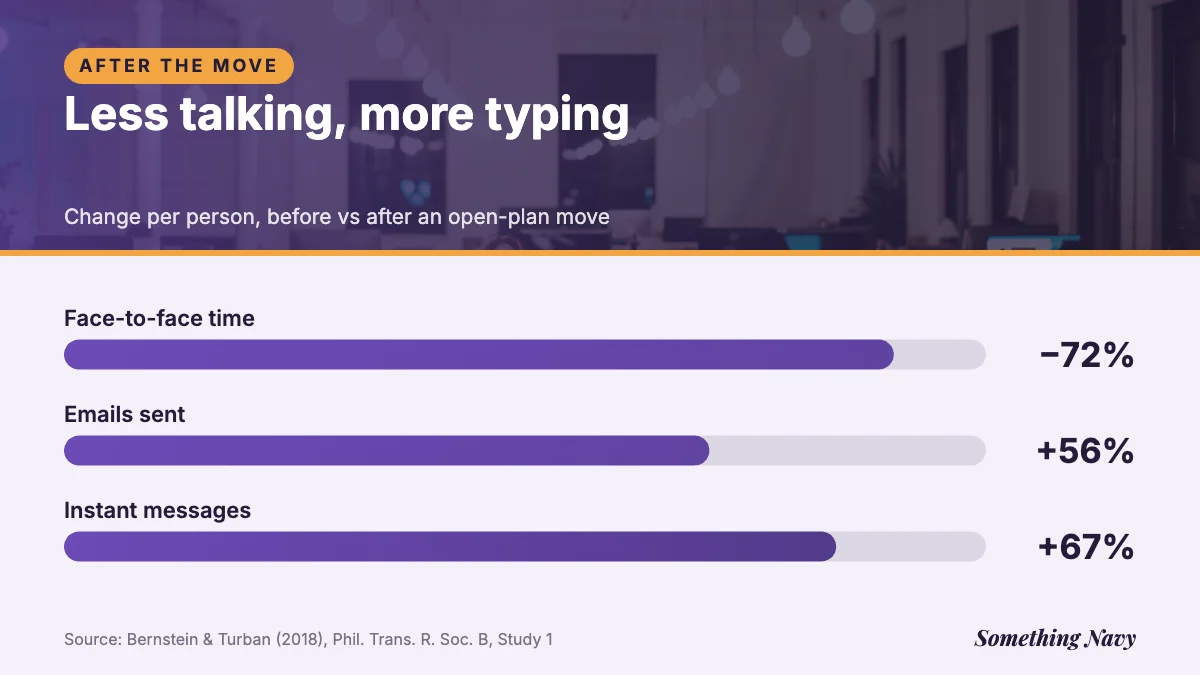
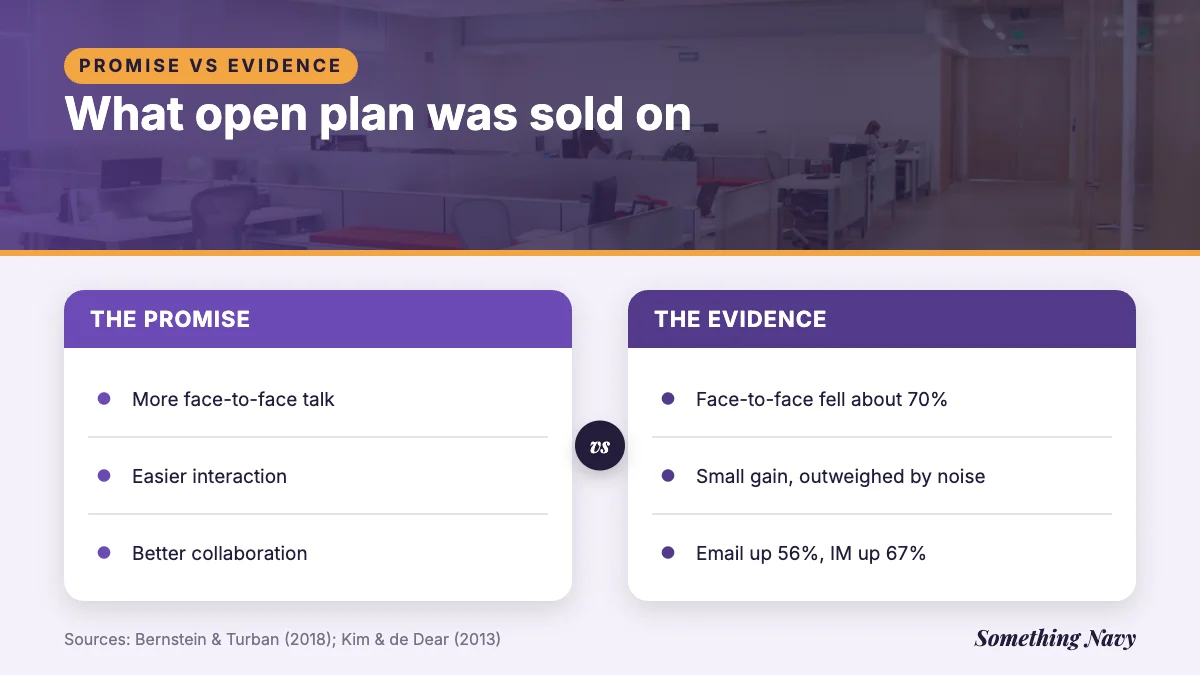
In 2018 a Harvard Business School professor and his co-author tested that pitch directly, with sensors worn by staff before and after their employers went open-plan. Face-to-face interaction did not rise. It fell by roughly 70%. Email and instant messaging went up.
The finding has been quoted in office-design arguments ever since, often loosely. So it is worth checking what the study actually measured, what other research adds, and what any of it means now that so many people spend only part of the week in an office at all.
The Harvard sensor study that counted every conversation
Ethan Bernstein, of Harvard Business School, and his co-author Stephen Turban published their study in Philosophical Transactions of the Royal Society B in July 2018. They had access to something rare: two Fortune 500 multinationals about to move their global headquarters from cubicles to open-plan floors.
Rather than asking staff how much they talked, they measured it. Volunteers wore sociometric badges, small devices with an infrared sensor that registers when two wearers are facing each other, a microphone to detect speech, an accelerometer and Bluetooth for location. The companies also handed over data from their email and instant-messaging servers.
In the first study, 52 employees, about 40% of those affected by the move, wore the badges for 15 working days before the redesign and 15 working days about three months after it.
The results were not subtle. Face-to-face interaction fell by 72%, from roughly 5.8 hours per person per day to about 1.7 hours. Over the same period, the group collectively sent 56% more emails and 67% more instant messages, and the number of words typed in those messages rose by 75%.
The second study, at a different company, followed 100 employees for eight weeks before and eight weeks after a redesign, and analysed 1,830 pairs of colleagues. Depending on the statistical model, face-to-face interaction fell by 67% to 71%, while email rose by 22% to 50%. Of the pairs whose behaviour changed, 643 talked less in person and only 141 talked more.
The authors’ interpretation, in the paper’s abstract, was that open architecture “appeared to trigger a natural human response to socially withdraw from officemates”.
In other words, when everyone can see you, you go quiet.

Myth versus evidence: what the 70% figure really proves
A number that clean invites over-reading, in both directions. Before going further, it helps to separate the claims.
Myth: removing walls makes people collaborate more
This is the core promise, and Bernstein and Turban’s data cut directly against it. Proximity did not produce conversation. It produced headphones, chat windows and inbox traffic.
But be careful with the scale of the claim. These were two companies, both large multinationals, with volunteers rather than every employee. Study 2 did not measure instant messaging at all. And the badges counted interactions, not their value. Some of those lost conversations may have been idle chat that nobody misses.
Productivity is the weakest link. The paper reports that executives at the first company said, in a confidential internal review, that productivity had declined. That is a qualitative judgement, not a measured result, and it should not be quoted as if it were.
Myth: people only hate open plans because they hate change
If complaints were simply resistance to something new, they would fade once people settled in. A much larger body of data suggests the problem is built into the layout.
Jungsoo Kim, then a PhD candidate, and Richard de Dear, both at the University of Sydney, analysed 42,764 survey responses from 303 office buildings in the US, Finland, Canada and Australia. The data came from the Center for the Built Environment at the University of California, Berkeley, which has surveyed office occupants since 2000. Their paper in the Journal of Environmental Psychology appeared in 2013.
Enclosed private offices beat open-plan layouts on most measures of indoor environmental quality, and especially on acoustics and privacy. Open plan did score better on “ease of interaction”. But that gain was small, and much smaller than the losses from noise and lost privacy.
The detail most people miss is about partitions. As The Conversation reported, dissatisfaction with sound privacy was highest in cubicles with high partitions, at 59%, followed by low-partition cubicles at 58% and open plans with few or no partitions at 49%. Screens can hide your colleague without silencing them.
Kim’s summary was blunt: “the disadvantages brought by noise disruption were bigger than the predicted benefits of increased interaction.” He also noted that the analysis did not measure productivity directly. This is satisfaction data, from people describing their own offices, which is useful but not the same as output.
Myth: office noise is merely an irritation
The word “noise” makes it sound like a nuisance you can tune out. The research suggests the kind of noise matters more than the volume, and overheard speech is the worst kind.
In a 2012 study in the journal Noise and Health, the Swedish researcher Helena Jahncke compared people working in quiet with people working while irrelevant speech played in the background. Her results showed that tasks relying on short-term memory and rehearsing what you have just read were the most disrupted. She concluded that searching for information and remembering material are poorly suited to offices where speech is constant.
That maps neatly on to office life. A conversation you are not part of still pulls at the same mental machinery you need to hold a sentence, a figure or a plan in your head. It is one reason the idea that we can easily multitask falls apart under scrutiny.
An open-plan office does not remove barriers between people. It moves them into headphones, chat windows and inboxes.
Myth: the layout has nothing to do with health
In 2011 Jan Pejtersen and colleagues in Denmark examined survey data from 2,403 office employees. After adjusting for age, sex, socioeconomic status, smoking, alcohol, body mass index and exercise, they found that people in open-plan offices of more than six people reported 62% more days of sickness absence than those in single-person offices. Two-person offices came in at 50% more, and offices of three to six people at 36% more.
This one needs the strongest health warning of all. The data were cross-sectional and self-reported, so they show an association, not proof that open plans make people ill. Shared air, shared surfaces and more people to catch things from are all plausible explanations. So is the possibility that different kinds of jobs end up in different kinds of rooms.
Weighing the open-plan evidence side by side
Each of these studies has a blind spot. Read together, they point the same way more often than not.
| Study | What they did | Main finding | Main limitation |
|---|---|---|---|
| Bernstein & Turban (2018) | Sensor badges and server data at two Fortune 500 headquarters | Face-to-face time fell 67–72%; email and IM rose | Two firms, volunteers, no hard productivity data |
| Kim & de Dear (2013) | 42,764 survey responses from 303 buildings | Noise and privacy losses outweighed easier interaction | Satisfaction, not output |
| Jahncke (2012) | Tasks done in quiet versus with background speech | Memory-heavy tasks suffered most from speech | Lab setting, not real offices |
| Pejtersen et al. (2011) | Survey of 2,403 Danish office workers | 62% more sick days in open plans of 7+ people | Cross-sectional and self-reported |
A short history of the open-plan office, from Bürolandschaft to hot-desking
Open plan did not begin as a cost-cutting exercise. It began as an idealistic one.
1958. In Germany, the brothers Eberhard and Wolfgang Schnelle set up the Quickborner consultancy near Hamburg and begin developing Bürolandschaft, or “office landscape”. Desks are arranged in organic clusters according to who works with whom, broken up by plants and screens rather than walls.
1964. In the US, the furniture maker Herman Miller launches Action Office, conceived by Robert Propst and designed by George Nelson. It aims to give workers flexibility and some privacy. Sales are disappointing.
1968. Action Office II arrives, built from movable panels. Companies fix the panels in place and fill whole floors with them. The cubicle farm is born.
Mid-1970s. The cubicle has largely replaced the office landscape it grew out of.
1994. The advertising agency Chiat/Day tries a “virtual office” in New York with no assigned desks. Staff collect a phone and laptop each day and keep their belongings in lockers. Many find it distracting, and the agency later returns to a conventional layout.
2020 onwards. The pandemic sends office workers home. When many return, it is for part of the week, often to shared desks.
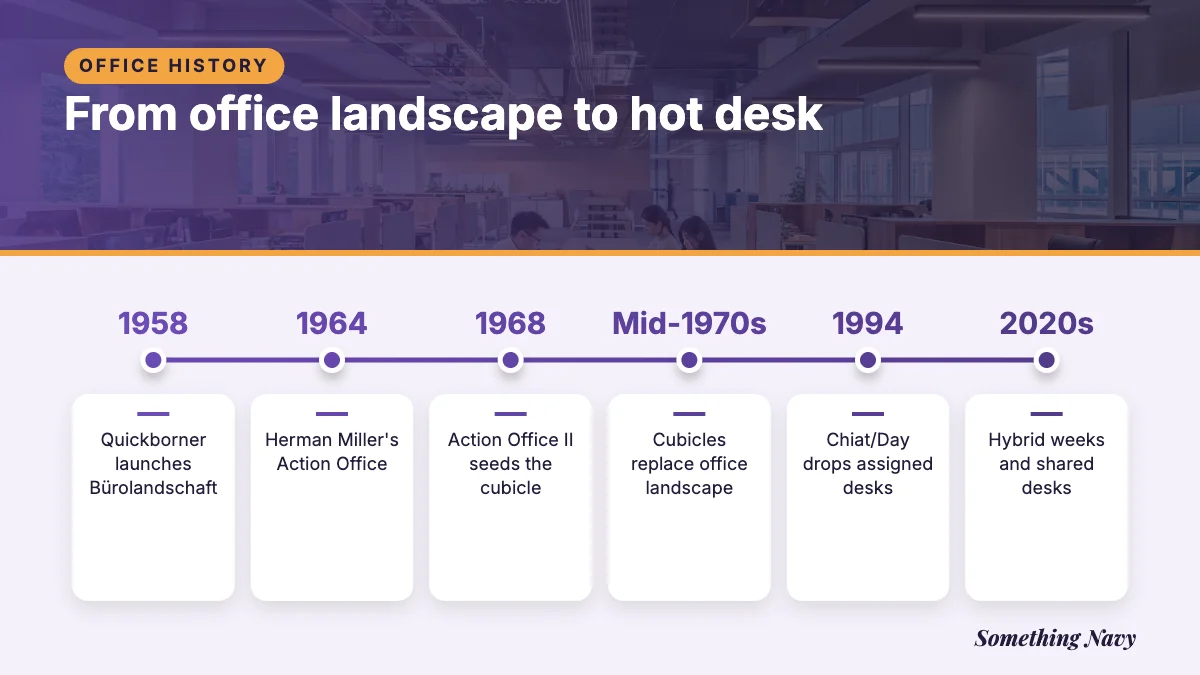
Notice what got lost along the way. Bürolandschaft was a theory about how teams communicate. The cubicle and the hot desk became, very often, a theory about square footage.


Hot-desking and the colleagues you never quite get to know
If an open-plan office makes people retreat into themselves, hot-desking adds a second problem: nobody has a place.
Rachel Morrison, of Auckland University of Technology, and her co-author surveyed 1,000 working Australians about their office set-ups, their relationships with colleagues and how supported they felt by their managers. The study appeared in Applied Ergonomics in 2017. Writing about the research, she reported that hot-desking and open-plan arrangements were linked to more distraction, uncooperativeness, distrust and negative relationships.
Co-worker friendships were of the lowest quality in these shared spaces, worse than in private or small shared offices, and even worse than for people who mainly worked from home or on the road. Perceptions of support from supervisors were lower too.
Again, this is a survey at one point in time, so it cannot show which way the arrow runs. But it fits with a simple observation. Friendships at work are built from repeated, low-stakes contact with the same people, and that takes many hours. A seating plan that reshuffles everyone daily makes those repeated encounters rarer.
It also strips away the small signals of belonging. You cannot leave your mug, your plant or your creative mess on a desk that will belong to someone else tomorrow.
Why hybrid work makes the open-plan problem more urgent
Here is where the old research collides with the new routine.
In autumn 2024, the Office for National Statistics found that 28% of working adults in Great Britain were hybrid working. Among managers, directors and senior officials, the figure between April and June 2024 was 45%. For millions of people, the office is now somewhere you visit rather than somewhere you live.
That changes what the office is for. Some of the strongest evidence on remote work suggests that one of its biggest costs is connection. In a study of 61,182 Microsoft employees in the US during the first half of 2020, Longqi Yang, David Holtz and colleagues reported in Nature Human Behaviour that firm-wide remote work made the company’s collaboration network “more static and siloed”, with fewer bridges between different parts of the business. Real-time communication fell, while slower, asynchronous messages rose.
Meanwhile, hybrid working itself looks fairly benign. In a randomised trial at the Chinese travel company Trip.com, Nicholas Bloom, Ruobing Han and James Liang randomly assigned 1,612 staff either to work from home two days a week or to stay in the office full time. Writing in Nature in 2024, they reported that quit rates fell by a third, from 7.2% to 4.8%, with no difference in performance reviews or promotions over the following two years.
Put these together and the logic is uncomfortable. If remote days quietly narrow your network, the office days are where you are supposed to widen it again. And the open-plan layout is exactly the environment that Bernstein and Turban found pushes people back towards their screens.
If you commute for an hour to message someone four metres away, the office has failed at the one job it has left.

How to get real conversation back in an open-plan or hot-desk office
None of this means every open office should be walled up again. Private offices for everyone are expensive, and the evidence for them is about satisfaction and noise, not proof that they make teams more creative. The useful lesson is narrower: proximity alone does not create conversation, and speech you did not choose to hear is a real cost.
Try this if you work in an open-plan or hot-desk office
- Sort your week by task. Save memory-heavy work, such as drafting, analysis and anything you need to hold in your head, for home or a quiet room. Bring the work that needs other people into the office.
- Turn messages into visits. If the person is in the building and the question takes two minutes, walk over or suggest a quick coffee. A short conversation away from the desks spares neighbours the overheard speech.
- Sit near the same people. On shared-desk days, pick a regular area near your team. Repeated contact is what turns colleagues into allies.
- Reduce speech, not just volume. Overheard talk is what disrupts concentration most, so a quiet room for focused work is worth more than a slightly quieter open floor.
- Say hello first. Most people underestimate how much others enjoyed talking to them. In a room full of headphones, someone has to go first.
What managers of open-plan and hybrid offices can do differently
For anyone who sets office policy, the research suggests a few checks before the next redesign or desk-booking scheme.
- Measure before and after. Bernstein and Turban’s method is a reminder that what people do can differ from what designers predict. Even simple counts of meetings and messages are better than assumptions.
- Coordinate office days. A hot desk on a day when your team is at home is just a noisier version of your kitchen table. Agree shared days so the commute buys contact.
- Build enough enclosed space. Quiet rooms, phone booths and bookable small rooms give people somewhere to talk without broadcasting, and somewhere to think without hearing every call.
- Keep teams together. Team areas, rather than a free-for-all, protect the repeated contact that Morrison’s findings suggest hot-desking erodes.
- Judge collaboration by its results. A floor full of people is not evidence of teamwork. A floor full of people silently typing to each other may be evidence of the opposite.
The open office was sold as a machine for conversation. The data suggest conversation is more fragile than that. It needs a reason, a moment and somewhere to happen where nobody else has to listen.
Walls were never really the barrier. Attention was.
Frequently asked questions
In the best-known sensor study, face-to-face interaction fell by about 70% after two company headquarters went open-plan, while email and messaging rose. It covered only two large firms, so it shows a strong warning sign rather than a universal law.
Not necessarily. In Kim and de Dear’s survey data, dissatisfaction with sound privacy was actually highest in high-partition cubicles, at 59%, because partitions block sight more than sound.
Survey research from Australia linked hot-desking with more distrust, more distraction and weaker co-worker friendships. The data are correlational, and keeping teams seated together may reduce the downsides.
A randomised trial found two days at home cut quit rates by a third without hurting performance reviews. Research at Microsoft suggests fully remote work can make networks more siloed, so in-person days are best used for real contact.
Official links and research
- Bernstein, E. S., & Turban, S. (2018). The impact of the ‘open’ workspace on human collaboration. Philosophical Transactions of the Royal Society B: Biological Sciences, 373(1753), 20170239. DOI
- Kim, J., & de Dear, R. (2013). Workspace satisfaction: The privacy-communication trade-off in open-plan offices. Journal of Environmental Psychology, 36, 18–26. Link
- Jahncke, H. (2012). Open-plan office noise: The susceptibility and suitability of different cognitive tasks for work in the presence of irrelevant speech. Noise and Health, 14(61), 315–320. Link
- Pejtersen, J. H., Feveile, H., Christensen, K. B., & Burr, H. (2011). Sickness absence associated with shared and open-plan offices: A national cross sectional questionnaire survey. Scandinavian Journal of Work, Environment & Health, 37(5), 376–382. Link
- Morrison, R. (2016). Get out of my face! We’re more antisocial in a shared office space. The Conversation, republished by NBR. Research published as Morrison, R. L., & Macky, K. A. (2017), Applied Ergonomics, 60, 103–115. Link
- Yang, L., Holtz, D., Jaffe, S., Suri, S., Sinha, S., Weston, J., Joyce, C., Shah, N., Sherman, K., Hecht, B., & Teevan, J. (2022). The effects of remote work on collaboration among information workers. Nature Human Behaviour, 6, 43–54. Link
- Bloom, N., Han, R., & Liang, J. (2024). Hybrid working from home improves retention without damaging performance. Nature, 630, 920–925. DOI
- Office for National Statistics. (2024). Who are the hybrid workers? Link
Cover photo: Petr on Unsplash. Charts and graphics: Something Navy, with photography by Israel Andrade, LYCS Architecture and Adolfo Félix on Unsplash.
How we reported this. Every figure was checked against the 8 sources above. Reviewed by Brooke Hilland, Senior Content Editor. Report an error · How we work