Your basket is all sensible. Own-brand pasta, a tin of chopped tomatoes, the cheaper washing-up liquid, the bread on the yellow sticker. You have been good all month.
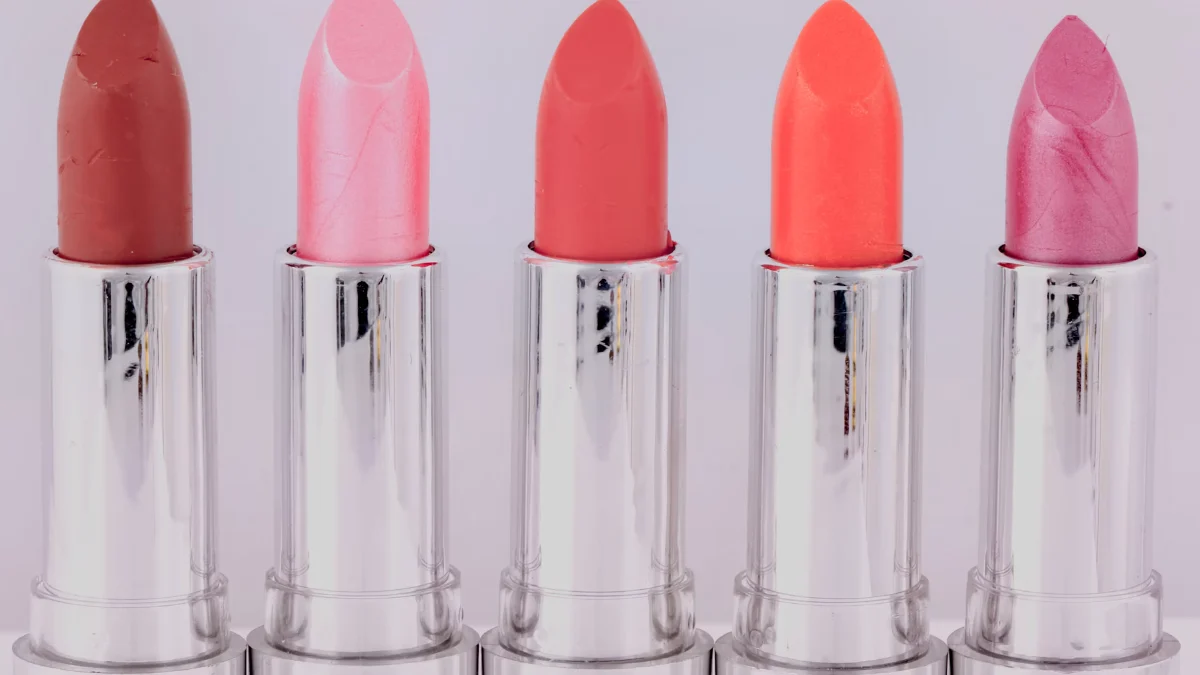
Then, at the end of the aisle, a lipstick in exactly the right red. £14. It goes in the basket before you have quite decided to put it there.
If that feels like a contradiction, you are in good company. The idea that people trim the big spending in hard times but keep buying small luxuries has a name: the lipstick effect. It has been repeated in business pages for a quarter of a century.
Here is the twist. The famous sales version of it is shaky. The psychology underneath it is far more interesting, and it explains a lot about that £14.
In brief
- The “lipstick index” began in 2001 as an observation by Estée Lauder’s Leonard Lauder, not as a study.
- Later sales data complicated it: lipstick sales reportedly fell after the 2008 crash, and makeup sales dropped sharply in 2020.
- Lab experiments from 2012 and 2016 found that recession news nudged women towards appearance products, possibly for dating or career reasons.
- A simpler driver may be mood: small purchases can restore a sense of control. Planned well, a budget treat can be a smart choice rather than a slip.
How the lipstick index started: one executive and a hunch
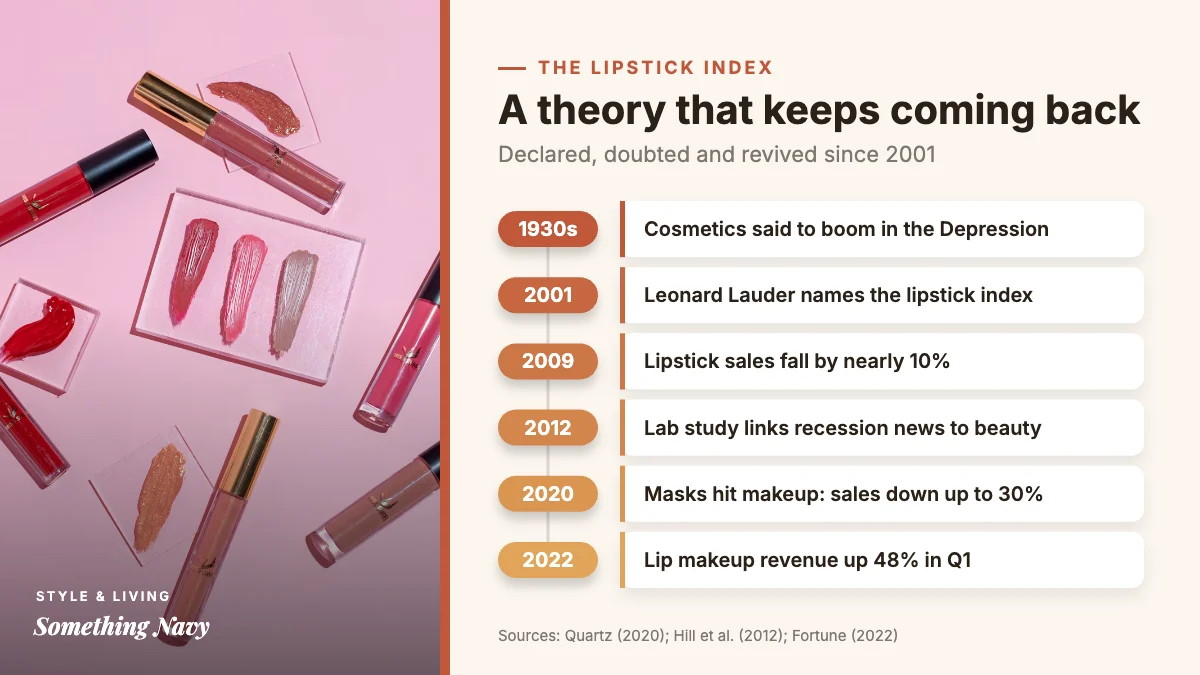
The story usually begins in late 2001. The US economy was in recession and still reeling from the September 11 attacks. Leonard Lauder, then running Estée Lauder, noticed that his company’s lipstick sales were rising and began talking about a “leading lipstick index”.
His theory was neat and quotable. When the economy turns down, people stop buying the dress, the handbag or the holiday, but they still want a lift. A lipstick is a luxury you can afford. The idea spread fast, and commentators soon linked it to an older belief that cosmetics sales boomed during the Great Depression of the 1930s.
Notice what is missing, though. It was a chief executive talking about his own company’s products, at a moment when a good-news story about lipstick was very welcome. Lipstick sales had reportedly spiked. That is an observation, not a test.
A good story about money spreads faster than the spreadsheet that could check it.
What lipstick sales data actually showed after 2001
Once journalists started tracking the index, it behaved badly.
During the 2008 financial crisis, many expected lipstick sales to climb. Instead, according to Fortune figures later cited by Quartz, lipstick sales fell by nearly 10% in 2009, the year after the crash. In January 2009, NPR’s Morning Edition, discussing an analysis in The Economist, described the historical data as “spotty”.
Beauty as a whole did not collapse. L’Oréal reported 5.3% sales growth in 2008, a figure later cited by psychologists studying the effect. But one company growing is not the same as a whole category rising because times are hard.
The pandemic muddled things further. A McKinsey report in May 2020, as summarised by Quartz, said makeup sales were down by as much as 30% globally that year. On Amazon, sales of lip care and colour dropped 15% year on year in the four weeks to 11 April 2020. A recession had arrived, and lipstick sank with it. Masks are the obvious culprit: nobody needs a perfect red under a face covering.
Then, as masks came off and prices rose, lipstick bounced back. Fortune reported in May 2022 that NPD Group data showed lip makeup revenue up 48% in the first quarter compared with the same period of 2021, making it the fastest-growing part of the makeup category.
So is the lipstick index real? As an economic forecasting tool, the evidence is thin. Sales move with fashion, product launches, social media trends and, yes, face masks. The economy is only one ingredient.

The 2012 experiments that tested the lipstick effect in a lab
Sales figures were never going to settle the question, so a team of psychologists tried a different approach. Sarah Hill and Christopher Rodeheffer at Texas Christian University, Vladas Griskevicius at the University of Minnesota, Kristina Durante at the University of Texas at San Antonio and Andrew White at Arizona State University ran five studies, published in 2012 in the Journal of Personality and Social Psychology.
They started with real spending. Using US government data on unemployment and retail sales for 232 months, from January 1992 to April 2011, they found that when unemployment was higher, the share of spending going on personal care and cosmetics was higher too (a correlation of 0.52). Clothing and accessories showed a smaller positive link. The share going on furniture, electronics and hobbies moved the other way.
That is correlation, and the link was weaker when they looked at raw spending rather than shares. So they moved into the lab.
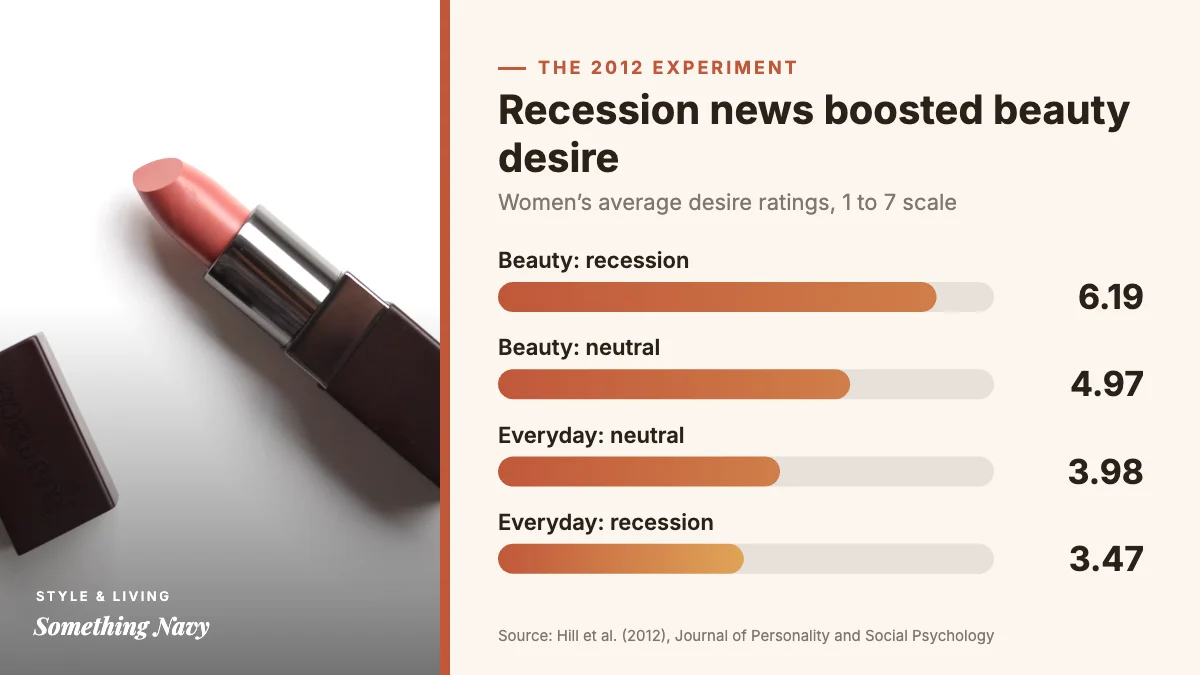
In the second study, 154 students (82 women and 72 men) read either a news article about the recession or a neutral article about architecture. Then they rated how much they wanted various products on a 1 to 7 scale. Some were appearance products such as fitted jeans and lipstick. Others were everyday items such as a stapler and headphones.
Women who had read about the recession wanted the beauty products more and the ordinary products less. Their average desire for beauty products was 6.19 after the recession article, against 4.97 after the neutral one, while everyday items slipped from 3.98 to 3.47. Men did not show the pattern at all: recession news made them less keen on everything.
Why the lipstick effect favoured luxury, not bargain beauty
If the lipstick effect were simply about swapping big treats for cheap ones, you would expect bargain beauty products to benefit most. The fourth study, with 64 women, found the opposite.
After a recession slideshow, desire rose for luxury beauty products. Desire for discount versions did not. The women also rated the cheaper products as less effective at improving appearance, and the effect held regardless of their own family’s financial position.
The team’s explanation was evolutionary. In a downturn, they argued, financially secure partners become scarcer and more valuable, so investing in appearance becomes a more pressing strategy. In the third study, women’s growing preference for partners with resources accounted for the rise in beauty-product desire. In the fifth, recession cues increased desire for jeans, perfume and boots only when the adverts used dating-themed slogans.
As Hill put it in the university’s 2012 press release, “Recession cues increased women’s desire to buy high-end cosmetics and designer clothing.”
It is a provocative theory, and it has an obvious gap. Many women buy lipstick for themselves, their friends, their work or their mood, with no partner anywhere in the picture.
A career motive behind the lipstick effect
That gap is exactly what Ekaterina Netchaeva of Bocconi University and McKenzie Rees of Brigham Young University picked up on. In a 2016 paper in Psychological Science, titled “Strategically stunning”, they argued that economic worry pushes women to invest in their appearance for two reasons: to attract a partner, and to make a good impression at work. Both routes lead to financial security.
Their key finding was about priorities. Women with high economic concern were more likely to choose to improve their professional appearance than their romantic attractiveness. In other words, the job interview mattered more than the date.
For anyone who has bought a sharp blazer or a good lipstick before a big meeting, this rings true. Clothes and makeup change how others see you and, according to research on enclothed cognition, possibly how you see yourself. That said, the career explanation sits on the same foundation as the dating one: how people say they feel in a study, not what they go on to buy.
The simplest explanation: small treats repair a bad mood
There is a less glamorous theory, and it may explain the £14 lipstick best of all.
Scott Rick, Beatriz Pereira and Katherine Burson at the University of Michigan tested “retail therapy” in three experiments published in the Journal of Consumer Psychology in 2014. In one experiment, described by the university, 100 adults watched a sad film clip. Some were then asked to choose four products to buy from a set of 12, imagining a $100 budget. Others simply browsed the same items, picking which would be most useful for travel. The choosers ended up less sad.
The researchers linked the effect to control. Sadness often comes from feeling that circumstances are running your life, and choosing what to buy restores a small sense of agency. Tellingly, the benefit worked even when the shopping choices were hypothetical. It did not help with anger.
A recession is the very definition of circumstances running your life. Picking a lipstick is one decision you get to make entirely on your own terms.
The treat is rarely about the lipstick. It is about having one thing you chose.
| Explanation | What drives the treat | Best evidence | Main weakness |
|---|---|---|---|
| Affordable luxury | Big purchases are cut, small ones fill the gap | Lauder’s 2001 observation | Sales data has not reliably backed it |
| Dating motive | Recession makes partners with resources more valuable | Hill et al. (2012), five studies | Small US student samples, mostly women |
| Career motive | Looking polished protects your job prospects | Netchaeva & Rees (2016) | Measures intentions, not purchases |
| Mood repair | Choosing restores a sense of control | Rick et al. (2014), three experiments | Mild sadness, short-term effects |


What the lipstick effect research cannot tell you
It is worth being clear about the limits, because the lipstick effect is often described as settled science. It is not.
- Most experiments measured desire, not spending. Rating a lipstick 6 out of 7 after a recession slideshow is not the same as buying one in a real recession.
- The samples were small and young. Hill’s lab studies used US university students, between 64 and 154 people each, and the retail therapy experiments were similarly modest.
- The sales evidence is mixed. Real-world lipstick sales have fallen in some downturns and jumped during recoveries.
- Culture matters. Hill’s team noted that they did not test how beauty norms and gender roles vary between countries.
What does seem robust is the everyday version: when money is tight, many of us still want a small, pleasurable thing, and choosing it can make us feel better. That is not a flaw to stamp out. It is a need to plan for.
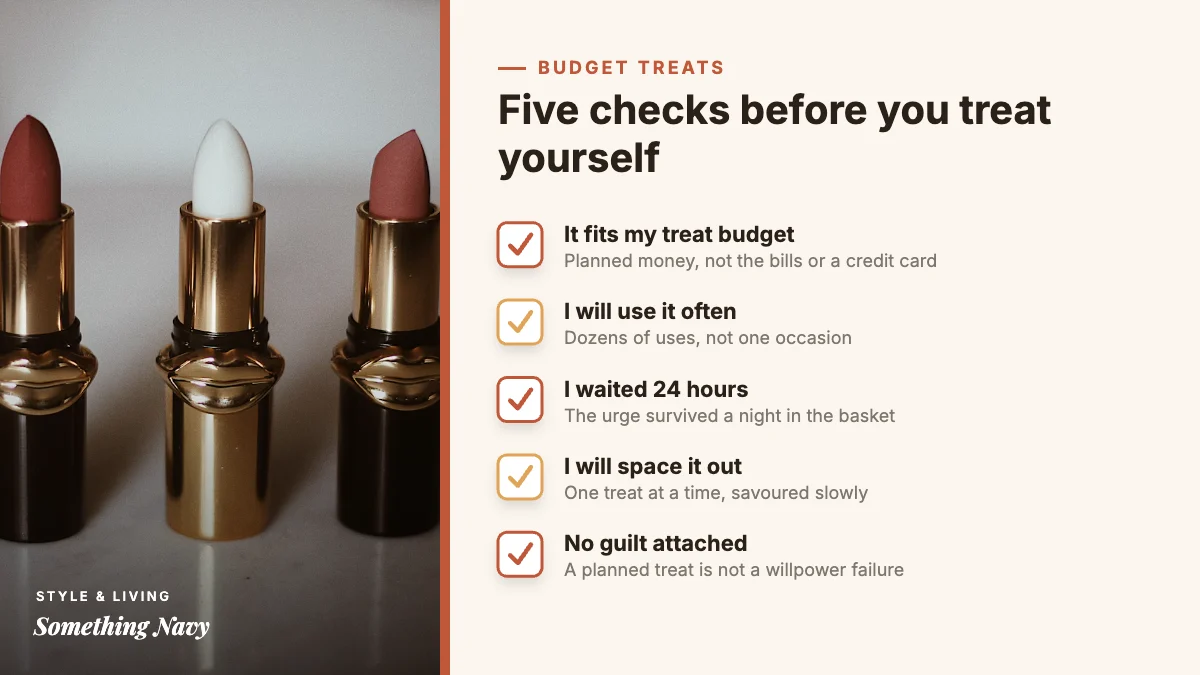
Here are five ways to do it well.
1. Treat yourself on a budget: shrink the price, keep the ritual
In a widely cited 2011 review, psychologists Elizabeth Dunn, Daniel Gilbert and Timothy Wilson argued that money tends to buy more happiness when it goes on many small pleasures rather than a few big ones. Each small treat is a fresh hit of enjoyment, whereas we get used to one big purchase surprisingly fast.
So keep the moment and lower the cost. A proper coffee in a real cup on Saturday morning. A single good bar of chocolate eaten slowly. A lipstick you will wear for months, rather than a jacket you might wear twice. There is more on how spending and wellbeing connect in our piece on whether money buys happiness.
2. Give small luxuries a budget line, not a mood trigger
The treats people regret are usually the unplanned ones, bought in a low moment and then counted again at the end of the month. The fix is boring and effective: give pleasure a line in your budget.
Pick a monthly amount you can genuinely afford, even if it is £10 or £15. Once it is earmarked, spending it is not a slip. It is the plan working. If the money is still there at the end of the month, it rolls over and next month’s treat gets a little better.
3. Choose the treat you will use every day
A useful style rule: the best budget luxury is something you touch often. A great lipstick, a nice hand cream, a silk scrunchie or a candle for the evenings will give you hundreds of small moments. A statement piece for a hypothetical party may give you one.
This is the same arithmetic behind why so many clothes go unworn: price divided by uses. A £14 lipstick worn 100 times costs 14p a wear. That is a treat that earns its keep.
4. Try the imagined basket first
Remember the Michigan finding that even hypothetical shopping choices eased sadness? You can borrow it.
When the urge hits, fill an online basket, choose your shade, compare the two candles. Then close the tab and wait 24 hours. Often the act of choosing does the mood work, and the urge fades. If you still want it tomorrow, and it fits your treat budget, buy it with a clear conscience.
5. Make the moment last longer than the purchase
We get used to good things quickly, a process psychologists call hedonic adaptation. You can slow it down. Space treats out instead of stacking them. Save the new lipstick for a day that needs it, and notice the small ceremony of putting it on.
It helps to drop the guilt, too. A modest, planned purchase is not a failure of willpower. If you would tell a friend her £14 lipstick was fine, say the same to yourself: a little self-compassion goes a long way on a tight budget.
None of this means every hard month should come with a shopping trip. It means the urge behind the lipstick effect is human, predictable and manageable.
So back to that basket. Own-brand pasta, yellow-sticker bread, and one red lipstick that fits the plan. That is not a lapse in a careful month.
It is the part of the careful month that feels like yours.
Frequently asked questions
It is the idea that when money is tight, people cut back on big purchases but keep buying small, affordable luxuries such as lipstick. The term grew out of Leonard Lauder’s 2001 “lipstick index”.
Not really. Lipstick sales were reported to fall after the 2008 crash and makeup sales dropped steeply in 2020, so most analysts treat it as an anecdote rather than a forecasting tool.
In Hill and colleagues’ 2012 study, it did not: recession news made men less interested in all the products tested. Men were not the focus of most later research, so the question is still open.
There is no single right figure. Choose a small monthly amount you can afford without borrowing, plan it in advance and favour things you will use often.
Official links and research
- Hill, S. E., Rodeheffer, C. D., Griskevicius, V., Durante, K. M., & White, A. E. (2012). Boosting beauty in an economic decline: Mating, spending, and the lipstick effect. Journal of Personality and Social Psychology, 103(2), 275–291. DOI
- Netchaeva, E., & Rees, M. (2016). Strategically stunning: The professional motivations behind the lipstick effect. Psychological Science, 27(8), 1157–1168. DOI
- Rick, S. I., Pereira, B., & Burson, K. A. (2014). The benefits of retail therapy: Making purchase decisions reduces residual sadness. Journal of Consumer Psychology, 24(3), 373–380. Link
- Dunn, E. W., Gilbert, D. T., & Wilson, T. D. (2011). If money doesn’t make you happy, then you probably aren’t spending it right. Journal of Consumer Psychology, 21(2), 115–125. Summary via Journalist’s Resource. Link
- Newswise. (2012, 2 July). Recession boosts beauty product sales, study finds [Texas Christian University press release]. Link
- NPR. (2009, 27 January). Lipstick index glosses over spotty data. Morning Edition. Link
- Ossola, A. (2020, 6 August). It is time for the “lipstick index” to go away for good. Quartz. Link
- Morris, C. (2022, 6 May). The ‘lipstick index’ tracked the economy up until the face mask era of the pandemic. Now it’s back. Fortune. Link
Cover photo: Marek Studzinski on Unsplash. Charts and graphics: Something Navy, with photography by Ashley Piszek, Evangeline Sarney and Karly Jones on Unsplash.
How we reported this. Every figure was checked against the 8 sources above. Reviewed by Valentino Adkins, Senior Content Manager. Report an error · How we work