“I’m sorry you feel that way.”
Picture this. It is late on a Sunday, the washing-up is half done, and you have just told your partner that the joke they made about you at dinner, in front of their friends, stung. They turn from the sink, sigh, and say the line above. Six words, one of them “sorry”, and somehow you feel worse than before you spoke.
Most of us have been on both sides of that kitchen. The words are polite. Nobody raised their voice. And yet something in the sentence quietly hands the problem back to you.
Psychologists have spent a surprising amount of time taking apologies apart, clause by clause, to see which bits carry the weight. The short version is encouraging. A good apology is not a mystery or a gift some people are born with. It is built from a handful of parts, and one of them matters far more than the rest.
It is also the part that “I’m sorry you feel that way” leaves out.
“I’m sorry you feel that way”: why the non-apology lands so badly
Listen to where that sentence points. The speaker is sorry, yes, but the thing they are sorry about is your feeling. The joke, the choice to make it, the person who made it: none of them appear. Grammatically, the only actor left in the room is you.
Karina Schumann, a social psychologist who runs the Conflict Resolution Lab at the University of Pittsburgh, spends much of her working life coding what people actually say when they apologise. On the American Psychological Association’s Speaking of Psychology podcast, she singled out the conditional version, the “if anything I did upset you” family, as especially weak. “That’s the worst case scenario,” she said, “because you’re really not even aware it seems of what was wrong.”
She grouped close cousins with it too. Phrases such as “I’m sorry that this hurt you” or “I’m sorry that you were offended” sound softer, but they do the same thing. They make the other person’s reaction the problem, rather than the action that caused it.
That is the sleight of hand at the centre of the non-apology. “Sorry” is present, so the speaker can say they apologised. But the sentence has been built, often unconsciously, so that nobody did anything.

The six parts of an apology, as researchers tested them
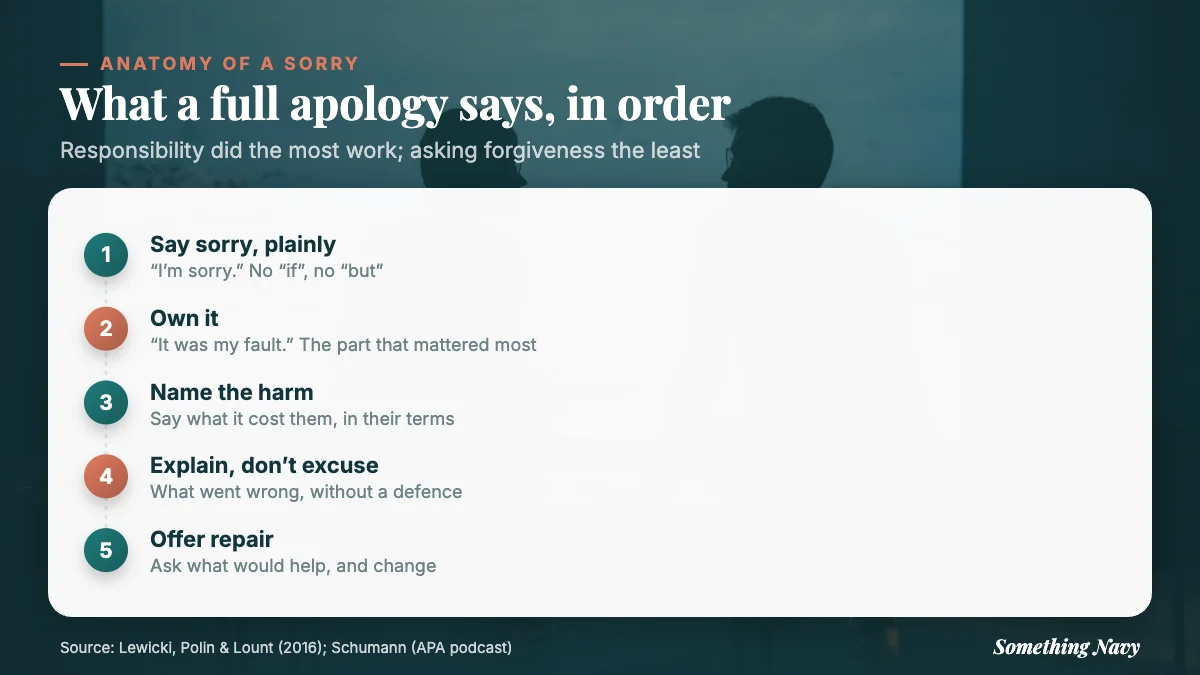
So what does a full apology contain? In 2016, Roy Lewicki of Ohio State University, with Beth Polin and Robert Lount Jr., set out to test that directly. Their paper, published in Negotiation and Conflict Management Research, looked at six components that keep turning up in the apology literature:
- an expression of regret (“I’m sorry”);
- an explanation of what went wrong;
- an acknowledgement of responsibility;
- a declaration of repentance (“it won’t happen again”);
- an offer of repair;
- a request for forgiveness.
The method was simple and rather clever. According to the Association for Psychological Science’s summary, 333 adults taking part online imagined they were managing an accounting department and hiring. One applicant had previously filed a tax return that understated a client’s income, and when confronted, the applicant apologised. The apology contained one, three or all six of the components. For half the participants, the mistake was an honest misreading of the tax rules; for the other half, the applicant had done it knowingly.
Participants rated how effective, credible and adequate each apology felt. A second study ran the same scenarios with 422 college students, this time with apologies rewritten to sound like something a person would actually say out loud.
Two patterns came through. Apologies with more of the six components were rated as more effective. And the components were not equal.
“It was my fault”: the words that did most of the work
One component stood out. “Our findings showed that the most important component is an acknowledgement of responsibility,” Lewicki said when the study was published. Saying, in effect, this was my fault, I made a mistake, was by far the most effective element on its own.
Explaining what went wrong and offering to put things right also mattered, and the researchers counted those among the most important parts of a sincere apology. Right at the bottom sat the request for forgiveness. Of all six elements, asking the other person to forgive you was the least convincing.
“Can you forgive me?” feels like the emotional climax of an apology. To the person who was hurt, it can sound like a new demand: you have just been wronged, and now you are being asked to do something.
There was a second, quieter result. Apologies for the deliberate tax fraud worked less well than apologies for the honest mistake. Words can patch a slip in competence more easily than a lapse in integrity, which will not surprise anyone who has tried to apologise their way out of a lie.
Keep the setting in mind: these were written scenarios about a stranger’s job application, not a betrayal by someone you love. The ranking is a map, not a law. But it points where the rest of this field points: ownership first.
An apology is not a performance of regret. It is a sentence with you as the subject and what you did as the verb.


“I can see how this affected you”: the line most apologies skip
Lewicki’s six parts are not the only way to slice an apology. Schumann’s coding scheme counts a few more, including an acknowledgement of harm: naming, specifically, what your action cost the other person.
It turns out to be the forgotten ingredient. “About 85% to 90% of the apologies that I code don’t include that,” she said on the APA podcast. The example she offered: “Wow, I see how this has affected you.” Followed, crucially, by a description of how.
Go back to the kitchen. Compare “I’m sorry you feel that way” with “I’m sorry. That joke made you the punchline in front of people you barely know, and I didn’t think about how that would feel.” The second version is longer and more awkward. It also proves the speaker was listening.
“But you have to understand…”: how defensiveness leaks into an apology
Most bad apologies are not cynical. They are defensive, and defensiveness has a recognisable grammar.
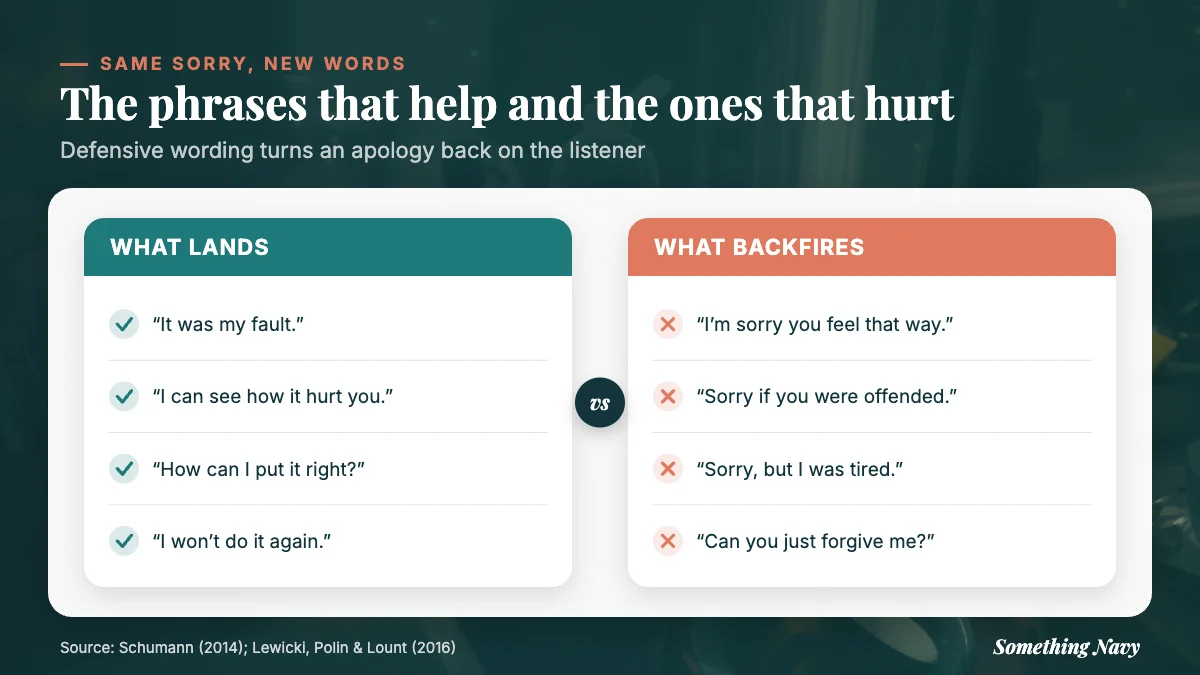
In a 2014 paper in the Journal of Experimental Social Psychology, Schumann asked people to recall an unresolved conflict in which they had been the one who did wrong, then to write what they would say to the person they had hurt. Independent coders went through every response. As she described in a blog post for the Society for Personality and Social Psychology, they looked for the parts of a comprehensive apology and for four defensive moves: justifying the behaviour, blaming the victim, making excuses and minimising the harm.
You will recognise each one by its connective tissue. Justifications arrive after “but”. Victim blaming arrives after “if you hadn’t”. Excuses lean on “I was just”. Minimising hides in “it was only” and “you know I didn’t mean it like that”.
Then came the twist. Some participants had first completed a short values exercise, writing about something that mattered deeply to them. Across two studies, these participants offered more comprehensive apologies and used fewer defensive strategies than the people who had not.
Schumann’s interpretation is that admitting fault threatens our sense of being a good person. When that sense is shored up in some other way first, there is less need to defend it, and more room to attend to the person in front of us. The defensiveness was never really about them.
If the word “defensiveness” rings a bell from couples research, it should. John Gottman lists it as one of the four communication patterns that predict trouble in relationships, and a defensive apology is that pattern wearing a nicer coat.
Does saying sorry actually lead to forgiveness?
An honest answer needs a big dataset, and there is one. In 2010, Ryan Fehr, Michele Gelfand and Monisha Nag pooled 175 studies with 26,006 participants in a meta-analysis for Psychological Bulletin, looking at everything that tends to travel alongside forgiveness.
Apology was among the variables with a notable relationship. Its correlation with forgiveness was .42, a moderate effect in psychology terms. Two other factors were stronger still. Whether the hurt seemed intentional had a correlation of −.49, meaning the more deliberate an offence looked, the less it was forgiven. And state empathy, how much the hurt person could feel their way into the offender’s position, came in at .51.
Read those numbers with care. A correlation shows things go together, not that one causes the other; people who receive apologies may also be dealing with smaller offences. And an apology does not guarantee forgiveness, nor should it.
Still, look at how those findings fit together. Apology helps. So does a sense that the harm wasn’t meant, and so does empathy. A good apology touches all three: it owns the act, often explains how it happened without excusing it, and gives the other person a clearer view of the human being who got it wrong.
In a Pitt Wire feature, Schumann describes apologies as the superglue of life. The glue only holds, though, if the other person believes you. “Sincerity matters the most,” she told the APA, and in her account sincerity is something the listener reads off the words themselves: how complete they are, and how little they defend.
Why “sorry” sticks in your throat
If apologies work, why are they so hard to say? Part of the answer is uncomfortable.
In a 2013 paper with a wonderfully unrepentant title, “Refusing to apologize can have psychological benefits (and we issue no mea culpa for this research finding)”, Tyler Okimoto, Michael Wenzel and Kyli Hedrick asked what happens inside the person who refuses. Across two studies, people recalled or imagined a wrong they had done, and some wrote a message apologising or explicitly refusing to.
Refusing raised people’s self-esteem compared with not refusing. The boost seemed to run through two feelings: a greater sense of power and control, and a sense that they had stayed true to their values. “When you refuse to apologize, it actually makes you feel more empowered,” Okimoto told NPR.
The researchers were not recommending stubbornness, and the NPR report noted that the benefits of apologising for relationships are huge. But refusal pays out in a private currency, and quickly, which helps explain why reconciliation stalls.
We are also poor at predicting how apologising will feel. In research published in Social Justice Research in 2014, Joost Leunissen and colleagues ran two lab experiments and an autobiographical recall study. People who were only anticipating an apology expected it to be more unpleasant than people who had actually apologised reported it to be. The dread, in other words, is bigger than the deed.
That is a useful thing to remember the next time you are standing in the hallway, rehearsing.
“I can do better”: the people who find it easier to own a mistake
Some people apologise more readily than others, and one reason has to do with how they think about character.
In four studies published in 2014 in Personality and Social Psychology Bulletin, Schumann and Carol Dweck of Stanford University looked at people’s beliefs about whether personality is fixed or can change. One of the studies followed cohabiting couples through a week-long diary of everyday conflicts.
People who saw personality as malleable were more willing to accept responsibility for what they had done. The authors suggest that for them, admitting a mistake is less of a verdict on who they are and more of a chance to grow. For people who see character as fixed, every “I was wrong” risks sounding like “I am bad”.
This lines up neatly with the self-affirmation work. Both suggest that the enemy of a good apology is not pride exactly, but threat. Anything that makes “I got this wrong” feel survivable, including a bit of self-compassion, makes the honest words easier to reach for.
There is an irony here, a cousin of the pratfall effect: owning a mistake openly tends to make us look more human, not less.
“Sorry, love”: what apologies do between couples
Most apology experiments use strangers and imaginary offences. Real apologies happen over cold tea between people who will share a bathroom tomorrow.
Schumann tackled that gap in a 2012 diary study titled, perfectly, “Does love mean never having to say you’re sorry?” Sixty married or cohabiting couples rated how satisfied they were with their relationship, then kept daily records of their partner’s transgressions and apologies, how sincere those apologies seemed and how willing they were to forgive.
Apologies predicted forgiveness only for people who were highly satisfied with their relationship. Satisfied partners also tended to see the apologies they received as more sincere, and that perceived sincerity was what linked the apology to forgiveness.
In a good patch, a brief “sorry, love” can be enough, because your partner fills in the sincerity for you. In a strained patch, the apology has to carry its own proof: more specifics, more ownership, less “but”.
The study is modest and shows associations, not cause and effect. But it captures something long-term couples know in their bones. Trust is the medium an apology travels through.
Schumann has also described a simpler engine underneath. “When you empathize a lot with your partner, you offer them an apology in that situation,” she told the APA. Empathy, it seems, works on both sides of the sorry: it helps the offender say it, and it helps the hurt person accept it.
Try saying it this way instead
None of this calls for a script; read word for word, any formula sounds like a hostage statement. But it helps to know which words pull their weight.
Try saying
- Instead of “I’m sorry you feel that way.” Try “I’m sorry I made that joke. It was unkind.”
- Instead of “I’m sorry if anything I said upset you.” Try “What I said upset you, and that’s on me.”
- Instead of “Mistakes were made.” Try “I made a mistake.”
- Instead of “I’m sorry, but I was exhausted.” Try “I was exhausted, and that’s not an excuse. I’m sorry.”
- Instead of “Can you just forgive me?” Try “Is there anything I can do to put this right?”
- Instead of “It was only a comment.” Try “I can see it left you feeling small in front of everyone.”
A few habits are worth taking with you.
Put yourself in the subject position. “I did”, “I said”, “I forgot”. If your sentence would work just as well with nobody in it, it is not an apology yet.
Name the harm in their terms. Not “I know you were upset”, but what it cost them: the embarrassment, the wasted evening, the feeling of not mattering.
Watch the word after “sorry”. If it is “but” or “if”, start again. Explanations can come later, once the other person feels heard, and they should explain rather than excuse.
Offer repair, don’t demand absolution. Asking what would help gives the other person something. Asking for forgiveness takes something.
Let them have their response. Forgiveness may come later, or not in the way you hoped. An apology offered on condition of being accepted is just a transaction with nicer manners.
“I was wrong, and I’m sorry”
Go back to the kitchen one last time. The washing-up is still half done. Your partner turns from the sink, dries their hands slowly on a tea towel, and says it differently.
“I’m sorry. I made you the joke tonight, in front of people you’d only just met. That wasn’t fair, and I should have known better.”
No “if”. No “but”. No request for anything. Just a person, saying what they did, and that they can see what it did to you.
You don’t have to say anything back straight away. You can pick up a plate, and they can pick up the next one, and the silence between you is a different silence now.
Official links and research
- Lewicki, R. J., Polin, B., & Lount, R. B., Jr. (2016). An exploration of the structure of effective apologies. Negotiation and Conflict Management Research, 9(2), 177–196. DOI
- Fehr, R., Gelfand, M. J., & Nag, M. (2010). The road to forgiveness: A meta-analytic synthesis of its situational and dispositional correlates. Psychological Bulletin, 136(5), 894–914. DOI
- Okimoto, T. G., Wenzel, M., & Hedrick, K. (2013). Refusing to apologize can have psychological benefits (and we issue no mea culpa for this research finding). European Journal of Social Psychology, 43(1), 22–31. DOI
- Schumann, K. (2012). Does love mean never having to say you’re sorry? Associations between relationship satisfaction, perceived apology sincerity, and forgiveness. Journal of Social and Personal Relationships, 29(7), 997–1010. DOI
- Schumann, K. (2014). An affirmed self and a better apology: The effect of self-affirmation on transgressors’ responses to victims. Journal of Experimental Social Psychology, 54, 89–96. Link
- Schumann, K., & Dweck, C. S. (2014). Who accepts responsibility for their transgressions? Personality and Social Psychology Bulletin, 40(12), 1598–1610. DOI
- Leunissen, J. M., De Cremer, D., van Dijke, M., & Reinders Folmer, C. P. (2014). Forecasting errors in the averseness of apologizing. Social Justice Research, 27(3), 322–339. DOI
- American Psychological Association. (2022). Why you should apologize even when it’s hard to, with Karina Schumann, PhD [Podcast episode]. Speaking of Psychology. Link
Cover photo: Michaela St on Unsplash. Charts and graphics: Something Navy, with photography by Etienne Boulanger and Devon MacKay on Unsplash.
How we reported this. Every figure was checked against the 8 sources above. Reviewed by Valentino Adkins, Senior Content Manager. Report an error · How we work