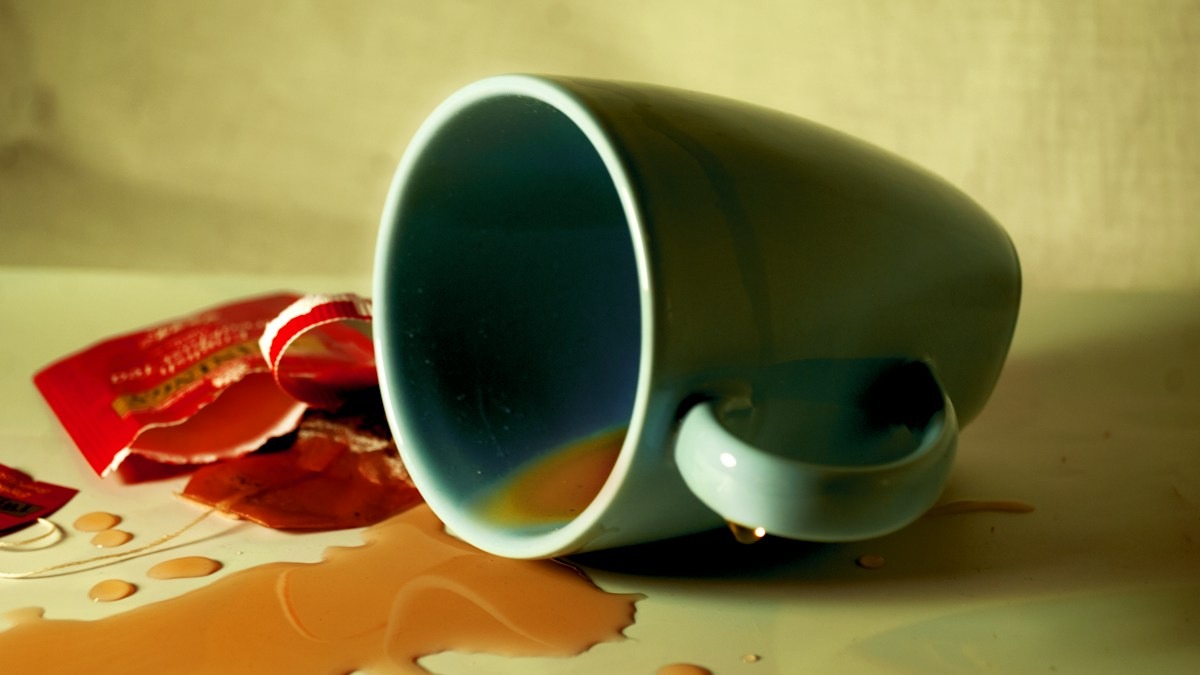
The cup tips. Hot coffee spreads across your shirt in the middle of a meeting where, until ten seconds ago, you were doing rather well.
Your face burns. You assume everyone in the room has just quietly downgraded you.
Sixty years ago, a social psychologist built an experiment around almost exactly that moment. He wanted to know whether a clumsy slip makes people think less of you, or whether, under the right conditions, it does something stranger.
The answer he got has been quoted in management books, dating advice and brand strategy ever since. It is also more conditional than most of those retellings admit.
A quiz-show hopeful and a cup of coffee
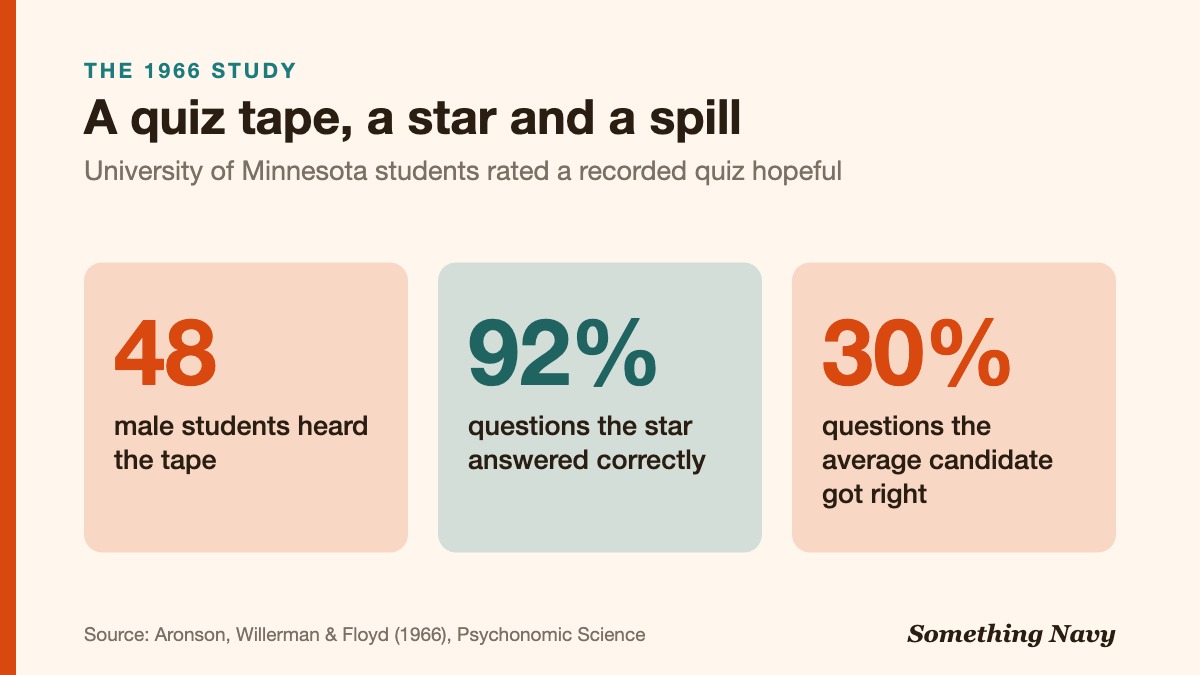
The psychologist was Elliot Aronson, working with Ben Willerman and Joanne Floyd. Their short paper, published in Psychonomic Science in 1966, describes a study run with 48 male sophomores from an introductory psychology course at the University of Minnesota.
The students were told it was a study of how people form impressions. They then listened to a tape recording of a young man described as a student trying out for the College Quiz Bowl team, a nod to the televised university quiz of the era.
The tape came in four versions. In two of them the candidate was brilliant: he answered 92% of the questions correctly and mentioned an impressive track record. In the other two he was distinctly ordinary, getting only 30% right.
Then came the twist. In one of the brilliant versions and one of the ordinary versions, the listeners heard a clatter near the end of the interview, followed by the candidate exclaiming that he had spilled coffee all over his new suit.
That was it: one accident, a few seconds of tape. Afterwards each student rated the candidate on a set of eight questions about how much they liked him and how attractive they found him as a person, which the researchers summed into a single score.
The star who spilled came out on top
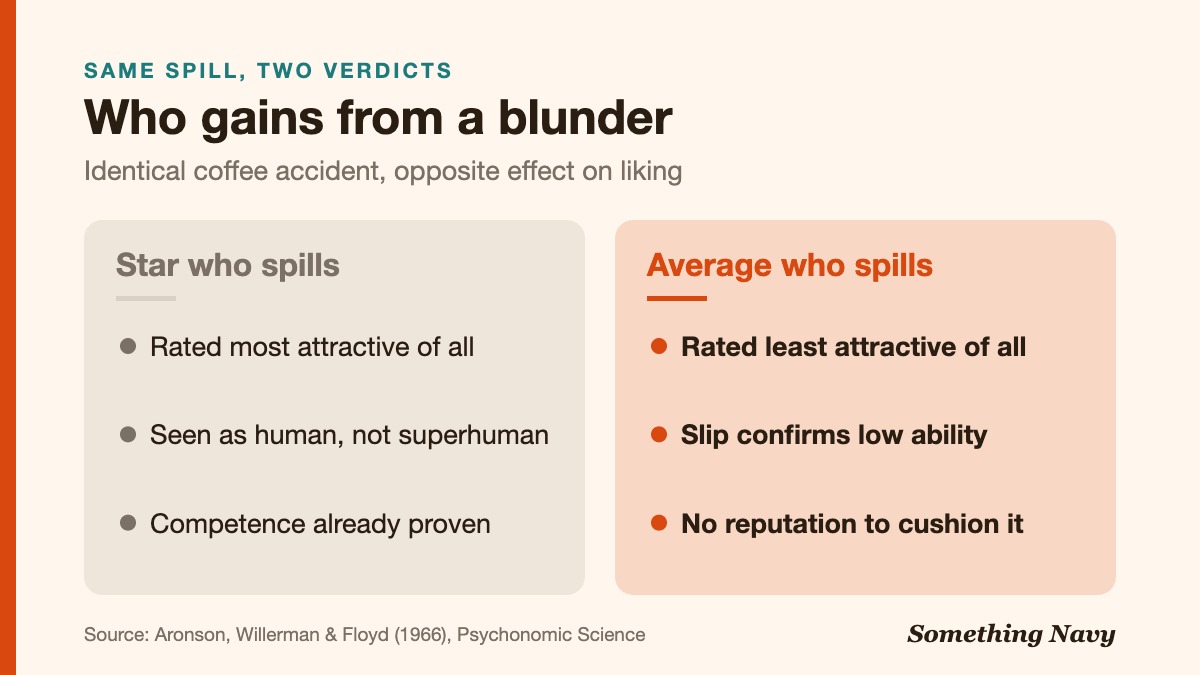
The highest-rated person in the whole experiment was the brilliant candidate who knocked his coffee over. His combined score averaged 30.2.
The lowest-rated was the ordinary candidate who did exactly the same thing. His average was minus 2.5.
Same accident. Same words. Opposite effect.
Statistically, the spill on its own did nothing much. What mattered was the combination: competence plus a blunder pushed liking up, while mediocrity plus a blunder pushed it down. Psychologists call that an interaction, and it is the heart of what became known as the pratfall effect.
| Candidate | Questions right | Spilled coffee? | How he was rated |
|---|---|---|---|
| Superior | 92% | Yes | Most attractive of all four (average score 30.2) |
| Superior | 92% | No | Liked, but less than his clumsy twin |
| Average | 30% | No | In the middle of the pack |
| Average | 30% | Yes | Least attractive of all four (average score −2.5) |
Aronson’s explanation was elegant. A person who seems flawless can feel distant, even slightly threatening. In the paper’s own words, a superior person “may be viewed as superhuman”, and a small slip brings him back down to earth.
The star stops being a performance and starts being a person.
The same slip, a very different verdict
Here is the part that tends to get cut from the motivational posters.
For the average candidate, the coffee did not humanise anything. It simply confirmed what listeners already suspected: this was someone who did not quite have it together. There was no halo of brilliance for the blunder to soften, so it landed as one more mark against him.
That makes the pratfall effect less a rule about mistakes and more a rule about context. A slip reads as charming only when people have already decided you are good at what you do.
A mistake doesn’t create your reputation. It gets read through the one you already have.


Who is watching changes the result
In 1970, Robert Helmreich, Aronson and James LeFan published a follow-up in the Journal of Personality and Social Psychology with a telling title: “To err is humanizing sometimes.” They added the observer’s own self-esteem to the mix, and found that how listeners felt about themselves shaped whether a competent person’s blunder made him more appealing. The word “sometimes” was doing real work.
Two years later, Kay Deaux published a paper whose title says it all: “To err is humanizing: But sex makes a difference.” The original study had used only men, as listeners and as the candidate, and later work suggested that men and women did not react to a stumbling expert in identical ways. That literature is old and patchy, so it is safest to read it as a warning that the effect is not universal, rather than as a neat rule about gender.
Also in 1972, David Mettee and Paul Wilkins tested humorous blunders of different sizes and how similar the observer felt to the person making them. Their title, “When similarity ‘hurts’”, hints at the result: seeing someone you identify with slip up can be uncomfortable rather than endearing, and the size of the blunder mattered too.
Put together, these studies say the pratfall effect is real but fussy. It depends on how capable the person seems, how big the mistake is, and who is doing the judging.
Before you knock over a coffee on purpose
- The 1966 study had 48 participants, all male students at one American university.
- They never met the candidate. They heard an audio tape, so this was a first impression, not a working relationship.
- The blunder was physical and harmless. It said nothing about the candidate’s judgement or honesty.
- Follow-up studies found the effect shifts with the observer’s self-esteem, gender and similarity to the person, and with the size of the slip.
- A staged mistake that people see through is likely to backfire. The research tested accidents, not tactics.
Your slip looks better from the outside
For decades, the pratfall effect was mostly about how we judge other people’s accidents. In 2018, a team at the University of Mannheim turned the question around and asked how we judge our own.
Anna Bruk, Sabine Scholl and Herbert Bless ran seven studies, published in the Journal of Personality and Social Psychology. Most asked participants to imagine showing vulnerability on purpose: admitting a mistake, confessing romantic feelings, asking for help. Some pictured themselves doing it; others pictured someone else.
In one more realistic version, participants were told they would either have to improvise a song in front of a jury or sit on the jury and watch someone else do it. (The performance never actually happened, which is worth remembering.)
Across the studies, people consistently rated their own vulnerability more harshly than the same act by someone else. When they imagined another person owning up to a mistake, they leaned towards seeing courage. When they imagined themselves doing it, they leaned towards seeing weakness. The researchers called this the “beautiful mess” effect.
Their explanation draws on construal level theory. We picture our own exposure up close, in vivid, concrete detail: the silence, the faces, the reddening cheeks. We picture other people’s at a distance, in more abstract terms, and abstract thinking tends to be kinder.
You see the mess. Everyone else is more likely to see the beauty.
It fits neatly alongside the spotlight effect, our habit of overestimating how much other people notice our slip-ups in the first place. The audience in your head is harsher and more attentive than the one in the room.
Even robots get a likeability bump
One of the stranger modern echoes of Aronson’s study comes from robotics.
In 2017, Nicole Mirnig and colleagues at the University of Salzburg had 45 people work with a small humanoid robot on an interview and a LEGO-building task. For 21 of them, the robot was programmed to make mistakes: freezing for 15 seconds, repeating itself, cutting people off, fumbling a LEGO board. For the other 24, it performed flawlessly.
On a five-point likeability scale, the faulty robot scored 4.30 on average, against 3.93 for the perfect one. It was not seen as any more intelligent or more humanlike, just more likeable.
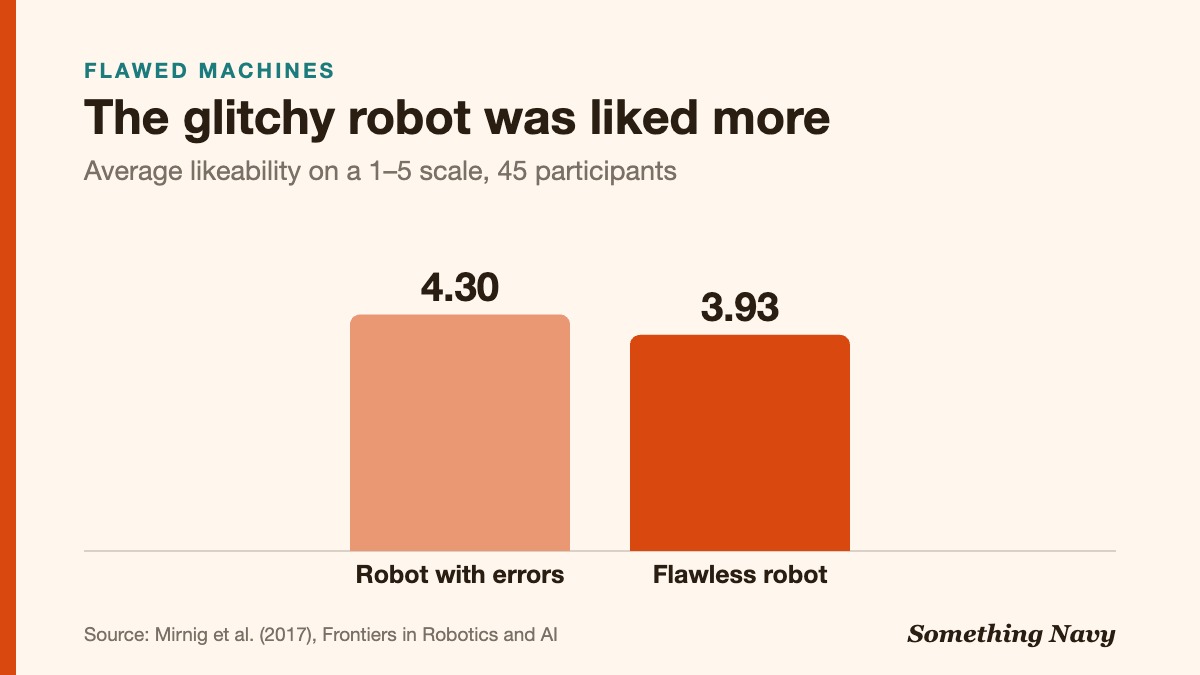
It is a small study, and the difference only just reached statistical significance, so treat it as a curiosity. Still, perfection seems a little off-putting even from a machine.
The marketing version: one small flaw
Marketers have their own cousin of the pratfall effect. In 2012, Danit Ein-Gar, Baba Shiv and Zakary Tormala reported a “blemishing effect” in the Journal of Consumer Research: across four lab and field studies, adding a small dose of negative information to an otherwise glowing product description could make people like the product more.
The conditions matter, and they mirror Aronson’s. The flaw had to be minor. It had to come after the positive information, not before. And it worked when people were taking in the description casually rather than scrutinising every word.
What this means at work
The useful lesson is not “make mistakes”. It is closer to “stop hiding the small ones”.
If you are good at your job and people know it, owning a minor slip quickly (the wrong attachment, the mispronounced name, the meeting you double-booked) is unlikely to cost you much, and may make you easier to work with. Colleagues who never see you get anything wrong can find you hard to approach, and harder still to bring their own problems to.
For leaders, this matters more. A manager who says “that was my call, and it was the wrong one” makes it safer for everyone else to admit errors early, when they are cheap to fix.
But the 1966 caveat applies in full. If you are new, or your competence is still being judged, a string of slips will not read as charming. Build the track record first. And if you often feel like a fraud despite good evidence that you are not, it is worth reading about imposter syndrome before you assume your mistakes are as visible as they feel.
On a date, and with friends
The same logic holds in dating, with one adjustment: the “competence” that matters here is less about skills and more about being socially at ease and basically trustworthy.
Laughing when you trip on the restaurant step, or admitting you practised the name of the wine, can make you warmer and more real. Confessing something sizeable on a first date is a different matter. The pratfall research is about small, harmless slips, not about a pile of red flags.
Being slightly imperfect in front of someone is a kind of invitation.
How to let a mistake work for you
None of this research says you should engineer accidents. People are good at spotting staged humility, and the studies all tested genuine, unplanned slips. What it does suggest is a better way of handling the ones that happen anyway.
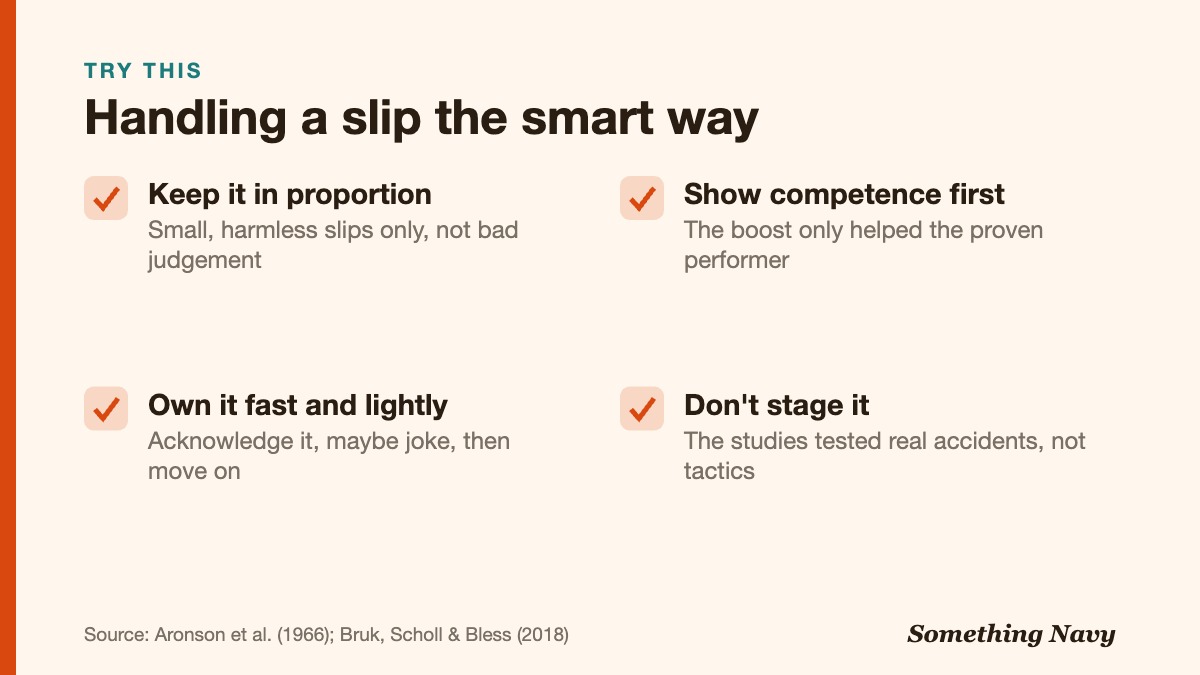
- Keep it in proportion. Every study here involved minor, harmless blunders. A mistake that hurts someone or reveals poor judgement is not a pratfall.
- Own it fast and lightly. A quick acknowledgement, maybe a joke, and then back to the work. Over-apologising turns a small moment into a big one.
- Let your competence do the heavy lifting. The effect only helped the candidate who had already shown he was good.
- Remember the beautiful mess. Whatever you think the room saw, they probably judged it more kindly than you are judging yourself.
If a mortifying moment keeps replaying in your head at 2am, there is a whole body of research on why cringe memories stick around and what to do about them.
Sixty years on, what still holds up
The original pratfall study was tiny by modern standards, used a single audio tape, and recruited only young men from one university in the 1960s. It would not, on its own, pass muster as strong evidence today.
What has lasted is the shape of the idea, which later work has tested from several angles. Flawlessness can feel cold. Competence plus a small, genuine slip tends to read as human. And the same slip, from someone whose ability is in doubt, reads as exactly what it is.
So the next time the coffee goes everywhere, it is worth remembering what was actually on that tape in Minnesota. The listeners did not like the star because he spilled his drink. They liked him because he was good, and the spill reminded them he was also one of them.
Frequently asked questions
It is the finding that a person who is clearly competent can become more likeable after a small, harmless blunder, because the slip makes them seem more human and approachable.
No. In the original 1966 study, the same coffee spill made an average performer less likeable. The boost only appeared for someone already seen as highly capable.
The research tested genuine accidents, not staged ones, and people tend to notice when humility is performed. It is better to handle real slips honestly than to manufacture them.
It is a 2018 finding from the University of Mannheim that people judge their own acts of vulnerability, such as admitting a mistake, more harshly than they judge the same acts in others.
Sources
- Aronson, E., Willerman, B., & Floyd, J. (1966). The effect of a pratfall on increasing interpersonal attractiveness. Psychonomic Science, 4(6), 227–228. DOI
- Helmreich, R., Aronson, E., & LeFan, J. (1970). To err is humanizing sometimes: Effects of self-esteem, competence, and a pratfall on interpersonal attraction. Journal of Personality and Social Psychology, 16(2), 259–264. DOI
- Mettee, D. R., & Wilkins, P. C. (1972). When similarity “hurts”: Effects of perceived ability and a humorous blunder on interpersonal attractiveness. Journal of Personality and Social Psychology, 22(2), 246–258. DOI
- Ein-Gar, D., Shiv, B., & Tormala, Z. L. (2012). When blemishing leads to blossoming: The positive effect of negative information. Journal of Consumer Research, 38(5), 846–859. DOI
- Mirnig, N., Stollnberger, G., Miksch, M., Stadler, S., Giuliani, M., & Tscheligi, M. (2017). To err is robot: How humans assess and act toward an erroneous social robot. Frontiers in Robotics and AI, 4, 21. DOI
- Bruk, A., Scholl, S. G., & Bless, H. (2018). Beautiful mess effect: Self–other differences in evaluation of showing vulnerability. Journal of Personality and Social Psychology, 115(2), 192–205. DOI
Cover photo: Chiara Guercio on Unsplash. Charts and graphics: Something Navy.
How we reported this. We went back to the original research for this story, 6 sources in all, listed above, and checked every figure against them. If you think we have got something wrong, tell us and we will look at it. Read more about how we work.