Shampoo in one hand, eyes shut against the suds, and there it is. The opening line for the speech. The reason the spreadsheet won’t balance. The name you couldn’t remember on Tuesday.
You had spent an hour at your desk trying to summon that thought. It arrived, uninvited, somewhere between rinse and repeat, at the precise moment you had nothing to write with.
This is so common it has its own internet genre. It also has a growing research literature, and the most interesting finding is not about water at all.
In 2022 a team led by the philosopher Zac Irving reported that letting your mind drift helped people come up with fresh ideas only when the thing they were doing was moderately engaging. Not gripping. Not dull. Somewhere in between, which is exactly where a shower sits.
So here is the shower test: six reasons, counted down, why the bathroom keeps beating the boardroom.
The shower test, scored from six to one
A quick word on terms. Psychologists call the gap between working on a problem and solving it “incubation”: you set the problem aside, do something else, and come back better off. “Mind-wandering” is what your head gets up to in the meantime, the drift towards thoughts that have nothing to do with the task in front of you.
The shower combines both. Here is how it scores.
6. Your mind was going to wander anyway
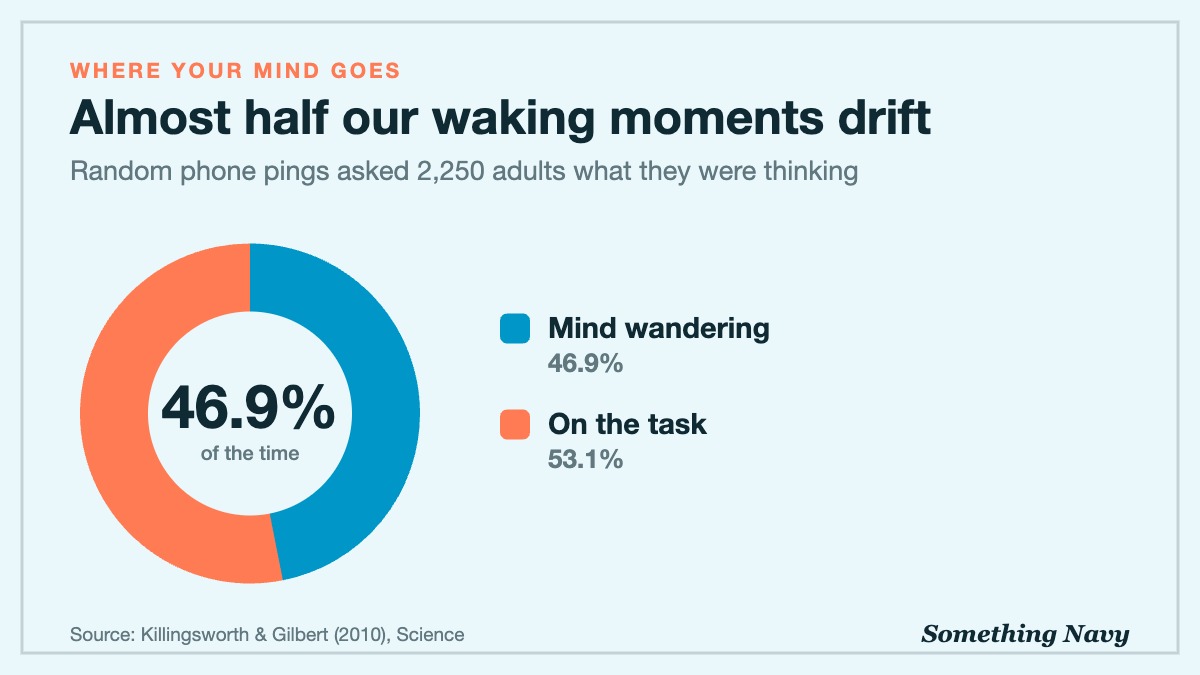
Start with the raw material. In 2010 the Harvard psychologists Matthew Killingsworth and Daniel Gilbert built an iPhone app that pinged 2,250 adults at random moments and asked what they were doing, what they were thinking about and how they felt. The results, published in Science, drew on about 250,000 replies.
People were thinking about something other than what they were doing 46.9% of the time. That left only 53.1% of waking moments with attention firmly on the task in hand.
There was a sting in it. The same study found that wandering minds were, on average, less happy minds, and the timing of the replies suggested the wandering tended to come before the low mood rather than after it. As the researchers wrote, the ability to think about what isn’t happening is a cognitive achievement that “comes at an emotional cost” (Harvard Gazette).
So the drift is not a rare gift. It is the default setting, and not always a pleasant one. The shower question is really: when does all that drifting pay its way?
5. Stepping away really does help (a bit)
The best overview of incubation comes from Lancaster University. In 2009 Ut Na Sio and Thomas Ormerod pooled 117 studies involving 3,606 participants for a meta-analysis in Psychological Bulletin.
They found a genuine incubation effect, with an average effect size of 0.29. In plain terms, that is small to moderate: real, repeatable, not magic.
The detail is more useful than the headline. Breaks helped most on divergent thinking tasks, the “list as many uses as you can for a brick” kind, where there is no single right answer. They helped more when people had spent longer wrestling with the problem first. And they helped less when the break was filled with something mentally demanding.
One more finding from the same review deserves a gold star. For word-based insight puzzles, the kind where a single missing link suddenly clicks, breaks filled with a low-demand task produced a bigger effect than breaks spent simply resting.
Which brings us to the shampoo.
4. Easy beats hard, and also beats doing nothing
In 2012 Benjamin Baird, Jonathan Schooler and colleagues at the University of California, Santa Barbara ran the experiment that put the shower effect on the scientific map. They asked 145 students to think of unusual uses for everyday objects, then gave them a 12-minute break.
The break came in four flavours. Some students did a demanding memory task. Some did an undemanding task (pressing keys in response to simple prompts). Some simply rested. Some got no break at all.
When everyone tried again, only one group improved: the people who had done the easy task. They also reported more mind-wandering during it. The results appeared in Psychological Science.
Rest, interestingly, did not do the trick. Neither did a hard task that soaked up all the attention. The winning combination was something to keep the hands and eyes occupied, with plenty of spare mental capacity left over.
That is a decent description of washing your hair.
3. It only works on problems you have already met
Here is the part of Baird’s study that rarely makes the headlines. After the break, students tackled two problems they had seen before and two brand-new ones. The improvement showed up only on the problems they had already started.
That fits Sio and Ormerod’s finding about preparation. The shower is not a vending machine for ideas. It works on whatever you loaded into it beforehand, ideally something you were properly stuck on.
It also echoes the Zeigarnik effect, the tendency for unfinished business to keep nagging at us. Leave a problem half-solved and it seems to keep a seat warm in the back of your mind.
The idea that ambushes you under the hot water is usually the answer to a question you asked an hour ago.
2. There is no phone in the cubicle
This one is less a finding than an observation, but it matters. The shower is one of the last places most of us are reliably unreachable. No notifications, no quick scroll, no “just checking”.
Baird’s work suggests why that is valuable. The demanding task in his study wiped out the benefit of the break, and a feed full of headlines, messages and other people’s holidays is many things, but undemanding is not one of them. There is also evidence that a phone sitting nearby can quietly drain attention even when you are not using it.
Nobody has yet run a clean trial of “shower with phone” against “shower without”. But if the recipe is low demand plus spare attention, a screen is the fastest way to spoil it.
1. It is just engaging enough
And so to number one, and the study that gave the phenomenon its name. Irving, a philosopher at the University of Virginia, teamed up with the psychologist Caitlin Mills of the University of Minnesota to ask why earlier experiments had produced such mixed results.
Their argument: many studies used deliberately boring tasks, and boredom is not what a shower feels like. So in an experiment with 222 participants recruited at the University of New Hampshire, they had people spend 90 seconds listing alternative uses for a brick or a paperclip.
Then came a three-minute video. Half watched a scene from When Harry Met Sally. The other half watched two men folding laundry. Afterwards, everyone got a surprise 45 seconds to add more ideas.
Among the Harry Met Sally viewers, more mind-wandering went with more ideas. Among the laundry watchers, it did not. A second experiment, with 118 people, pointed the same way. The paper, published in Psychology of Aesthetics, Creativity, and the Arts, is titled simply “The shower effect”.
Irving’s examples of the sweet spot were walking, gardening and taking a shower. His example of what to avoid, quoted by UVA Today: “Probably not something mind-numbingly boring like watching paint dry.”
Boredom gives your mind room to wander. A shower gives it somewhere interesting to go.
Something Navy
The small print on a big idea
Before you start billing your water company as a creative consultant, some honesty.
These are lab studies, mostly with university students, using puzzles such as listing uses for a brick. That is a long way from writing a novel or fixing a business plan. Effects were modest, and the improvements were measured over minutes, not months.
And not everything has held up. In a paper published online in 2021, a team including Paul Seli at Duke University ran a conceptual replication of the incubation experiment across two studies with 443 people in total. In their words, they “found no evidence for the claim” that mind-wandering during the break boosts this kind of creativity.
Their explanation is worth hearing. Measuring mind-wandering simply as “thinking about something other than the task” may be too blunt, lumping together useful free association with worrying about your tax return. Irving’s team made a similar point, which is partly why they focused on how engaging the activity was.
None of this makes the shower effect a myth. It means the mechanism is less tidy than the internet version, in which hot water somehow switches on genius. The water is incidental. The pause is the point.
The fair summary: stepping away from a problem helps a little, fairly reliably. Whether wandering thoughts are the reason is still being argued over.
How to build a shower moment without running the taps
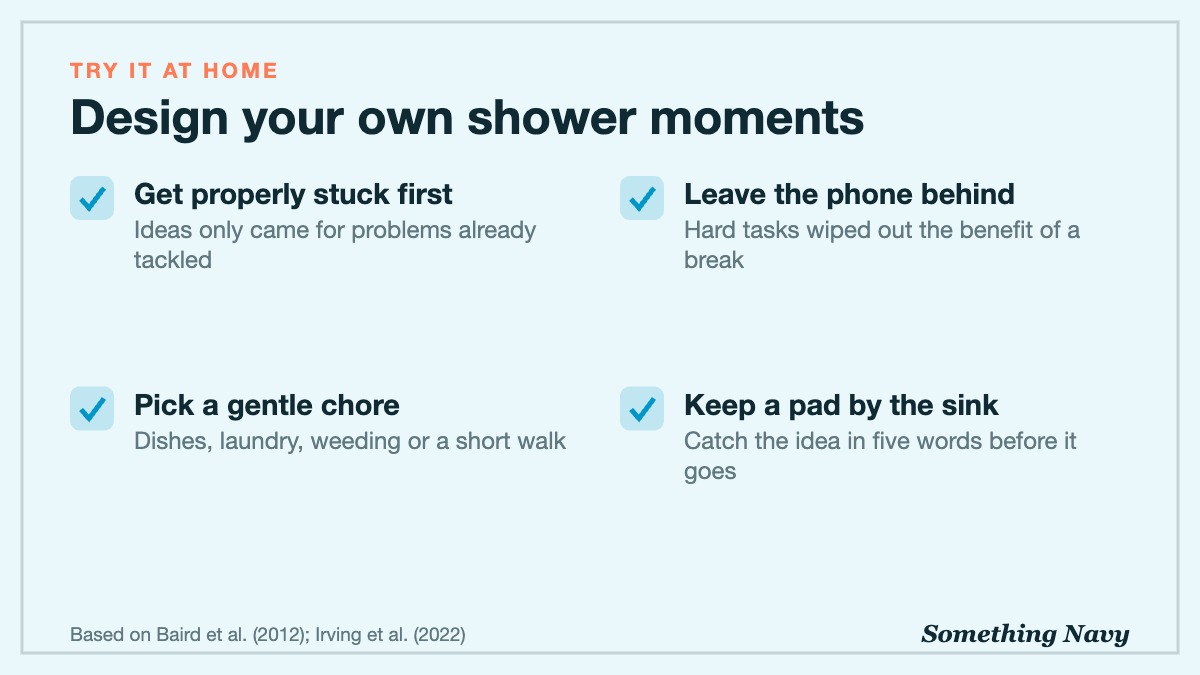
You cannot spend all day in the bathroom (and your housemates would have views). But the ingredients travel well: a problem you have genuinely chewed on, a task that occupies your hands without hogging your head, no screen, and a way to catch whatever floats up.
Most homes are full of candidates. Washing up. Hanging laundry. Weeding. Chopping vegetables. A walk round the block without headphones, which also nudges up your daily step count. These are the chores most of us rush through while listening to something. Try leaving the gap empty instead.
Try this: the 20-minute stuck test
- Work on the problem properly first. Write down exactly where you are stuck.
- Then pick a moderately engaging chore: dishes, folding, a short walk. Leave the phone in another room.
- Don’t force it. Let your thoughts drift wherever they like.
- Return to the problem straight after and look at it fresh. Note whether anything shifted.
Keep a pencil by the sink
The cruel joke of the shower thought is that it arrives where you cannot write it down, and by the time you are dry it has a habit of slipping away. So plan for the catch.
A notepad on the kitchen windowsill. A pencil in the garden shed. A waterproof notepad in the bathroom if you are serious. Write the idea in five words, not fifty; you can tidy it later.
None of this needs willpower or an app. It needs a little emptiness, deliberately left in the day, and a problem to put in it.
Your best idea this week probably will not come at your desk. Give it somewhere else to land.
Sources
- Baird, B., Smallwood, J., Mrazek, M. D., Kam, J. W. Y., Franklin, M. S., & Schooler, J. W. (2012). Inspired by distraction: Mind wandering facilitates creative incubation. Psychological Science, 23(10), 1117–1122. DOI
- Irving, Z. C., McGrath, C., Flynn, L., Glasser, A., & Mills, C. (2022). The shower effect: Mind wandering facilitates creative incubation during moderately engaging activities. Psychology of Aesthetics, Creativity, and the Arts. Advance online publication. DOI
- Killingsworth, M. A., & Gilbert, D. T. (2010). A wandering mind is an unhappy mind. Science, 330(6006), 932. DOI
- Murray, S., Liang, N., Brosowsky, N., & Seli, P. (2024). What are the benefits of mind wandering to creativity? Psychology of Aesthetics, Creativity, and the Arts, 18(3), 403–416. DOI
- Sio, U. N., & Ormerod, T. C. (2009). Does incubation enhance problem solving? A meta-analytic review. Psychological Bulletin, 135(1), 94–120. DOI
- Williamson, E. (2022, October 5). Finally, the real answer why your best ideas come while showering. UVA Today. Link
Cover photo: Zac Gudakov on Unsplash. Charts and graphics: Something Navy.
How we reported this. We went back to the original research for this story, 6 sources in all, listed above, and checked every figure against them. If you think we have got something wrong, tell us and we will look at it. Read more about how we work.