

It is Sunday night and the washing-up can wait. You are on the sofa with your partner, and your eldest has the tablet, swiping through a rescue centre’s page. A lurcher with one ear up. A grey-muzzled spaniel the volunteers describe as a perfect gentleman. A cat called Biscuit who apparently dislikes other cats, children and Mondays.
Someone says it out loud: we would be happier with a dog. Nobody argues. The walks would happen and the kids would put their phones down. It feels less like a decision than a forecast.
Then the adult part of your brain, the part that pays the vet bills, asks a quieter question. Is that actually true? Do pets make you happier, or do happier, healthier, better-off people simply tend to own pets?
Scientists have argued about this for decades, and the answer is more honest than either the greetings card version or the cynic’s.

The pet effect: where the idea that pets make us happier came from
In research circles the belief has a name: the “pet effect”, the claim that living with a companion animal improves your mental and physical health. It is a lovely idea, and it has some striking numbers behind it.
The trouble is separating cause from coincidence. People who get dogs are not a random slice of the population. They are more likely to have gardens, steady incomes, time at home and the physical health to walk twice a day. Any study comparing owners with non-owners has to untangle all of that before it can say anything about the dog itself.
Keep that in mind. It turns out to be the whole story.
The big dog studies: lower death rates in Sweden
The most cited piece of evidence comes from Sweden, where dog registration has been mandatory since 2001. That gave researchers an official record of dog owners to link with national health registers.
Mwenya Mubanga, then a PhD student at Uppsala University, and Tove Fall, an associate professor of epidemiology there, led a team that followed 3,432,153 Swedes aged 40 to 80 who had no history of cardiovascular disease in 2001. They tracked them for up to 12 years. The results were published in Scientific Reports in November 2017.
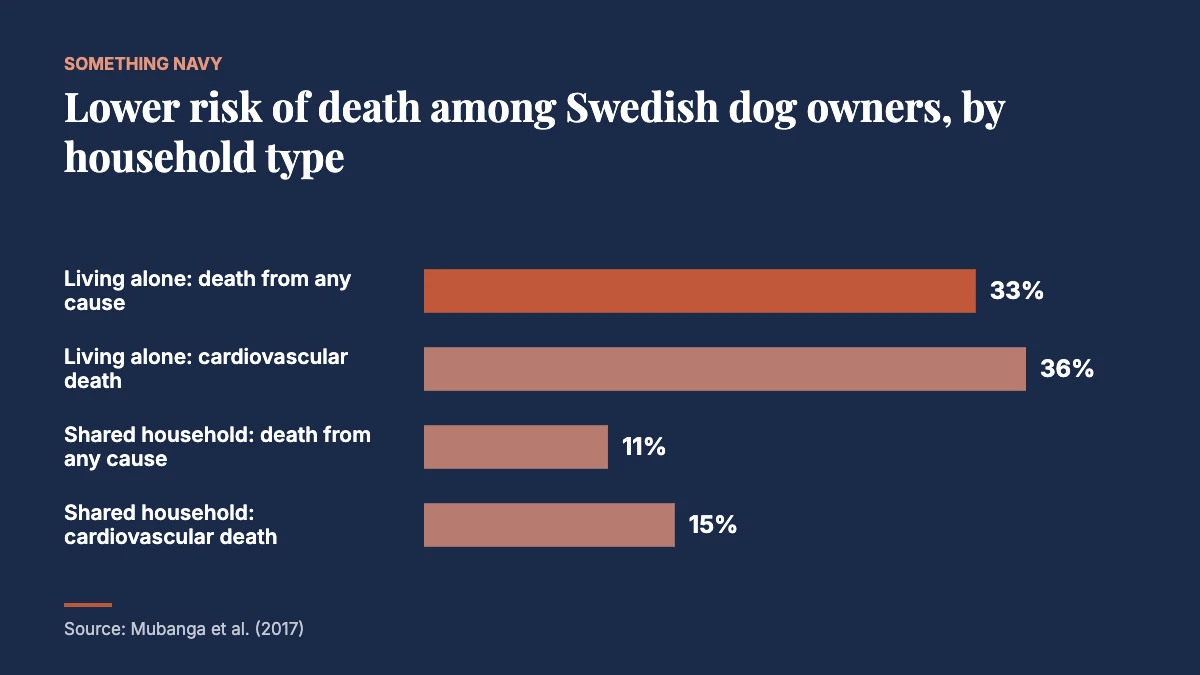
Dog owners had a lower risk of dying from cardiovascular disease and from any cause. The effect was largest among people who lived alone. Compared with single people without a dog, single dog owners had a 33% lower risk of death from any cause during the follow-up and a 36% lower risk of dying from cardiovascular disease. In households of two or more, the reductions were smaller: 11% for death from any cause and 15% for cardiovascular death.
There were some odd wrinkles. Owners of breeds originally bred for hunting appeared to have the greatest protection, while mixed-breed ownership was linked with slightly higher cardiovascular risk. And when the team ran a separate analysis on Swedish twins, which helps control for shared genes and upbringing, they found no significant association between dog ownership and cardiovascular disease.
Fall was careful at the time, saying this kind of study cannot show whether or how dogs protect the heart. Dog walking might explain it; so might differences between owners and non-owners that existed before anyone bought a dog.
A meta-analysis puts the figure at 24%
Two years later, Caroline Kramer of the University of Toronto and Mount Sinai Hospital, with colleagues Sadia Mehmood and Renée Suen, pooled the best available studies. Their systematic review, published in October 2019 in the American Heart Association journal Circulation: Cardiovascular Quality and Outcomes, combined 10 studies covering more than 3.8 million people.
Dog owners had a 24% lower risk of death from any cause. Cardiovascular mortality was 31% lower, and among heart attack survivors the risk of death was 65% lower.
That headline travelled fast. Kramer was more measured, describing an association rather than proof and acknowledging that the analysis did not account for confounders such as fitness or healthier lifestyles. She said the next step should be an interventional study.
A dog might keep you alive longer without making you any happier, and those are two very different promises.
Why some researchers think the pet effect is overstated
In 2011, Harold Herzog, a psychology professor at Western Carolina University, published a short paper in Current Directions in Psychological Science with a title that asked whether the health benefits of pets were “fact, fiction, or hypothesis”. It has become the standard critique.
Herzog’s point was not that pets are bad for you but that the evidence was a mess. For every study linking pet ownership to lower blood pressure or less depression, another found owners no better off, or worse off in some respects. He blamed the methods: small samples drawn from narrow groups, a lack of proper control groups and heavy reliance on people’s own reports of how healthy and happy they felt.
His conclusion was blunt. In the press release that accompanied the paper, he said “there simply isn’t strong evidence for the general claim” that pets make people happier, healthier or longer-lived. He did not rule out real benefits for some people; he said nobody knew how big they were or who they helped.
The RAND study that controlled for 100 things
One of the clearest demonstrations of Herzog’s warning came in 2017 from the RAND Corporation in the United States. Jeremy Miles, Layla Parast, Susan Babey, Beth Ann Griffin and Jessica Saunders used data from the 2003 California Health Interview Survey, the one year it asked about pets. They compared more than 2,200 children in homes with a dog or cat with roughly 3,000 households without one. The study appeared in Anthrozoös.
At first glance the pet children looked better off. They were in better general health and more physically active, and their parents worried less about their mood, behaviour and learning.
Then the team used a statistical technique called propensity score weighting to balance the two groups on more than 100 variables, including family income, housing type and language skills. Once those differences were accounted for, the link between pets and better health disappeared. The pets were not doing the work. The circumstances of the families who owned them were.
It covered children, not adults, and it is correlational too. But it shows how easily a “pet effect” can turn out to be a “comfortable household effect” wearing a collar.
What happened to pet owners during lockdown
The pandemic gave researchers an unplanned test. Millions of people were stuck at home, many of them alone. If pets protect mental health, 2020 should have shown it.
The York and Lincoln survey: a buffer, but a small one
Elena Ratschen of the University of York and Daniel Mills of the University of Lincoln led an online survey of 5,926 UK adults during the first lockdown, published in PLOS ONE in September 2020. Almost nine in ten respondents, 89.8%, had at least one companion animal.
Compared with non-owners, owners reported smaller declines in mental health and smaller rises in loneliness since lockdown began. In figures released alongside the study, 90% of owners said their animal had helped them cope emotionally, though 68% also said they worried about their pets, mostly over practical care. One unexpected detail: the emotional closeness people reported did not differ significantly by species.
The survey was a one-off snapshot and the differences were modest. People whose mental health was poorer before lockdown also reported stronger bonds with their animals, which hints that struggling people may lean harder on their pets, rather than pets making people feel better.
The 2024 follow-up that found no benefit at all
A larger and longer study arrived in September 2024. Christine Parsons of Aarhus University in Denmark and Katherine Young, with colleagues at King’s College London, followed 6,018 UK adults for 12 months as part of the Repeated Assessment of Mental Health in Pandemics study. Using standard questionnaires for depression, anxiety, loss of pleasure and loneliness, they published the results in Mental Health & Prevention.
The title of the paper gives away the ending: no beneficial associations between living with a pet and mental health outcomes. If anything, pet owners reported slightly higher depression, anxiety and anhedonia than non-owners. Dog owners did exercise daily more often, 40% against 35%, but it did not show up as better mental health.
There was one exception, and it echoes Sweden. Among people who lived alone, both dog and cat owners reported slightly less loneliness, though the effect was small. For people living with partners, family or housemates, owning a pet made no measurable difference to loneliness. Parsons summed it up kindly: pets, she said, “are by no means a cure-all for mental health issues.”
It is one cohort, recruited during a pandemic, but it is hard to square with the idea that a pet reliably lifts your mood.
| Study | Who was studied | What it found |
|---|---|---|
| Mubanga et al., 2017 | 3.4 million Swedes aged 40 to 80 | Lower death rates in dog owners, strongest in people living alone |
| Kramer et al., 2019 | 10 studies, 3.8 million people | 24% lower risk of death from any cause in dog owners |
| Miles et al., 2017 | Over 5,000 Californian households | Health advantage vanished after controlling for 100+ factors |
| Ratschen et al., 2020 | 5,926 UK adults in lockdown | Owners’ mental health dipped slightly less than non-owners’ |
| Parsons et al., 2024 | 6,018 UK adults over 12 months | No mental health benefit; slightly less loneliness only for those living alone |
| Gmeiner and Gschwandtner, 2025 | About 2,500 UK households | Pets linked to life satisfaction worth up to £70,000 a year |
The newest research: life satisfaction and the ageing brain
Not all recent work is deflating. In March 2025, Michael Gmeiner of the London School of Economics and Adelina Gschwandtner of the University of Kent published a study in Social Indicators Research that tried to get closer to cause and effect. They used the Innovation Panel of the UK Household Longitudinal Study, a long-running survey of roughly 2,500 British households.
Their trick was an instrumental variable: a factor linked to having a pet but, in theory, not directly to happiness. They chose how often people kept an eye on a neighbour’s property while the neighbour was away, and controlled for how well people got on with their neighbours in the first place.
By their calculation, a pet companion was worth up to £70,000 a year in life satisfaction, roughly comparable to the value other studies place on seeing friends and relatives regularly. Gschwandtner’s explanation was simple: “You have your pet every day.”
It is a striking figure, but treat it gently. That £70,000 is an upper estimate from a particular economic method, and instrumental variables are only as good as the instrument. Megan Mueller of Tufts University, who was not involved, told CNN that results in this field depend heavily on how wellbeing is measured.
Another 2025 paper, in Scientific Reports, looked further down the road. Rostekova and colleagues analysed 18 years of data from the Survey of Health, Ageing and Retirement in Europe, covering adults aged 50 and over. Compared with owning no pet, owning a dog was associated with slower decline in memory, and owning a cat with slower decline in verbal fluency and delayed recall. Owning birds or fish was not. It is observational, but the split by species is intriguing.


So do pets make you happier? What the evidence adds up to
The link between dogs and living longer keeps turning up in very large samples. It is not proven to be causal, and the Swedish twin analysis shows how much shared background can explain. Still, it is plausible that a dog gets you outside and gives your day structure.
The link between pets and day-to-day happiness is much shakier. The better controlled a study is, the more the advantage tends to shrink, and the longest lockdown study found none at all. Herzog’s 2011 warning has aged well.
The one finding that keeps reappearing across very different studies is about people who live alone. In Sweden the mortality gap was two to three times bigger for single owners. In the 2024 lockdown study, the only benefit was slightly lower loneliness among people living alone. If a pet does anything for wellbeing, it may matter most where there is no other heartbeat in the house. That fits what we know about the scale of loneliness in modern life.
There is also the question of novelty. The rush of the first weeks with a puppy is real, but so is hedonic adaptation, the tendency for even wonderful changes to become normal. A dog that was a joy in May can feel like a 6am obligation by February.

UK pet ownership in 2026: how many of us have one
If you do get a pet, you will have plenty of company. According to the PDSA Animal Wellbeing (PAW) Report 2026, run with YouGov and drawing on a panel survey of 10,000 UK adults, 27% of adults own a dog, which works out at an estimated 10.2 million pet dogs. Some 24% own a cat, an estimated 11.3 million animals. Rabbits trail well behind at 2% of adults and about 700,000 animals.
One detail is worth noting for anyone on a rescue site on a Sunday night. PDSA’s figures show the share of dog owners who got their dog from a rescue or rehoming centre fell from 22% in 2018 to 17% in 2024.
The real costs and responsibilities of owning a pet
Whatever the research says about wellbeing, the costs are not in dispute. PDSA’s own estimates, calculated in 2024 from online prices, put the minimum monthly cost of a dog at £69 for a small breed, £83 for a medium one and £116 for a large one. Over a lifetime that adds up to roughly £6,200 to £12,000 for a small dog, £9,000 to £14,000 for a medium dog and £8,200 to £18,800 for a large dog. A cat costs a minimum of around £79 a month, or £11,400 to £13,600 over its life.
Those are floors, not averages. They cover things like food, insurance, vaccinations, flea and worm treatments and basic kit. They leave out the price of buying or adopting the animal, vet bills for illness or injury, boarding when you go on holiday, special diets, grooming and training classes. Most of us are prone to the planning fallacy when it comes to budgets, and pets are a classic case: we picture the walks, not the dental surgery.
Then there is time. A dog needs daily exercise, company and someone to look after it when you are away. Rabbits, PDSA notes, are social animals that need a companion of their own; the charity estimated in 2024 that around 400,000 pet rabbits were not having that need met.
None of this argues against pets. It argues for choosing one because you want the animal and the routine, not because a headline promised you would live longer.
A better question to ask on a Sunday night
Back on the sofa, the honest answer to “would we be happier with a dog?” is: possibly, but the research cannot promise it. Families who get pets tend to be doing fine already, and careful studies struggle to find a lasting mood boost once that is accounted for.
What the evidence does suggest is more modest and, in a way, more useful. Pets seem to matter most for people who would otherwise be alone. Dogs are tied to a longer life, even if nobody has yet proved why. And the benefits, where they exist, come from the daily business of care: the walks, the feeding, the stroking, the reason to get up.
So perhaps the better question is not whether a pet will make you happier, but whether you will be glad to look after one for the next decade or more. If the answer is yes, the spaniel with the grey muzzle might be a very good idea indeed.
Frequently asked questions
The evidence is mixed. Some studies link pets with higher life satisfaction, but a 12-month UK study of 6,018 adults published in 2024 found no mental health benefit for owners overall.
Large studies say dog owners have lower death rates, including a 24% lower risk of death from any cause in a 2019 meta-analysis of 10 studies. These studies are observational, so they cannot prove the dog is the reason.
That is where the evidence is most consistent. The Swedish study found the biggest mortality gap among single owners, and the 2024 lockdown study found slightly lower loneliness only among owners living alone.
PDSA estimates a minimum of £69 to £116 a month depending on size, or roughly £6,200 to £18,800 over a lifetime, excluding purchase price, vet bills for illness and boarding.
Official links and research
- Gmeiner, M., & Gschwandtner, A. (2025). The value of pets: The quantifiable impact of pets on life satisfaction. Social Indicators Research, 178, 185–223. DOI
- Herzog, H. (2011). The impact of pets on human health and psychological well-being: Fact, fiction, or hypothesis? Current Directions in Psychological Science, 20(4), 236–239. DOI
- Kramer, C. K., Mehmood, S., & Suen, R. S. (2019). Dog ownership and survival: A systematic review and meta-analysis. Circulation: Cardiovascular Quality and Outcomes, 12(10), e005554. DOI
- Miles, J. N. V., Parast, L., Babey, S. H., Griffin, B. A., & Saunders, J. M. (2017). A propensity-score-weighted population-based study of the health benefits of dogs and cats for children. Anthrozoös, 30(3), 429–440. DOI
- Mubanga, M., Byberg, L., Nowak, C., Egenvall, A., Magnusson, P. K., Ingelsson, E., & Fall, T. (2017). Dog ownership and the risk of cardiovascular disease and death: A nationwide cohort study. Scientific Reports, 7, 15821. DOI
- Parsons, C. E., Landberger, C., Purves, K. L., & Young, K. S. (2024). No beneficial associations between living with a pet and mental health outcomes during the COVID-19 pandemic in a large UK longitudinal sample. Mental Health & Prevention, 35, 200354. DOI
- PDSA. (2026). PDSA Animal Wellbeing (PAW) Report 2026: UK pet populations of dogs, cats and rabbits. Link
- PDSA. (2024). The cost of owning a dog. Link
- Ratschen, E., Shoesmith, E., Shahab, L., Silva, K., Kale, D., Toner, P., Reeve, C., & Mills, D. S. (2020). Human-animal relationships and interactions during the Covid-19 lockdown phase in the UK: Investigating links with mental health and loneliness. PLOS ONE, 15(9), e0239397. DOI
- Rostekova, A., Lampraki, C., Maurer, J., Meier, C., Wieczorek, M., & Ihle, A. (2025). Longitudinal relationships between pet ownership and cognitive functioning in later adulthood across pet types and individuals’ ages. Scientific Reports, 15, 19066. DOI
Cover photo: kevin turcios on Unsplash. Charts and graphics: Something Navy, with photography by Vitaly Gariev and Annie Spratt on Unsplash.
How we reported this. Every figure was checked against the 10 sources above. Reviewed by Brooke Hilland, Senior Content Editor. Report an error · How we work