

You are 34, clearing out a drawer, and a photo slides out from under an old phone charger. It is you at 24: a haircut you would not choose now, a jacket you cannot believe you paid for, a grin from a night you only half remember.
You wince a little, then feel something warmer. You have come a long way. Different job, different friends, a completely different idea of a good Saturday. And then a quiet, satisfied thought arrives: at least that’s all settled now. This is who you are.
Psychologists have a name for that thought. They also have a fair amount of evidence that it is wrong.
What the end of history illusion is
In January 2013, Jordi Quoidbach and Daniel Gilbert, then both at Harvard, and Timothy Wilson of the University of Virginia published a short paper in Science with a deliberately grand title: “The End of History Illusion”. Across six studies involving more than 19,000 people aged 18 to 68, they found the same lopsided pattern again and again. People readily agreed they had changed a great deal over the previous ten years. Asked about the next ten, they predicted much less.
The trick was in the comparison. In the largest study, more than 7,000 adults recruited through a popular television show’s website completed a personality questionnaire. Some described themselves now and as they had been a decade earlier. Others described themselves now and as they expected to be a decade later. That let the researchers line up, say, an 18-year-old’s forecast of the next ten years against a 28-year-old’s memory of the last ten. They should roughly match. They did not. At every age, the people looking back reported more change than the people looking forward expected.
The same gap appeared for values. In a further study, thousands of adults rated how much they cared about things such as pleasure and security, and recalled change outstripped predicted change. Another large study asked about concrete preferences, such as favourite food, music and type of holiday. Same story. We know our playlists shifted over the last decade. We seem to assume they have now been laminated.
Isn’t it just bad memory?
Perhaps, the obvious objection goes, people exaggerate how much they have changed. To check, the team turned to MIDUS, a large American study that has followed the same adults for years. Among 3,808 people who had completed personality measures in the mid-1990s and again roughly a decade later, the change people actually showed was close to what Quoidbach’s participants recalled, and well beyond what they predicted.
The measures were not identical, so the comparison is suggestive rather than airtight. Christian Jarrett, writing for the British Psychological Society’s Research Digest days after publication, raised a sharper point: if you cannot know which direction you will change in, predicting “no change” might be the least bad guess. It is a fair challenge.
The band experiment that put a price on it
The study most people remember is the simplest. Quoidbach and colleagues recruited 170 adults aged 18 to 64 online and split them into two groups. One group named their current favourite band and said how much they would pay to see it play in ten years’ time. The other group named their favourite band from ten years ago and said how much they would pay to see it play next week.
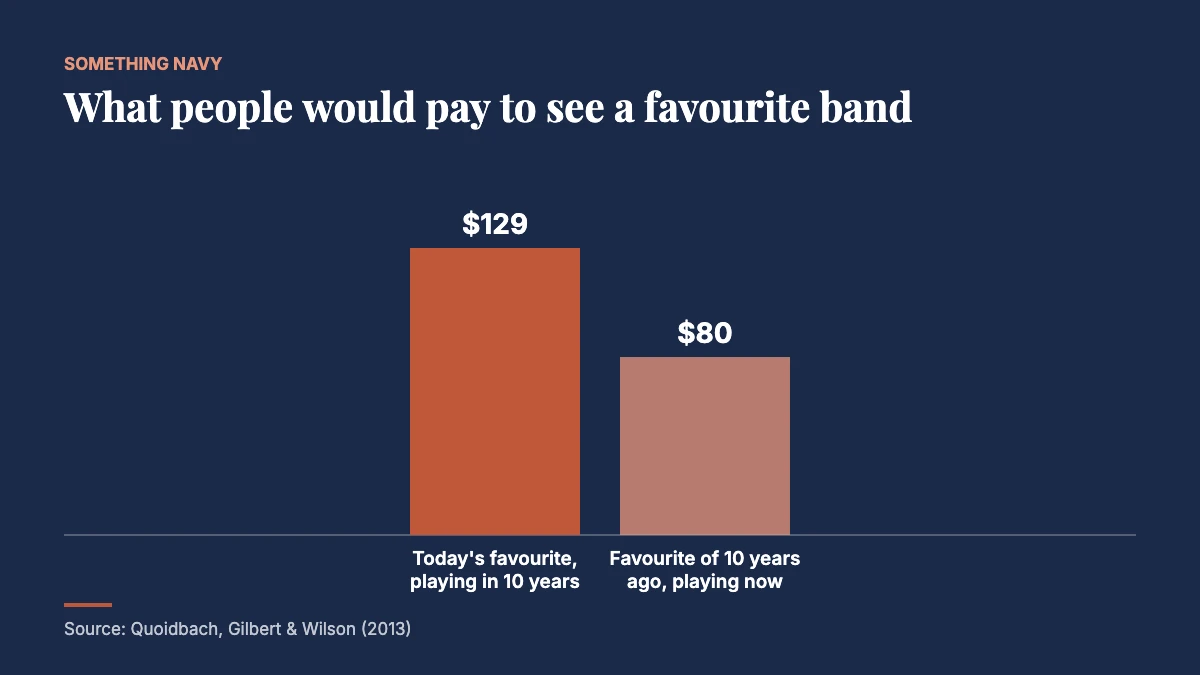
The forward-looking group offered $129. The backward-looking group offered $80, so people would pay 61 per cent more to indulge a current taste in the future than their own past suggests that taste will be worth. The point was not really about concerts. The illusion costs money, because we place bets for a future self we assume will want exactly what we want now.
In the values study the illusion shrank with age without disappearing: people aged 50 and over still underestimated how much they would change. In the personality study, the size of the gap did not reliably vary by decade at all.
What 63 years of personality data reveal
If the end of history illusion is a mistake, we should be able to watch people keep changing long after they think they have stopped. One striking demonstration comes from Scotland.
In 1950, teachers rated a group of 14-year-olds on six traits, including self-confidence, perseverance, stability of moods and conscientiousness. These children were part of the 6-Day Sample of the Scottish Mental Survey 1947, a cohort of 1,208 people born on six particular days in 1936. More than six decades later, a team at the University of Edinburgh, including Mathew Harris and Ian Deary, traced as many as they could. By then 417 had died. Of the 635 invited to take part, 174 completed questionnaires in 2013, at an average age of nearly 77, and someone who knew them well rated them too.
Their 2016 paper in Psychology and Aging found that the teacher ratings and the later ratings showed, in the authors’ words, “hardly any relationship at all”. Only one trait, stability of moods, showed statistically significant continuity in their more complex model, with conscientiousness close behind.
That needs careful handling. Each trait was measured with a single item, teachers in 1950 are not the same kind of rater as an old friend in 2013, and those who survived and took part were not a random slice of the original class. The authors flag all of this. Even so, it is hard to conclude that the person you are at 14 sets the template for the person you are at 77.
The version of you that feels finished is simply the most recent draft.
Personality is stable, but not frozen
None of this means personality is random from year to year. Wiebke Bleidorn and colleagues, including Brent Roberts, published a large meta-analysis in Psychological Bulletin in 2022, pooling longitudinal studies. The rank-order analysis drew on 189 studies and 178,503 participants; the analysis of average change drew on 276 studies and 242,542 people.
They found that the consistency of people’s traits, relative to others, rises steeply through childhood and adolescence and then levels off in young adulthood. They found little sign that it keeps climbing after about 25, which differs from earlier findings. At the same time, people on average drift towards greater maturity, and emotional stability in particular increases more steadily across life than earlier work suggested.
So both things are true. You will probably still be recognisably you in ten years, and also changed in ways you cannot currently picture.
Change you choose
There is a more hopeful strand here too. In 2017, Brent Roberts and colleagues reviewed 207 studies of interventions, including therapy, and asked whether personality traits shifted as a result. Over an average of about 24 weeks, they did, by an amount the authors described as marked (an effect size of 0.37, which in plain English is a small-to-moderate but meaningful shift). Emotional stability moved most, followed by extraversion. The review mixed experimental and non-experimental studies, and the changes held in both. As with our fact-check on growth mindset, the lesson is that change is real, just less dramatic than motivational posters suggest.


Is the illusion real? The evidence is contested
Not every attempt to find the end of history illusion has succeeded. In 2019, Holly Harris and Michael Busseri of Brock University in Canada looked at life satisfaction in the MIDUS data, where 2,390 adults had rated their past, present and expected future happiness, and then reported their actual satisfaction roughly nine years later. Most people either forecast their future accurately or expected too much change, rather than too little. Younger adults in particular expected their lives to improve more than they did.
Quoidbach, Gilbert and Wilson replied in 2020 with a reanalysis of a larger slice of the same data. Looking at the size of each person’s change, rather than group averages, they found people did underestimate how much their life satisfaction would move. Average satisfaction stayed flat, they argued, while individuals bounced up and down.
So the illusion looks solid for personality, values and tastes. For life satisfaction, the answer depends partly on how you count.
It starts surprisingly early
The newest evidence pushes the illusion back into childhood. In 2024, Christina Starmans and colleagues at the University of Toronto published three experiments in Cognition with children aged 4 to 11. Across the first two studies, 256 children were asked whether things about themselves had changed in the past or would change in the future. Children reported more past change than they predicted future change, and the pattern held even when the same child answered both questions.
The twist came in a third study of 83 children. Asked about another child instead of themselves, the illusion disappeared. The researchers concluded that the blind spot is specific to the self. We can easily imagine other people growing up. It is ourselves we picture standing still.
How the end of history illusion shapes your decisions
Daniel Gilbert put it neatly in a 2014 TED talk: “Human beings are works in progress that mistakenly think they’re finished.” Take that seriously and ordinary choices look different.
Take tattoos. The question is not whether you love the design today. It is whether a person with somewhat different tastes, who will exist in a decade, is likely to feel the same. The same logic applies to choosing a degree, turning down a career pivot because “that’s just not me”, or locking in a long, expensive commitment based on preferences that the evidence says will drift.
That does not mean refusing to commit. It means building in a little slack: when costs are similar, pick the option that keeps doors open, and treat confident predictions about what you will want at 45 as sceptically as you would a friend’s. And when you look back at an old photo and feel a twinge, as our piece on cringe memories explores, it may help to remember that the wince is evidence of growth, not embarrassment to be buried.
The 34-year-old with the photo is right that they have changed. They are only wrong about the next bit. Somewhere, a 44-year-old is going to find a picture of them and smile at how sure they were.
Frequently asked questions
It is the tendency to accept that you changed a lot in the past while expecting to change very little in the future. Quoidbach, Gilbert and Wilson described it in Science in 2013 after studying more than 19,000 adults.
Partly. In the 2013 studies it shrank with age for values, but people aged 50 and over still underestimated how much they would change.
Evidence suggests traits can shift. A 2017 review of 207 intervention studies, including therapy, found meaningful change over about 24 weeks, especially in emotional stability.
Official links and research
- Bleidorn, W., Schwaba, T., Zheng, A., Hopwood, C. J., Sosa, S. S., Roberts, B. W., & Briley, D. A. (2022). Personality stability and change: A meta-analysis of longitudinal studies. Psychological Bulletin, 148(7–8), 588–619. DOI
- Gilbert, D. (2014). The psychology of your future self [Video]. TED. TED
- Harris, H., & Busseri, M. A. (2019). Is there an ‘end of history illusion’ for life satisfaction? Evidence from a three-wave longitudinal study. Journal of Research in Personality, 83, 103869. DOI
- Harris, M. A., Brett, C. E., Johnson, W., & Deary, I. J. (2016). Personality stability from age 14 to age 77 years. Psychology and Aging, 31(8), 862–874. DOI
- Jarrett, C. (2013, January 14). “The end of history illusion” illusion. BPS Research Digest. BPS
- Quoidbach, J., Gilbert, D. T., & Wilson, T. D. (2013). The end of history illusion. Science, 339(6115), 96–98. DOI
- Quoidbach, J., Gilbert, D. T., & Wilson, T. D. (2020). Your life satisfaction will change more than you think: A comment on Harris and Busseri (2019). Journal of Research in Personality, 86, 103937. DOI
- Roberts, B. W., Luo, J., Briley, D. A., Chow, P. I., Su, R., & Hill, P. L. (2017). A systematic review of personality trait change through intervention. Psychological Bulletin, 143(2), 117–141. DOI
- Sacchi, A., Sah, J., Finlay, M., & Starmans, C. (2024). Forever young: The end of history illusion in children. Cognition, 250, 105867. DOI
Cover photo: Annie Spratt on Unsplash. Charts and graphics: Something Navy, with photography by Cheryl Winn-Boujnida on Unsplash.
How we reported this. Every figure was checked against the 9 sources above. Reviewed by Valentino Adkins, Senior Content Manager. Report an error · How we work