

The waiter puts the card machine down between you and doesn’t say a word. He has seen this before. You both reach for your phones at the same moment.
“I had the risotto, you had the steak and the second glass,” you say, thumb already in the banking app. Your partner opens the calculator. Is service included? Who had the bread? There is a brief, very civil negotiation about the tiramisu you shared but technically ordered, and then the two of you tap, one after the other, while the waiter studies the ceiling.
It is all perfectly fair. Walking home, though, a small question surfaces: if you put everything in one pot, would it change how you feel about each other?
For a long time the honest answer from science was “probably, but we can’t be sure”. Couples who share money tended to be happier, but happy couples might simply be the ones who choose to share. Then, in 2023, a team of psychologists did something nobody had tried before. They told newlyweds which kind of bank account to have, and watched what happened.
Joint bank accounts and relationship quality: the experiment that assigned couples an account
The study was led by Jenny Olson of Indiana University’s Kelley School of Business, with Scott Rick of the University of Michigan, Deborah Small of Yale University and Eli Finkel of Northwestern University. It appeared in the Journal of Consumer Research in 2023 under the title “Common cents: Bank account structure and couples’ relationship dynamics”.
The researchers recruited 230 couples who were either engaged or newly married. Everyone was in their first marriage, and every couple started out with their money in separate personal accounts. They also had to agree, in advance, that they were willing to change how they banked.
Then came the unusual part. Each couple was randomly assigned to one of three groups: merge your money into a joint account, keep your accounts separate, or do as you please.
Six check-ins over two years
Partners filled in surveys separately, every three months across the first year and then again at the two-year mark, six waves in all, according to the Kellogg School’s summary. The questionnaires asked about relationship satisfaction, the quality of their everyday interactions and how they handled conflict, including how often they shouted at each other. They also measured what the team called financial harmony: whether people felt their partner was happy with their attitudes to money, for example.
At the start, the three groups looked much the same. Two years later they did not.
Couples told to keep separate accounts, and couples left to their own devices, showed the slow slide in relationship quality that researchers expect across the first couple of years of marriage. The couples told to open a joint account did not slide. Their relationship quality held steady across the whole two years, and they reported more harmony about money than either of the other groups.
Finkel admitted the result surprised him. “The effect was even bigger than I anticipated,” he told Kellogg Insight.
One detail from the no-instruction group is easy to miss. Left to choose freely, 72% of those couples kept their money separate for the entire study. Inertia, in other words, is a powerful banker.
Why one account might matter
Using the experiment and a second, correlational study of 507 people married for an average of 15 years, the team found support for three reasons.
First, merging seemed to improve how partners felt about the way the household handled money. Second, it encouraged financial goal alignment, so that both people were saving and spending towards the same things. Third, and probably most interesting for anyone who has ever done sums over a dinner bill, it helped couples stick to what psychologists call communal norms: responding to each other’s needs without keeping track of who owes whom.
Olson’s explanation, as summarised in Indiana University’s release, was that separate accounts nudged couples to think about money as a kind of exchange, a tit-for-tat. She also suggested that separate accounts might make leaving feel slightly easier. When everything is already divided, there is less to untangle.
If you have read our piece on couples who say “we”, the idea will feel familiar.
Pooling finances and relationship satisfaction: what tens of thousands of couples showed
Olson’s experiment was small but rigorous. The other key paper on the question is the reverse: enormous, and mostly built on observation.
It was published in the Journal of Personality and Social Psychology in December 2022, after Cornell announced the findings in March that year. The authors were Joe Gladstone of the Leeds School of Business at the University of Colorado Boulder, Emily Garbinsky of Cornell University’s Johnson Graduate School of Management and Cassie Mogilner of UCLA’s Anderson School of Management.
Across six studies with a combined 38,534 participants, they used both their own surveys and large existing datasets. According to the paper’s abstract, as listed on the University of Colorado’s research page, couples who pooled all of their money reported greater relationship satisfaction and were less likely to break up than couples who kept some or all of it apart. The authors say the pattern replicated across experimental, cross-sectional and longitudinal data.
The UK data on break-ups
Writing for the Society for Personality and Social Psychology in 2023, Gladstone described two of the long-running datasets in everyday terms. One was a 12-year study in the UK that followed more than 7,000 people. Compared with couples who used a mix of joint and separate accounts, those whose money was entirely separate had a 22% higher chance of splitting up. Those who pooled everything had an 18% lower chance.
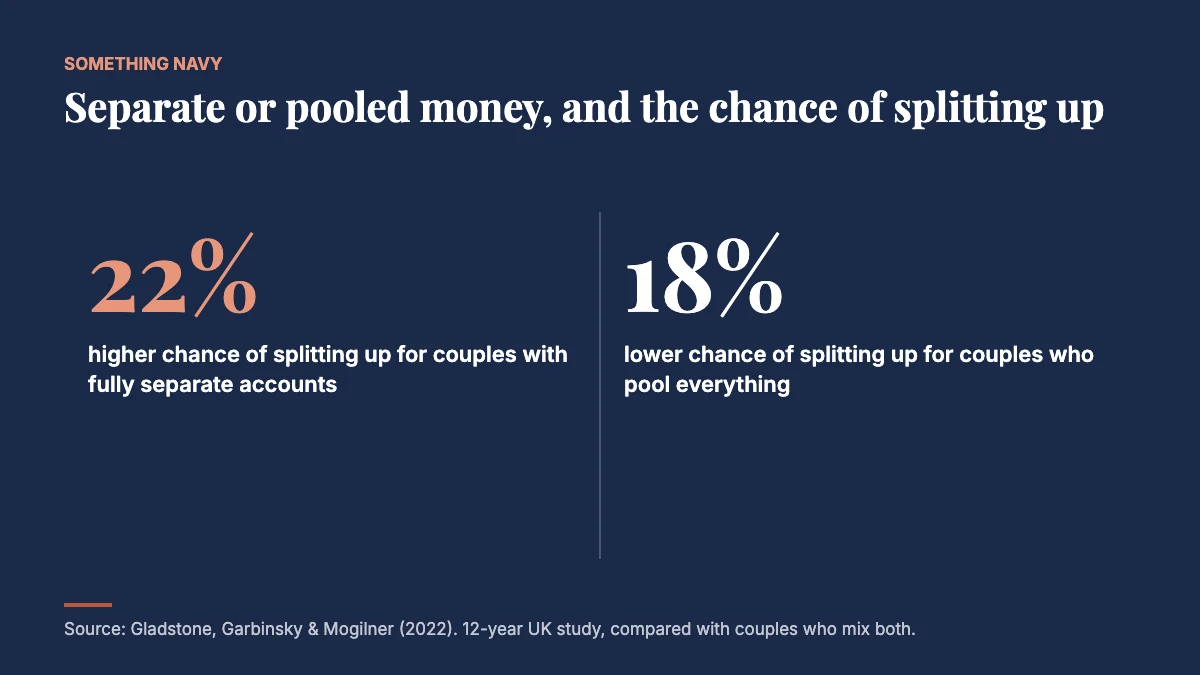
Those figures are relative, so they describe a shift in risk rather than a precise forecast for any one couple. They also come from observational data, which means people were not told how to bank. Couples who merge everything may differ in other ways, such as how committed they already feel.
A second dataset spanned nine years and included more than 25,000 people. Here, pooling money went along with relationship satisfaction rising over time, while keeping money separate went along with it falling.
Who seemed to benefit most
The link between pooling and satisfaction was strongest for couples with less financial room, meaning lower household incomes or self-reported financial strain. That fits with what we know about money and happiness more broadly: an extra pound or dollar tends to matter more when you have fewer of them, and so, perhaps, does the sense that you are not facing the shortfall alone.
The benefits did not differ between women and men, and Olson’s experiment also found no gender differences.
The team also went looking for togetherness in the wild. According to Cornell’s announcement, in public online forums about personal finance, people who pooled their money used more shared pronouns such as “we”, “us” and “our”, fewer “I” words, and more words about connection and agreement. Garbinsky said they had expected pooling “to increase one’s level of dependence on their partner”. In interdependence theory that is a good thing: when your fortunes are tied together, looking after each other makes sense.

How many couples keep separate bank accounts?
If you split the bill on two phones, you have company. In December 2025, YouGov surveyed 2,564 US adults for the personal finance site Bankrate, including 1,208 who were married, in a civil partnership or living with a partner. The results, published in February 2026, found that 38% of those couples kept all their money joint. Another 36% kept some joint and some separate, and 26% kept everything separate.
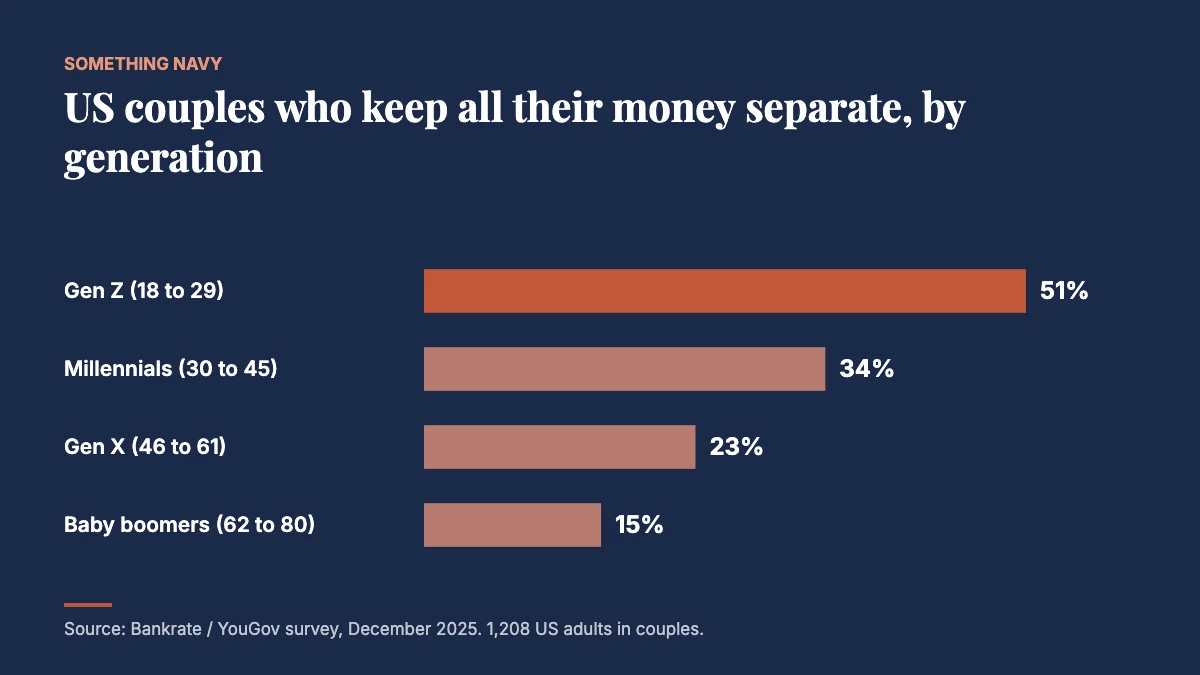
Half of Gen Z couples in the survey kept everything separate, compared with fewer than one in six baby boomers. Some of that may reflect life stage rather than generation; the release does not split results by marital status.
Income mattered too. Among couples with household incomes under $50,000, 39% kept all their money separate, against 17% of those earning $100,000 or more. Higher earners were more likely to run a mix of joint and separate accounts.
That sits awkwardly beside the Gladstone findings: the couples who seemed to gain most from pooling were the most likely to keep everything apart.
One older figure is a useful contrast. In a 2019 University of Notre Dame press release about an earlier paper by Garbinsky and Gladstone, the researchers put the share of US couples with at least one joint account at roughly 82%. That is not a clean trend line, because “having a joint account” and “pooling everything” are different things. Gladstone has written that between 30% and 50% of couples with joint accounts also keep separate ones.
Is a joint account for bills plus separate spending money the best of both?
This is the arrangement many people assume is the sensible compromise: one shared account for rent, groceries and utilities, plus personal accounts for haircuts, hobbies and the occasional ill-advised jacket. The research so far does not give it a clear endorsement.
In Olson’s work, partial merging was not linked to the same benefits as full merging, according to Kellogg Insight. Finkel was careful not to overstate that, and called for more research. In the UK break-up data, mixed couples sat in the middle: better off than fully separate couples, worse off than full poolers.
None of this proves that hybrid set-ups harm anyone. The advantage, where it appears, seems to grow as the boundary between “yours” and “mine” shrinks. A shared bills account still leaves plenty of room for quiet arithmetic about who contributed what.
What joint accounts do to spending, and to talking about money
People spend a little differently from a shared pot
Garbinsky and Gladstone had looked at another side of pooling a few years earlier, in a 2019 paper in the Journal of Consumer Psychology. Across five studies, Notre Dame reported, people paying from a joint account leaned towards practical purchases over indulgent ones. In one experiment, people who had both kinds of account chose between a beer mug and a coffee mug; with the joint card in hand, they were more likely to pick the coffee mug. In another, those assigned to pay from the joint account felt a stronger need to justify what they bought.
Real bank data from 12 months of spending told a similar story. Joint-account holders spent less on categories such as holidays, alcohol and beauty products, and more on insurance, electricity and petrol. The press release does not give exact figures for the size of these differences, so treat it as a direction rather than a sum.
Whether that is good news depends on your point of view, but it does suggest that a shared account changes how people think about money, not just where it sits.
Couples who pool talk about money more
The newest piece of the puzzle comes from Johanna Peetz of Carleton University in Canada, published in the Journal of Social and Personal Relationships in January 2025. Across three studies, she found that people who fully pooled their finances reported better and more frequent conversations about money than those who partly pooled or kept things separate, even after accounting for demographics and how satisfied they were with the relationship overall.
In her third study, Peetz used a simple experimental nudge: asking people to think about joint rather than separate accounts. That alone made them more willing to discuss financial decisions with their partner. It was a short prompt, not a change in banking, but it hints at a mechanism. When money is shared, it becomes something you have to talk about.
Money is a classic flashpoint for couples, much like the washing-up, and talking about it regularly may keep small grievances small.


How strong is the evidence on joint bank accounts?
| Study | Who took part | Design | Main finding | Main limits |
|---|---|---|---|---|
| Olson, Rick, Small & Finkel (2023) | 230 engaged or newlywed US couples | Randomised experiment, six waves over two years | Joint-account couples held steady; others declined | Small, mostly white sample; 20% dropped out |
| Gladstone, Garbinsky & Mogilner (2022) | 38,534 people in six studies, mainly US and UK, plus Japan | Surveys, panel data and an experiment | Full pooling linked to higher satisfaction and fewer break-ups | Mostly observational |
| Garbinsky & Gladstone (2019) | Five studies, including 12 months of bank data | Experiments plus spending records | Joint-account spending tilted towards practical buys | About spending, not satisfaction |
| Peetz (2025) | Three studies of people in relationships | Surveys plus a brief experimental prompt | Full poolers talked about money more, and better | Prompt only, no real account change |
| Bankrate and YouGov (2026) | 1,208 US adults in couples | Online survey, December 2025 | 38% fully joint, 36% mixed, 26% fully separate | Snapshot; non-probability panel |
What the experiment can and cannot tell us
Olson’s study is the strongest evidence that the account itself does something, because random assignment rules out the obvious explanation that happier couples simply choose to merge. Olson called it the best evidence to date on the question, and that is fair.
It is still one study. With 230 couples, it is modest in size. The sample was mostly white, moderately educated and clustered around a median household income of $50,000. The average participant was 28, and around 10% had children. It covered only first marriages, only male and female couples, and only two years.
There is also the drop-out problem. About 20% of couples did not finish the study. The final picture is built on the couples who stayed in it.
Then there is culture. In Gladstone’s research the link between pooling and satisfaction was weaker in Japan than in the US and UK. Garbinsky suggested this may reflect differences between individualist and collectivist cultures: where the family unit is already emphasised, merging bank accounts may add less. Gladstone himself has noted that the findings may not carry over to places with very different financial norms.
Averages are not instructions
Every result here is an average. Gladstone has written that separate accounts can suit couples for good reasons, including different goals, a wish for autonomy or privacy. None of these studies looked in detail at second marriages, blended families or very unequal incomes. This article describes research findings, not financial advice.
When a joint account is not a safe idea
There is one context where talk of pooling needs real care. Kellogg Insight’s report on Olson’s study flagged the risk for couples in precarious relationships or finances, where shared money can become a tool of financial control or abuse.
This is not rare. In a nationally representative survey of 2,849 UK women carried out by Ipsos for the charity Surviving Economic Abuse in late 2024, 15% said they had experienced economic abuse from a current or former partner in the previous 12 months, about 4.1 million women. Economic abuse can include restricting access to money, running up debt in a partner’s name or controlling every purchase.
The communal trust that makes pooling work in the studies above depends on a relationship where both people have a fair say. If one partner controls the money, or you feel unable to spend without permission, that is not the arrangement the research describes. Organisations such as Surviving Economic Abuse in the UK offer specialist support.
So, should you have that conversation over the tiramisu?
The best evidence we have suggests that, for many couples early in marriage, putting money in one place goes along with steadier relationship quality, and one well-designed experiment suggests the account may be part of the cause rather than just a sign of an already happy couple. Shared money seems to make couples agree on goals, talk more about spending and stop keeping score.
What the research does not say is that splitting the bill is a red flag, or that a joint account will rescue a struggling relationship. Most couples in the US surveys keep at least some money apart, and plenty of them are fine.
Perhaps the most useful takeaway is the one hidden in the no-instruction group: 72% of those couples kept their money separate, not necessarily because they had weighed it up, but because nothing pushed them to change. Whatever you decide, deciding it together, out loud, is a different thing from drifting into it. The researchers’ own framing was modest. Merging, Indiana University’s summary said, should “warrant a conversation”. That seems like a reasonable thing to split.
Official links and research
- Bankrate. (2026, February 9). Most couples keep at least some of their money separate [Press release]. Bankrate
- Garbinsky, E. N., & Gladstone, J. J. (2019). The consumption consequences of couples pooling finances. Journal of Consumer Psychology, 29(3), 353–369. DOI
- Gladstone, J. J. (2023, June 23). The power of pooling finances. Character & Context, Society for Personality and Social Psychology. SPSP
- Gladstone, J. J., Garbinsky, E. N., & Mogilner, C. (2022). Pooling finances and relationship satisfaction. Journal of Personality and Social Psychology, 123(6), 1293–1314. DOI
- Ipsos UK. (2024, November 26). Almost one million UK women who experienced economic abuse said the abuse prevented them from leaving an abusive partner. Ipsos
- Kellogg Insight. (2023, May 9). One key to a happy marriage? A joint bank account. Kellogg School of Management, Northwestern University. Kellogg Insight
- Olson, J. G., Rick, S. I., Small, D. A., & Finkel, E. J. (2023). Common cents: Bank account structure and couples’ relationship dynamics. Journal of Consumer Research, 50(4), 704–721. DOI
- Peetz, J. (2025). Talk about shared money: Account pooling is associated with financial communication. Journal of Social and Personal Relationships, 42(4), 983–1003. DOI
Cover photo: Vitaly Gariev on Unsplash. Charts and graphics: Something Navy, with photography by Vitaly Gariev on Unsplash.
How we reported this. Every figure was checked against the 8 sources above. Reviewed by Brooke Hilland, Senior Content Editor. Report an error · How we work