

You have the number up on your screen. Your thumb is hovering. It is the call you have been putting off since Monday: the landlord, the client who has not paid, the sister you have not spoken to since the wedding.
You put the phone face down on the kitchen counter and walk a small loop round the table. Under your breath, you are rehearsing. Okay. You can do this. Just say it plainly. Then, without quite meaning to, you hear yourself say your own name. Come on, Sam. You’ve had worse conversations than this.
It feels a bit daft, the sort of thing you would stop doing if someone walked in. But something shifts. The knot in your chest loosens a notch, the opening line arrives, and you pick up the phone.
That small switch, from “I” to your own name, has been studied in labs, brain scanners, school rooms and a two-week text-message experiment. The results are real, more modest than the headlines suggest, and more interesting for it.
What distanced self-talk is, and why a pronoun might matter
Most of us keep up a running commentary in our heads, from “where did I put my keys?” to “why did I say that?” Ethan Kross, a psychologist at the University of Michigan, became interested less in what we say to ourselves than in who we say it to.
The idea grew out of research on self-distancing. Reflect on something upsetting from deep inside your own head and you tend to replay it and re-feel it. Look at it as an observer would and it often makes more sense and stings less. The trouble is that “step back” is a vague instruction.
Language offered a shortcut. We use “I” from inside an experience, and names, “you”, “he” and “she” for other people. Kross and his colleagues wondered whether borrowing the grammar we use for others might pull us into the observer’s seat, with no elaborate mental exercise required.
They called this distanced self-talk. In practice it means silently asking yourself “Why is Sam so nervous?” instead of “Why am I so nervous?”, or “You’ve got this” instead of “I’ve got this”.
The research on talking to yourself in the third person
The 2014 study that started it: speeches, first impressions and threat
The founding paper appeared in the Journal of Personality and Social Psychology in 2014. Kross wrote it with eight colleagues from Michigan, the University of California, Berkeley and Michigan State University, and it reported a run of experiments with 585 participants in total.
Participants about to reflect on their feelings were told either to use “I” and “me”, or to use “you” and their own name, along the lines of “Why did Jane feel this way?” In the first studies, the name group reported seeing the situation more from a distance, as though watching rather than reliving it.
Then came the stress tests. In one study, 89 undergraduates were told they would give a five-minute speech, without notes, to evaluators, explaining why they were qualified for their dream job. They had five minutes to prepare. The group who reflected on their nerves using their own name and non-first-person pronouns gave speeches that independent judges rated as better. They also reported less shame afterwards, and ruminated less over how it had gone. Anyone who has lain awake replaying a presentation will see the value of that last one.
In another study, women trying to make a good first impression in a filmed conversation with a stranger also performed better when they used their name. Two more studies found that distanced self-talk made people more likely to see an upcoming stressor as a challenge rather than a threat.
How big were these effects? In statistical terms, the pronoun condition explained roughly 5% to 11% of the variation in the outcomes across these studies. By psychology’s conventions that is a respectable, medium-sized effect. But the samples were modest, roughly 50 to 117 people per study after exclusions, mostly students, and effects from samples that size often shrink when others try again. One encouraging detail: high social anxiety did not weaken the effects, and about 10% of the pooled sample scored in the clinical range for social phobia.
The trick is not to talk yourself out of the feeling, but to talk to yourself the way you would talk to a friend having it.
What happens in the brain: the 2017 EEG and fMRI study
If distanced self-talk works, is it hard work? In 2017 Jason Moser of Michigan State University, with Kross and nine other colleagues, published two brain studies in Scientific Reports to find out.
In the first, 29 participants wore EEG caps while looking at 60 disturbing and 60 neutral images from a standard research picture set. Before each image, a cue told them to reflect on their feelings using either “I” or their own name. The researchers tracked a brainwave signal called the late positive potential, which rises when we react emotionally to something. With “I”, the disturbing pictures produced the usual bigger spike than the neutral ones. With their own name, that gap was no longer statistically significant. Crucially, a marker of preparatory mental effort did not change between the two conditions.
In the second study, 50 participants lay in an fMRI scanner and recalled eight painful memories from their own lives, again cued to think about them with “I” or with their name. They rated their negative feelings as lower on the name trials, by a little over half a point on the study’s scale (3.24 against 3.82). A region of the medial prefrontal cortex associated with thinking about yourself was less active with name-based reflection. The fronto-parietal regions linked to effortful control showed no difference, even at a lenient statistical threshold.
The authors concluded that third-person self-talk may be a relatively effortless form of self-control. Plausible, but the samples were modest, and “we did not detect extra effort” is not quite the same as “there was no extra effort”.
Has it replicated?
Psychology has a long list of tidy, intuitive findings that wobbled when tested again; we have written about the case of power posing. For distanced self-talk, the honest answer is: partly, and mostly by the same research network.
In 2022 Christopher Webster, Martha Berg, Kross and Moser published a direct replication of the EEG finding in the International Journal of Psychophysiology. With 67 participants, distanced self-talk again reduced the late positive potential without raising the effort marker. The same study tested a better-known technique, detached reappraisal, for comparison. That one failed to show its expected effect, which meant the planned head-to-head comparison could not be made.
In 2021 Ariana Orvell and colleagues reported two experiments in Clinical Psychological Science asking whether the technique holds up for genuinely intense experiences. Around 50 participants in each study reflected on worries about the future or painful memories, including betrayal and rejection. Distanced self-talk cut negative emotional reactivity by roughly 10% to 12% compared with first-person self-talk, and the benefit did not shrink for the most intense memories. An exploratory look at 13 participants who met clinical cutoffs for both worry and moderate depression found a larger reduction, about 18%, but the authors were clear that a group that small cannot settle anything.
Independent tests are thinner on the ground, and the most notable one was a miss. Helena Gunnarsson and Jens Agerström of Linnaeus University in Sweden asked whether third-person self-talk could make physical pain easier to bear. Their 292 participants held a hand in ice-cold water, a standard lab pain test, under one of four conditions. Third-person self-talk produced few differences from the other groups on pain tolerance, pain intensity, mood or blood pressure. The paper went online in 2024 and appeared in print in Psychological Reports in June 2026. The authors could not rule out a small effect, but they found no meaningful one.
One plausible reading is that distanced self-talk works mainly on the thinking side of distress: how you interpret a situation, how much you dwell on it. It may simply have little purchase on sensations like pain.


Solomon’s paradox: why your advice to friends is better than your advice to yourself
Wiser about everyone else
King Solomon was famed for his wisdom, yet by tradition struggled with his own personal decisions. In 2014 Igor Grossmann of the University of Waterloo and Ethan Kross gave the pattern a name, Solomon’s paradox, and tested it in Psychological Science.
Across three experiments with 693 participants, people in committed relationships imagined either their own partner or a friend’s partner being unfaithful, then answered questions designed to capture wise reasoning. That meant things like admitting the limits of what they knew, considering the other person’s view, looking for compromise and recognising that the situation could change.
People reasoned more wisely about their friend’s crisis than their own. When they were nudged to take a distanced, third-person view of their own dilemma, the gap disappeared.
The third experiment compared younger adults aged 20 to 40 with older adults aged 60 to 80. Their reasoning about their own conflicts did not differ. So much for wisdom arriving automatically with age.
Can you train it?
A single lab session says little about everyday life, so in 2021 Grossmann and colleagues at Waterloo, Geisinger and the University of Minnesota ran something longer. In a study published in Psychological Science, 555 participants kept a diary for a month, writing each day about an interpersonal conflict. One group was told to picture the situation and ask, “Why is [their own name] feeling or behaving this way?” Others wrote in the first person or had no reflection instructions.
The third-person diarists showed greater gains in wise reasoning over the month, especially in intellectual humility and in recognising other people’s perspectives. Grossmann described the result as “the first empirical evidence for the trainability of wisdom in daily life”. If you keep a journal, our piece on whether journaling helps pairs well with this.
The Batman effect: what children taught researchers about self-distancing

In 2017 Rachel White, then at Hamilton College and the University of Pennsylvania, published a study in Child Development with Stephanie Carlson of the University of Minnesota, Angela Duckworth of Penn, Kross and two other colleagues.
They tested 180 children, 90 four-year-olds and 90 six-year-olds, on a deliberately tedious ten-minute computer task. Right beside them sat an iPad with an appealing game they could switch to whenever they liked.
Children were split into three groups of 60. One group was asked to think about their own feelings and ask “Am I working hard?” A second asked the same question in the third person, using their own name. The third chose a character, Batman, Bob the Builder, Rapunzel or Dora the Explorer, put on a costume prop, and asked whether that character was working hard. A recorded reminder of their question played every minute.
The iPad mostly won. On average the children spent 37% of the ten minutes on the work. Six-year-olds managed about 46%, four-year-olds about 28%.
But the order across groups was striking. The character group persevered longest, the name group came next, and the “I” group did least. The difference between the character group and the “I” group was moderate in size, a Cohen’s d of about 0.54.
The paper’s own caveats tend to get lost in the headlines. The name group sat between the other two, but its results were less clear-cut, and the comparison the paper leans on is between the character group and the “I” group. The researchers also could not tell whether the character children were helped by distance or simply by channelling a hero known for being capable. And the study was a single, cross-sectional experiment. We could not find a large, independent replication of it published since.
For parents, the safe reading is that inviting a child to talk about their effort as a favourite character is possibly helpful and fun, not a proven method for building grit.
The limits of distanced self-talk
Small in everyday life
Lab participants are told exactly when and how to use their name. In daily life, nobody prompts you. A study published in Scientific Reports in November 2025 looked at what happens then. Kathryn Schertz, Kross and five colleagues trained 208 mostly American undergraduates to recognise the difference between immersed and distanced self-talk. For 14 days, participants received five text-message surveys a day at random times, producing 12,966 surveys covering 20,646 situations.
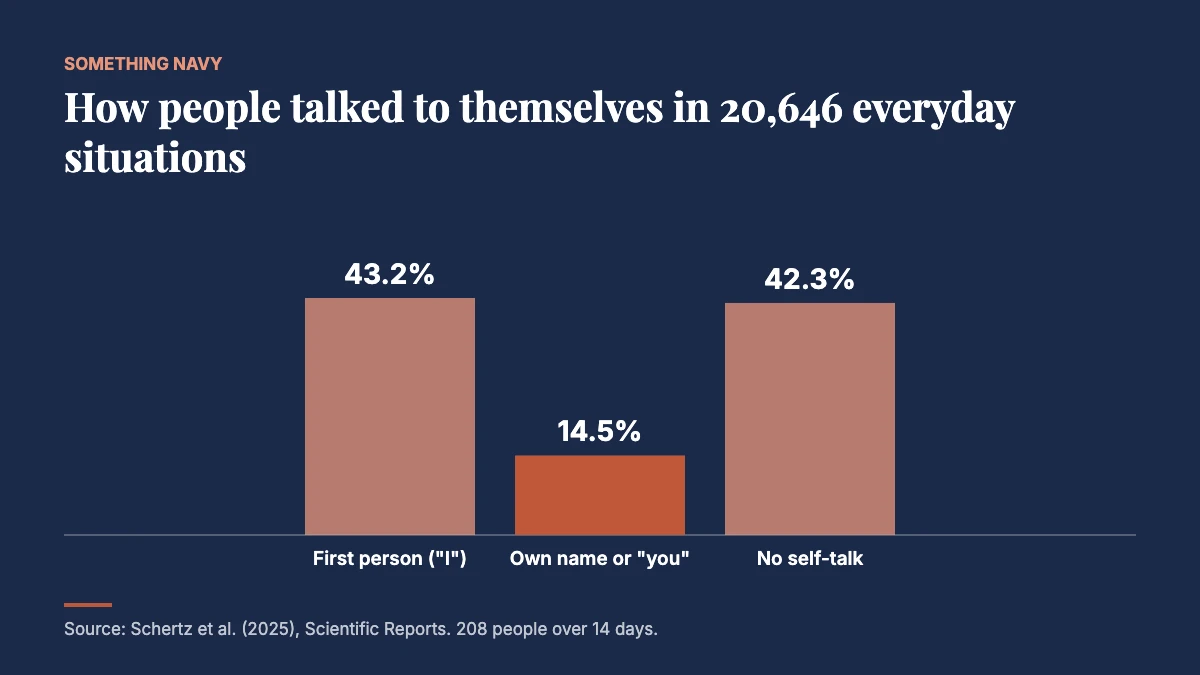
Distanced self-talk turned out to be the rarest option, showing up in only about one situation in seven. And its benefits were narrow. Only when people were preparing for something, working out what to do or say, was distanced self-talk linked to a rise in positive mood, and the effect was small, a d of about 0.09. In moments of self-criticism, or when people were trying to cheer themselves up, it made no significant difference.
The authors suggest everyday distancing may be shallower than the deliberate lab version. Still, the phone call you are dreading is precisely the preparatory moment where the effect showed up.
Modest across the board
A 2023 meta-analysis in Stress and Health by Elizabeth Murdoch, Michael Chapman, Monique Crane and Daniel Gucciardi pooled 25 experiments with 2,397 adults who reflected on a past stressor from a distanced or immersed perspective. It found a small advantage for distancing, a Hedges’ g of 0.19. That analysis covers several distancing techniques, not just pronouns, and the authors rated the overall quality of evidence as uncertain. They called for larger, better-designed trials before treating the benefit as firm.
Not a cure, and not a replacement for help
Nothing here suggests distanced self-talk treats anxiety or depression. The clinical findings so far rest on very small groups. If worry or low mood is getting in the way of your life, a GP or therapist remains the right call. Treat this as a small, free tool, closer to a deep breath than a course of treatment. And there is no need to say your name aloud in an open-plan office: the 2021 intense-emotions experiments, for one, used silent self-talk.
How to try distanced self-talk before a hard conversation
In the experiments, people typically asked themselves questions, “Why did Jane feel this way?” or “Is Hannah working hard?”, rather than barking orders. That turns the conversation in your head into something closer to advice from a friend than a pep talk from a sergeant major. If your inner voice tends towards the sergeant major, our article on self-compassion is a good companion read.
It also pairs naturally with if-then planning, deciding in advance “if they push back on the deadline, then I’ll offer Friday”.
Try it: the two-minute name check
- Before a stressful call, meeting or message, give yourself two minutes and a quiet spot.
- Silently ask a question using your name or “you”: “What’s really worrying Sam here?” or “What do you want from this call?”
- Answer the way you would answer a friend who asked for help, in the same voice.
- Ask one more question about the next step: “What’s the first thing Sam needs to say?”
- Then stop thinking and make the call. Notice afterwards whether you dwelt on it less than usual.
- Keep it silent. Saying it in your head is enough.
Do not expect fireworks. The everyday study suggests the gain is small. But it costs nothing and takes seconds, which is more than can be said for most advice about nerves.
What the evidence adds up to
Twelve years after the first major paper, the picture is clearer and smaller than the viral version. The core lab finding, that reflecting on stress using your name or “you” dampens emotional reactions, has held up in several follow-ups, including a direct replication of the brain-wave result. Its cousin in the wisdom literature, that distance makes us reason about our own problems as fairly as we reason about other people’s, has been extended to a month-long diary study.
Against that, almost all of the supportive work comes from one network of researchers, often with samples under 100. The one sizeable independent test we found, on pain, came up empty. The wider meta-analysis found a small effect and uncertain evidence. And in daily life, distanced self-talk was rare and its benefit tiny, showing up only in the run-up to a challenge.
That last finding might be the most practical one. The moment you are pacing the kitchen, phone face down, is exactly where the effect seems to live. Saying your own name will not make the conversation easy. It might make you a slightly better version of the friend you need in that moment.
Frequently asked questions
No. Most people talk to themselves, and the 2025 everyday study found people did so in more than half of the situations they reported. Using your name or “you” is simply a less common form of it.
No. The 2021 experiments on intense emotions defined distanced self-talk as silently referring to yourself by name, and still found a benefit.
The original 2014 studies combined both, asking people to use “you” and their own name, so the research does not cleanly separate them. Either moves you away from “I”, which is the point.
Probably not much. A 2026 study of 292 people found third-person self-talk made few differences to pain tolerance, pain intensity or distress during a cold-water pain test.
Official links and research
- Gunnarsson, H., & Agerström, J. (2026). Pain from a distance: Can third-person self-talk mitigate pain sensitivity and pain related distress during experimentally induced pain? Psychological Reports, 129(3), 1949–1964. DOI
- Grossmann, I., Dorfman, A., Oakes, H., Santos, H. C., Vohs, K. D., & Scholer, A. A. (2021). Training for wisdom: The distanced-self-reflection diary method. Psychological Science, 32(3), 381–394. DOI
- Grossmann, I., & Kross, E. (2014). Exploring Solomon’s paradox: Self-distancing eliminates the self-other asymmetry in wise reasoning about close relationships in younger and older adults. Psychological Science, 25(8), 1571–1580. DOI
- Kross, E., Bruehlman-Senecal, E., Park, J., Burson, A., Dougherty, A., Shablack, H., Bremner, R., Moser, J., & Ayduk, O. (2014). Self-talk as a regulatory mechanism: How you do it matters. Journal of Personality and Social Psychology, 106(2), 304–324. DOI
- Moser, J. S., Dougherty, A., Mattson, W. I., Katz, B., Moran, T. P., Guevarra, D., Shablack, H., Ayduk, O., Jonides, J., Berman, M. G., & Kross, E. (2017). Third-person self-talk facilitates emotion regulation without engaging cognitive control: Converging evidence from ERP and fMRI. Scientific Reports, 7, Article 4519. DOI
- Murdoch, E. M., Chapman, M. T., Crane, M., & Gucciardi, D. F. (2023). The effectiveness of self-distanced versus self-immersed reflections among adults: Systematic review and meta-analysis of experimental studies. Stress and Health, 39(2), 255–271. DOI
- Orvell, A., Vickers, B. D., Drake, B., Verduyn, P., Ayduk, O., Moser, J., Jonides, J., & Kross, E. (2021). Does distanced self-talk facilitate emotion regulation across a range of emotionally intense experiences? Clinical Psychological Science, 9(1), 68–78. DOI
- Schertz, K. E., Orvell, A., Chandhok, S., Vickers, B. D., Moser, J. S., Ayduk, O., & Kross, E. (2025). The frequency, form, and function of self-talk in everyday life. Scientific Reports, 15, Article 38883. DOI
- Webster, C. T., Berg, M. K., Kross, E., & Moser, J. S. (2022). An event-related potential investigation of distanced self-talk: Replication and comparison to detached reappraisal. International Journal of Psychophysiology, 177, 122–132. DOI
- White, R. E., Prager, E. O., Schaefer, C., Kross, E., Duckworth, A. L., & Carlson, S. M. (2017). The “Batman effect”: Improving perseverance in young children. Child Development, 88(5), 1563–1571. DOI
Cover photo: Laurenz Kleinheider on Unsplash. Charts and graphics: Something Navy, with photography by Gabriel Porras and Vitaly Gariev on Unsplash.
How we reported this. Every figure was checked against the 10 sources above. Reviewed by Valentino Adkins, Senior Content Manager. Report an error · How we work